Cost-Sensitive Fuzzy Random Forest with Abstention for Credit Card Default Prediction
Keywords:
Credit Card Default Prediction, Cost-Sensitive Learning, Fuzzy Random Forest, Abstention, Selective Classification, Credit Risk, Machine LearningAbstract
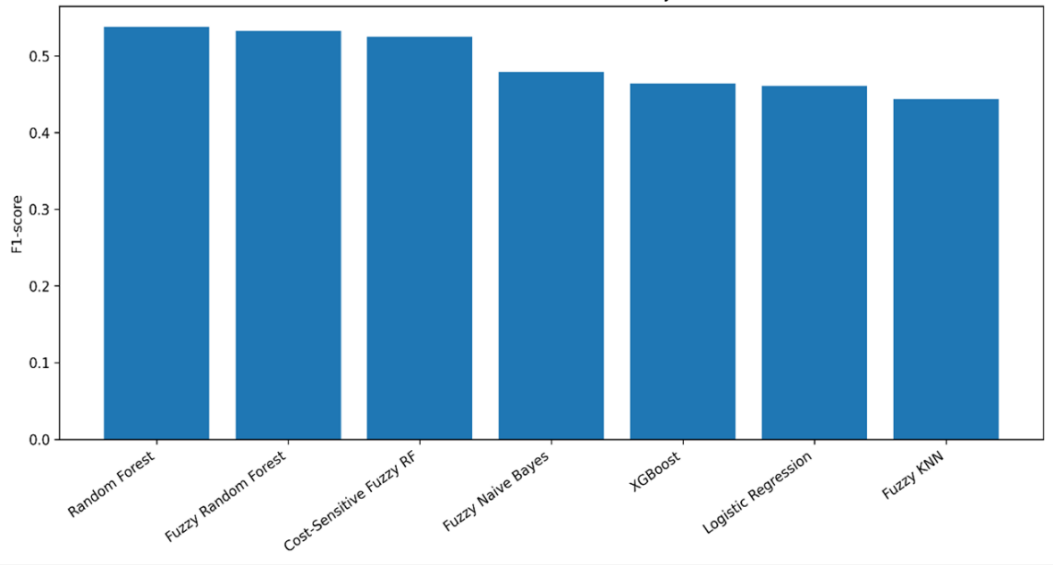
Credit card default prediction is an important task in credit risk management because incorrect predictions can result in substantially different financial consequences. Conventional classification approaches generally assign every borrower to either the default or non-default class, even when the model has limited confidence in the prediction. This can be problematic in credit-risk settings where false-negative decisions may result in financial losses and borderline cases may require additional assessment. This study proposes a Cost-Sensitive Fuzzy Random Forest with Abstention framework that combines fuzzy risk-based sample weighting, cost-sensitive learning, and manual review of uncertain borrower cases. The study uses the publicly available Default of Credit Card Clients dataset, comprising 30,000 customer records and 23 input features. Seven models are evaluated: Logistic Regression, Random Forest, XGBoost, Fuzzy K-Nearest Neighbors, Fuzzy Naive Bayes, Fuzzy Random Forest, and the proposed Cost-Sensitive Fuzzy Random Forest. Model performance is assessed using conventional classification measures, including accuracy, precision, recall, F1-score, and ROC-AUC, together with decision-cost measures under different abstention levels. The results show that Random Forest achieves the highest F1-score of 0.5380 among the evaluated models, whereas the proposed Cost-Sensitive Fuzzy Random Forest achieves the lowest decision cost. Under the proposed model, increasing the manual-review level from 0% to 30% reduces the average decision cost from 0.5790 to 0.4769. These findings indicate that predictive performance alone may not adequately represent the quality of credit-risk decisions when misclassification costs are asymmetric and borrower uncertainty is relevant. The study therefore suggests that combining fuzzy risk representation, cost-sensitive learning, and selective manual review can provide a potentially useful decision-support approach for credit card default prediction.