Religious Beliefs and Disaster Risk Perception: The Moderating Role of Education among Residents of Buner, Pakistan
Keywords:
Religious Beliefs, Buner, Disaster Risk, Climate Change, CorrelationAbstract
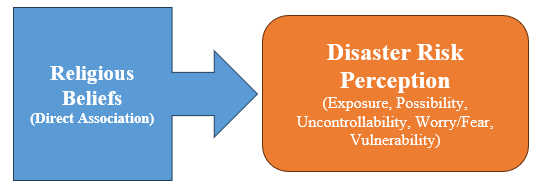
This research study shows the relationship between religious beliefs and disaster risk perception among residents of District Buner, Khyber Pakhtunkhwa, Pakistan, with particular emphasis on the moderating role of education. For a sample of 104 respondents, descriptive statistics and correlation analysis techniques were employed to assess the prevailing patterns and associations among key variables. Religious beliefs and disaster risk perception were measured using a five-point Likert scale, and composite indices were constructed to capture mean religious beliefs (MRB) and mean disaster risk perception (MDRP). A sample of 45 males and 59 females reveals that respondents generally exhibit strong religious beliefs alongside moderate to high levels of disaster risk perception. The study finds weak and negative associations between ROS and the core dimensions of disaster risk perception. ROS is negatively correlated with Exposure (r = –0.1781), Uncontrollability (r = –0.1356), and Vulnerability (r = –0.0652). Descriptive results indicate that disaster risk perception is multidimensional, encompassing exposure, perceived possibility, uncontrollability, worry/fear, and vulnerability, with strong interrelationships among these components. The study underscores the need for integrated disaster risk reduction strategies that incorporate religious institutions and educational interventions to enhance community resilience in hazard-prone regions such as Buner.