Diversity and Conservation of Avian Fauna in Daphar Forest Sanctuary, Mandi Bahauddin, Pakistan
Ehtiham Ali1, Muhammad Amjad Khan1, Syeda Shazia Bokhari1, Roheela Yasmeen1*
1Department of Biology, Lahore Garrison University, Sector C, Phase VI, DHA Lahore
Corresponding Author’s Email ID: roheelayasmeen@lgu.edu.pk
Citation |Ali. E, Khan. A. M, Bokhari. S. S, Yasmeen. R, “Diversity and Conservation of Avian Fauna in Daphar Forest Sanctuary, Mandi Bahauddin, Pakistan”. International Journal of Innovations in Science and Technology. Vol 4, Issue 3, 2022, pp: 641-648
Received | May 01, 2022; Revised | June 22, 2022; Accepted | June 25, 2022; Published | June 30, 2022.
______________________________________________________________________________________________________________________________
Biodiversity is representative of a healthy ecosystem. Anthropogenic activities, including habitat degradation, hunting, and fragmentation, are major circumstances which results in species extinction. The present study was conducted to explore avian fauna and role of Daphar Forest Sanctuary, Mandi Bahauddin, Pakistan, in its conseration. Study was carried out for 12 months, and 12 visits were made during 1st January 2020 – 31st December 2020. The visits were paused during periods of rain or high wind. Sampling was done by direct count method. A total of 2999 avian population were observed during the study. An overall population was composed of 12 orders, 20 families, 28 genera, and 32 species. Relative Abundance was calculated highest for family Sturnidae, 12.94% (N = 388) of birds, and order Passerine 54.95% (N = 1648). Simpson Diversity index (SDI) value was 0.95, Shannon Weiner Diversity Index value was 3.224 that, showed high diversity of avian fauna. However, evenness was 0.78, which showed an even distribution was found among birds population. It was noticed that Sanctuary faces drastic pollution which results in complications for the native wildlife. It was concluded scientific activities and researches were legalized in the respective wildlife sanctuary so that more information is gathered about the wildlife thriving in these areas.
Keywords: Avian Fauna, Biodiversity, Daphar Forest Sanctuary, Pollution, Poaching
INTRODUCTION
Avian biodiversity plays a key role in identifying the health of a native ecosystem [1]. Birds provide their key services as scavengers, pollinators, and insect’s predators andplay a significant role in agro-ecosystems as some species are insectivorous and act as biological regulator by consuming detrimental insects of crops, and some species also support pollination moreover, birds are seed eater, and in this way, they cause the dispersal of seeds consequently affecting the agricultural sector and human health in a positive manner [2]. Birds may be proving appropriate biological indicators because they are very sensitive towards ecological changes and are highly effective to observe the ecological health [3].
Pakistan occupies lies between 24° and 37° in North and 61° and 75° in East. Wildlife Diversity in Pakistan is distinctive and unique as the country occupies 3 biogeographic realms i.e., Palearctic, Ethiopian, and Oriental. More or less 2/3 of the state is rocky and abrupt distinctions in altitude results in varied biodiversity within small spaces. But numerous natural habitat zones are being altered to make distinct agro-ecosystems for cultivation processes [4]. Rapid growth of population, communities having low literacy rate (35 %), and poverty effects the natural resources and exploits its productivity to meet their basic needs [5].
Reduction and extinction in bird’s populations at an alarming level throughout the 21st century may possibly disrupt ecological progressions [6]. Loss of bird’s population might reduce the level of pollination and seed dispersal of some plant species that, could lead to overall enhanced extinction rate of plant species and also results in ecosystem collapse [7]. According to the data of IUCN, nearly 12% of avian diversity is under the risk of extinction [8]. Scientific research and education both are playing a significant role in conservation of wildlife species and protection of natural environment [9][10].
A small effort for conserving genetic recourses globally is done through construction of protected areas particularly when the natural resources are being increasingly manipulated [11]. The sites which are concerned with wildlife conservation are designated as Wildlife Sanctuaries (WLS), these sites are perfectly aimed to conserve animal fauna, and all sort of activities such as hunting and shooting is strictly controlled in these sites. Therefore, they are called as reservoirs for conservation of local environment and species [12], [13] and are always a great source of natural resources like fuel, fodder, medicinal plants, edible seed, and fruits [14], along with genetic combination of endangered populations in west Himalaya [15]. Ecological deviation inside a narrow geographical zone makes altitudinal gradients appropriate for inspecting numerous environmental and biogeographical theories [16].
Conservation of the biodiversity is becoming significant issue since the onset of 21st century due to severe challenges like wildlife deterioration, habitat and ecological degradation, ineffective awareness about wildlife importance [17]. Anthropogenic effects result in destruction, collapse, and contamination of natural resources. Lack of effective governance along with over harvesting and poor administrative activities is the basic factors that results in abolishing the diversity [18]. Heterogeneity in a habitat is much more favorable as it carries more diversity and provides ecosystem services more effectively than a homogenous one [19], [20].
A wildlife Sanctuary is an area set aside as an undisturbed breeding ground, primarily for protection of all natural resources to which public access is restricted or regulated. Settlement and grazing by domestic livestock are prohibited in Wildlife Sanctuaries [21]. At present, there are 99 Wildlife Sanctuaries in Pakistan. Daphar wildlife forest sanctuary, also called as Rakh forest, is assigned as the 2nd largest forest of Punjab. Thus, the soil of forest has some composition of sand and clay, and plantation is irrigated with the river water. The height of trees is diverse, and it varies from 15-30 feet [22].
The present study was designed to explore the avian fauna diversity in Daphar plantation reserved forest. The study highlights the importance of this ignored wildlife sanctuary and to find the major problems and threats to avian species in this study area.
MATERIALS AND METHODS
Study Site
The selected study area was Daphar wildlife forest sanctuary, that is commonly named as Daphar plantation reserved forest. It covers an area of 7135 acres. It is situated at intersection of latitude 32-25’30” degree north, and longitude 73-10’59.98” degree east in Tehsil Malakwal, of district Mandi Bahauddin and is almost 9.6 Km to south course of Pakhowal Railway Station (Figure 1).
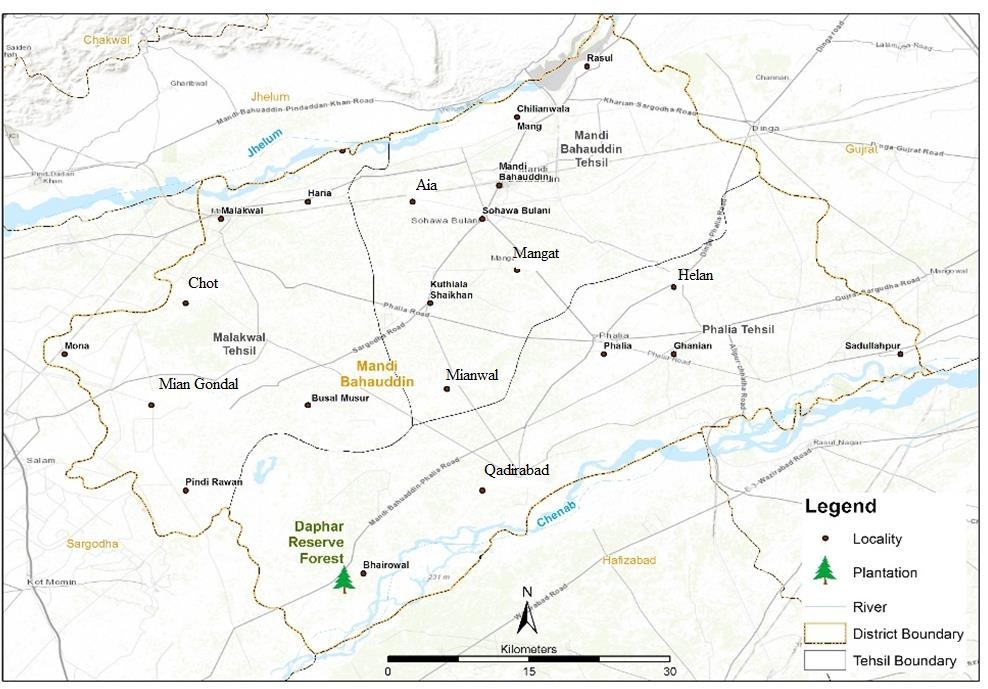
Figure. 1. Location of Daphar Wildlife Forest Sanctuary
Number of Sampling Surveys
Study area Daphar Forest Sanctuary was divided into twelve zones, and it was visited 12 times for the avifauna collection. Each study was carried out at early in the morning, at 5:00 am to 08:00 am, and at evening 3:00 pm to 7:00 pm in summer and at 6:00 am to 09:00 am and at evening 3:00 pm to 6:00 pm in winter. Survey stopped duringrain or high winds. The study was conducted from 1st January 2020 – 31st December 2020 under the natural ecological conditions of district Mandi Bahauddin.
Methodology for Data Collection
Census Method and Direct count method, meeting with local communities and expert opinion of concerned Department was adopted for data collection.
Proposed Analysis of Collected Data
Various sorts of analysis were conducted to establish the diversity index, such as Specie Richness was found as described by Jost (2006) [23].
Simpson Diversity Index (SDI) = D = 1 - ∑n (n−1) ⁄ N (N −1) was calculated.
n = total number of birds of a particular species
N = the entire number of birds of all species
Shannon-Wiener Index was measured by using formulae H’ = – ∑ pi log pi.
Evenness was completed using formulae (Shannon Weiner Diversity Index ⁄ln (log natural) of Total Population).
STATISTICAL ANALYSIS
Data was statistically analyzed by using SPSS version 25- and one-way ANOVA was applied to see the significance of avian data.
RESULTS AND DISCUSSION
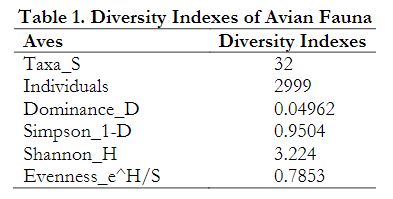
The study was conducted on twelve distinct sites of Daphar Forest Sanctuary. Each site was visited once in each month to check the “Diversity and Conservation of Avian Fauna in Daphar Forest Sanctuary”, Punjab, Pakistan. It was noticed that overall population of 2999 bird species were found in Daphar Forest Sanctuary that belongs to 12 orders, 20 families, 28 genera, and 32 species, and maximum population was recorded among dense forestation in sanctuary. Statistical analysis was carried out by ANOVA, which showed a value of 0.038 (P >0.05), and significant differences were found in different bird species.
Simpson Diversity index (SDI) value was calculated along with Shannon Weiner Diversity Index and Evennes; the resulted values werer 0.95, 3.224, and 0.78, respectively (Table 1).
Table 1. Diversity Indexes of Avian Fauna
 Species Abundance
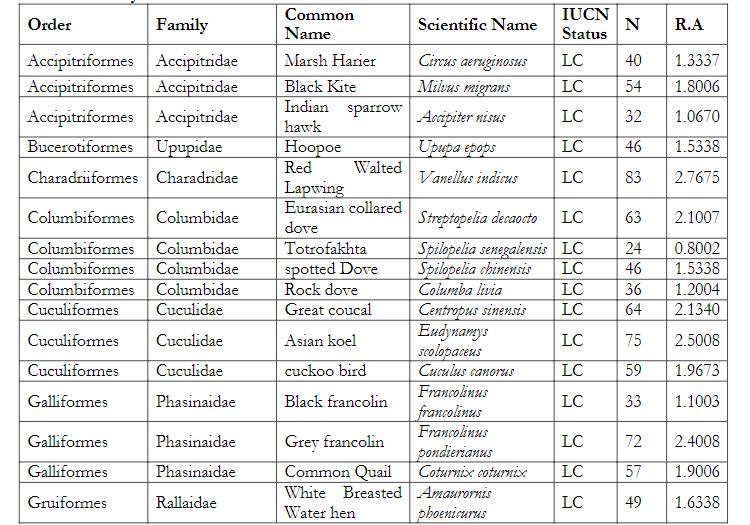
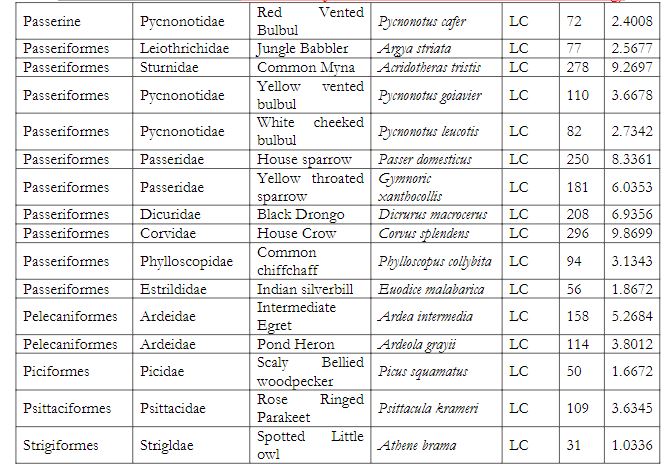
It was noticed that during the study, 5 species were recorded high in the study besides their counts and relative abundance these were Corvus splendens (Passeriformes: corvidae) N=296 (R.A, 9.8699), Acridotheras tristis (Passeriformes: Stumidae) N=278 (R.A, 9.2697), Passer domesticus (Passeriformes: Passeridae) N=250 (R.A, 8.3361), Dicrurus macrocerus (Passeriformes: Dicuridae), N=208 (R.A, 6.9356), Gymnoric xanthocollis (Passeriformes: Passeridae), N=181 (R.A, 6.0353) and average value among 5 most observed birds species were 242.6. Least counted species were Spilopelia senegalensis (Columbiformes: Columbidae), N=24 (R.A, 0.8002), Athene brama (Strigiformes: Strigldae), N=31 (R.A, 1.0336), Accipiter nisus (Accipitriformes: Accipitridae), N=32 (R.A 1.0670), Francolinus francolinus (Galliformes: Phasinaidae), N=33 (R.A, 1.1003), Columba livia (Columbiformes: Columbidae), N=36 (R.A 1.2004) and the average value for the most frequent observed species was 31.2 (Table 2).
Relative abundance of Avian Fauna upto Family and Order Level
20 bird’s families were observed among which highest R.A was calculated for family Sturnidae 12.94% (N = 388) succeeded by Pycnonotidae 11.07% (N = 332). However, minimum was calculated for families including Strigldae, Upupidae, and Pycnonotidae. 12 orders were documented and highest R.A was recognized for order Passerine 54.95% (N = 1648) succeeded by Cuculiformes 9.87% (N = 296) and Charadriiformes7.20% (N = 216). However, minimum R.A was measured for orders Bucerotiformes, Strigiformes, Piciformes, Columbiformes, Psittaciformes, and Pelecaniformes (Table 2).
It was revealed that Daphar wildlife sanctuary faces drastic pollution, which results in complications for the native wildlife. Adil et.al [24] also reported that the people who visited these areas polluted the water resources, which is one of biggest human interruption that causes decrease in diversity of this sanctury. Moreover, an increased level of toxic chemicals in various environmental media such as air, water, soil, and non-degradable wastage from urban, agricultural, and rural areas are considered as important factor which affects the forest plantation [24]. Similarly, hunting, human-driven fragmentation, habitat destruction, poaching, and chopping down forests are among biggest drivers of degradation of species. Poaching was perhaps one of the biggest threats to wildlife, particularly to few species, especially the ones that were almost endangered and heavily poached for their economic value [25]–[27].
Table 2. Avian Fauna Diversity and Relative Abundance in Daphar Forest Wildlife Sanctuary
 CONCLUSION
Overall, a very lesser number of species was recorded in Daphar forest Wildlife Sanctuary. Although the number of species can be enhanced by fulfilling the objective that were considered to establish Daphar forest Wildlife Sanctuary. The purpose was to protect particular species or group of species by providing space for reproduction and to protect them from extinction. However, study revealed that Daphar wildlife sanctuary shared a border with native community and it faces drastic pollution causing complications for the native wildlife. Moreover, hunting, habitat destruction, illegal killing or hunting, and cutting down of forests are different factors for the loss of few species, particularly those which are endangered and have high economic value. So, it was concluded that there is a need to enhance the importance of such protected areas by research to conserve wild bird species.
REFERENCES
[1] A. M. Schrag, M. E. Zaccagnini, N. Calamari, and S. Canavelli, “Climate and land-use influences on avifauna in central Argentina: Broad-scale patterns and implications of agricultural conversion for biodiversity,” Agric. Ecosyst. Environ., vol. 132, no. 1–2, pp. 135–142, Jul. 2009, doi: 10.1016/J.AGEE.2009.03.009.
[2] A. M. Klein et al., “Importance of pollinators in changing landscapes for world crops,” Proc. R. Soc. B Biol. Sci., vol. 274, no. 1608, pp. 303–313, 2007, doi: 10.1098/rspb.2006.3721.
[3] D. N. R. D. Gregory R. Field, J. Marchant, M. Raven and and D. W. Gibbons, “Using birds as indicators of biodiversityFile Attachments,” Ornis Hungarica, vol. 12–13, no. January, pp. 11-24 ST-Using birds as indicators of biodivers, 2003.
[4] N. J. Roberts, “Investigation into survey techniques of large mammals: Surveyor competence and camera-trapping vs. transect-sampling,” Biosci. Horizons, vol. 4, no. 1, pp. 40–49, 2011, doi: 10.1093/biohorizons/hzr006.
[5] “BIODIVERSITY A CTION PLA N FOR PAKISTAN.”
[6] G. W. Luck, G. C. Daily, and P. R. Ehrlich, “Population diversity and ecosystem services,” Trends Ecol. Evol., vol. 18, no. 7, pp. 331–336, 2003, doi: 10.1016/S0169-5347(03)00100-9.
[7] E. S. Kathryn, “Nest Predation and Differential Insular Extinction among Selected Forest Birds of Central Panama,” Ecology, vol. 73, no. 6, pp. 2310–2328, 1992.
[8] D. Loads et al., “WILDLIFE CONSERVATION EDUCATION AND INTERNATIONAL PROGRAMMES Wildlife Conservation Education Programmes : It is Conservation Education and Outreach Techniques :,” J. Environ. Educ., vol. 8, no. 4, pp. 33–45, 2017.
[9] W. J. Sutherland, “Conservation science and action,” Conserv. Sci. action, 1998, doi: 10.1002/9781444313499.
[10] J. Keulartz, “Captivity for Conservation? Zoos at a Crossroads,” J. Agric. Environ. Ethics, vol. 28, no. 2, pp. 335–351, 2015, doi: 10.1007/s10806-015-9537-z.
[11] “Wildlife conservation and the invasion of nature reserves by introduced species: a global perspective – ScienceOpen.” https://www.scienceopen.com/document?vid=bc5c665a-9831-49c9-af04-0505faabb2c1 (accessed Jun. 24, 2022).
[12] U. Dhar, R. S. Rawal, and S. S. Samant, “Structural diversity and representativeness of forest vegetation in a protected area of Kumaun Himalaya, India: implications for conservation,” Biodivers. Conserv. 1997 68, vol. 6, no. 8, pp. 1045–1062, 1997, doi: 10.1023/A:1018375932740.
[13] S. S. Samant, U. Dhar, and R. S. Rawal, “Biodiversity status of a protected area in West Himalaya: Askot Wildlife Sanctuary,” Int. J. Sustain. Dev. World Ecol., vol. 5, no. 3, pp. 194–203, 1998, doi: 10.1080/13504509809469983.
[14] G. Singh and G. S. Rawat, “Ethnomedicinal Survey of Kedarnath Wildlife Sanctuary in Western Himalaya , India,” Indian J. Fundam. Appl. Life Sci. ISSN, vol. 1, no. 1, pp. 35–46, 2011.
[15] M. S. Rana and S. S. Samant, “Threat categorisation and conservation prioritisation of floristic diversity in the Indian Himalayan region: A state of art approach from Manali Wildlife Sanctuary,” J. Nat. Conserv., vol. 18, no. 3, pp. 159–168, Aug. 2010, doi: 10.1016/J.JNC.2009.08.004.
[16] C. Körner, “A re-assessment of high elevation treeline positions and their explanation,” Oecologia 1998 1154, vol. 115, no. 4, pp. 445–459, Jul. 1998, doi: 10.1007/S004420050540.
[17] J. A. Savidge, “Extinction of an island forest avifauna by an introduced snake.,” Ecology, vol. 68, no. 3, pp. 660–668, 1987, doi: 10.2307/1938471.
[18] T. M. Brooks et al., “Habitat Loss and Extinction in the Hotspots of Biodiversity,” Conserv. Biol., vol. 16, no. 4, pp. 909–923, Aug. 2002, doi: 10.1046/J.1523-1739.2002.00530.X.
[19] C. Winqvist et al., “Mixed effects of organic farming and landscape complexity on farmland biodiversity and biological control potential across Europe,” J. Appl. Ecol., vol. 48, no. 3, pp. 570–579, Jun. 2011, doi: 10.1111/J.1365-2664.2010.01950.X.
[20] T. G. Benton, J. A. Vickery, and J. D. Wilson, “Farmland biodiversity: is habitat heterogeneity the key?,” Trends Ecol. Evol., vol. 18, no. 4, pp. 182–188, Apr. 2003, doi: 10.1016/S0169-5347(03)00011-9.
[21] “1990 United Nations list of national parks and protected areas | IUCN.” https://www.iucn.org/content/1990-united-nations-list-national-parks-and-protected-areas (accessed Jun. 24, 2022).
[22] M. A. Maan and A. A. Chaudhry, “Wildlife Diversity in the Punjab (Pakistan),” J. Biol. Sci., vol. 1, no. 5, pp. 417–420, Apr. 2001, doi: 10.3923/JBS.2001.417.420.
[23] L. Jost, P. Devries, T. Walla, H. Greeney, A. Chao, and C. Ricotta, “Partitioning diversity for conservation analyses,” Divers. Distrib., vol. 16, no. 1, pp. 65–76, 2010, doi: 10.1111/j.1472-4642.2009.00626.x.
[24] S. Adil, S. Ijaz, H. Aslam, R. Kanwal, and S. Afsheen, “Diversity of amphibians and reptiles in Daphar Forest Sanctuary, district Mandi Bahauddin, Pakistan,” vol. 4, pp. 15–26, 2020.
[25] T. C. Bonebrake, F. Guo, C. Dingle, D. M. Baker, R. L. Kitching, and L. A. Ashton, “Integrating Proximal and Horizon Threats to Biodiversity for Conservation,” Trends Ecol. Evol., vol. 34, no. 9, pp. 781–788, Sep. 2019, doi: 10.1016/J.TREE.2019.04.001.
[26] A. M. Lechner, F. K. S. Chan, and A. Campos-Arceiz, “Biodiversity conservation should be a core value of China’s Belt and Road Initiative,” Nat. Ecol. Evol. 2018 23, vol. 2, no. 3, pp. 408–409, Jan. 2018, doi: 10.1038/s41559-017-0452-8.
[27] P. Romero-Vidal, F. Hiraldo, F. Rosseto, G. Blanco, M. Carrete, and J. L. Tella, “Opportunistic or Non-Random Wildlife Crime? Attractiveness Rather Than Abundance in the Wild Leads to Selective Parrot Poaching,” Divers. 2020, Vol. 12, Page 314, vol. 12, no. 8, p. 314, Aug. 2020, doi: 10.3390/D12080314.
 |
Copyright © by authors and 50Sea. This work is licensed under Creative Commons Attribution 4.0 International License. |