Empirical Assessment for the Domestic Worker Housing: A Case Study of Lahore
Haroon Gulzar1, Taimoor Hassan1
Department of City & Regional Planning, University of Engineering & Technology Lahore, Pakistan
* Correspondence: Email: haroongulzarcrp@gmail.com
Citation |Gulzar. H, “Empirical Assessment for the Domestic Worker Housing: A Case Study of Lahore”. International Journal of Innovations in Science and Technology. Vol 4, Issue 3, 2022, pp: 649-669
Received | May 28, 2022; Revised | June 22, 2022; Accepted | June 28, 2022; Published| June 30, 2022.
_____________________________________________________________________________________________________________________________
A house is considered a basic human need. It provides identity, security, belonging, and privacy. Regrettably, Pakistan is facing a housing backlog of almost 10 million units. This research aims to diagnose the problems related to accommodation that domestic workers are facing and to assess the pragmatic options for housing the labor class groups. Data for this research was collected from the residents, domestic workers, and relevant authorities through a structured questionnaire survey in selected case study areas. The dependent variable in the study is the provision of accommodation to the domestic workers, which needs to be calculated. The predictors or independent variables are affordability of domestic workers’ residence, salary, housing provision, financial status, and role of government. The results reveal that when “provision of housing allowance” to the domestic workers will help in overcoming the problem of housing available to the workers Its value goes up by 1, “provision of residence to domestic workers at nearby places” increases by 0.518 Similarly, “provision of nearby residence increases the work efficiency” goes up to 1, “provision of residence to domestic workers at nearby places” goes up by the value 0.118.
Analysis revealed that workers’ work efficiency depends upon, Government and financial support from the people. The findings of the study/research analysis revealed that most domestic workers are being deprived of livable housing and have to bear significant travel expenses to reach their workplaces. There is a dire need to form a government-based strong association for the domestic worker which would work for the betterment of domestic workers to improve their quality of life. The government and private developers should increase the supply of low-income housing in the form of vertical growth development. It can be pertinent to propose that housing opportunities have to be placed close to the vicinity of workplaces to reduce the travel cost bear by domestic workers.
Keywords: housing provision, domestic workers, accommodation, demand, Lahore
INTRODUCTION
Domestic work is considered hidden and one of the biggest sources of employment in the informal sector that lifts the economy. A large number of women, men, girls, and boys are moving from rural areas to cities in search of work, but with little or no education or skills, many end up taking low-paying, exploitative domestic jobs as their only alternative. The poverty rate for domestic employees is three times higher than that of other workers, and nearly three times as many domestic workers are either below the poverty line or above it but still unable to make ends meet [1].
According to the bureau of statistics, Pakistan is facing a housing backlog of almost 10 million units, with demand growing at 0.7 million new housing units per year. Provincial and Federal Governments of Pakistan in the recent years made initiatives for the provision of low-income homes for the citizens of Pakistan, but nothing happened on realistic grounds. Fewer than one in 10 domestic employees are protected by an employer-provided retirement scheme, and just one in five receives health insurance coverage via their job [2].
Yet, there are no exact figures, it is assessed that there are approximately 8.5 million domestic workers in Pakistan. Most of them are women and children [3]. Although most middle-class families in the country use domestic help to take care of the most vital aspects of their lives their homes, children, and the provision of food this job is done by these workers is often overlooked or undervalued [4]. The United Nations declared a house is the fundamental right of every citizen [5]. Keeping in view the ratio of domestic workers and percentage of housing backlog in Pakistan it can be said that there is a dearth of accommodation for domestic workers.
The trend of developing the private housing schemes and land subdivisions in the form of real estate business became very common practice among the real estate developers [6] which no doubt made the cities look aesthetically vibrant but unfortunately failed to meet the increasing growing housing demand as most of the developed housing schemes are vacant or being utilized for the sales and purchase the business of plots/housing units, directly tending to increase the price of land for housing. That’s why the labor class is unable to buy even a house of three Marla in Lahore [7].
Domestic work is, therefore, an important source of earning, mainly in poor families but is often ignored. It accounts for almost 1.7 percent of total employment globally and some percent of all wage employment [8]. This study highlights the importance of regularizing domestic workers and also focuses on problems that they are The study recommends a framework which includes the parameters and statistics upon which the housing for domestic workers that can be established. Additionally, the housing demand for domestic workers has been increasing in Pakistan and incorporating this can be a significant step to develop sustainable communities.
International Scenarios
At least 53 million people work as domestic workers around the world; the majority of them are women (83 percent) approx., according to International Labor Organization, 2013 [3]. In private households, tens of millions of women and girls are hired as housekeepers [9]. “They are among the most exploited and abused workers globally," according to a report by the Human Rights Watch report published, about 60 million women mostly from poor countries represent a mobile labor force, especially in the Middle East, Europe, Canada, and the United States" [10] has been noticed by experts in transnational labor relations. Domestic workers in Uganda, particularly teenage female domestic workers, are an excellent example of those who have been oppressed [11].
With the excess of cruelty, high-rise apartments developed to meet the need of labor income housing couldn’t offer subsidized rental prices to the competent public and most likely were inhabited by the high-income class [12]. A series of high-rise apartments might not only be the solution for meeting housing demand in cases where unaffordability causes vacant towns and housing settlements as 50 million housing units are vacant in the form of apartments in China [13]. In this way, low-income housing being provided in new housing schemes according to the Private Housing Scheme Rules 2017, became unaffordable to competent people for which such low-income housing provisions have been developed for [14].
As a result of three significant factors, the employment relationship between domestic workers and their employers is highly regulated: first, because domestic workers have long been excluded from federal employment protections; second because the home is commonly ignored as a workplace; and thirdly, because of the complexity of caregiving and the close relationships formed during the process of caring [15], [16].
In addition, the working circumstances of domestic employees in developing countries are highly complicated. Some of the "currency" at play in these partnerships include food and shelter, education, and financial aid. The lack of compensation for domestic employees may be due to these informal social structures. Overall, there is a lot of room for improvement for domestic workers, starting with solid coordination between several Ministries, activist groups, unions, and policymakers who are prepared to take responsibility for various delicate topics [17].
Adolescent domestic workers' subordination stems from their unique combination of gender, age, social status, and geographic location. There are an estimated 5.2 million domestic workers in Africa with a 70 percent female composition, but that estimate is probably low in an area where "nearly everyone has a domestic worker" [18]. Child labor affects 65 million children in sub-Saharan Africa, and nine out of ten domestic workers are female. As many as six million individuals in Uganda work as domestic workers according to Platform for Labor Action. Over 78% of Uganda's population is under 30 years old, making it the world's youngest country as per the Population Secretariat of Uganda.
Young people in Africa make up 60% of those without jobs. As a result, rural-urban migration and urban-centered domestic work have become increasingly common in the United States due to high unemployment [19]. According to the limited figures, at least 52.6 million men and women were employed worldwide in 2010 as domestic workers. To put this in perspective, the number of people employed in huge countries like Vietnam, Mexico, or Nigeria is more than this statistic [20].
Material and Methods
The research methodology comprises of the following sequence: Comprehensive questionnaires were designed, according to characteristics (Socio-Economic, Remuneration, Housing Affordability, Socio Environment, and Accessibility) separately for the house owner, relevant authority, and the domestic worker. Knowing the variability of selected case studies and the diversity of inhabitants living there, a pilot survey was conducted to check the level of execution of the research. The sample size is selected using this formula; Z2V2/D2, the calculated value was 246.
A stratified sampling technique has been applied in which the total number of plots are counted; WAPDA town has total number of Residential Plots 9804 while the Gulberg has 1321 plots. According to the number of residential plots, total sample size is being divided among the two case studies; two hundred and eleven respondents were from WAPDA town, and thirty-five respondents were from Gulberg. Surveys were also conducted by categorizing the respondents into three categories as: response from the owners (Employers), the response from the Domestic workers, and the response from government departments. Based on the collected data, results are drawn.

Figure 1: Step by Step Methodology
Investigation site (case study area)
The ultimate criteria and framework involved in the selection of case studies are meeting all the core aims and objectives of the research. WAPDA Town and Gulberg are selected after considering following aspects. First, these are areas where the inhabitant’s financial conditions are adequate to hire a domestic worker. Second, a huge amount of demand for attaining the services of domestic workers does exist in these areas. Third, high-class income groups should be the inhabitant of the chosen case study. Fourth, there are houses, in selected areas, with large plot sizes which can have the area for accommodating the domestic workers. Lastly, these are among those areas where landless people illegally stay in the housing society and carrying out the services of domestic work for the high-class income group people. WAPDA Town and Gulberg have been found in meeting the objectives of the research. The study sites have been shown in figure 1 and figure 2.

Figure 2: Case study area Wapda Town, Lahore

Figure 3: Case study area Gulberg, Lahore
Results and discussion
The following tables/figures shows the findings collected through questionnaires.

Figure 4: Average household size of domestic workers
The Household size in the case study was 29 households are of 1-3 Marla, 189 households are 4-6 Marla, and 28 plots are above six Marla out of 246 households as shown in the figure.
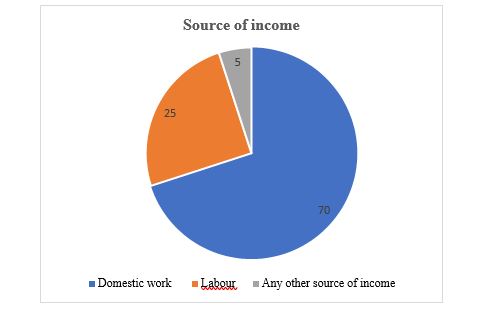
Figure 5: Source of income of domestic workers
As per observations, (figure 5) the domestic workers face low pay, rarely receive benefits, and have less access to full-time work than other workers. They do not have any other source of income. Therefore, their financial status is never improved. They are particularly prone to exploitation since they labor in private homes and flats, out of sight and separated from other workers.
Table 1: Status of written contract taken by workers Without written contracts or employment guarantees, these workers are employed directly by their employers. In Pakistan, the majority of informally employed domestic workers are women who work in a variety of situations, frequently without the benefit of defined terms of employment [21]. The above table shows that out of 246 residents, only 27 have a written agreement with domestic workers. This value is 11 percent only. As per the attitude of residents towards hiring of domestic workers is concerned, 217 are willing to hire and 29% don’t want to be hire. They may have no right to rest, or take leave or sick days, and have limited to no access to health care.
Table 2: Gender of workers
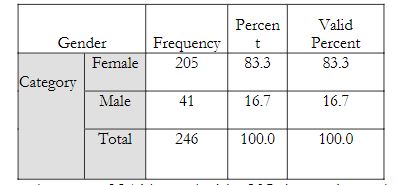
The table shows that out of 246 households, 205 domestic workers are females, which is 83.3 percent of the total. According to outcomes, a significant part of the domestic workforce is female domestic workers. Females comprise 83% and male only 18%. Women are forced to look for work due to migration, poverty, illiteracy, and difficult family situations. Due to a lack of education and employable skills, they are forced to rely on this kind of income, which they do on a daily basis in their own houses. Domestic workers are in higher demand around the world as a result of urbanization, changing family structures, educated women seeking employment, and the need for someone to undertake household duties.
Table 3: Number of working hours of workers
Most of the respondents exposed that they work for private households, often without clear terms of employment and excluded from the scope of labor legislation. This exposes them to physical, sexual and mental abuse, trafficking and bonded labor, as well as physical, social and cultural isolation. The table shows that 110 domestic workers do work for 5-9 hours a day, 88 workers do work for 10-12 hours a day, and 32 workers do work from 13-17 hours a day.
Table 4: Scale showing status of financial support given to workers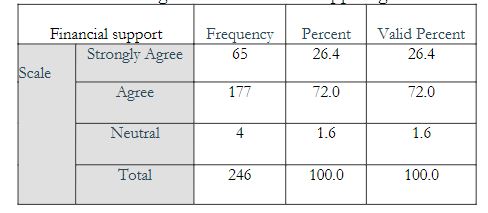 Most of the worker belong to low-income families and live in rural areas with few options for obtaining an education or developing their skills. Others, particularly those who go abroad, may be highly qualified but unable to find work that matches their educational background. This table shows that 65 residents strongly agree that they have provided enough money to support domestic workers' housing, 117 residents are agreed, and four residents are neutral.

Figure 6: perception regarding policy need to be adopted
According to the results evaluated, 64 residents strongly agreed that the provision of accommodation to domestic workers is necessary, 179 agreed with it, and only three residents are neutral. The analysis shows that 65 domestic workers strongly agreed that the provision of nearby residence will increase work efficiency. One hundred seventy-five workers are agreed, four workers are neutral, and two workers disagree. Moreover, the figures shows that 58 domestic workers believe that supporting with financial contribution will encourage the government to provide apartments or flats to workers, 172 workers agree with it, 12 are neutral, and two disagree with it.
Statistical Analysis
The dependent variable in the study is the provision of housing to the domestic workers which was calculated. The independent variables include (total contribution per month by domestic workers, residence, the ratio of salary a domestic servant save for a house, and accessibility to house. It was assumed that nearby residence increases the work efficiency of workers. These variables were developed by the researchers to find out the correlation between the dependent and independent variables. The results in the tables are further explained in the text.
Table 5: Summary of the Model Table 6: Analysis of Variance
 Table 5 exhibits that the value of R2 is significant as the regression model perceives the relationship with an accuracy of 80.5%. Table 6 highlights that the analysis of variance (ANOVA) among the variables provision of accommodation to the domestic workers is significant.
Table 7: Regression Coefficient The results in table 7 demonstrate that provision of housing allowance to the domestic workers help in overcoming housing shortage its value goes up by 1, “provision of residence to domestic workers at nearby places” increases by 0.518 Similarly, the “provision of nearby residence increase the work efficiency” goes up to 1, that means if the residence is near, work efficiency of workers will automatically increase. The results shown in the table revealed that the factor “financial support” by Government or by house owners also have high significance with value of 0.123. The analysis depicts that the element “total contribution per month helps domestic workers to afford a small house or rented a residence” its value increases to 1. Whereas, the Provision of accommodation to the domestic workers goes up by 0.182. Thus, it can be said that savings from salary, encouraging Government and financial support from the people are strongly co-related with the housing problem of domestic workers.
Table 8: Correlations between variables
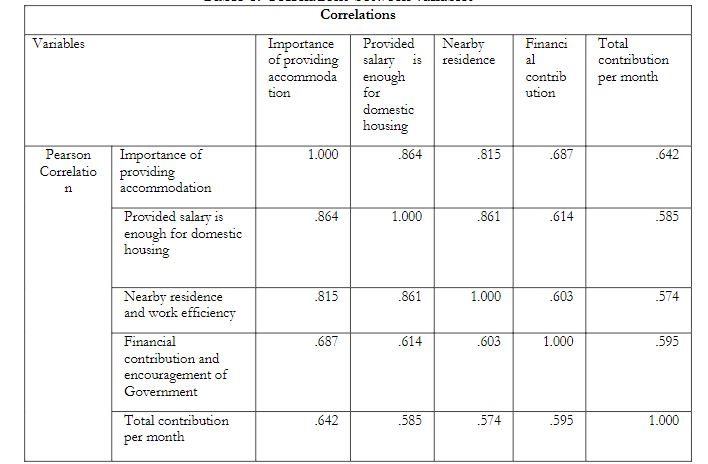 Table 8 shows that five variables have been identified by the researchers in which one has been taken as dependent variable; provision of nearby housing for workers, and four have been taken as the predictors; amount of salary provided per month, provision of nearby housing will increase the work efficiency, financial support will encourage the government to provide workers with apartments or flats and total financial contribution per month by the people for affordable housing of workers. The masses are in favor of providing the residence to domestic workers at nearby places as it will increase their work efficiency, so for this, people will be more than willing to contribute financially and hence this act will encourage the government to provide apartments or flats to the domestic workers/workers. The correlation between first two variables having value .864 shows that public response towards provision of accommodation to the domestic workers housing is necessary is highly supportive. The accommodation allowance provided by residents will be helpful in the provision of accommodation to the domestic workers. Similarly amount of salary provided per person is enough to support for domestic workers’ housing. The table depicts that the value 0.861 shows that the provision of nearby residence will increase the work efficiency of the domestic workers. But 0.642 shows the not so strong relation but the relation between ‘financial support by the residents in the provision of apartment or flat’ is also supporting the first variable of ‘provision of domestic workers housing is necessary’.
Conclusions and Recommendations
1. A critical first step to providing domestic workers with the same protections as other workers are enacting a National Domestic In addition to extending basic wage and hour protections to domestic workers, such a measure would include:
(a) Key provisions establish fair scheduling (i.e., no unexpected shift cancellations or changes without warning or compensation).
(b) Transparent employment.
(c) Access to health care and retirement benefits for domestic
2. Pakistan should learn from the states, for example, California, Connecticut, Hawaii, Illinois, Massachusetts, Nevada, New Mexico, New York, Oregon, and the city of Seattle, which has already approved Domestic Workers Bills of Rights, and other states and cities should follow suit [22].
3. It is vital that these rules now protect domestic workers across the country. A beginning point would be to take steps to inform both employers and domestic employees about the existence of these safeguards through mass media, apart from supporting unions of domestic workers that can enable a network of workers to collectivize to campaign for ensuring
4. In order to provide social security, health facility, safety, welfare, and to regulate employment, a bill was introduced in the senate of Pakistan which was named as The Punjab Domestic Workers Act, The act should be implemented by its true means. Innovative adjustments to the existing domestic workers' act should be made to enable it to guarantee social security for domestic employees [23].
5. Due to the personal and locale-specific methods in which employees negotiate wage and working conditions, there is an urgent need to decentralize this process and factor in the diverse geographic and socio-economic profiles of places while creating norms on wage-fixing and working
6. Some of the proposed legislation delegates various activities to welfare boards. Boards are to supervise the design of rules and programs for workers and be accountable for enabling the registration of workers while monitoring and providing funds for the benefit of workers. These are wide-ranging operations, and the competence of any organization to manage such a combination of tasks needs to be
7. While taking the initiative for the provision of domestic workers, participatory planning approaches have to be ensured between the developers and domestic There is a dire need to form a government-based strong association for the domestic worker which would work for the betterment in empowering the quality of life for them.
Discussions
The research tends to conclude that determining factor of choices, feasibility from the domestic workers, in the provision of housing opportunities are crucial aspects which reflect the real needs of housing for the domestic workers. Most of the domestic workers have to travel much to reach their working destination. As illustrated by [18]. As a result, traveling expenses becomes unbearable for them. Additionally, many domestic workers are living in a depressed condition tend to have a wish to have their own house either as an individual house or in an apartment.
It can infer that a significant number of domestic workers are facing a lack of the provision of a livable environment by owners. Most of them had to travel much to reach their working destination. A notable amount of domestic workers’ housing conditions is miserable.
There is also a lack of interest in empowering the workers' quality of life by the government department. It is also noted that if the owner is providing housing, allied uses in housing schemes don’t match with the economic conditions of the workers [19].
Although the domestic employment market is unorganized, our research found that working and living conditions are not as bad as previously thought. Domestic employees appear to have gained negotiating power due to the increased demand for their services. Empowering domestic workers by making them eligible for social security such as healthcare benefits, the minimum wage, and maternity benefits is the most pressing issue of our time. This should be implemented across the country, not just in a few states. Employees and employers will profit from a regular workday and regular leave schedule. Ensuring their contributions to the economy are acknowledged would be an excellent first step, as would issue them official identification cards and drafting work contracts [20].
Similarly, many domestic workers disagree with the residing at owners' place due to their social cohesion and related responsibilities. It can also say that land for allied uses is very crucial and essential, which includes the opportunities for domestic workers to have their livestock. Possibly, mostly domestic workers also want to do business-related work. Under the shadow of all that has been said, it can be ventured that housing opportunities should be provided to workers. Below is the framework devised by researchers which can be used by policymakers, planners and other stakeholders to solve the problems faced by domestic worker.

Figure 7: Framework devised by Researchers
REFERENCES
[1] World Economic Forum, The Global Competitiveness Index Report 2017-2018. 2018.
[2] J. Cock, “Trapped workers: The case of domestic servants in South Africa,” Patriarchy Cl. African Women Home Work., pp. 205–220, Jan. 2019, doi: 10.4324/9780429301155-10.
[3]“Domestic Workers: Giving rights to millions of domestic workers in Pakistan.” https://www.ilo.org/islamabad/info/public/fs/WCMS_347029/lang--en/index.htm (accessed Jun. 24, 2022).
International Journal of Innovations in Science & TechnologyJuly2022 | Vol 4|Issue 3Page| 662
[4] M. Ishii et al., “Space weather benchmarks on Japanese society,” Earth, Planets Sp., vol. 73, no. 1, pp. 1–20, Dec. 2021, doi: 10.1186/S40623-021-01420-5/TABLES/3.
[5] B. Bersaglio, C. Enns, and T. Kepe, “Youth under construction: the United Nations’ representations of youth in the global conversation on the post-2015 development agenda,” http://dx.doi.org/10.1080/02255189.2015.994596, vol. 36, no. 1, pp.57–71, Jan. 2015, doi: 10.1080/02255189.2015.994596.
[6] I. A. Rana and S. S. Bhatti, “Lahore, Pakistan –Urbanization challenges and opportunities,” Cities, vol. 72, pp. 348–355, Feb. 2018, doi: 10.1016/J.CITIES.2017.09.014.
[7] A. M. Islam. S. H, Mayo. M. S, Rahman.A, Afzal. U, “Determination and Mitigation of Urban Heat Island (UHI) In Lahore (A comparative Study of Landsat 8&9),” I nternational J. Innov. Sci. Technol., vol. 4, no. 2, pp. 526–551, 2022.
[8] S. Banerjee and D. Govil, “Bengali Female Migrants: Domestic Workers in Mumbai,” ANTYAJAA Indian J. Women Soc. Chang., vol. 3, no. 2, pp. 194–206, 2018, doi: 10.1177/2455632718798071.
[9] F. T. J. Malit and S. Ghafoor, “Domestic Work Legislation in the Gulf Countries: A Comparative Policy Review,” Int. Assoc. Int. Gulf Organ., no. August, 2016, doi: 10.13140/RG.2.2.32072.52483.
[10] P. A. Cawood and C. J. Hawkesworth, “Continental crustal volume, thickness and area, and their geodynamic implications,” Gondwana Res., vol. 66, pp. 116–125, Feb. 2019, doi: 10.1016/J.GR.2018.11.001.
[11] Shakir. M. M. ZaheerH, “A Study of Reasons behind Unproductivity and In-decisiveness in public Institutions of Urban Planning in Pakistan,” I nternational J. Innov. Sci. Technol., vol. 4, no. 2, pp. 564–577, 2022.[12] V. Desai, “Urban widows: living and negotiating gendered dispossession in speculative slum housing markets in Mumbai,” https://doi.org/10.1080/0966369X.2020.1811642, vol. 28, no. 10, pp. 779–799, 2020, doi: 10.1080/0966369X.2020.1811642.
[13] E. JANSEN, “Like Family,” Apr. 2019, doi: 10.18772/12019043511.
[14] J. S. I. Dodíaz, “The Trade in Domestic Servants (Morianer) from Tranquebar for Upper Class Danish Homes in the First Half of the Seventeenth Century,” Itinerario, vol. 43, no. 2, pp. 194–217, Aug. 2019, doi: 10.1017/S0165115319000238.
[15] S. Ghosh, “DAILY LIFE OF WOMEN : An Encyclopedia from Ancient Times to the Present,” no. March, 2021.[16] S. S. A. Khurshid. M, “Assessment and Validation of Land Surface Temperature (LST) Dynamics using Geo-spatial Techniques in Dera Ghazi Khan City, Pakistan,” I nternational J. Innov. Sci. Technol.,vol. 4, no. 2, pp. 300–312, 2022.
[17] N. Sinha, N. Varma, and P. Jha, “Servants’ pasts.”
[18]“Lahore (District, Pakistan) -Population Statistics, Charts, Map and Location.” https://www.citypopulation.de/en/pakistan/distr/admin/716__lahore/ (accessed Jun. 24, 2022).
[19] F. Wagman Roisman, “Stumbling Stones at Levittown: What to Do About Racial, International Journal of Innovations in Science & TechnologyJuly2022 | Vol 4|Issue 3Page| 663Covenants in the United States,” Accessed: Jun. 24, 2022. [Online]. Available: https://www.mappingsegregationdec.org.
[20] M. Klimaszewski, “Servants and Collaborative Storytelling Space in The Haunted House,” Victorians A J. Cult. Lit., vol. 140, no. 1, pp. 115–125, 2021, doi: 10.1353/VCT.2021.0012.
[21] L. Ernst, “Domestic Workers in Hong Kong : Their Stories , Self-Perception , and Their Portrayal in Hong Kong and Filipino Media,” 2018.
[22] T. A. Grose, “If you don’t know how, just learn: Chinese housing and the transformation of Uyghur domestic space,” https://doi.org/10.1080/01419870.2020.1789686, pp. 1–22, 2020, doi: 10.1080/01419870.2020.1789686.
[23] N. Theodore, B. Gutelius, and L. Burnham, “Workplace Health and Safety Hazards Faced by Informally Employed Domestic Workers in the United States,” Work. Heal. Saf., vol. 67, no. 1, pp. 9–17, Jan. 2019, doi: 10.1177/2165079918785923
Questionnaire Survey from domestic servants of case study Area
Questionnaire No:
Address/House No:
- Domestic Servants profile
|
A1. Full Name: |
A10. Monthly Average Savings: |
|
A2. Age: |
A11. House Ownership: (1)Owned (2) Rented (3)Leased |
|
A3. Marital Status: |
A12. Religion: |
|
A4. If Yes, How many children do you have? |
A12. Citizenship status: [Native][Non-native] |
|
A5. Who looks after them during the day and during school holidays? |
A13.If Native where do you live? |
|
A6. Major source of income: |
A14. If non-native, then how long has you been in this city? |
|
A8. Earning Members: Dependents: |
A15. Where did you live before? |
|
A9. Average HH Expenditure: |
A16. Why did you migrate to this place? |
1. Remuneration: -
B1. How do you consider yourself?
[1] Very Poor [2] Poor [3] Middle income [4] Rich [5] Very rich B2. Mention the amount of monthly salary received from the owner? Rs.
B3. (i) Are you being residing in the Owner’s house? Yes/No
B4. Are you being working in the Owner’s house under the written Contract?
Yes/No
B5. If yes, mark which one of the following facilities have been provided to you by the owner as a domestic servant.
|
1. Food Environment |
2. Transport Allowance |
3. Livable |
|
4. Electricity |
5. Heating |
6. Cooling |
|
7. Drinkable Water Employment Injury |
8. Health & Medical Care |
9. |
|
10. Weekly Holidays |
11. Occasional Holidays |
12. Bonus |
B6. If No, Kindly state the amount which you have been expending on the following: -
|
No. |
Facilities/Benefits |
Amount Spending(Rs) |
No. |
Facilities/Benefits |
Amount Spending (Rs) |
|
1. |
Food |
|
2. |
Transport Expense |
|
|
3. |
Health & Medical Care |
|
4. |
Electricity |
|
|
5. |
Heating |
|
6. |
Cooling |
|
|
7. |
Clothing |
|
8. |
Drinkable Water |
|
B7. If you are not being provided with the residents from owners, (i). How do you get to work? How long does it take you?
- What is your home environment like? (House, Apartment, squatter camp)?
- What type of home environment do you wish to have?
- If the Government made necessary for the Owner to provide you the place of residence at his/her home, would you be able to live in the Owner’s house? Yes/No
(v) If yes, State can you be able to manage your livelihood expenses at Owner’s house?
No
(Vi) Will Living in the owner’s house not disturb your social cohesion?
No/Yes
(vii). If the Government provides you the residence near the place of work, with better & expensive living standard Would you be able to migrate? Yes/No
(a) And how much amount you will be able to pay the monthly rent for the residence provided by the government?
(b). ≤ 1000RS (b). 1000-3000RS (c) 3000-5000RS (D) ≥
5000RS
(c) State your expectations which do you want to be incorporated in the residence provided by the Government?
B8. What do you expect from me as your employer? (State at least 3 expectations)
B9. If you were not a domestic worker, what other type of work would you like to do?
B10. Are you aware by the Labor Law of Pakistan had been established for the protection of
the rights of the Labor? Yes/No
B11. Are you being aware by the Naya Pakistan Housing Project being initiated by the Prime Minister of Pakistan for the provision of Affordable houses? Yes/No
B12. If yes, what are your recommendations and suggestions which can be incorporated while implementing this project?
Questionnaire Survey from Residents of case study Area
- Household profile
|
A1. HH Size: |
A5. Earning Members: Dependents: |
|
A2. Family type: [Nuclear][joint] |
A6. Occupation of earning members: |
|
A3. Size of house (Marla): |
A7. Average HH Expenditure: |
|
A4. Setbacks Available (Feet): |
A8. Monthly Average Savings: |
- Domestic Servants
B1. Have you hired domestic servants for getting household services? Yes No
B2. If yes, please state the number of domestic servants you have hired with respect to their gender?
|
No. of Male(s): |
No. of Female(s): |
B3. If NO, state the reason?
B4. Have you made a written agreement/contract with domestic servant stating the scope of work, amount of salary and number of hours? Yes No
B5. Are you aware about the provisions of Labor Law Pakistan preserving the rights of Domestic Servants? Yes/No
B5. If you have employed a domestic servant in your house, how many hours you make them to work per day?
B6. State the amount of Salary you offer to the Servant (Per head)? Rs.
B7. Does your house have enough space to offer occupancy to the servants? Yes/No
B7. Have you made the provision of residence for the domestic servant? Yes/No
B8. If Yes, State the area of accommodation you are provided to the domestic Servant?
(Sq. feet)
B9. If No, will you provide accommodation or housing allowance to the servants (If government made it compulsory)?
Yes No
B10. Will the nearby residence of Domestic Servants can increase their work efficiency?
Yes No
B11. Will you pay the Servant’s residence charges if Government offered them occupancy in nearby flats or apartments?
B12. If yes, How much you will be able to give monthly allowance for the residence of Domestic Servant?
(a). ≤ 1000RS (b). 1000-3000RS (c) 3000-5000RS
(D) ≥ 5000RS
C. Facilities and Benefits
C1. Please Mark from the following options which Facilities and benefits are you being providing to the domestic workers?
Food Weekly Holidays Health & Medical Care Maternity Benefits
Bonus Pension Traveling Allowance Occasional Gifts
Questionnaire Survey from the Officials of Labor & Human Resource Department Lahore
- Every organization has a vision to follow to complete their State the
Vision/Mission of Labor & Human Resource Department Lahore?
2. Every Government Department has to follow certain legislative Act/ Law or Rules and Regulation, so under which statutory backup, the Labor & Human Resource Department Lahore is being working on?
3. Under that statutory backup, what are the key objectives and responsibilities which comes under the functions of department?
- What are the responsibilities of Labour & Human Resource Department Lahore concerning Domestic Servants?
5. Which welfare services are being provided by your department to the Domestic Servants?
- State the measures which have been taken by the department to establish check and balance system for the provided facilities?
7. Under the statutory backup, what are the standard operating procedures, SOPs adopted while resolving the cases of domestic violence, harassment, Child Labor and interfering the rights of Domestic Servants?
- Have you ever collected the data related to the problems and issues faced by the Domestic Servants? If Yes, share some findings of that study?
9. Did you receive complaints from the domestic servants in history? If yes, what were the issues and what measures the Department took to address those complaints?
- What are the steps which your Department has adopted to protect the rights of Domestic servants under the provisions of Labor Law?
11. Have you carry out the awareness activities among the Labors to be aware about their rights? If Yes, state the name of activities and their place of execution?
- What are the initiatives which your Department is planning to initiate in future to overcome the issues of Domestic servants?
13. What are the issues and limitations faced by your Department while performing the duties?
- Is your department is currently playing a role in Naya Pakistan low cost housing project? If No, state the reasons?
15. State the postulates of recommendations & suggestion which can be incorporated in Naya Pakistan Housing Project?

Copyright © by authors and 50Sea. This work is licensed under Creative Commons Attribution 4.0 International License.