Assessing Sustainability Performance in the Textile Industry Using a Triple Bottom Line and SEM Approach: Evidence from a Developing Economy
DOI:
https://doi.org/10.33411/IJIST/1697Keywords:
Sustainability, Textile Industry, Structural Equation Modeling (SEM), Circular Economy, Eco- Design, Resource EfficiencyAbstract
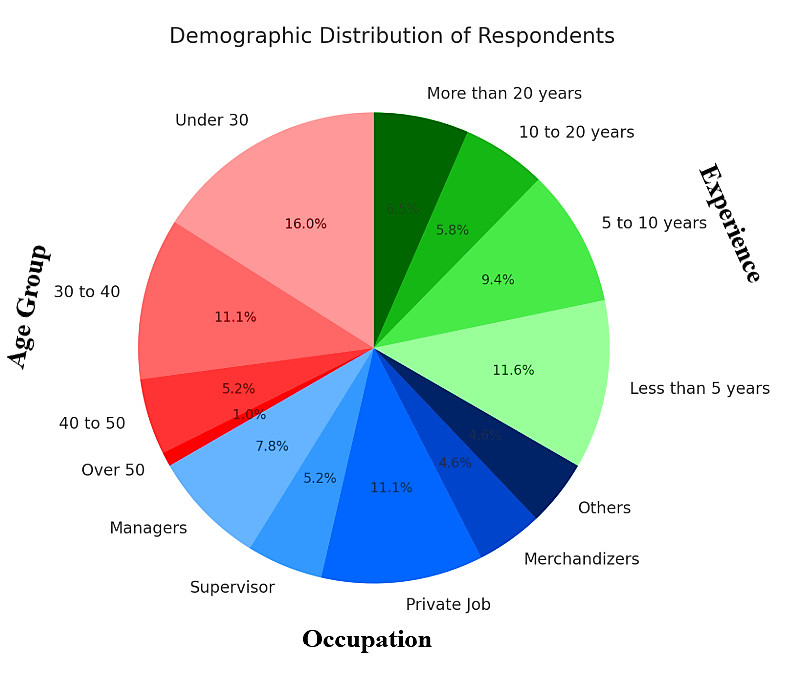
Textile industry can be considered as one of the most resource-intensive manufacturing sectors that poses significant environmental, social, and economic challenges, especially in developing economies. Despite growing interest, empirical research on the interdependencies among sustainability dimensions remains limited., although there is an increasing interest in sustainable textile production. The proposed study will evaluate the performance of sustainability in the textile industry by applying the Triple Bottom Line (TBL) framework and Structural Equation Modelling (SEM). A structured questionnaire survey was conducted on 120 textile manufacturing companies in Pakistan to collect primary data. The outcome shows that social sustainability positively affects economic performance (β = 0.794, p < 0.001) and environmental performance (β = 0.659, p < 0.001), and economic sustainability also has a strong effect on environmental sustainability (β = 0.730, p < 0.001). Some critical aspects contributing to sustainability performance include economic stability, waste management, energy efficiency, and adherence to human rights standards. Even though all the structural relationships are deemed to be statistically significant, the overall model fit indices (CFI = 0.704; RMSEA = 0.094) provide evidence of potential improvement of the measurement model.
References
John Elkington, “Cannibals with Forks: The Triple Bottom Line of 21st Century Business,” Journal of Business Ethics. Accessed: Feb. 03, 2026. [Online]. Available: https://www.jstor.org/stable/25074238
Textile Focus, “The Sustainability in Textile Industry.” Accessed: Feb. 03, 2026. [Online]. Available: https://textilefocus.com/sustainability-textile-industry/
M. Koszewska, “Circular Economy — Challenges for the Textile and Clothing Industry,” Autex Res. J., vol. 18, no. 4, 2018, [Online]. Available: https://www.researchgate.net/publication/326546054_Circular_Economy_-_Challenges_for_the_Textile_and_Clothing_Industry
J. M. . Allwood, “Well dressed? : the present and future sustainability of clothing and textiles in the United Kingdom,” 2006, Accessed: Feb. 03, 2026. [Online]. Available: https://www.researchgate.net/publication/282249347_Well_Dressed_The_Present_and_Future_Sustainability_of_Clothing_and_Textiles_in_the_United_Kingdom
Marion I. Tobler-Rohr, “Handbook of Sustainable Textile Production,” Sci. Direct, 2011, [Online]. Available: https://www.sciencedirect.com/book/monograph/9780857091369/handbook-of-sustainable-textile-production
“Textiles and the environment: the role of design in Europe’s circular economy | Publications | European Environment Agency (EEA).” Accessed: Feb. 03, 2026. [Online]. Available: https://www.eea.europa.eu/en/analysis/publications/textiles-and-the-environment-the-role-of-design-in-europes-circular-economy-1
Alana James, Kelly Sheridan, “Circular Business Strategies in the Portuguese Textile and Clothing Industry,” Sustainability, vol. 17, no. 11, p. 5005, 2025, [Online]. Available: https://www.mdpi.com/2071-1050/17/11/5005
Nancy M.P. Bocken, Ingrid de Pauw, “Product design and business model strategies for a circular economy,” J. Ind. Prod. Eng., vol. 33, 2016, [Online]. Available: https://www.tandfonline.com/doi/full/10.1080/21681015.2016.1172124
“Circular business models for fashion and textiles | WRAP - The Waste and Resources Action Programme.” Accessed: Feb. 03, 2026. [Online]. Available: https://www.wrap.ngo/taking-action/textiles/actions/circular-business-models-fashion-textiles
“Leveraging skills for a better future in the textile and garment industry | International Labour Organization.” Accessed: Feb. 03, 2026. [Online]. Available: https://www.ilo.org/resource/article/leveraging-skills-better-future-textile-and-garment-industry
Q. Z. Joseph Sarkis, “An organizational theoretic review of green supply chain management literature,” Int. J. Prod. Econ., vol. 130, no. 1, pp. 1–15, 2011, [Online]. Available: https://www.sciencedirect.com/science/article/abs/pii/S0925527310004391
Stefan Seuring, Martin Müller, “From a literature review to a conceptual framework for sustainable supply chain management,” J. Clean. Prod., vol. 16, no. 15, pp. 1699–1710, 2008.
Esteban Koberg, Annachiara Longoni, “A systematic review of sustainable supply chain management in global supply chains,” J. Clean. Prod., vol. 207, 2018, [Online]. Available: https://www.researchgate.net/publication/328167596_A_systematic_review_of_sustainable_supply_chain_management_in_global_supply_chains
“How to Achieve Sustainability and Quality in Textile Production.” Accessed: Feb. 03, 2026. [Online]. Available: https://www.3-tree.com/blog/how-to-achieve-sustainability-and-quality-in-textile-production/
Valerio Schiaroli, Luca Fraccascia, “How can consumers behave sustainably in the fashion industry? A systematic literature review of determinants, drivers, and barriers across the consumption phases,” J. Clean. Prod., vol. 483, p. 144232, 2024, [Online]. Available: https://www.sciencedirect.com/science/article/pii/S0959652624036813
“Fast Fashion Consumption Trade Offs → Area → Sustainability.” Accessed: Feb. 03, 2026. [Online]. Available: https://lifestyle.sustainability-directory.com/area/fast-fashion-consumption-trade-offs/
Martha García Samper, Dilson Goethe Florez, “Industry 4.0 for sustainable supply chain management: Drivers and barriers,” Procedia Comput. Sci., vol. 203, pp. 644–650, 2022, [Online]. Available: https://www.sciencedirect.com/science/article/pii/S1877050922006998
M. M. R. Mohammed Raihan Uddin, “Sustainable Supply Chain in the Textile Industry,” Proc. 5th Int. Conf. Ind. Mech. Eng. Oper. Manag. Dhaka, Bangladesh, 2023, [Online]. Available: https://www.researchgate.net/publication/369586237_Sustainable_Supply_Chain_in_the_Textile_Industry
F. Shrouf, J. Ordieres, and G. Miragliotta, “Smart factories in Industry 4.0: A review of the concept and of energy management approached in production based on the Internet of Things paradigm,” IEEE Int. Conf. Ind. Eng. Eng. Manag., vol. 2015-January, pp. 697–701, 2014, doi: 10.1109/IEEM.2014.7058728.
Downloads
Published
How to Cite
Issue
Section
License
Copyright (c) 2026 50sea

This work is licensed under a Creative Commons Attribution 4.0 International License.