A Real-Time Skin Lesion Classification System Using Deep Learning and Flask Framework for Remote Healthcare Diagnostics
DOI:
https://doi.org/10.33411/IJIST/1712Keywords:
Skin Disease Classification,, MobileNetV2, Deep Learning, Medical Image Analysis and Classification, TelemedicineAbstract
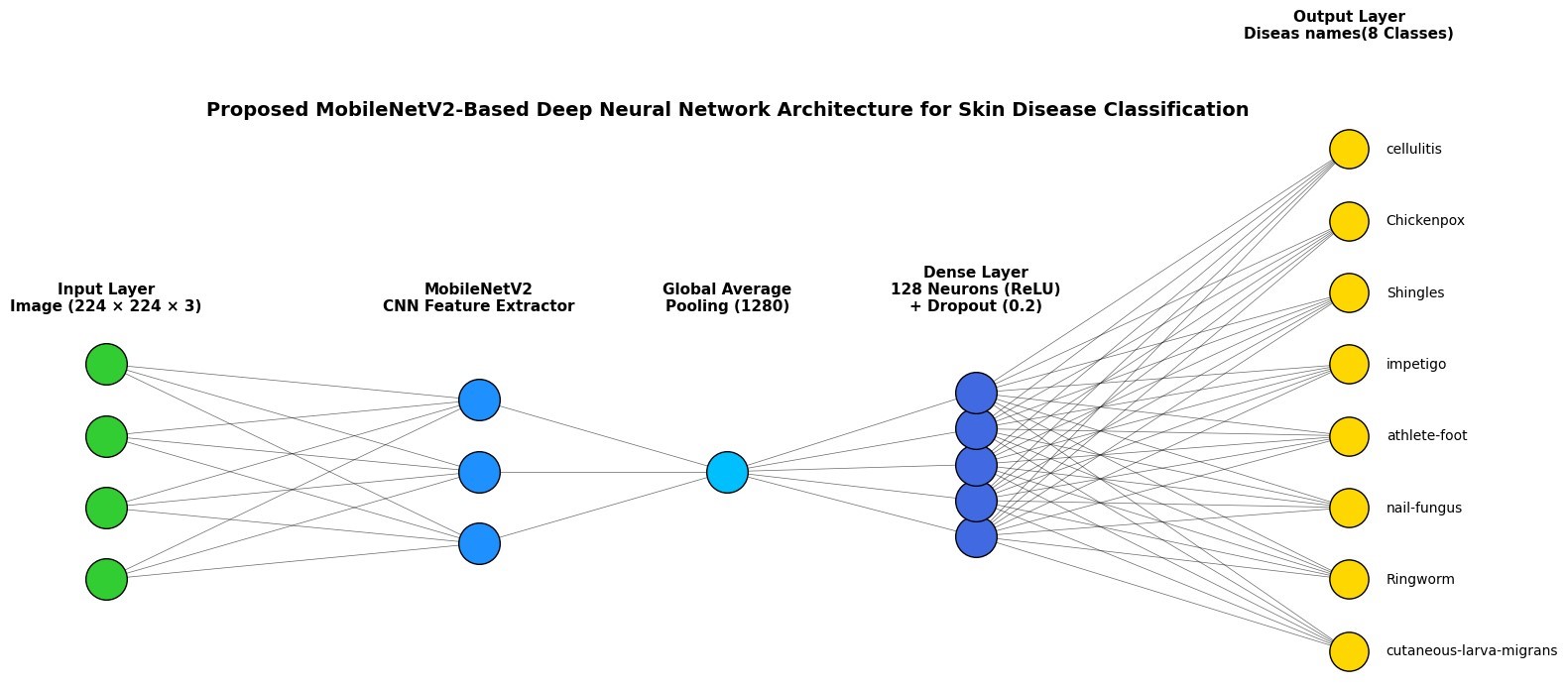
Skin disorders are among the most prevalent medical conditions worldwide, particularly affecting individuals in underdeveloped and low-resource regions where access to dermatologists is limited. Delayed or inaccurate diagnosis often leads to disease progression, secondary infections, increased treatment costs, and prolonged patient discomfort. Although deep learning techniques have demonstrated strong performance in medical image analysis, many existing models are computationally expensive and unsuitable for real-time or web-based deployment [1][2]. This paper presents an efficient skin disease classification system based on the MobileNetV2 architecture for accurate real-time diagnosis of eight common skin diseases, using a dataset of 1,247 clinical images. The model leverages transfer learning with ImageNet-pretrained weights, extensive data augmentation, and class-balancing strategies to improve performance and generalization. The trained model is deployed through a Flask-based web application to support remote healthcare diagnosis. Experimental results demonstrate high classification accuracy across all disease categories, with F1-scores ranging from 0.91 to 1.00, and low computational complexity, making the proposed system well-suited for telemedicine and practical clinical applications.
References
A. Esteva et al., “Dermatologist-level classification of skin cancer with deep neural networks,” Nat. 2017 5427639, vol. 542, no. 7639, pp. 115–118, Jan. 2017, doi: 10.1038/nature21056.
Parvathaneni Naga Srinivasu, Jalluri Gnana Sivasai, “Classification of Skin Disease Using Deep Learning Neural Networks with MobileNet V2 and LSTM,” Sensors, vol. 21, no. 8, p. 2852, 2021, [Online]. Available: https://www.mdpi.com/1424-8220/21/8/2852
K. A. Muhaba, K. Dese, “Automatic skin disease diagnosis using deep learning from clinical image and patient information,” Ski. Heal. Dis., vol. 2, no. 1, 2021, [Online]. Available: https://pubmed.ncbi.nlm.nih.gov/35665205/
Peng Yao, Shuwei Shen, Mengjuan Xu, Peng Liu, Fan Zhang, Jinyu Xing, Pengfei Shao, Benjamin Kaffenberger, Ronald X. Xu, “Single Model Deep Learning on Imbalanced Small Datasets for Skin Lesion Classification,” arXiv:2102.01284, 2021, [Online]. Available: https://arxiv.org/abs/2102.01284
M. Sandler, A. Howard, M. Zhu, A. Zhmoginov, and L. C. Chen, “MobileNetV2: Inverted Residuals and Linear Bottlenecks,” Proc. IEEE Comput. Soc. Conf. Comput. Vis. Pattern Recognit., pp. 4510–4520, Dec. 2018, doi: 10.1109/CVPR.2018.00474.
Abdurrahim Yilmaz, Gulsum Gencoglan, “MobileSkin: Classification of Skin Lesion Images Acquired Using Mobile Phone-Attached Hand-Held Dermoscopes,” J. Clin. Med, vol. 11, no. 17, p. 5102, 2022, [Online]. Available: https://www.mdpi.com/2077-0383/11/17/5102
Nahla Tarisafitri, Andi Aljabar, “Classification of Skin Diseases using Digital Image Processing with MobileNetV2 Architecture,” Nusant. J. Artif. Intell. Inf. Syst., vol. 1, no. 1, pp. 35–44, 2025, [Online]. Available: https://www.researchgate.net/publication/392910237_Classification_of_Skin_Diseases_using_Digital_Image_Processing_with_MobileNetV2_Architecture
Sachin More, Aditya Parekar, Yusuf Ansari, Tanay Jajoo, Hemant Chaudhary, “Automated Detection of Skin Disorders Using Convolutional Neural Networks,” Int. J. Res. Appl. Sci. Eng. Technol., vol. 13, no. 4, p. 4, 2025, [Online]. Available: https://www.ijraset.com/research-paper/automated-detection-of-skin-disorders-using-convolutional-neural-networks
Khadija Nawaz, Atika Zanib, Iqra Shabir, Jianqiang Li, Yu Wang, Tariq Mahmood, “Skin cancer detection using dermoscopic images with convolutional neural network,” Sci. Rep., vol. 15, 2025, [Online]. Available: https://www.nature.com/articles/s41598-025-91446-6
Jessica S. Velasco, Jomer V. Catipon, Edmund G. Monilar, Villamor M. Amon, Glenn C. Virrey, Lean Karlo S. Tolentino, “Classification of Skin Disease Using Transfer Learning in Convolutional Neural Networks,” arXiv:2304.02852, 2023, [Online]. Available: https://arxiv.org/abs/2304.02852
Sana Fatima, Muhammad Usman Akram, Sabah Mohammad, “Deep learning in dermatopathology: applications for skin disease diagnosis and classification,” Discov. Appl. Sci., vol. 7, no. 1006, 2025, [Online]. Available: https://link.springer.com/article/10.1007/s42452-025-07138-3
Downloads
Published
How to Cite
Issue
Section
License
Copyright (c) 2026 50sea

This work is licensed under a Creative Commons Attribution 4.0 International License.