AI-Based Plagiarism Detection System
DOI:
https://doi.org/10.33411/IJIST/1716Keywords:
AI-Based Plagiarism Detection, Semantic Similarity, Urdu Natural Language Processing (NLP), Sentence Transformers, Transformer Embeddings, Paraphrase Detection, Semantic Text Analysis, Machine Learning, Deep LearningAbstract
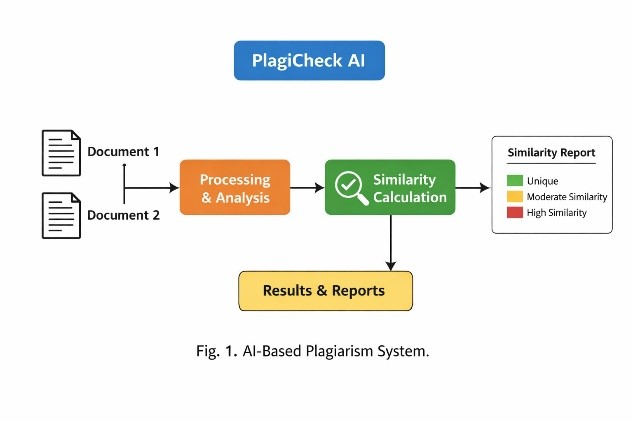
The AI-Based Plagiarism Detection System, named PlagiChek, is an intelligent solution designed to overcome the limitations of traditional plagiarism detection tools that rely primarily on keyword and string matching. Conventional techniques are ineffectual against AI-generated or rephrased plagiarism because they frequently fail to detect paraphrased or semantically restructured text. The proposed approach utilizes semantic similarity analysis and natural language processing (NLP) to more accurately identify conceptually comparable information, addressing this gap. The system tokenizes, preprocesses, and creates transformer-based sentence embeddings to process and compare two text documents. It was developed using Python, Streamlit, Sentence Transformers (MiniLM), NLTK, NumPy, and ReportLab. These embeddings enable the model to calculate the semantic similarity of sentences, resulting in a precise similarity percentage displayed via an interactive Streamlit interface. Furthermore, the system generates color-coded similarity reports—green for unique, orange for moderate similarity, and red for extreme similarity—as well as downloadable PDF summaries for in-depth research. The goal is to create an advanced plagiarism detection technology that can identify reworded and contextually identical content in addition to word matching. This approach has useful applications in academic and research settings, supporting institutions, instructors, and students in ensuring academic integrity and originality in research papers, theses, and assignments.
References
D. Pandoi, “The Role of Artificial Intelligence in Combating Plagiarism: A Comprehensive Overview,” Transform. Bus. Educ. through Artif. Intell., pp. 443–457, Jan. 2025, doi: 10.1201/9781998511471-22.
A. O. Mohmmed, A. S. Elmardi, M. W. Saleem, and E. Ganawa, “Epistemological dilemma: Evaluating conflicting sources in AI plagiarism detection of students’ work,” Explor. Pillars Sustain. Mod. Age Improv., pp. 87–102, Dec. 2024, doi: 10.4018/979-8-3693-5748-4.ch005.
Hafiz Rizwan Iqbal, Muhammad Sharjeel, “Urdu Sentential Paraphrased Plagiarism Detection Using Large Language Models,” ACM Trans. Asian Low-Resource Lang. Inf. Process., vol. 24, no. 9, 2025, doi: 10.1145/3748320.
A. J. Fuad, A. K. Wicaksono, M. A. Aqib, M. A. Khoiruddin, A. S. M. Il Fajar, and K. Mustamir, “AI Hybrid Based Plagiarism Detection System Creation,” 2024 4th Int. Conf. Adv. Comput. Innov. Technol. Eng. ICACITE 2024, pp. 1495–1500, 2024, doi: 10.1109/ICACITE60783.2024.10616945.
Muhammad Sajid, Muhammad Sanaullah, Muhammad Fuzail, “Comparative analysis of text-based plagiarism detection techniques,” PLoS One, 2025, [Online]. Available: https://journals.plos.org/plosone/article?id=10.1371/journal.pone.0319551
S. Mishra and S. Mishra, “Enhancing Plagiarism Detection: The Role of Artificial Intelligence in Upholding Academic Integrity,” Libr. Philos. Pract., Jul. 2023, Accessed: Feb. 08, 2026. [Online]. Available: https://digitalcommons.unl.edu/libphilprac/7809
Sharyhin, Oleksandr Klochko, Oksana Tverdokhlib, Ihor, “Automation of Plagiarism and AI Detection in IT Students Papers with a Software Tool Using API,” Hochschule Anhalt, 2025, [Online]. Available: https://repo.bibliothek.uni-halle.de/handle/1981185920/121201
Altynbek Amirzhanov, Cemil Turan, “Plagiarism types and detection methods: a systematic survey of algorithms in text analysis,” Front. Comput. Sci., vol. 7, 2025, [Online]. Available: https://www.frontiersin.org/journals/computer-science/articles/10.3389/fcomp.2025.1504725/full
A. Singh, “A Comparison Study on AI Language Detector,” 2023 IEEE 13th Annu. Comput. Commun. Work. Conf. CCWC 2023, pp. 489–493, 2023, doi: 10.1109/CCWC57344.2023.10099219.
Timur Sağlam, Sebastian Hahner, “Automated Detection of AI-Obfuscated Plagiarism in Modeling Assignments,” Proc. - Int. Conf. Softw. Eng., pp. 297–308, 2024, [Online]. Available: https://dl.acm.org/doi/10.1145/3639474.3640084
Attila Kovari, “Ethical use of ChatGPT in education—Best practices to combat AI-induced plagiarism,” Front. Educ., 2024, [Online]. Available: https://www.frontiersin.org/journals/education/articles/10.3389/feduc.2024.1465703/full
Downloads
Published
How to Cite
Issue
Section
License
Copyright (c) 2025 50sea

This work is licensed under a Creative Commons Attribution 4.0 International License.