Smart Study AI Mentor
DOI:
https://doi.org/10.33411/IJIST/1718Keywords:
AI, Educational Technology, Intelligent Tutoring, Knowledge Extraction, Learning System, PDF Processing, Video UnderstandingAbstract
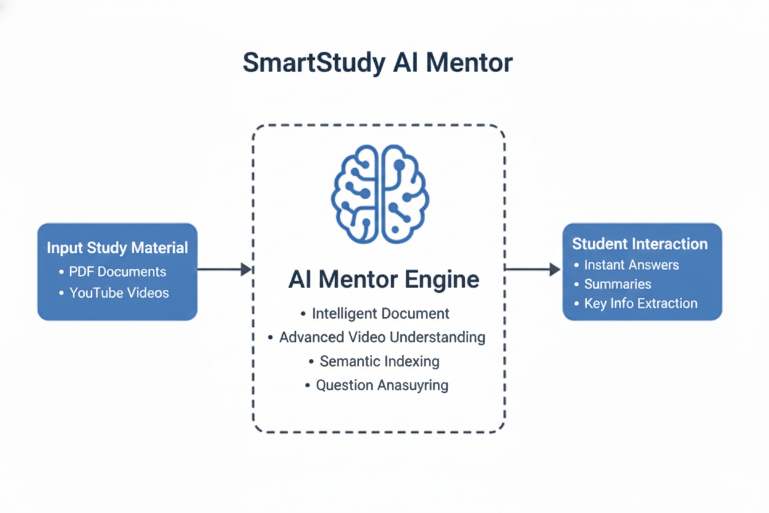
The Smart Study AI Mentor system directly addresses the challenge faced by contemporary students in handling of complex study materials under time restrictions, such as lengthy PDFs and online video courses. It overcomes the limitations of traditional study methods by merging two approaches: Advanced Video Understanding for semantically indexing content from YouTube lectures and Intelligent Document Processing for efficient key information extraction and indexing from PDFs. By integrating these features, the AI assistant creates a highly searchable knowledge base that enables it to deliver accurate, timely answers to a learner's specific questions. This essential component aims to improve conceptual clarity, save critical study time, and lessen student effort—all of which will eventually lead to higher learning results.
References
C. L. Xiaofeng Hou, “Architecting Efficient Multi-modal AIoT Systems,” Proc. - Int. Symp. Comput. Archit., 2023, [Online]. Available: https://dl.acm.org/doi/10.1145/3579371.3589066
A. K. Erümit and İ. Çetin, “Design framework of adaptive intelligent tutoring systems,” Educ. Inf. Technol., vol. 25, no. 5, pp. 4477–4500, Sep. 2020, doi: 10.1007/s10639-020-10182-8.
Anchal Dahiya, Pooja Mittal, Yogesh Kumar Sharma, “Machine Learning-Based Prediction of Parking Space Availability in IoT-Enabled Smart Parking Management Systems,” J. Adv. Transp., 2024, [Online]. Available: https://onlinelibrary.wiley.com/doi/10.1155/2024/8474973
Mingjing Huang, Ngai Cheong, “Literature Review of Personalizing Learning Recommendation Systems Using Machine Learning in Chinese Higher Education,” ICETM 2024 - Proc. 2024 7th Int. Conf. Educ. Technol. Manag., 2025, [Online]. Available: https://dl.acm.org/doi/full/10.1145/3711403.3711441
Sherry Ruan, Allen Nie, William Steenbergen, Jiayu He, J. Q. Zhang, Meng Guo, Yao Liu, Kyle Dang Nguyen, Catherine Y. Wang, Rui Ying, James A. Landay, “Reinforcement learning tutor better supported lower performers in a math task,” Mach. Learn., vol. 113, pp. 3023–3048, 2024, [Online]. Available: https://link.springer.com/article/10.1007/s10994-023-06423-9
N. T. Akniyet Tokhtarov, “AI-Based Analysis of Student Frustration: Speech and Facial Expression Recognition,” Electron. J. e-Learning, vol. 23, no. 2, pp. 143–157, 2025, [Online]. Available: https://www.researchgate.net/publication/392939365_AI-Based_Analysis_of_Student_Frustration_Speech_and_Facial_Expression_Recognition
Muhammad Faseeh, Abdul Jaleel, “Hybrid Approach to Automated Essay Scoring: Integrating Deep Learning Embeddings with Handcrafted Linguistic Features for Improved Accuracy,” Mathematics, vol. 12, no. 21, p. 3416, 2024, [Online]. Available: https://www.mdpi.com/2227-7390/12/21/3416
“AI Mentoring Tools: Unlocking Smarter, Scalable Mentorship Programs.” Accessed: Mar. 03, 2026. [Online]. Available: https://www.qooper.io/blog/ai-mentoring-tools
Mingzhe Yang, Hiromi Arai, “Fair Machine Guidance to Enhance Fair Decision Making in Biased People,” Conf. Hum. Factors Comput. Syst. - Proc., 2024, [Online]. Available: https://dl.acm.org/doi/10.1145/3613904.3642627
G. G. Luís Cabral, Rui Pinto, “AI-powered learning analytics dashboards: a systematic review of applications, techniques, and research gaps,” Discov. Educ., vol. 4, no. 525, 2025, [Online]. Available: https://link.springer.com/article/10.1007/s44217-025-00964-y
L. Z. Jianjia Zhang, “Clustering and Personalized Course Recommendation Based on Improved K-means Algorithm for Student Learning Behavior Data,” Proc. 2025 6th Int. Conf. Educ. Knowl. Inf. Manag. ICEKIM 2025, 2025, [Online]. Available: https://dl.acm.org/doi/10.1145/3756580.3756639
A. H. L. Anirudha Paul, “Focused domain contextual AI chatbot framework for resource poor languages,” J. Inf. Telecommun., vol. 3, no. 2, 2019, [Online]. Available: https://www.tandfonline.com/doi/full/10.1080/24751839.2018.1558378
Ameer Muhammed Moeed Mahdi, Sabiha Haseeb, “Cognitive Load Management through Adaptive AI System an Educational Psychology Perspective,” Crit. Rev. Soc. Sci. Stud. /, vol. 3, no. 3, 2025, [Online]. Available: https://www.researchgate.net/publication/394658394_Cognitive_Load_Management_through_Adaptive_AI_System_an_Educational_Psychology_Perspective
“Predictive Analytics For Student Success: Ai-Driven Early Warning Systems And Intervention Strategies For Educational Risk Management,” Educ. Res. Hum. Dev., vol. 2, no. 2, 2025, doi: 10.61784/erhd3042.
M. Lazrag and M. Machkour, “A multi-agent architecture for an intelligent tutoring system,” J. Adv. Res. Dyn. Control Syst., vol. 12, no. 4 Special Issue, pp. 997–1000, 2020, doi: 10.5373/JARDCS/V12SP4/20201572.
Downloads
Published
How to Cite
Issue
Section
License
Copyright (c) 2025 50sea

This work is licensed under a Creative Commons Attribution 4.0 International License.