Prediction and Interpretability Analysis of Concrete Tensile Strength Using Machine Learning
DOI:
https://doi.org/10.33411/IJIST/1724Keywords:
XGBoost, Machine Learning, SHAP Analysis, Fiber-Reinforced Concrete, Tensile StrengthAbstract
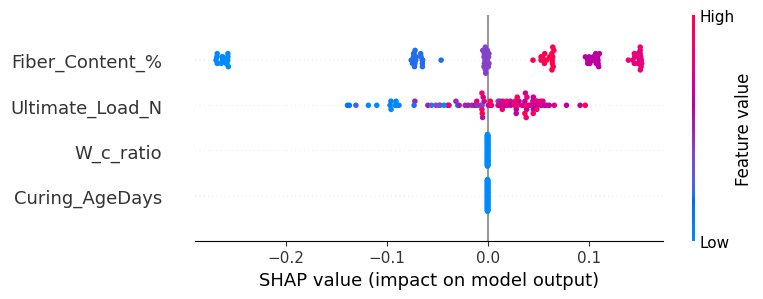
Fiber-Reinforced Concrete (FRC) is used for its improved tensile performance and crack resistance. However, accurate prediction of split tensile strength remains challenging due to the nonlinear influence of mix parameters. This study presents a machine learning–based approach for predicting the split tensile strength of FRC using experimental data. Experimental data from various FRC mix designs were used to develop predictive models using advanced machine learning techniques: Extreme Gradient Boosting (XGBoost), Gaussian Process Regression (GPR), Support Vector Regression (SVR), and Random Forest (RF). Among these models,XGBoost exhibited exceptional performance, attaining R^2 =0.97, RMSE = 0.0313, and MAE = 0.0253 during the training phase, and R^2 =0.88, RMSE = 0.0836, and MAE = 0.0665 in the testing phase. To further interpret the model predictions, sensitivity analysis was conducted using Shapley Additive exPlanations (SHAP). The SHAP-based analysis revealed that fiber content and ultimate load are the most influential parameters affecting tensile strength, followed by curing age and water–cement ratio. The results highlight the effectiveness of the XGBoost model in predicting the tensile strength of Concrete and provide valuable insights into the relative importance of key input variables. This study demonstrates that machine learning-based predictive frameworks can serve as reliable tools for optimizing material design and reducing dependence on extensive experimental testing, thereby supporting the development of more efficient and sustainable construction materials.
References
Scott Lundberg, Su-In Lee, “A Unified Approach to Interpreting Model Predictions,” Adv. Neural Inf. Process. Syst., 2017.
“Interpretable Machine Learning.” Accessed: Feb. 09, 2026. [Online]. Available: https://christophm.github.io/interpretable-ml-book/
A. M. P. Abhay Shende, “ Experimental study and prediction of tensile strength for steel fiber reinforced concrete,” International Journal of Civil and Structural Engineering. Accessed: Feb. 09, 2026. [Online]. Available: https://www.researchgate.net/publication/359209187_Experimental_study_and_prediction_of_tensile_strength_for_steel_fiber_reinforced_concrete
Mohammed Alarfaj, Hisham Jahangir Qureshi, Muhammad Zubair Shahab, Muhammad Faisal Javed, Md Arifuzzaman, Yaser Gamil, “Machine learning based prediction models for spilt tensile strength of fiber reinforced recycled aggregate concrete,” Case Stud. Constr. Mater., vol. 20, p. e02836, 2024, [Online]. Available: https://www.sciencedirect.com/science/article/pii/S2214509523010173
Yongzhong Zhu, Ayaz Ahmad, “Predicting the Splitting Tensile Strength of Recycled Aggregate Concrete Using Individual and Ensemble Machine Learning Approaches,” Crystals, vol. 12, no. 5, p. 569, 2022, [Online]. Available: https://www.mdpi.com/2073-4352/12/5/569
Amrinder Singh, “Predicting the mechanical properties of concrete incorporating metakaolin, rice husk ash, and steel fibers using machine learning,” Eng. Res. Express, vol. 7, 2025, [Online]. Available: https://iopscience.iop.org/article/10.1088/2631-8695/adb6f1/pdf
Downloads
Published
How to Cite
Issue
Section
License
Copyright (c) 2026 50sea

This work is licensed under a Creative Commons Attribution 4.0 International License.