A Resonant Band-Pass Filter-Based Facile Recipe for the Estimation of Number Pi
DOI:
https://doi.org/10.33411/IJIST/1762Keywords:
Resonant Band-Pass Filter (BPF), LC Tank Circuit, Fourier Series, Fourier Analyzer, Odd Harmonics, Estimation of the Number Pi (π).Abstract
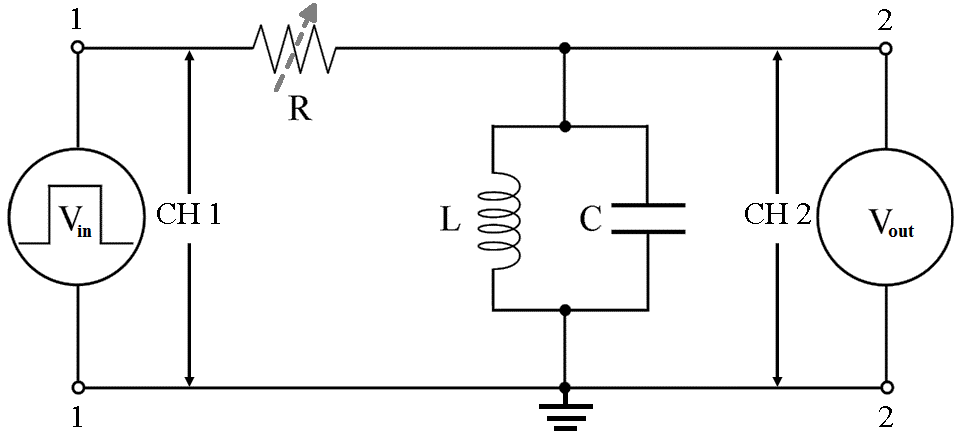
In this article, we report an interesting exploration of the basic principles of the Fourier series by using a simple electrical resonant band-pass filter (BPF), driven by a periodic square wave input, and a dual-trace cathode ray oscilloscope (CRO). Here, the BPF circuit is presented as a remarkable Fourier analyzer tool, used to isolate individual frequency components (i.e., the odd harmonics) of the applied square wave. At a fixed resonant frequency (f₀), one can probe the higher-order Fourier components of the square wave, corresponding to lower frequencies of f₀/n. The amplitudes of these odd harmonics can be measured directly from the CRO display or from screenshots captured with a camera. These amplitudes and the corresponding square wave frequencies can then be easily compared with the theoretical prediction of 1/n behavior for n = odd, enabling an engaging and illustrative experiment for students in the laboratory. We also propose the possibility of estimating the value of the famous mathematical constant denoted by the Greek letter π, not only from experimentally measured amplitude values but also from the slope of linearly fitted experimental data. The experimentally determined mean value of π (Pi) was 3.15873, with a total uncertainty of 0.128430. The relative percentage error compared to the accepted value of π (3.14159) was 0.546%, and the percent uncertainty was approximately 0.0003%. Thus, the BPF-based approach yields results consistent with the true value of π within experimental uncertainty. To the best of our knowledge, this paper is unique in presenting such an interesting exploration of the BPF circuit using a CRO while incorporating Fourier components. Finally, in this contemporary age of rapid computation, the suggested experiments provide a valuable addition to physics laboratory experiments involving concepts of Fourier analysis, electrical resonance, BPF circuits, and harmonics.
References
“Principles of Fourier Analysis - 2nd Edition - Kenneth B. Howell - Rou.” Accessed: Mar. 09, 2026. [Online]. Available: https://www.routledge.com/Principles-of-Fourier-Analysis/Howell/p/book/9781032477008
C. J. Pereyra, M. Osorio, A. Laguarda, and D. L. Gau, “Fourier analysis of a vibrating string through a low-cost experimental setup and a smartphone,” Phys. Educ., vol. 53, no. 4, p. 045019, Jun. 2018, doi: 10.1088/1361-6552/aac488.
I. Singh and B. Kaur, “Teaching graphical simulations of Fourier series expansion of some periodic waves using spreadsheets,” Phys. Educ., vol. 53, no. 3, p. 035031, Apr. 2018, doi: 10.1088/1361-6552/aab447.
M. T. Caccamo, G. Castorina, F. Catalano, and S. Magazù, “Rüchardt’s experiment treated by Fourier transform,” Eur. J. Phys., vol. 40, no. 2, p. 025703, Jan. 2019, doi: 10.1088/1361-6404/aaf66c.
Peter F. Hinrichsen, “Fourier analysis of the non-linear pendulum,” Am. J. Phys, vol. 88, no. 12, pp. 1068–1074, 2020, doi: https://doi.org/10.1119/10.0001788.
P. Ashdhir, J. Arya, C. E. Rani, and Anshika, “Exploring the fundamentals of fast Fourier transform technique and its elementary applications in physics,” Eur. J. Phys., vol. 42, no. 6, p. 065805, Sep. 2021, doi: 10.1088/1361-6404/ac20ad.
V. L. B. De Jesus, C. Haubrichs, A. L. De Oliveira, and D. G. G. Sasaki, “Video analysis of a massive coiled spring transverse oscillations described by Fourier series,” Eur. J. Phys., vol. 43, no. 6, p. 065001, Aug. 2022, doi: 10.1088/1361-6404/ac831f.
M. Riaz, “An exhibition of a rich variety of periodic attractors through alternation in elemental order of series LCR-type resonant circuits,” Eur. Phys. J. Plus 2020 1356, vol. 135, no. 6, pp. 498-, Jun. 2020, doi: 10.1140/epjp/s13360-020-00521-6.
Josué Lara-Reyes, Mario Ponce-Silva, “Series RLC Resonant Circuit Used as Frequency Multiplier,” Energies, vol. 15, no. 24, p. 9334, 2022, doi: https://doi.org/10.3390/en15249334.
M. Riaz, “A remarkably facile automated numerical data extraction tool from oscilloscope screen snapshots,” Eur. J. Phys., vol. 41, no. 6, p. 065806, Oct. 2020, doi: 10.1088/1361-6404/aba4db.
Rod Cross, “A simple method to estimate Q for a damped oscillation,” Phys. Teach, vol. 62, no. 5, p. 406, 2024, doi: https://doi.org/10.1119/5.0208143.
T. Williamson, “Calculating Pi Using the Monte Carlo Method,” Phys. Teach., vol. 51, no. 8, pp. 468–469, Nov. 2013, doi: 10.1119/1.4824938.
R. O. Ocaya, “Estimating π using an electrical circuit,” Eur. J. Phys., vol. 38, no. 1, p. 015803, Nov. 2016, doi: 10.1088/0143-0807/38/1/015803.
U. B. Pili, “Rapid estimation of π by weighing triangles, circles, and ellipses,” Phys. Educ., vol. 57, no. 2, p. 025025, Jan. 2022, doi: 10.1088/1361-6552/ac45c8.
Vibhooti Shekhawat, “Graphite-paper circuit elements: Resistor, capacitor, and π value estimation,” Phys. Teach, vol. 61, no. 2, pp. 154–155, 2023, doi: https://doi.org/10.1119/5.0077435.
K. I. Nagao, Y. Sakano, T. Shinohara, Y. Matsuda, and H. Takami, “Estimation of π via experiment,” Eur. J. Phys., vol. 46, no. 4, p. 045006, Jul. 2025, doi: 10.1088/1361-6404/adebc0.
Downloads
Published
How to Cite
Issue
Section
License
Copyright (c) 2026 50sea

This work is licensed under a Creative Commons Attribution 4.0 International License.