A Review of Modern Requirement Prioritization: From NLP Pipelines to Agentic AI
Keywords:
Large Language Model (LLM), Natural Language Processing (NLP), Retrieval Augmented Generation (RAG), Requirement Prioritization (RP), Issue Prioritization (IP)Abstract
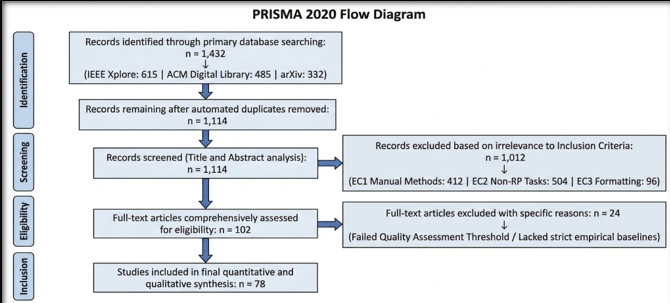
Requirement Prioritization (RP) and Issue Prioritization (IP) are critical for effective software engineering, dictating optimal resource allocation and deployment sequencing. While conventional frameworks such as the Analytic Hierarchy Process (AHP) and MOSCOW offer structured approaches, they lack the scalability required for modern Agile and DevOps environments. To evaluate the technological trajectory toward automated backlog management, this study conducts a PRISMA-compliant Systematic Literature Review (SLR) analyzing the paradigm shift from foundational Natural Language Processing (NLP) pipelines to Large Language Models (LLMs) and autonomous agentic workflows. Synthesizing data from exactly 78 peer-reviewed empirical studies published between 2015 and 2025, the review quantifies the evolution of prioritization efficacy. The analysis reveals that while static NLP models achieve robust baseline metrics demonstrating average top-3 accuracy scores of 81% and Mean Squared Errors of 2.2 on massive datasets exceeding 29,000 repository issues, they inherently lack deep contextual inference capabilities. Conversely, recent LLM-augmented and deep learning frameworks demonstrate prioritization accuracies ranging from 73% to 90% while reducing processing times to under 25 seconds. Optimized metaheuristic approaches additionally report up to a 30% performance increase over traditional AHP. However, despite these statistical improvements, enterprise LLM deployments remain constrained by hallucination risks and an inability to adapt to real-time temporal dependencies without human intervention. Addressing this critical gap, the review examines the orchestration of LangChain-based agentic architectures capable of dynamic, self-correcting multi-agent decision logic. The study concludes by presenting an agentic workflow framework validated against historical issue tracking datasets and proposes a consolidated research agenda focusing on algorithmic governance, multi-stakeholder fairness, and real-time dependency graph modeling in next-generation automated requirement engineering.
References
H. Arshad, S. Shaheen, J. A. Khan, M. S. Anwar, K. Aurangzeb, and M. Alhussein, “A novel hybrid requirement’s prioritization approach based on critical software project factors,” Cogn. Technol. Work 2023 252, vol. 25, no. 2, pp. 305–324, Jun. 2023, doi: 10.1007/s10111-023-00729-3.
Ireneusz Miciuła, Łukasz Radlí, “An Automated Framework for Prioritizing Software Requirements,” Electronics, vol. 14, no. 6, p. 1220, 2025, doi: https://doi.org/10.3390/electronics14061220.
Arshia Hemmat, Mohammadreza Sharbaf, “Research directions for using LLM in software requirement engineering: a systematic review,” Front. Comput. Sci., vol. 7, 2025, doi: https://doi.org/10.3389/fcomp.2025.1519437.
S. Shafiq, A. Mashkoor, C. Mayr-Dorn, and A. Egyed, “NLP4IP: Natural Language Processing-based Recommendation Approach for Issues Prioritization,” Proc. - 2021 47th Euromicro Conf. Softw. Eng. Adv. Appl. SEAA 2021, pp. 99–108, Sep. 2021, doi: 10.1109/SEAA53835.2021.00022.
“(PDF) Evaluating the Capabilities of LLMs in Traceability Maintenance for Automotive System and Software Requirements: Three Case Studies.” Accessed: Mar. 18, 2026. [Online]. Available: https://www.researchgate.net/publication/389906003_Evaluating_the_Capabilities_of_LLMs_in_Traceability_Maintenance_for_Automotive_System_and_Software_Requirements_Three_Case_Studies
Chetan Arora, John Grundy, Mohamed Abdelrazek, “Advancing Requirements Engineering through Generative AI: Assessing the Role of LLMs,” arXiv:2310.13976, 2023, [Online]. Available: https://arxiv.org/abs/2310.13976
Saurabh Malgaonkar, Sherlock A. Licorish, “Prioritizing user concerns in app reviews: A study of requests for new features, enhancements and bug fixes,” Inf. Softw. Technol., vol. 144, p. 106798, 2022, doi: https://doi.org/10.1016/j.infsof.2021.106798.
Muhammad Aminu Umar & Kevin Lano, “Advances in automated support for requirements engineering: a systematic literature review,” Requir. Eng., vol. 29, pp. 177–207, 2024, [Online]. Available: https://link.springer.com/article/10.1007/s00766-023-00411-0
Tariq Shahzad, Tehseen Mazhar, Muhammad Usman Tariq, Wasim Ahmad, Khmaies Ouahada & Habib Hamam, “A comprehensive review of large language models: issues and solutions in learning environments,” Discov. Sustain., vol. 6, 2025, [Online]. Available: https://link.springer.com/article/10.1007/s43621-025-00815-8
J. A. Crowder and C. W. Hoff, “MDRE: The Requirements Engineering Process,” Requir. Eng. Lay. a Firm Found., pp. 75–84, 2022, doi: 10.1007/978-3-030-91077-8_5.
P. Tálele and R. Phalnikar, “Classification and prioritisation of software requirements using machine learning - A systematic review,” Proc. Conflu. 2021 11th Int. Conf. Cloud Comput. Data Sci. Eng., pp. 912–918, Jan. 2021, doi: 10.1109/CONFLUENCE51648.2021.9377190.
Jonathan Winton, Francis Palma, “Improving Software Requirements Prioritization through the Lens of Constraint Solving,” arXiv:2306.12391, 2023, [Online]. Available: https://arxiv.org/abs/2306.12391
Hassan Sartaj, Shaukat Ali, Paolo Arcaini, Andrea Arcuri, “Search-Based Software Engineering and AI Foundation Models: Current Landscape and Future Roadmap,” arXiv:2505.19625, 2025, [Online]. Available: https://arxiv.org/abs/2505.19625
F. Sarro, “Search-Based Software Engineering in the Era of Modern Software Systems,” Proc. IEEE Int. Conf. Requir. Eng., vol. 2023-September, pp. 3–5, 2023, doi: 10.1109/RE57278.2023.00010.
M. Grootendorst, “BERTopic: Neural topic modeling with a class-based TF-IDF procedure,” Mar. 2022, Accessed: Sep. 16, 2024. [Online]. Available: http://arxiv.org/abs/2203.05794
A. Tanveer, N. B. Ibrahim, M. Z. Rehman, and N. M. Nawi, “A Framework for Handling Scalability in Requirements Prioritization Using IMPA Algorithm for Large Scale Projects,” 2024 2nd Int. Conf. Comput. Data Anal. ICCDA 2024 - Proc., 2024, doi: 10.1109/ICCDA64887.2024.10867359.
S. S. Tanveer and Z. A. Rana, “Prioritizing Software Requirements by Combining the Usage Monitoring and User Feedback Data,” IEEE Access, vol. 12, pp. 82825–82841, 2024, doi: 10.1109/ACCESS.2024.3409847.
Shizhen Bai, Songlin Shi, “Prioritizing user requirements for digital products using explainable artificial intelligence: A data-driven analysis on video conferencing apps,” Futur. Gener. Comput. Syst., vol. 158, pp. 167–182, 2024, doi: https://doi.org/10.1016/j.future.2024.04.037.
Jason Wei, Xuezhi Wang, Dale Schuurmans, Maarten Bosma, Brian Ichter, “Chain-of-Thought Prompting Elicits Reasoning in Large Language Models,” arXiv:2201.11903, 2023, [Online]. Available: https://arxiv.org/abs/2201.11903
J. W. Long Ouyang, “Training language models to follow instructions with human feedback,” Adv. Neural Inf. Process. Syst., 2022, doi: https://doi.org/10.48550/arXiv.2203.02155.
D. K. Patrick Lewis, Ethan Perez, Aleksandra Piktus, Fabio Petroni, Vladimir Karpukhin, Naman Goyal, Heinrich Küttler, Mike Lewis, Wen-tau Yih, Tim Rocktäschel, Sebastian Riedel, “Retrieval-Augmented Generation for Knowledge-Intensive NLP Tasks,” arXiv:2005.11401, 2021, doi: https://doi.org/10.48550/arXiv.2005.11401.
Y. C. Shunyu Yao, Jeffrey Zhao, Dian Yu, Nan Du, Izhak Shafran, Karthik Narasimhan, “ReAct: Synergizing Reasoning and Acting in Language Models,” arXiv:2210.03629, 2023, [Online]. Available: https://arxiv.org/abs/2210.03629
Usman Gohar, Lu Cheng, “A Survey on Intersectional Fairness in Machine Learning: Notions, Mitigation, and Challenges,” arXiv:2305.06969, 2023, [Online]. Available: https://arxiv.org/abs/2305.06969
Galen Harrison, Julia Hanson, “An empirical study on the perceived fairness of realistic, imperfect machine learning models,” FAT* 2020 - Proc. 2020 Conf. Fairness, Accountability, Transpar., 2020, [Online]. Available: https://dl.acm.org/doi/10.1145/3351095.3372831
Max Hort, Zhenpeng Chen, Jie M. Zhang, Mark Harman, Federica Sarro, “Bias Mitigation for Machine Learning Classifiers: A Comprehensive Survey,” arXiv:2207.07068, 2023, [Online]. Available: https://arxiv.org/abs/2207.07068
Anjana Perera, Aldeida Aleti, Chakkrit Tantithamthavorn, Jirayus Jiarpakdee, Burak Turhan, “Search-based fairness testing for regression-based machine learning systems,” Empir. Softw. Eng., vol. 27, no. 79, 2022, [Online]. Available: https://link.springer.com/article/10.1007/s10664-022-10116-7
Dana Pessach, Erez Shmueli, “A review on fairness in machine learning,” ACM Comput. Surv., vol. 55, no. 3, 2022, [Online]. Available: https://dl.acm.org/doi/full/10.1145/3494672
Matthew J. Page, Joanne E. McKenzie, “The PRISMA 2020 statement: an updated guideline for reporting systematic reviews,” BMJ, 2021, [Online]. Available: https://pubmed.ncbi.nlm.nih.gov/33782057/
Downloads
Published
How to Cite
Issue
Section
License
Copyright (c) 2026 50sea

This work is licensed under a Creative Commons Attribution 4.0 International License.