COVID-19 Detection from X-Rays Using CNN
DOI:
https://doi.org/10.33411/IJIST/1791Keywords:
Deep Learning, AI (artificial intelligence), CNN (Convolutional Neural Network), Chest X-raysAbstract
Introduction: COVID-19 broke out in December 2019 and was recognized by the World Health Organization (WHO). It spread to approximately 114 countries worldwide, with the first reported case identified in China. The initial diagnostic technique for detecting COVID-19 was reverse transcription polymerase chain reaction (RT-PCR). Artificial intelligence and deep learning have revolutionized healthcare by enhancing the accuracy, speed, and accessibility of diagnosis. As a result, researchers are actively working on the early detection of COVID-19.
Novelty: Preprocessing is a critical step in feature extraction in image processing. While existing studies used the fractal technique, our research employs the moving filter technique for the feature extraction. The main advantage of our method over the existing technique is its ability to capture the local spatial variation rather than the global self-similarities. Additionally, a local dataset sample was collected from a local hospital to evaluate the performance of the trained model. The model is trained on a labelled dataset, which is collected from Kaggle, and a local labelled dataset is used to assess its prediction performance for COVID-19 detection.
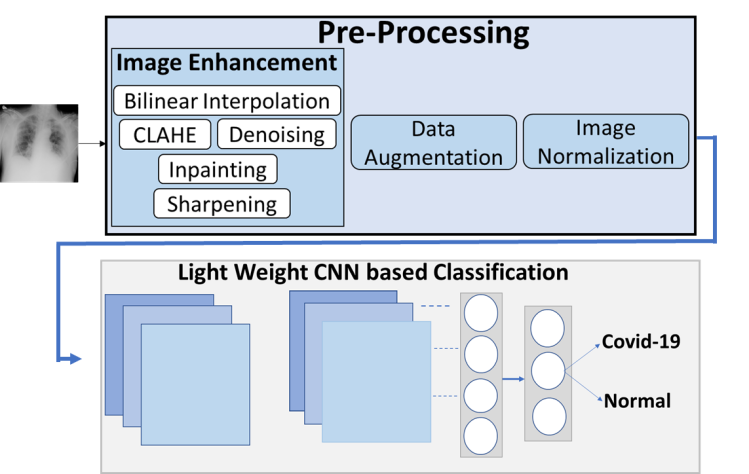
Material and Methodology: This study proposes a deep learning-based classification model using a Convolutional Neural Network (CNN) for the diagnosis of COVID-19. The model enables rapid disease detection by capturing the fine-grained details at the pixel level from the chest x-ray images. It was trained on a dataset consisting of two classes: 4,641 COVID-19 images and 4,641 normal images. Data augmentation was also applied to enhance the diversity of the dataset. The performance of the proposed model was compared with the five existing models, taking into account the number of layers used for feature detection in chest X-ray images.
Results and Discussion: The proposed model consists of 8 layers for extracting abnormalities from the chest X-ray images. It was trained over 150 epochs on a dataset of 8,762 samples, achieving an overall accuracy of 92.31%, precision of 95%, recall of 89%, and F1-score of 92%. However, when the dataset size could not be increased, and the number of epochs was raised, the resulting improvements in accuracy and precision were negligible. This indicates that the model achieves optimal performance with fewer epochs, requiring less training time and computational resources compared to the other approaches.
Conclusion: The proposed CNN model achieved a high accuracy of approximately 93% on the test dataset, demonstrating its effectiveness through strong generalization on unseen data and consistent performance across both classes. This indicates that the model can reliably distinguish between COVID19 and normal chest X-ray images. These results suggest that the approach can support an automated diagnostic system.
References
A. M. Ayalew, A. O. Salau, B. T. Abeje, and B. Enyew, “Detection and classification of COVID-19 disease from X-ray images using convolutional neural networks and histogram of oriented gradients,” Biomed. Signal Process. Control, vol. 74, p. 103530, Apr. 2022, doi: 10.1016/J.BSPC.2022.103530.
Soumya Ranjan Nayak, Deepak Ranjan Nayak, “An Efficient Deep Learning Method for Detection of COVID-19 Infection Using Chest X-ray Images,” Diagnostics, vol. 13, no. 1, p. 131, 2023, doi: https://doi.org/10.3390/diagnostics13010131.
Pedro R.A.S. Bassi, Romis Attux, “A deep convolutional neural network for COVID-19 detection using chest X-rays,” Res. Biomed. Eng., vol. 38, no. 1, pp. 139–148, 2021, doi: 10.1007/s42600-021-00132-9.
Emtiaz Hussain, Mahmudul Hasan, “CoroDet: A deep learning based classification for COVID-19 detection using chest X-ray images,” Chaos, Solitons & Fractals, vol. 142, p. 110495, 2021, [Online]. Available: https://www.sciencedirect.com/science/article/pii/S0960077920308870
Roberta Fusco, Roberta Grassi, “Artificial Intelligence and COVID-19 Using Chest CT Scan and Chest X-ray Images: Machine Learning and Deep Learning Approaches for Diagnosis and Treatment,” J. Pers. Med., vol. 11, no. 10, p. 993, 2021, [Online]. Available: https://pmc.ncbi.nlm.nih.gov/articles/PMC8540782/
Md Alamin Talukder, Md Abu Layek, “Empowering COVID-19 detection: Optimizing performance through fine-tuned EfficientNet deep learning architecture,” Comput. Biol. Med., vol. 168, p. 107789, 2024, doi: https://doi.org/10.1016/j.compbiomed.2023.107789.
Manoucher Teymouri, Samaneh Mollazadeh, “Recent advances and challenges of RT-PCR tests for the diagnosis of COVID-19,” Pathol. Res. Pract., vol. 221, 2021, [Online]. Available: https://pubmed.ncbi.nlm.nih.gov/33930607/
Laith Alzubaidi, Ye Duan, “Deepening into the suitability of using pre-trained models of ImageNet against a lightweight convolutional neural network in medical imaging: an experimental study,” PeerJ Comput. Sci., vol. 7, 2021, [Online]. Available: https://pubmed.ncbi.nlm.nih.gov/34722871/
Md Nahiduzzaman, Md Rabiul Islam, “ChestX-Ray6: Prediction of multiple diseases including COVID-19 from chest X-ray images using convolutional neural network,” Expert Syst. Appl., vol. 211, p. 118576, 2023, doi: https://doi.org/10.1016/j.eswa.2022.118576.
T. Ozturk, M. Talo, E. A. Yildirim, U. B. Baloglu, O. Yildirim, and U. Rajendra Acharya, “Automated detection of COVID-19 cases using deep neural networks with X-ray images,” Comput. Biol. Med., vol. 121, p. 103792, Jun. 2020, doi: 10.1016/J.COMPBIOMED.2020.103792.
Pedro Moisés de Sousa, Pedro Cunha Carneiro, “COVID-19 classification in X-ray chest images using a new convolutional neural network: CNN-COVID,” Res. Biomed. Eng., vol. 38, no. 1, pp. 87–97, 2021, doi: 10.1007/s42600-020-00120-5.
Md Amirul Islam, Giovanni Stea, “COVID-19 Cases Detection from Chest X-Ray Images using CNN based Deep Learning Model,” Int. J. Adv. Comput. Sci. Appl., vol. 13, no. 5, 2022, doi: 10.14569/IJACSA.2022.01305108.
Tripti Goel, R. Murugan, Seyedali Mirjalili & Deba Kumar Chakrabartty, “OptCoNet: an optimized convolutional neural network for an automatic diagnosis of COVID-19,” Appl. Intell., vol. 51, pp. 1351–1366, 2020, [Online]. Available: https://link.springer.com/article/10.1007/s10489-020-01904-z
Shayan Hassantabar, Mohsen Ahmadi, “Diagnosis and detection of infected tissue of COVID-19 patients based on lung x-ray image using convolutional neural network approaches,” Chaos, Solitons & Fractals, vol. 140, p. 110170, 2020, doi: https://doi.org/10.1016/j.chaos.2020.110170.
“(PDF) Deep Convolutional Neural Network Approach for COVID-19 Detection.” Accessed: Mar. 19, 2026. [Online]. Available: https://www.researchgate.net/publication/357494689_Deep_Convolutional_Neural_Network_Approach_for_COVID-19_Detection
Azher Uddin, Bayazid Talukder, Mohammad Monirujjaman Khan, Atef Zaguia, “Study on Convolutional Neural Network to Detect COVID-19 from Chest X-Rays,” Math. Probl. Eng., 2021, [Online]. Available: https://onlinelibrary.wiley.com/doi/10.1155/2021/3366057
J. Wu, “Introduction to Convolutional Neural Networks,” 2017.
“Image Processing 101 Chapter 2.1: A Complete Guide to Enhancing Visual Quality | Dynamsoft Blog.” Accessed: Mar. 19, 2026. [Online]. Available: https://www.dynamsoft.com/blog/insights/image-processing/image-processing-101-image-enhancement/
Oscar Ramos-Soto, Jorge Ramos-Frutos, “Visual enhancement of chest X-ray scans through metaheuristic-based optimization of Gamma correction and CLAHE,” Biomed. Signal Process. Control, 2026, doi: 10.1016/j.bspc.2025.109153.
Nahida Nazir, Abid Sarwar, “Recent development in denoising medical images using deep learning: An overview of models, techniques, and challenges,” Micron, vol. 180, p. 103615, 2024, doi: https://doi.org/10.1016/j.micron.2024.103615.
Agata Giełczyk, Anna Marciniak, “Pre-processing methods in chest X-ray image classification,” PLoS One, 2022, doi: https://doi.org/10.1371/journal.pone.0265949.
Linwei Fan, Fan Zhang, Hui Fan & Caiming Zhang, “Brief review of image denoising techniques,” Vis. Comput. Ind. Biomed. Art, vol. 2, no. 7, 2019, [Online]. Available: https://link.springer.com/article/10.1186/s42492-019-0016-7
Hossein Arabi, Habib Zaidi, “Non-local mean denoising using multiple PET reconstructions,” Ann. Nucl. Med., vol. 35, no. 2, pp. 176–186, 2021, [Online]. Available: https://pubmed.ncbi.nlm.nih.gov/33244745/
“Image Inpainting - an overview | ScienceDirect Topics.” Accessed: Mar. 19, 2026. [Online]. Available: https://www.sciencedirect.com/topics/computer-science/image-inpainting
Cuong Cao Pham, Jae Wook Jeon, “Efficient image sharpening and denoising using adaptive guided image filtering Cuong Cao Pham, Jae Wook Jeon,” IET Image Process., 2015, [Online]. Available: https://ietresearch.onlinelibrary.wiley.com/doi/10.1049/iet-ipr.2013.0563
Madhavi M, Supraja P, “COVID-19 infection prediction from CT scan images of lungs using Iterative Convolution Neural Network model,” Adv. Eng. Softw., vol. 173, 2022, [Online]. Available: https://pubmed.ncbi.nlm.nih.gov/35919705/
Joseph Paul Cohen, Paul Morrison, “Automated detection of COVID-19 through convolutional neural network using chest x-ray images,” PlosOne, 2022, [Online]. Available: https://journals.plos.org/plosone/article?id=10.1371/journal.pone.0262052
V. Thakkar, S. Tewary, and C. Chakraborty, “Batch Normalization in Convolutional Neural Networks - A comparative study with CIFAR-10 data,” Proc. 5th Int. Conf. Emerg. Appl. Inf. Technol. EAIT 2018, Sep. 2018, doi: 10.1109/EAIT.2018.8470438.
S. Albawi, T. A. Mohammed, and S. Al-Zawi, “Understanding of a convolutional neural network,” Proc. 2017 Int. Conf. Eng. Technol. ICET 2017, vol. 2018-January, pp. 1–6, Jul. 2017, doi: 10.1109/ICENGTECHNOL.2017.8308186.
Downloads
Published
How to Cite
Issue
Section
License
Copyright (c) 2026 50sea

This work is licensed under a Creative Commons Attribution 4.0 International License.