Revolutionizing Martian Terrain Mapping: Precision Segmentation Through Deep Learning
DOI:
https://doi.org/10.33411/IJIST/1803Keywords:
Segmentation, Grad-CAM, Attention-Enhanced ResNet-50, Explainable Artificial Intelligence (XAI), Deep Learning for Planetary MappingAbstract
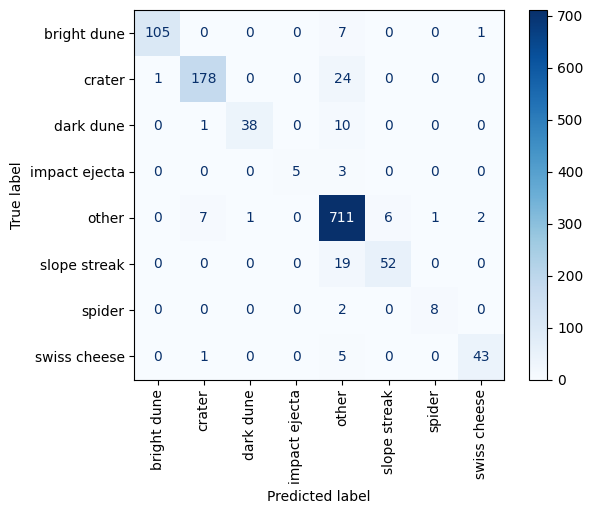
Planetary mapping, autonomous rover navigation, geological analysis, and mission planning are all based on the Martian terrain segmentation. However, differentiating various surface characteristics is not easy because of the variations in illumination, imbalance in classes, and similarity of the appearance of different terrain types. To overcome these obstacles, this paper suggests a more accurate segmentation model, using an attention-enriched ResNet-50 framework, combined with two explainability methods, i.e., Grad-CAM and Integrated Gradients, to enhance the performance and explainability. The Mars_terrain_classification dataset, which consists of 6,153 high-resolution images of various terrain classes (craters, dunes, impact ejecta, slope streaks) was used to train and test the model. The experimental findings indicate that the proposed framework had an overall accuracy of 92.61, a mean Intersection over Union (IoU) of 84.7, and a total F1-score of 88.48, which is better than baseline models like U-Net and DeepLabV3+ given the same training conditions. In particular, the proposed model has led to a 6.41 percentage points F1-score improvement compared to U-Net and 2.59 percentage points improvement compared to DeepLabV3+, and an 8.7 and 3.2 percentage points IoU improvement, respectively. Class wise analysis revealed that Bright Dune (95.89% F1-score), Crater (91.28%), and other terrain (94.23%) have high scores, whereas Impact Ejecta (76.92%), and Slope Streak (80.62%) have lower scores, suggesting the still existing challenges in minority and visually ambiguous classes. The explainability results showed that Grad-CAM and Integrated Gradients always show geologically meaningful areas, which adds to the transparency and reliability of predictions. The results indicate that the presented framework can offer a correct and sensible solution to the high-precision mapping of the Martian terrain.
References
Junbo Li, Keyan Chen, Gengju Tian, Lu Li, Zhenwei Shi, “MarsSeg: Mars Surface Semantic Segmentation with Multi-level Extractor and Connector,” arXiv:2404.04155, 2024, [Online]. Available: https://arxiv.org/abs/2404.04155
Boyu Lin, Fei Wang, “LisseMars: A Lightweight Semantic Segmentation Model for Mars Helicopter,” Aerospace, vol. 12, no. 12, p. 1049, 2025, doi: https://doi.org/10.3390/aerospace12121049.
Yuan Ma, Zhaojin Li, “DepthFormer: Depth‐Enhanced Transformer Network for Semantic Segmentation of the Martian Surface From Rover Images,” Earth Sp. Sci., vol. 12, no. 6, 2025, [Online]. Available: https://www.semanticscholar.org/paper/DepthFormer%3A-Depth‐Enhanced-Transformer-Network-for-Ma-Li/8ad9d389573aef7a01faefcb327bf144e3f29fc0
Raul Castilla-Arquillo, Carlos Perez-del-Pulgar, Levin Gerdes, Alfonso Garcia-Cerezo, Miguel A. Olivares-Mendez, “OmniUnet: A multimodal network for unstructured terrain segmentation on planetary rovers using RGB, depth, and thermal imagery,” 2025 Int. Conf. Sp. Robot., 2025, [Online]. Available: https://arxiv.org/abs/2508.00580
Shan Lin, Quanke Hu, “An interactive gated-attention network with dual streams for semantic understanding of Martian surface images,” Acta Astronaut., vol. 241, pp. 529–546, 2026, doi: https://doi.org/10.1016/j.actaastro.2026.01.002.
L. Rubanenko, S. Pérez-López, J. Schull and M. G. A. Lapôtre, “Automatic Detection and Segmentation of Barchan Dunes on Mars and Earth Using a Convolutional Neural Network,” IEEE J. Sel. Top. Appl. Earth Obs. Remote Sens., vol. 14, pp. 9364–9371, 2021, doi: 10.1109/JSTARS.2021.3109900.
Mirali Purohit, Bimal Gajera, Vatsal Malaviya, Irish Mehta, Kunal Kasodekar, Jacob Adler, Steven Lu, Umaa Rebbapragada, Hannah Kerner, “Mars-Bench: A Benchmark for Evaluating Foundation Models for Mars Science Tasks,” arXiv:2510.24010, 2025, [Online]. Available: https://arxiv.org/abs/2510.24010
Yang Fang, Xuefeng Rao, “MTSNet: Joint Feature Adaptation and Enhancement for Text-Guided Multi-view Martian Terrain Segmentation,” MM 2024 - Proc. 32nd ACM Int. Conf. Multimed., 2024, [Online]. Available: https://dl.acm.org/doi/10.1145/3664647.3681430
Wenjing Wang, Lilang Lin, Zejia Fan, Jiaying Liu, “Semi-Supervised Learning for Mars Imagery Classification and Segmentation,” arXiv:2206.02180, 2022, [Online]. Available: https://arxiv.org/abs/2206.02180
L. Yang, G. Huang, and Y. Xing, “Improved Mars Terrain Segmentation in Terms of Style Transfer and Network Architecture,” Int. J. Aeronaut. Sp. Sci. 2024 253, vol. 25, no. 3, pp. 1121–1134, Feb. 2024, doi: 10.1007/s42405-023-00702-4.
Shrey Malvi, Hitansh Shah, “Automated Multi-class Crater Segmentation in Mars Orbital Images,” GeoAI 2023 - Proc. 6th ACM SIGSPATIAL Int. Work. AI Geogr. Knowl. Discov., 2023, [Online]. Available: https://dl.acm.org/doi/10.1145/3615886.3627748
Ryusei Gichu & Kazunori Ogohara, “Segmentation of dust storm areas on Mars images using principal component analysis and neural network,” Prog. Earth Planet. Sci., vol. 6, 2019, [Online]. Available: https://link.springer.com/article/10.1186/s40645-019-0266-1
D. M. DeLatte, S. T. Crites, N. Guttenberg, E. J. Tasker and T. Yairi, “Segmentation Convolutional Neural Networks for Automatic Crater Detection on Mars,” IEEE J. Sel. Top. Appl. Earth Obs. Remote Sens., vol. 12, no. 8, pp. 2944–2957, 2019, doi: 10.1109/JSTARS.2019.2918302.
H. Liu, M. Yao, X. Xiao, and Y. Xiong, “RockFormer: A U-Shaped Transformer Network for Martian Rock Segmentation,” IEEE Trans. Geosci. Remote Sens., vol. 61, 2023, doi: 10.1109/TGRS.2023.3235525.
J. Li, S. Zi, R. Song, Y. Li, Y. Hu, and Q. Du, “A Stepwise Domain Adaptive Segmentation Network With Covariate Shift Alleviation for Remote Sensing Imagery,” IEEE Trans. Geosci. Remote Sens., vol. 60, 2022, doi: 10.1109/TGRS.2022.3152587.
D. Gasperini, W. Masawat, S. Santra, and K. Yoshida, “CloverNet: A Real-Time Network for Semantic Segmentation Onboard Edge Devices Towards Planetary Exploration,” 9th 2023 Int. Conf. Control. Decis. Inf. Technol. CoDIT 2023, pp. 333–338, 2023, doi: 10.1109/CoDIT58514.2023.10284509.
R. Mulvi, S. Gauns, A. Gaonkar, S. Naik, S. Aswale, and P. Shetgaonkar, “Detection and Segmentation of Different Structures from Satellite Images,” Proc. 3rd Int. Conf. Intell. Eng. Manag. ICIEM 2022, pp. 384–389, 2022, doi: 10.1109/ICIEM54221.2022.9853106.
F. Mohammad, Y. Gao, S. Kay, R. Field, M. De Benedetti, and E. V. Ntagiou, “Deep Learning based Semantic Segmentation for Mars Rover Terrain Classification,” 2024 Int. Conf. Sp. Robot. iSpaRo 2024, pp. 292–298, 2024, doi: 10.1109/iSpaRo60631.2024.10687827.
H. Liu, M. Yao, X. Xiao, B. Zheng, and H. Cui, “MarsScapes and UDAFormer: A Panorama Dataset and a Transformer-Based Unsupervised Domain Adaptation Framework for Martian Terrain Segmentation,” IEEE Trans. Geosci. Remote Sens., vol. 62, pp. 1–17, 2024, doi: 10.1109/TGRS.2023.3343109.
Downloads
Published
How to Cite
Issue
Section
License
Copyright (c) 2026 50sea

This work is licensed under a Creative Commons Attribution 4.0 International License.