Enhancing e-Learning with AI and Blockchain: A Predictive Analysis of Acceptance Factors and Academic Performance
DOI:
https://doi.org/10.33411/IJIST/1821Keywords:
E-Learning, Human-Computer Interaction, Performance ImpactAbstract
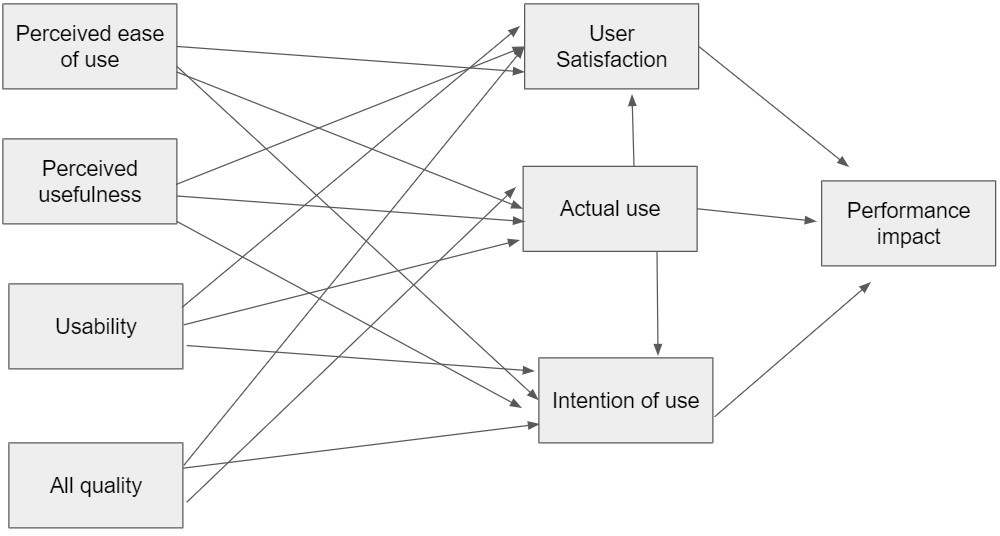
The research paper explores the key issues that determine the acceptance of eLearning tools by students and their effect on academic performance. Although the Technology Acceptance Model (TAM) has been used as the main model to describe adoption behavior in the past, little focus has been on the relationship between acceptance and performance outcomes. To fill this gap, we suggest a combined IS-TAM framework and confirm it using two datasets collected from higher education institutions (N = XXX). The results of Structural Equation Modeling (SEM) show that Perceived Ease of Use has α = 1.00 (p < 0.05), Perceived Usefulness (α = 0.8, p < 0.01), and System Quality (α = 0.87, p < 0.01). Moreover, the accuracy of the Machine Learning model was 0.79, indicating good predictive performance based on factors related to acceptance. The findings indicate that acceptance modeling coupled with predictive analytics is a more holistic way of understanding eLearning effectiveness. The study is valuable in that it bridges a gap between the behavioral and performance perspectives, which can be used in practice to enhance the design and student achievement of eLearning systems.
References
Yolanda Guerra-Macías, Sergio Tobón, “Development of transversal skills in higher education programs in conjunction with online learning: relationship between learning strategies, project-based pedagogical practices, e-learning platforms, and academic performance,” Heliyon, vol. 11, no. 2, p. e41099, 2025, doi: https://doi.org/10.1016/j.heliyon.2024.e41099.
G. H. T. Imran Mehboob Shaikh, “Students’ e-learning acceptance: empirical evidence from higher learning institutions,” Horiz. Int. J. Learn. Futur., vol. 33, no. 1, pp. 1–13, 2025, doi: https://doi.org/10.1108/OTH-08-2022-0041.
Sandra Matarneh, Lubna AlQaraleh, “An analysis of E-learning system challenges in engineering education: an empirical study,” Cogent Educ., vol. 12, no. 1, 2025, doi: https://doi.org/10.1080/2331186X.2024.2445967.
Elias Dritsas, Maria Trigka, “Methodological and technological advancements in e- learning,” Information, vol. 16, no. 1, p. 56, 2025, doi: https://doi.org/10.3390/info16010056.
Shahid Bashir, Alexander L. Lapshun, “E-learning future trends in higher education in the 2020s and beyond,” Cogent Educ., vol. 12, no. 1, 2025, doi: https://doi.org/10.1080/2331186X.2024.2445331.
Sean M. Leahy, Charlotte Holland, “The digital frontier: Envisioning future technologies impact on the classroom,” Futures, vol. 113, p. 102422, 2019, doi: https://doi.org/10.1016/j.futures.2019.04.009.
Daina Gudoniene, Evelina Staneviciene, “Hybrid teaching and learning in higher education: A systematic literature review,” Sustainability, vol. 17, no. 2, p. 756, 2025, doi: https://doi.org/10.3390/su17020756.
Min Lan & Xiaofeng Zhou, “A qualitative systematic review on AI empowered self- regulated learning in higher education,” npj Sci. Learn., vol. 10, no. 21, 2025, [Online]. Available: https://www.nature.com/articles/s41539-025-00319-0
C. H. Hsiao and K. Y. Tang, “Beyond acceptance: an empirical investigation of technological, ethical, social, and individual determinants of GenAI-supported learning in higher education,” Educ. Inf. Technol. 2024 308, vol. 30, no. 8, pp. 10725–10750, Dec. 2024, doi: 10.1007/S10639-024-13263-0.
Hossein Mohammadi, “Investigating users’ perspectives on e-learning: An integration of TAM and IS success model,” Comput. Human Behav., vol. 45, pp. 359–374, 2015, doi: https://doi.org/10.1016/j.chb.2014.07.044.
I. Burman, S. Som, and M. Sharma, “Enhancing student learning behaviour using EDM and psychometric analysis,” 2017 6th Int. Conf. Reliab. Infocom Technol. Optim. Trends Futur. Dir. ICRITO 2017, vol. 2018-January, pp. 359–363, Apr. 2018, doi: 10.1109/ICRITO.2017.8342452.
Ahmed Younis Alsabawy, Aileen Cater-Steel, “IT infrastructure services as a requirement for e-learning system success,” Comput. Educ., vol. 69, pp. 431–451, 2013, doi: https://doi.org/10.1016/j.compedu.2013.07.035.
H. Y. Jeong and B. H. Hong, “A practical use of learning system using user preference in ubiquitous computing environment,” Multimed. Tools Appl. 2012 642, vol. 64, no. 2, pp. 491–504, Mar. 2012, doi: 10.1007/s11042-012-1026-z.
Hong Ren Chen, Hsiao Fen Tseng, “Factors that influence acceptance of web-based e-learning systems for the in-service education of junior high school teachers in Taiwan,” Eval. Program Plann., vol. 35, no. 3, pp. 398–406, 2012, doi: https://doi.org/10.1016/j.evalprogplan.2011.11.007.
William H. DeLone, Ephraim R. McLean, “Information Systems Success: The Quest for the Dependent Variable,” Inf. Syst. Res., vol. 3, no. 4, pp. 60–95, 1992, doi: 10.1287/isre.3.1.60.
W. H. DeLone and E. R. McLean, “The DeLone and McLean model of information systems success: A ten-year update,” J. Manag. Inf. Syst., vol. 19, no. 4, pp. 9–30, 2003, doi: 10.1080/07421222.2003.11045748.
Alireza Hassanzadeh, Fatemeh Kanaani, “A model for measuring e-learning systems success in universities,” Expert Syst. Appl., vol. 39, no. 12, pp. 10959–10966, 2012, doi: https://doi.org/10.1016/j.eswa.2012.03.028.
Y. Li, Y. Duan, Z. Fu, and P. Alford, “An empirical study on behavioural intention to reuse e-learning systems in rural China,” Br. J. Educ. Technol., vol. 43, no. 6, pp. 933– 948, Nov. 2012, doi: 10.1111/j.1467-8535.2011.01261.x.
Pee Vululleh, “Determinants of students’ e-learning acceptance in developing countries: An approach based on Structural Equation Modeling (SEM),” Int. J. Educ.Dev. using Inf. Commun. Technol. (IJEDICT, vol. 14, no. 1, pp. 141–151, 2018, [Online]. Available: https://files.eric.ed.gov/fulltext/EJ1178350.pdf
Damijana Keržič, Nina Tomaževič, “Exploring critical factors of the perceived usefulness of blended learning for higher education students,” PLoS One, 2019, [Online]. Available: https://journals.plos.org/plosone/article?id=10.1371/journal.pone.0223767
Joel S. Mtebe, Christina Raphael, “Key factors in learners’ satisfaction with the e- learning system at the University of Dar es Salaam, Tanzania,” Australas. J. Educ. Technol., vol. 34, no. 4, 2018, doi: 10.14742/ajet.2993.
S. A. Salloum, M. Al-Emran, K. Shaalan, and A. Tarhini, “Factors affecting the E- learning acceptance: A case study from UAE,” Educ. Inf. Technol. 2018 241, vol. 24, no. 1, pp. 509–530, Aug. 2018, doi: 10.1007/s10639-018-9786-3.
S. A. Salloum, A. Qasim Mohammad Alhamad, M. Al-Emran, A. Abdel Monem and K. Shaalan, “Exploring Students’ Acceptance of E-Learning Through the Development of a Comprehensive Technology Acceptance Model,” IEEE Access, vol. 7, pp. 128445–128462, 2019, doi: 10.1109/ACCESS.2019.2939467.
Yousef Abdel Latif Abdel Jawad, Basem Shalash, “The Impact of E-Learning Strategy on Students’ Academic Achievement. Case Study: Al- Quds Open University,” Int. J. High. Educ., vol. 9, no. 6, pp. 18602–18602, 2020, doi: 10.5430/ijhe.v9n6p44.
“(PDF) Effects of E-Learning on Students’ Academic learning at university Level.” Accessed: Mar. 25, 2026. [Online]. Available: https://www.researchgate.net/publication/347512838_Effects_of_E-Learning_on_Students’_Academic_learning_at_university_Level
Juan L. Rastrollo-Guerrero, Juan A. Gómez-Pulido, “Analyzing and Predicting Students’ Performance by Means of Machine Learning: A Review,” Appl. Sci., vol. 10, no. 3, p. 1042, 2020, doi: https://doi.org/10.3390/app10031042.
Khawlah Ahmed, Mujo Mesonovich, “Learning Management Systems and Student Performance,” Int. J. e-Learning Secur., vol. 8, no. 1, pp. 582–591, 2019, doi: 10.20533/ijels.2046.4568.2019.0073.
Lai Ying Leong, Teck Soon Hew, “A hybrid SEM-neural network analysis of social media addiction,” Expert Syst. Appl., vol. 133, pp. 296–316, 2019, doi: https://doi.org/10.1016/j.eswa.2019.05.024.
S. Sternad Zabukovšek, Z. Kalinic, S. Bobek, and P. Tominc, “SEM–ANN based research of factors’ impact on extended use of ERP systems,” Cent. Eur. J. Oper. Res., vol. 27, no. 3, pp. 703–735, Sep. 2019, doi: 10.1007/s10100-018-0592-1.
Sujeet Kumar Sharma, Ankita Joshi, “A multi-analytical approach to predict the Facebook usage in higher education,” Comput. Human Behav., vol. 55, pp. 430–453, 2016, doi: https://doi.org/10.1016/j.chb.2015.09.020.
Shahla Asadi, Rusli Abdullah, “An Integrated SEM-Neural Network Approach for Predicting Determinants of Adoption of Wearable Healthcare Devices,” Mob. Inf. Syst., vol. 2019, no. 2, pp. 1–9, 2019, doi: 10.1155/2019/8026042.
Sadhna Shukla, “M-learning adoption of management students’: A case of India,” Educ. Inf. Technol., vol. 26, no. 5, 2021, doi: 10.1007/s10639-020-10271-8.
F. D. Davis, “Perceived usefulness, perceived ease of use, and user acceptance of information technology,” MIS Q. Manag. Inf. Syst., vol. 13, no. 3, pp. 319–339, 1989, doi: 10.2307/249008.
V. Venkatesh, M. G. Morris, G. B. Davis, and F. D. Davis, “User acceptance of information technology: Toward a unified view,” MIS Q. Manag. Inf. Syst., vol. 27, no. 3, pp. 425–478, 2003, doi: 10.2307/30036540.
Edda Tandi Lwoga, “Critical success factors for adoption of web-based learning management systems in Tanzania,” Int. J. Educ. Dev. using Inf. Commun. Technol., vol. 10, no. 1, pp. 4–21, 2014, [Online]. Available: https://files.eric.ed.gov/fulltext/EJ1071193.pdf
P. B. Seddon, “A Respecification and Extension of the DeLone and McLean Model of IS Success,” https://doi.org/10.1287/isre.8.3.240, vol. 8, no. 3, pp. 240–253, Sep. 1997, doi: 10.1287/isre.8.3.240.
I. Ajzen and M. Fishbein, “Understanding Attitudes and Predicting Social Behavior (1980 edition) | Open Library,” Psychology, 1980, Accessed: Mar. 25, 2026. [Online]. Available: https://openlibrary.org/books/OL9299890M/Understanding_Attitudes_and_Predic ting_Social_Behavior
Changsu Kim, Mirsobit Mirusmonov, “An empirical examination of factors influencing the intention to use mobile payment,” Comput. Human Behav., vol. 26, no. 3, pp. 310–322, 2010, doi: https://doi.org/10.1016/j.chb.2009.10.013.
Petra Poulova, Ivana Simonova, “E-learning Reflected in Research Studies in Czech Republic: Comparative Analyses,” Procedia - Soc. Behav. Sci., vol. 116, pp. 1298–1304, 2014, doi: https://doi.org/10.1016/j.sbspro.2014.01.386.
T. Ramayah, Noor Hazlina Ahmad, “The role of quality factors in intention to continue using an e-learning system in Malaysia,” Procedia - Soc. Behav. Sci., vol. 2, no. 2, pp. 5422–5426, 2010, doi: https://doi.org/10.1016/j.sbspro.2010.03.885.
“(PDF) Assessing Information Systems Success Models: Empirical Comparison.” Accessed: Mar. 25, 2026. [Online]. Available: https://www.researchgate.net/publication/325499030_Assessing_Information_Syste ms_Success_Models_Empirical_Comparison
Tanzila Saba, “Implications of E-learning systems and self-efficiency on students outcomes: a model approach,” Human-centric Comput. Inf. Sci., vol. 2, no. 6, 2012, [Online]. Available: https://link.springer.com/article/10.1186/2192-1962-2-6
A. Horvat, M. Dobrota, M. Krsmanovic, and M. Cudanov, “Student perception of Moodle learning management system: a satisfaction and significance analysis,” Interact. Learn. Environ., vol. 23, no. 4, pp. 515–527, Jul. 2015, doi: 10.1080/10494820.2013.788033.
Yu Chun Kuo, Andrew E. Walker, “A predictive study of student satisfaction in online education programs,” Int. Rev. Res. Open Distrib. Learn., vol. 14, no. 1, p. 1, 2013, [Online]. Available: http://irrodl.org/index.php/irrodl/article/view/1338
T.-C. R. Chou, “A Scale of University Students’ Attitudes toward e-Learning on the Moodle System,” Int. J. Online Pedagog. Course Des., vol. 4, no. 3, pp. 49–65, Jul. 2014, doi: 10.4018/ijopcd.2014070104.
F. A. Y. David Eshun Yawson, “Understanding satisfaction essentials of E-learning in higher education: A multi-generational cohort perspective,” Heliyon, vol. 6, no. 11, p. e05519, 2020, doi: https://doi.org/10.1016/j.heliyon.2020.e05519.
Edward E. Marandu, Forbes Makudza, “Predicting Students’ Intention and Actual Use of E-Learning Using the Technology Acceptance Model: A Case from Zimbabwe,” Int. J. Learn. Teach. Educ. Res., vol. 18, no. 6, pp. 110–127, 2019, [Online]. Available: https://www.researchgate.net/publication/333800472_Predicting_Students’_Intentio n_and_Actual_Use_of_E-
Learning_Using_the_Technology_Acceptance_Model_A_Case_from_Zimbabwe
Byoung Chan Lee, Jeong Ok Yoon, “Learners’ acceptance of e-learning in South Korea: Theories and results,” Comput. Educ., vol. 53, no. 4, pp. 1320–1329, 2009, doi: https://doi.org/10.1016/j.compedu.2009.06.014.
“(PDF) Attitude toward e-learning in South West Nigerian universities: An application of technology acceptance model.” Accessed: Mar. 25, 2026. [Online]. Available: https://www.researchgate.net/publication/286800945_Attitude_toward_e- learning_in_South_West_Nigerian_universities_An_application_of_technology_acce ptance_model
“(PDF) An Analysis of the Technology Acceptance Model in Understanding University Students’ Behavioral Intention to Use e-Learning.” Accessed: Mar. 25, 2026. [Online]. Available: https://www.researchgate.net/publication/220374248_An_Analysis_of_the_Technol ogy_Acceptance_Model_in_Understanding_University_Students’_Behavioral_Intenti on_to_Use_e-Learning
“(PDF) This Week’s Citation Classic.” Accessed: Mar. 25, 2026. [Online]. Available: https://www.researchgate.net/publication/342504056_This_Week’s_Citation_Classi c
P. N. Sharma, G. Shmueli, M. Sarstedt, N. Danks, and S. Ray, “Prediction-Oriented Model Selection in Partial Least Squares Path Modeling,” Decis. Sci., vol. 52, no. 3, pp. 567–607, Jun. 2021, doi: 10.1111/deci.12329.
“(PDF) Implementing Artificial Intelligence in the United Arab Emirates Healthcare Sector: An Extended Technology Acceptance Model.” Accessed: Mar. 25, 2026. [Online]. Available: https://www.researchgate.net/publication/338224982_Implementing_Artificial_Intel ligence_in_the_United_Arab_Emirates_Healthcare_Sector_An_Extended_Technolo gy_Acceptance_Model
J. J. and M. S. Hair, G. T. M. Hult, C. M. Ringle, F., “A primer on partial least squares structural equation modeling (PLS-SEM),” Int. J. Res. Method Educ., vol. 38, no. 2, pp. 220–221, 2022, Accessed: Mar. 25, 2026. [Online]. Available: https://www.researchgate.net/publication/354331182_A_Primer_on_Partial_Least_ Squares_Structural_Equation_Modeling_PLS-SEM
“Multivariate Data Analysis: A Global Perspective | Request PDF.” Accessed: Mar. 25, 2026. [Online]. Available: https://www.researchgate.net/publication/237009923_Multivariate_Data_Analysis_ A_Global_Perspective
C. Fornell and D. F. Larcker, “Evaluating Structural Equation Models with Unobservable Variables and Measurement Error,” J. Mark. Res., vol. 18, no. 1, pp. 39–50, Feb. 1981, doi: 10.1177/002224378101800104.
Jörg Henseler, Christian M. Ringle & Marko Sarstedt, “A new criterion for assessing discriminant validity in variance-based structural equation modeling,” J. Acad. Mark. Sci., vol. 43, pp. 115–135, 2015, [Online]. Available: https://link.springer.com/article/10.1007/s11747-014-0403-8
Downloads
Published
How to Cite
Issue
Section
License
Copyright (c) 2026 50sea

This work is licensed under a Creative Commons Attribution 4.0 International License.