Automated Monkeypox Classification Using EfficientNetB3: A Deep Learning Approach for Multi-Class Skin Lesion Detection
DOI:
https://doi.org/10.33411/IJIST/1832Keywords:
Monkeypox Detection, EfficientNetB3, Transfer Learning, Multi-Class Classification, Deep Learning, Skin Lesion Analysis, Class Imbalance, Medical Image ClassificationAbstract
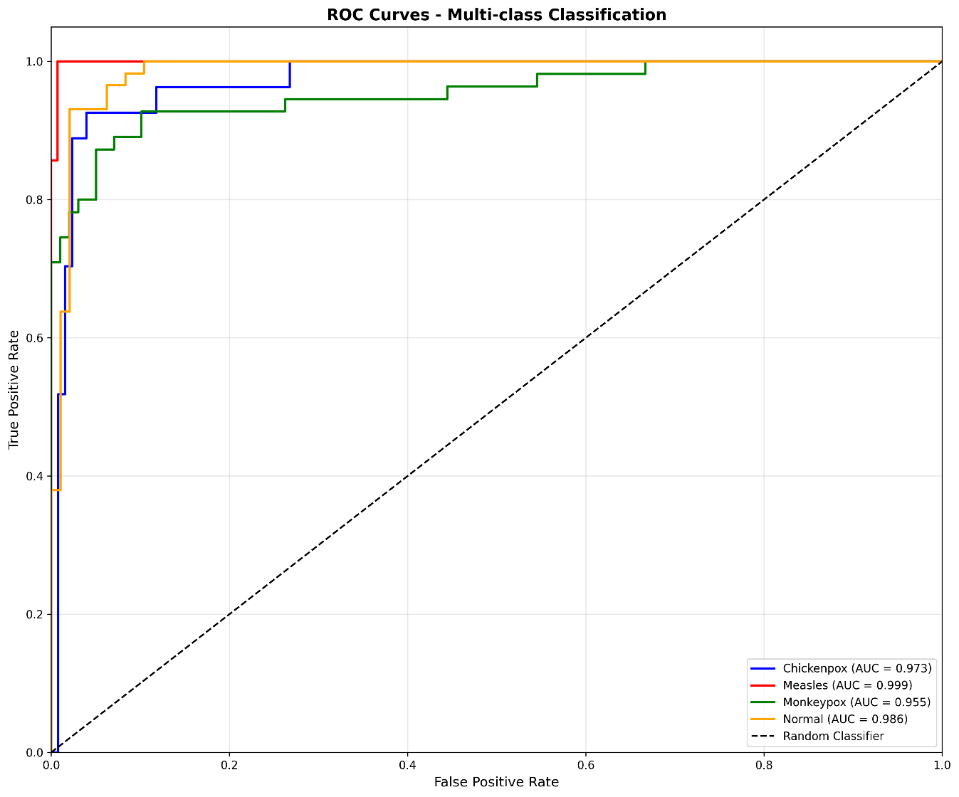
The 2022 international outbreak of monkeypox highlighted critical deficiencies in rapid diagnostic capability, particularly in differentiating monkeypox from clinically similar viral exanthems. This study presents the first implementation of EfficientNetB3 with a two-stage transfer learning approach for four-class skin lesion classification (monkeypox, chickenpox, measles, and normal skin). Key methodological contributions include inverse-frequency class weighting to address extreme data imbalance (3.2:1 ratio), a combination of L2 regularization and progressive dropout (0.6→0.5→0.4→0.3), and a six-transformation data augmentation pipeline. Trained on only 770 images, the smallest dataset in comparative literature, the model achieved a validation accuracy of 91.56% (95% CI: 87.68%–95.44%), the highest reported performance for multi-class monkeypox classification. Per-class F1-scores demonstrate balanced minority-class learning: chickenpox (F1: 87.72%), measles (F1: 86.67%), monkeypox (F1: 91.59%), and normal skin (F1: 94.74%). A one-sample t-test against the ResNet50 5-fold cross-validation baseline (91.04% ± 1.71%) confirmed no statistically significant difference in overall accuracy (t = 0.30, p = 0.77), while EfficientNetB3 achieved notable improvements in minority-class performance (+4.95 percentage points (pp); chickenpox F1 +4.75 pp). EfficientNetB3 delivers these results with 48% fewer parameters, 40% less training time, and 13% faster inference, demonstrating strong feasibility for deployment in resource-limited clinical settings.
References
Chiranjibi Sitaula & Tej Bahadur Shahi, “Monkeypox Virus Detection Using Pre-trained Deep Learning-based Approaches,” J. Med. Syst., vol. 46, no. 78, 2022, [Online]. Available: https://link.springer.com/article/10.1007/s10916-022-01868-2
Soumya Ranjan Nayak, Deepak Ranjan Nayak, “Application of deep learning techniques for detection of COVID-19 cases using chest X-ray images: A comprehensive study,” Biomed. Signal Process. Control, vol. 64, p. 102365, 2021, doi: https://doi.org/10.1016/j.bspc.2020.102365.
M. Pal et al., “Deep and Transfer Learning Approaches for Automated Early Detection of Monkeypox (Mpox) Alongside Other Similar Skin Lesions and Their Classification,” ACS Omega, vol. 8, no. 35, pp. 31747–31757, Sep. 2023, doi: 10.1021/ACSOMEGA.3C02784/ASSET/IMAGES/LARGE/AO3C02784_0005.JPEG.
Shams Nafisa Ali, Md. Tazuddin Ahmed, Joydip Paul, Tasnim Jahan, S. M. Sakeef Sani, Nawsabah Noor, Taufiq Hasan, “Monkeypox Skin Lesion Detection Using Deep Learning Models: A Feasibility Study,” arXiv:2207.03342, 2022, [Online]. Available: https://arxiv.org/abs/2207.03342
Ameera S. Jaradat, Rabia Emhamed Al Mamlook, “Automated Monkeypox Skin Lesion Detection Using Deep Learning and Transfer Learning Techniques,” Int. J. Environ. Res. Public Health, vol. 20, no. 5, 2023, doi: 10.3390/ijerph20054422.
Md Manjurul Ahsan, Muhammad Ramiz Uddin, Mithila Farjana, Ahmed Nazmus Sakib, Khondhaker Al Momin, Shahana Akter Luna, “Image Data collection and implementation of deep learning-based model in detecting Monkeypox disease using modified VGG16,” arXiv:2206.01862, 2022, [Online]. Available: https://arxiv.org/abs/2206.01862
N. Nazmee, M. S. Ali, S. Mahmud, K. Alam, A. Chakrabarty, and M. Fahim-Ul-Islam, “Enhancing Monkeypox Diagnosis: A Machine Learning Approach for Skin Lesion Classification,” 2023 26th Int. Conf. Comput. Inf. Technol. ICCIT 2023, 2023, doi: 10.1109/ICCIT60459.2023.10441041.
M. Tan and Q. V. Le, “EfficientNet: Rethinking Model Scaling for Convolutional Neural Networks,” Int. Conf. Mach. Learn., 2019.
“Is Convolutional Neural Network Accurate for Automatic Detection of Zygomatic Fractures on Computed Tomography? | Request PDF.” Accessed: Apr. 23, 2026. [Online]. Available: https://www.researchgate.net/publication/370473870_Is_Convolutional_Neural_Network_Accurate_for_Automatic_Detection_of_Zygomatic_Fractures_on_Computed_Tomography
N. Tajbakhsh et al., “Convolutional Neural Networks for Medical Image Analysis: Full Training or Fine Tuning?,” IEEE Trans. Med. Imaging, vol. 35, no. 5, pp. 1299–1312, May 2016, doi: 10.1109/TMI.2016.2535302.
Justin M. Johnson & Taghi M. Khoshgoftaar, “Survey on deep learning with class imbalance,” J. Big Data, vol. 6, 2019, [Online]. Available: https://link.springer.com/article/10.1186/s40537-019-0192-5
C. Shorten and T. M. Khoshgoftaar, “A survey on Image Data Augmentation for Deep Learning,” J. Big Data, vol. 6, no. 1, pp. 1–48, Dec. 2019, doi: 10.1186/S40537-019-0197-0/FIGURES/33.
Downloads
Published
How to Cite
Issue
Section
License
Copyright (c) 2026 50sea

This work is licensed under a Creative Commons Attribution 4.0 International License.