Next Generation Career Counseling Platform Powered by Artificial Intelligence
DOI:
https://doi.org/10.33411/IJIST/1835Keywords:
Artificial Intelligence, Career Counseling, Machine Learning, Natural Language Processing, Job Market Trends, Career Recommendation, Skills Gap AnalysisAbstract
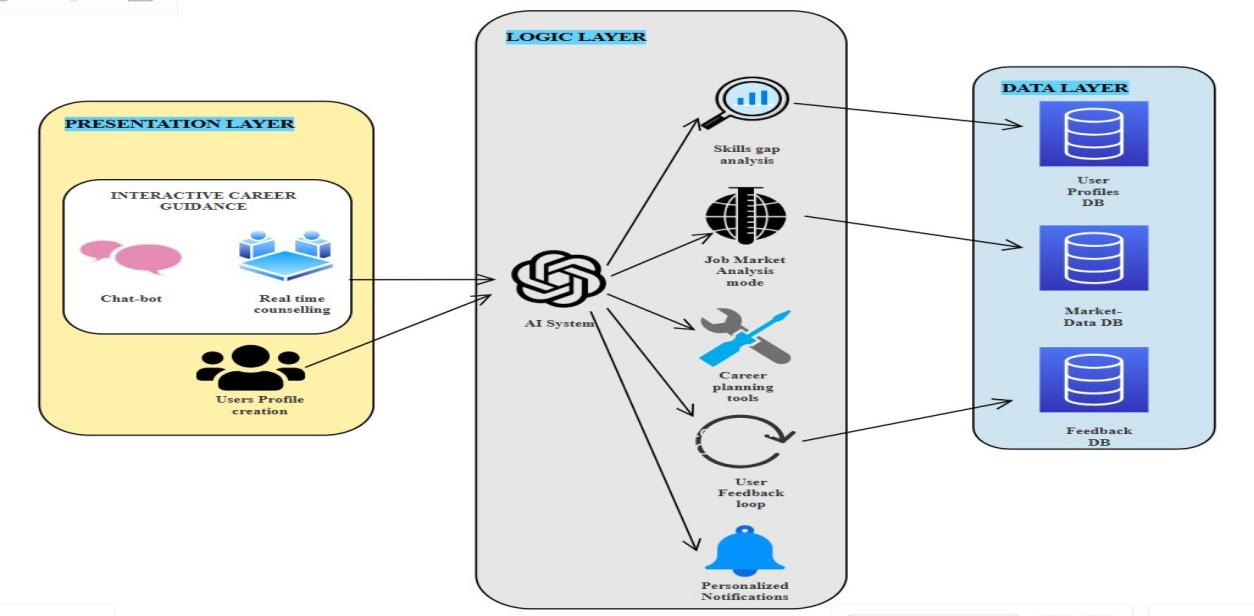
Individuals face a growing challenge in identifying career paths that align with their skills, interests, and goals in a world where career landscapes constantly shift due to technological advancements and global trends. By using machine learning algorithms, this platform seeks to bridge that gap by analyzing user profiles and providing personalized career recommendations. It ensures that users are not only aware of potential opportunities but also receive guidance on how to pursue them effectively on how to pursue them effectively. The platform evolves and adapts to changing user needs and job market dynamics through the integration of NLP for real-time interaction through an interactive career chatbot and a feedback-based learning system. A holistic approach to career development is ensured with features like skill gap analysis, job market trend monitoring, and educational resource suggestions. The aim of developing an AI-based career counseling platform is to give users precise, personalized career suggestions and acquire the knowledge and skills necessary to succeed in a diverse job market. The paper explores how to design and implement an AI-based career counseling platform, including methodologies and relevant technologies such as Angular and Node.js for front-end, Django and Python for back-end, and PostgreSQL for data manipulation. The platform is highlighted for its use of machine learning and natural language processing to offer personalized career guidance, analysis of skill gaps, and real-time job market insights. The experimental results show that the proposed system achieves a recommendation accuracy of 87.6% along with a precision of 0.85, a recall of 0.83, and an F1-score of 0.84, demonstrating strong predictive performance. The chatbot component responds to user queries with an average latency of 1.8 seconds and successfully resolves 86% of the queries, ensuring quick and effective communication. The skill gap analysis part accurately identifies gaps with an 82% accuracy rate, and overall user satisfaction is high at 89%, demonstrating the platform’s effectiveness and ease of use. The objective of the platform is to assist students and professionals in making informed job decisions and encourage the use of smart, data-driven tools in vocational development programs and educational institutions.
References
Sarah Bankins, Stefan Jooss, “Navigating career stages in the age of artificial intelligence: A systematic interdisciplinary review and agenda for future research,” J. Vocat. Behav., vol. 153, 2024, [Online]. Available: https://www.sciencedirect.com/science/article/pii/S0001879124000526
Danqi Wang, Yanling Li, “A systematic review on career interventions for high school students,” Front. Psychol., vol. 15, 2024, doi: https://doi.org/10.3389/fpsyg.2024.1461503.
Wa Ode Husniah, Unhaluddin T. Kurniawan, “Artificial Intelligence in Personalized Learning for Career Guidance: A Systematic Literature Review,” Int. Conf. Business, Educ. Heal. Scien-Tech, vol. 2, no. 1, 2025, [Online]. Available: https://journal.conference.umpalopo.ac.id/index.php/icbens/article/view/481
Rifqi Muhammad, Patriana Patriana, “Counselling Career with Artificial Intelligence: A Systematic Review,” Guid. J. Ilmu Pendidik. Psikol. Bimbing. dan Konseling, vol. 14, no. 1, p. 299, 2024, doi: 10.24127/gdn.v14i1.9357.
“CareerOneStop | Adult Education and Literacy | U.S. Department of Education.” Accessed: Mar. 31, 2026. [Online]. Available: https://lincs.ed.gov/professional-development/resource-collections/profile-564
“My Next Move.” Accessed: Mar. 31, 2026. [Online]. Available: https://www.mynextmove.org/
S. S. Pandya and J. Wang, “Artificial intelligence in career development: a scoping review,” Hum. Resour. Dev. Int., vol. 27, no. 3, pp. 324–344, May 2024, doi: 10.1080/13678868.2024.2336881.
“Fairness and Bias in Artificial Intelligence - GeeksforGeeks.” Accessed: Apr. 17, 2026. [Online]. Available: https://www.geeksforgeeks.org/artificial-intelligence/fairness-and-bias-in-artificial-intelligence/
R. Wahrini et al., “AI-Driven Career Guidance to Reduce Vocational Students’ Career Path Anxiety through Skills Mapping, Adaptive Mentoring, and Labor Market Intelligence.,” F1000Research, vol. 15, p. 298, 2026, doi: 10.12688/F1000RESEARCH.174858.1.
C. C. Aggarwal, “Recommender Systems: The Textbook,” Recomm. Syst. Textb., pp. 1–498, Jan. 2016, doi: 10.1007/978-3-319-29659-3/COVER.
S. Zhang, L. Yao, A. Sun, and Y. Tay, “Deep learning based recommender system: A survey and new perspectives,” ACM Comput. Surv., vol. 52, no. 1, Jan. 2019, doi: 10.1145/3285029;REQUESTEDJOURNAL:JOURNAL:CSUR;TAXONOMY:TAXONOMY:ACM-PUBTYPE;PAGEGROUP:STRING:PUBLICATION.
A. Vultureanu-Albisi and C. Badica, “Recommender systems: An explainable AI perspective,” 2021 Int. Conf. Innov. Intell. Syst. Appl. INISTA 2021 - Proc., Aug. 2021, doi: 10.1109/INISTA52262.2021.9548125.
Monika D S, Dr. K. Balaji, “A Review on AI-Based Chatbots for Personalized Career Guidance,” Int. J. Adv. Res. Comput. Sci. Technol., vol. 8, no. 5, 2025, [Online]. Available: https://ijarcst.org/index.php/ijarcst/article/view/131
G. Attigeri, A. Agrawal and S. V. Kolekar, “Advanced NLP Models for Technical University Information Chatbots: Development and Comparative Analysis,” IEEE Access, vol. 12, pp. 29633–29647, 2024, doi: 10.1109/ACCESS.2024.3368382.
L. R. Rameshbabu.V, “Skill Gap Analysis Using Machine Learning,” Int. J. Eng. Res. Sustain. Technol., vol. 3, no. 3, pp. 33–39, 2025, doi: 10.63458/ijerst.v3i3.122.
V. Rathod, S. Patil, U. Kawade, V. Chavan, S. Patil, and R. Patil, “SKILLSYNC: Personalized skill development,” Intell. Comput. Commun. Tech., pp. 785–790, May 2025, doi: 10.1201/9781003635680-113.
Yerbol Sarmurzin, Askar Azhenov, “Implementation of AI in career counselling for university students: a systematic review,” Front. Educ., vol. 11, 2026, doi: https://doi.org/10.3389/feduc.2026.1787689.
N. Shrivastava, P. Tewari, S. Sujatha, S. R. Bogireddy, N. Varshney, and V. Sharma, “Natural Language Processing for Conversational AI: Chatbots and Virtual Assistants,” 2025 IEEE Int. Conf. Interdiscip. Approaches Technol. Manag. Soc. Innov. IATMSI 2025, 2025, doi: 10.1109/IATMSI64286.2025.10984818.
A. Vadwala, “Career Recommendation using Machine Learning for Secondary Education,” 2025 IEEE Int. Conf. Interdiscip. Approaches Technol. Manag. Soc. Innov. IATMSI 2025, 2025, doi: 10.1109/IATMSI64286.2025.10985503.
“(PDF) Continuous Integration and Continuous Deployment (CI/CD) for Machine Learning Pipelines.” Accessed: Apr. 17, 2026. [Online]. Available: https://www.researchgate.net/publication/389021413_Continuous_Integration_and_Continuous_Deployment_CICD_for_Machine_Learning_Pipelines
Dr Reeta Mishra, “Web Scraping for Job Listings Using Python and BeautifulSoup,” Sci. J. Artif. Intell. Blockchain Technol., vol. 2, no. 3, 2025, doi: 10.63345/sjaibt.v2.i3.308.
Carlos A. Gomez-Uribe, Neil Hunt, “The Netflix Recommender System: Algorithms, Business Value, and Innovation,” ACM Trans. Manag. Inf. Syst., vol. 6, no. 4, pp. 1–19, 2015, [Online]. Available: https://dl.acm.org/doi/10.1145/2843948
Marian Ileana, Pavel Petrov, “AI-Enabled Secure and Scalable Distributed Web Architecture for Medical Informatics,” Appl. Sci., vol. 15, no. 19, p. 10710, 2025, doi: https://doi.org/10.3390/app151910710.
Downloads
Published
How to Cite
Issue
Section
License
Copyright (c) 2026 50sea

This work is licensed under a Creative Commons Attribution 4.0 International License.