Assessing the Effectiveness of Modern Deep Learning Architectures in Multi-Label News Categorization
Keywords:
Deep Neural Networks, Fake News Detection, Convolutional Neural Networks (CNN), Long Short-Term Memory (LSTM), Gated Recurrent Unit (GRU) ArchitectureAbstract
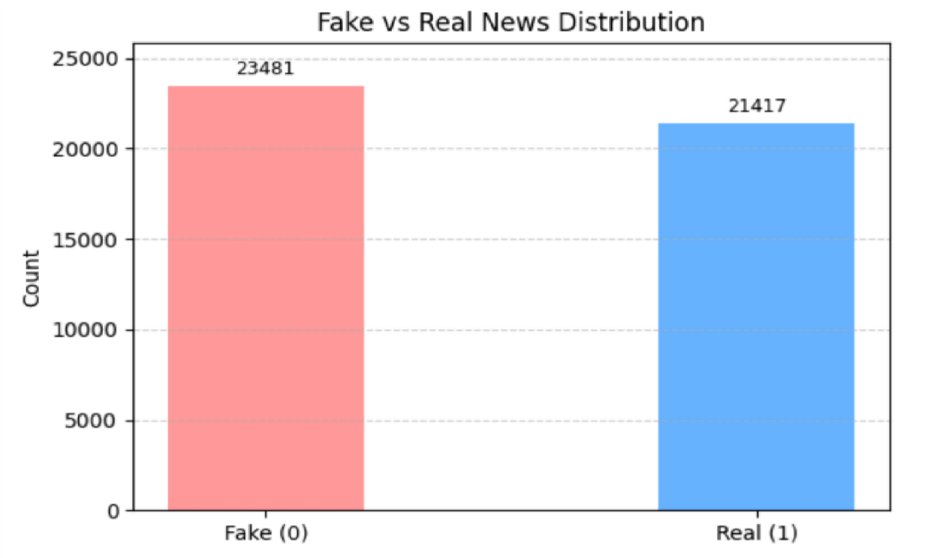
The rapid spread of fake news online poses a serious threat to public trust, making automated detection systems increasingly necessary. The proliferation of AI-generated content has intensified this challenge, with the number of AI-enabled fake news sites increased tenfold in 2023 alone [1]. This study is the first to compare seven deep learning architectures — CNN, LSTM, Bi-LSTM, RNN, Bi-RNN, GRU, and Bi-GRU — under identical experimental conditions on the same dataset, providing a reliable and unbiased performance benchmark. All models were trained on a publicly available dataset of 44,919 labeled news articles (23,502 fake, 21,417 real) using the Adam optimizer (learning rate = 0.001), binary cross-entropy loss, a batch size of 64, and early stopping, with sequences padded to 500 tokens and an 80/20 train-test split. Each model was evaluated using accuracy, precision, recall, F1-score, and misclassification count. GRU achieved the best overall performance, with 99.91% accuracy, precision, recall, and F1-score, recording only 8 misclassifications on 8,980 test samples. CNN ranked second with 99.82% accuracy and 16 misclassifications, followed by Bi-LSTM at 99.74% with 21 misclassifications. The LSTM achieved 99.57%, while the RNN reached 99.21% Bi-RNN performed the weakest at 96.80% accuracy with 287 misclassifications, the highest error count among all models. Notably, the standard GRU outperformed its bidirectional counterpart, Bi-GRU (99.69%), suggesting that increased architectural complexity does not always yield better performance. These findings demonstrate that GRU is a strong, lightweight choice for real-time fake news detection and offer practical guidance for selecting deep learning models in misinformation filtering systems.
References
“AI and Misinformation | 2024 Dean’s Report.” Accessed: Apr. 21, 2026. [Online]. Available: https://2024.jou.ufl.edu/page/ai-and-misinformation
Jamal Abdul Nasir, Osama Subhani Khan, “Fake news detection: A hybrid CNN-RNN based deep learning approach,” Int. J. Inf. Manag. Data Insights, vol. 1, no. 1, p. 100007, 2021, doi: https://doi.org/10.1016/j.jjimei.2020.100007.
D. Allington, B. Duffy, S. Wessely, N. Dhavan, and J. Rubin, “Health-protective behaviour, social media usage and conspiracy belief during the Covid-19 public health emergency,” Psychol Med, vol. 51, no. 10, pp. 1763–1769, Jul. 2020, doi: 10.1017/s003329172000224x.
Linmei Hu, Siqi Wei, “Deep learning for fake news detection: A comprehensive survey,” AI Open, vol. 3, pp. 133–155, 2022, doi: https://doi.org/10.1016/j.aiopen.2022.09.001.
I. Kadek Sastrawan, I. P.A. Bayupati, “Detection of fake news using deep learning CNN–RNN based methods,” ICT Express, vol. 8, no. 3, pp. 396–408, 2022, doi: https://doi.org/10.1016/j.icte.2021.10.003.
P. Ghadekar, M. Tilokchandani, A. Jevrani, S. Dumpala, S. Dass, and N. Shinde, “Prediction and Classification of Biased and Fake News Using NLP and Machine Learning Models,” Adv. Intell. Syst. Comput., vol. 1311 AISC, pp. 13–20, 2021, doi: 10.1007/978-981-33-4859-2_2.
Chaowei Zhang, Ashish Gupta, “A computational approach for real-time detection of fake news,” Expert Syst. Appl., vol. 221, p. 119656, 2023, [Online]. Available: https://doi.org/10.1016/j.eswa.2023.119656
Halyna Padalko, Vasyl Chomko, “A novel approach to fake news classification using LSTM-based deep learning models,” Front. Big Data, vol. 6, 2023, doi: https://doi.org/10.3389/fdata.2023.1320800.
“(PDF) A Comprehensive Review on Fake News Detection With Deep Learning.” Accessed: Apr. 21, 2026. [Online]. Available: https://www.researchgate.net/publication/356366106_A_Comprehensive_Review_on_Fake_News_Detection_With_Deep_Learning
A. Durić, S. Koprivica, D. Nikolić, and D. Stefanović, “Assessing Reproducibility and Accessibility in Hate Speech and Fake News Detection Datasets: A Literature Review (2023-2024),” 2025 24th Int. Symp. INFOTEH-JAHORINA, INFOTEH 2025 - Proc., 2025, doi: 10.1109/INFOTEH64129.2025.10959261.
Emmy Danny Ajik, Georgina N Obunadike, “Fake News Detection Using Optimized CNN and LSTM Techniques,” J. Inf. Syst. Informatics, vol. 5, no. 3, pp. 1044–1057, 2023, doi: 10.51519/journalisi.v5i3.548.
C. K. Hiramath and G. C. Deshpande, “Fake News Detection Using Deep Learning Techniques,” 1st IEEE Int. Conf. Adv. Inf. Technol. ICAIT 2019 - Proc., pp. 411–415, Jul. 2019, doi: 10.1109/ICAIT47043.2019.8987258.
Sangita M. Jaybhaye, Vivek Badade, “Fake News Detection using LSTM based deep learning approach,” ITM Web Conf., 2023, doi: 10.1051/itmconf/20235603005.
I. Y. Khudhair, S. H. Majeed, A. M. S. Ahmed, M. A. K. Alsaeedi, and F. M. Aswad, “An Improved Hybrid GRU and CNN Models for News Text Classification,” Int. J. Informatics Vis., vol. 9, no. 1, pp. 303–313, Jan. 2025, doi: 10.62527/JOIV.9.1.2658.
Al-obaidi, Saja A. and Çağlıkantar, Tuba, “Automated fake news detection system,” Iraqi J. Comput. Sci. Math., vol. 5, no. 4, 2024, [Online]. Available: https://ijcsm.researchcommons.org/cgi/viewcontent.cgi?article=1200&context=ijcsm
Mohammed E.Almandouh, Mohammed F. Alrahmawy, Mohamed Eisa, Mohamed Elhoseny & A. S. Tolba, “Ensemble based high performance deep learning models for fake news detection,” Sci. Rep., 2024, [Online]. Available: https://www.nature.com/articles/s41598-024-76286-0
J. A. Waqas Haider Bangyal, Rukhma Qasim, Najeeb ur Rehman, Zeeshan Ahmad, Hafsa Dar, Laiqa Rukhsar, Zahra Aman, “Detection of Fake News Text Classification on COVID-19 Using Deep Learning Approaches,” Comput. Math. Methods Med., 2021, doi: https://doi.org/10.1155/2021/5514220.
Faisal A. Alshuwaier, Fawaz A. Alsulaiman, “Fake News Detection Using Machine Learning and Deep Learning Algorithms: A Comprehensive Review and Future Perspectives,” Computers, vol. 14, no. 9, p. 394, 2025, doi: https://doi.org/10.3390/computers14090394.
Nida Aslam, Irfan Ullah Khan, Farah Salem Alotaibi, Lama Abdulaziz Aldaej, Asma Khaled Aldubaikil, “Fake Detect: A Deep Learning Ensemble Model for Fake News Detection,” Complexity, 2021, [Online]. Available: https://onlinelibrary.wiley.com/doi/10.1155/2021/5557784
Nabeela Kausar, Asghar AliKhan & Mohsin Sattar, “Towards better representation learning using hybrid deep learning model for fake news detection,” Soc. Netw. Anal. Min., vol. 12, no. 165, 2022, [Online]. Available: https://link.springer.com/article/10.1007/s13278-022-00986-6
S. Raza and C. Ding, “Fake news detection based on news content and social contexts: a transformer-based approach,” Int. J. Data Sci. Anal., vol. 13, no. 4, pp. 335–362, May 2022, doi: 10.1007/S41060-021-00302-Z.
Jia Li, Minglong Lei, “A Brief Survey for Fake News Detection via Deep Learning Models,” Procedia Comput. Sci., vol. 214, pp. 1339–1344, 2022, doi: https://doi.org/10.1016/j.procs.2022.11.314.
“fake-and-real-news-dataset.” Accessed: Apr. 21, 2026. [Online]. Available: https://www.kaggle.com/datasets/clmentbisaillon/fake-and-real-news-dataset
Nicolas Zucchet, Antonio Orvieto, “Recurrent neural networks: vanishing and exploding gradients are not the end of the story,” arXiv:2405.21064, 2024, [Online]. Available: https://arxiv.org/abs/2405.21064
V. Kovalenko, I. Dorohyi, and K. Doroshenko, “Comparative analysis of models for fake news detection and classification using gru,” Nauk. Pr. Donecʹkogo nacìonalʹnogo Teh. unìversitetu. Serìâ "Občislûvalʹna Teh. ta Avtom. Pr. Donecʹkogo nacìonalʹnogo Teh. unìversitetu. Serìâ Občislûvalʹna Teh. ta Avtom., pp. 39–57, Nov. 2024, doi: 10.31474/2786-9024/V2I2(34).313834.
I. D. Mienye, T. G. Swart, and G. Obaido, “Recurrent Neural Networks: A Comprehensive Review of Architectures, Variants, and Applications,” Inf. 2024, Vol. 15, Page 517, vol. 15, no. 9, p. 517, Aug. 2024, doi: 10.3390/INFO15090517.
Željko Vujović, “Classification Model Evaluation Metrics,” Int. J. Adv. Comput. Sci. Appl., vol. 12, no. 6, pp. 599–606, 2021, doi: 10.14569/IJACSA.2021.0120670.
Alaa Tharwat, “Classification assessment methods Open Access,” Appl. Comput. Informatics, vol. 17, no. 1, pp. 168–192, 2021, doi: https://doi.org/10.1016/j.aci.2018.08.003.
D. Yi, I. Kim, and S. Bu, “VARIATIONS OF TRAINING PROCESS IN VANILLA RECURRENT NEURAL NETWORK FRAMEWORK,” Neural Netw. World, vol. 34, no. 2, pp. 73–87, 2024, doi: 10.14311/NNW.2024.34.005.
V. U. Gongane, M. V. Munot, and A. D. Anuse, “A survey of explainable AI techniques for detection of fake news and hate speech on social media platforms,” J. Comput. Soc. Sci. 2024 71, vol. 7, no. 1, pp. 587–623, Mar. 2024, doi: 10.1007/S42001-024-00248-9.
Downloads
Published
How to Cite
Issue
Section
License
Copyright (c) 2026 50sea

This work is licensed under a Creative Commons Attribution 4.0 International License.