Intelligent Network Slicing in 6G Networks Using Generative Reinforcement Learning and Diffusion Models
DOI:
https://doi.org/10.33411/IJIST/1861Keywords:
6G Networks, Network Slicing, Generative Reinforcement Learning, Diffusion Models, URLLC, QoS, Resource AllocationAbstract
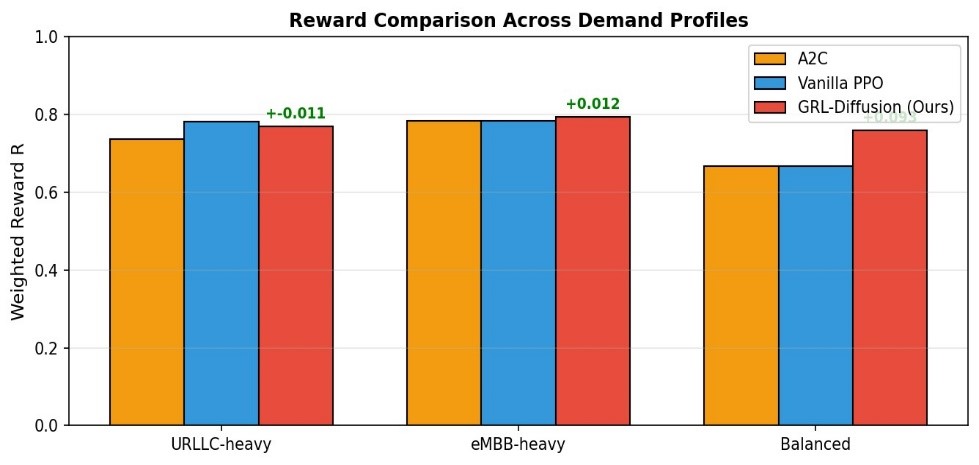
Network slicing in 6G environments necessitates resource orchestration that is adaptive, priority-aware, and capable of managing heterogeneous QoS requirements and dynamic traffic conditions. Conventional reinforcement learning techniques struggle with limited data, delayed convergence, and inadequate generalization when interacting with unforeseen traffic demands. This paper introduces a Generative Reinforcement Learning (GRL) framework integrating a Denoising Diffusion Probabilistic Model (DDPM) to enable priority-aware network slicing in 6G networks. The diffusion model functions as a scenario broker, producing synthetic edge-case traffic demands from real Uni-Cauca network flow traces using an experience mixing coefficient of λ = 0.6. Under a 150% load stress test with per-slice demands of D = [50, 50, 50] MHz, the proposed framework achieves a URLLC SLA satisfaction index of 1.0, meeting the 6G ultra-reliability target, compared to 0.667 for both Vanilla PPO and A2C baselines — a reliability gain of +33.33% over each baseline. Under URLLC-heavy demand (D = [30, 70, 20] MHz), GRL-Diffusion achieves a weighted reward of R = 0.771, compared to 0.760 for both baselines. Under balanced load (D = [50, 50, 50] MHz), the reward gain reaches +0.093 over both baselines, representing the largest improvement across all demand profiles. Over 151 training epochs, the diffusion model converged to a stable MSE loss of 1.019 from an initial peak of 2.72, with a computational overhead of T = 10 diffusion steps per synthetic sample generation. The overall weighted reward improved by 9.33% over both baselines across all evaluated load profiles. These findings confirm that combining priority-weighted allocation with diffusion-based generative modeling produces a slice orchestrator that is reliable, data-efficient, and well-suited for dynamic 6G environments.
References
Ahmed M. Alwakeel, Abdulrahman K. Alnaim, “Network Slicing in 6G: A Strategic Framework for IoT in Smart Cities,” Sensors, vol. 24, no. 13, p. 4254, 2024, doi: https://doi.org/10.3390/s24134254.
Waheed Ur Rehman,Mubarak Mohammed Al-Ezzi Sufyan, “Cooperative Distributed Uplink Cache over B5G small cell networks,” PLoS One, 2024, doi: https://doi.org/10.1371/journal.pone.0299690.
T. Salam, “Cooperative Dew Computing for Computational Offloading in Healthcare Monitoring,” IEEE Access, vol. 12, pp. 170041–170056, 2024, doi: 10.1109/ACCESS.2024.3498911.
Mubarak Mohammed Al Ezzi Sufyan, Waheed Ur Rehman, “On Improving Traffic Management in Small Cell Network Using a Novel Uplink Caching Framework,” J. Intell. Commun., vol. 4, no. 2, pp. 59–73, 2025, doi: 10.54963/jic.v4i2.1614.
T. Salam, W. Ur Rehman, and X. Tao, “Cooperative MTC data offloading with trust transitivity framework in 5G networks,” Proc. - IEEE Glob. Commun. Conf. GLOBECOM, vol. 2018-January, pp. 1–7, 2017, doi: 10.1109/GLOCOM.2017.8255045.
“(PDF) Advancements and Challenges in 5G Network Slicing: A Comprehensive Review.” Accessed: Apr. 30, 2026. [Online]. Available: https://www.researchgate.net/publication/384568439_Advancements_and_Challenges_in_5G_Network_Slicing_A_Comprehensive_Review
R. Mijumbi, J. Serrat, J. L. Gorricho, N. Bouten, F. De Turck, and R. Boutaba, “Network function virtualization: State-of-the-art and research challenges,” IEEE Commun. Surv. Tutorials, vol. 18, no. 1, pp. 236–262, Jan. 2016, doi: 10.1109/COMST.2015.2477041.
Huu Q. Tran, Viet-Thanh Pham, “A survey on the applications of machine learning, deep learning, and reinforcement learning in wireless communications,” Comput. Telecommun. Eng., vol. 3, no. 1, p. 3170, 2025, doi: 10.54517/cte3170.
D. N. and R. S. H. P. Phyu, “Machine Learning in Network Slicing—A Survey,” IEEE Access, vol. 11, pp. 39123–39153, 2023, doi: 10.1109/ACCESS.2023.3267985.
M. Sheraz, “A Comprehensive Survey on GenAI-Enabled 6G: Technologies, Challenges, and Future Research Avenues,” IEEE Open J. Commun. Soc., vol. 6, pp. 4563–4590, 2025, doi: 10.1109/OJCOMS.2025.3568496.
Giorgio Franceschelli, Mirco Musolesi, “Reinforcement Learning for Generative AI: State of the Art, Opportunities and Open Research Challenges,” arXiv:2308.00031, 2024, doi: https://arxiv.org/abs/2308.00031.
Xiaohu You, Cheng-Xiang Wang, Jie Huang, Xiqi Gao, Zaichen Zhang, Mao Wang, Yongming Huang, “Towards 6G wireless communication networks: vision, enabling technologies, and new paradigm shifts,” Sci. China Inf. Sci., vol. 64, 2021, [Online]. Available: https://link.springer.com/article/10.1007/s11432-020-2955-6
S. S. Mahdi and A. A. Abdullah, “Survey on Enabling Network Slicing Based on SDN/NFV,” Lect. Notes Networks Syst., vol. 550 LNNS, pp. 733–758, 2023, doi: 10.1007/978-3-031-16865-9_59.
Paul Scalise, Matthew Boeding, “A Systematic Survey on 5G and 6G Security Considerations, Challenges, Trends, and Research Areas,” Futur. Internet, vol. 16, no. 3, p. 67, 2024, doi: https://doi.org/10.3390/fi16030067.
T. A. Khan, A. Mehmood, J. J. D. Ravera, A. Muhammad, K. Abbas, and W. C. Song, “Intent-Based Orchestration of Network Slices and Resource Assurance using Machine Learning,” Proc. IEEE/IFIP Netw. Oper. Manag. Symp. 2020 Manag. Age Softwarization Artif. Intell. NOMS 2020, Apr. 2020, doi: 10.1109/NOMS47738.2020.9110408.
M. A. Islam Arif, S. Kabir, M. F. Hussain Khan, S. Kumar Dey, and M. M. Rahman, “Machine Learning and Deep Learning Based Network Slicing Models for 5G Network,” Proc. 2022 25th Int. Conf. Comput. Inf. Technol. ICCIT 2022, pp. 96–101, 2022, doi: 10.1109/ICCIT57492.2022.10054696.
H. Sun, “Advancing 6G: Survey for Explainable AI on Communications and Network Slicing,” IEEE Open J. Commun. Soc., vol. 6, pp. 1372–1412, 2025, doi: 10.1109/OJCOMS.2025.3534626.
John Schulman, Filip Wolski, Prafulla Dhariwal, Alec Radford, Oleg Klimov, “Proximal Policy Optimization Algorithms,” arXiv:1707.06347, 2017, [Online]. Available: https://arxiv.org/abs/1707.06347
Y. Li, W. Zheng, and Z. Zheng, “Deep Robust Reinforcement Learning for Practical Algorithmic Trading,” IEEE Access, vol. 7, pp. 108014–108021, 2019, doi: 10.1109/ACCESS.2019.2932789.
“(PDF) Federated Deep Reinforcement Learning for Prediction-Based Network Slice Mobility in 6 G Mobile Networks.” Accessed: May 10, 2026. [Online]. Available: https://www.researchgate.net/publication/380803191_Federated_Deep_Reinforcement_Learning_for_Prediction-Based_Network_Slice_Mobility_in_6_G_Mobile_Networks
X. Foukas, G. Patounas, A. Elmokashfi, and M. K. Marina, “Network Slicing in 5G: Survey and Challenges,” IEEE Commun. Mag., vol. 55, no. 5, pp. 94–100, May 2017, doi: 10.1109/MCOM.2017.1600951.
T. H. Vu, S. Kumar Jagatheesaperumal, M. D. Nguyen, N. Van Huynh, S. Kim, and Q. V. Pham, “Applications of Generative AI (GAI) for Mobile and Wireless Networking: A Survey,” IEEE Internet Things J., vol. 12, no. 2, pp. 1266–1290, 2025, doi: 10.1109/JIOT.2024.3487627.
“(PDF) Diffusion-RL for Scalable Resource Allocation for 6G Networks.” Accessed: Apr. 30, 2026. [Online]. Available: https://www.researchgate.net/publication/392530664_Diffusion-RL_for_Scalable_Resource_Allocation_for_6G_Networks
Navideh Ghafouri, John S. Vardakas, Kostas Ramantas, Christos Verikoukis, “Energy-Efficient Intra-Domain Network Slicing for Multi-Layer Orchestration in Intelligent-Driven Distributed 6G Networks: Learning Generic Assignment Skills with Unsupervised Reinforcement Learning,” arXiv:2410.23161, 2024, [Online]. Available: https://arxiv.org/abs/2410.23161
Z. Zhu et al., “Diffusion Models for Reinforcement Learning: A Survey,” Feb. 2024, Accessed: May 10, 2026. [Online]. Available: http://arxiv.org/abs/2311.01223
Muhammad Ahmed Mohsin, Junaid Ahmad, Muhammad Hamza Nawaz, Muhammad Ali Jamshed, “Towards 6G Intelligence: The Role of Generative AI in Future Wireless Networks,” arXiv:2508.19495, 2025, [Online]. Available: https://arxiv.org/abs/2508.19495
S. V. Oprea and A. Bâra, “An Edge-Fog-Cloud computing architecture for IoT and smart metering data,” Peer-to-Peer Netw. Appl., vol. 16, no. 2, pp. 818–845, Mar. 2023, doi: 10.1007/S12083-022-01436-Y.
Q. He et al., “Integrating IoT and 6G: Applications of Edge Intelligence, Challenges, and Future Directions,” IEEE Trans. Serv. Comput., vol. 18, no. 4, pp. 2471–2488, 2025, doi: 10.1109/TSC.2025.3586152.
M. Ishtiaq, N. Saeed, and M. A. Khan, “Edge Computing in IoT: A 6G Perspective,” May 2022, Accessed: May 10, 2026. [Online]. Available: http://arxiv.org/abs/2111.08943
J. Song, C. Meng, and S. Ermon, “Denoising Diffusion Implicit Models,” Oct. 2022, Accessed: May 10, 2026. [Online]. Available: http://arxiv.org/abs/2010.02502
Downloads
Published
How to Cite
Issue
Section
License
Copyright (c) 2026 50sea

This work is licensed under a Creative Commons Attribution 4.0 International License.