MLOps-Enabled Autonomous AI Agents for End-to-End Software Project Management
Keywords:
Autonomous AI Agents, MLOps, Software Project Management, Task Scheduling, Risk Assessment, Resource Optimization, Agile Development, Predictive Analytics, Multi-Agent Systems, Explainable AIAbstract
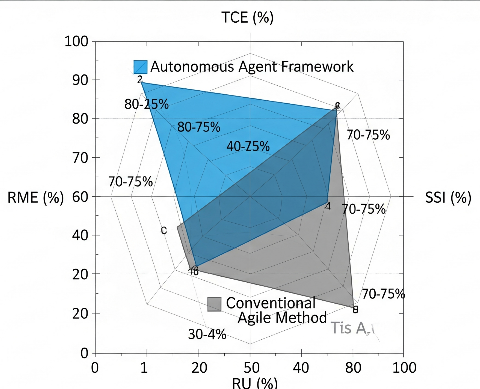
The rapid evolution of software project management (SPM) practices necessitates adaptive, intelligent systems capable of managing complex projects efficiently. This paper presents an MLOps-enabled framework of autonomous AI agents for end-to-end software project management, integrating task scheduling, predictive risk assessment, resource optimization, and automated stakeholder communication. The framework leverages multi-agent coordination and continuous MLOps pipelines to ensure reliable, adaptive, and scalable decision-making. Experimental evaluation across 90 simulated and historical software projects within a controlled Discrete Event Simulation environment demonstrates significant improvements, including a 64.98% reduction in average task delays, an 89.06% reduction in critical risk incidents, a 31.8% improvement in resource utilization consistency, and a 67.2% improvement in stakeholder response time compared to conventional Critical Path Method (CPM) and heuristic approaches. Overall Task Completion Efficiency (TCE) reached 92.5% (95% CI: 91.2%–93.8%) and Risk Mitigation Effectiveness (RME) reached 89.3% (95% CI: 87.6%–91.0%) across 50 independent simulation runs. Per-sprint analysis reveals progressive performance improvement from Sprint 1 (TCE: 88.2%; RME: 85.1%; Resource Utilization: 79.3%; Stakeholder Satisfaction Index: 4.2/5.0) to Sprint 5 (TCE: 94.7%; RME: 91.2%; RU: 87.2%; SSI: 4.7/5.0), demonstrating the compounding benefits of continuous MLOps retraining. Inter-agent communication overhead averaged 4.2 ms per message (95% CI: 3.8–4.6 ms), confirming negligible coordination latency. Model drift, measured via Population Stability Index (PSI), decreased from 0.21 to 0.08 across five automated retraining cycles triggered after every fifth simulation sprint, with zero agent downtime during retraining events. These outcomes were achieved through automated model retraining, drift detection, and explainable decision support for human-in-the-loop oversight. These simulation-based results highlight the framework's potential to redefine project management, providing a strong empirical foundation for future real-world validation in enterprise software development environments.
References
Lisana Berberi, Valentin Kozlov, Giang Nguyen, Judith Sáinz-Pardo Díaz, Amanda Calatrava, Germán Moltó, Viet Tran & Álvaro López García, “Machine learning operations landscape: platforms and tools,” Artif. Intell. Rev., vol. 58, no. 167, 2025, [Online]. Available: https://link.springer.com/article/10.1007/s10462-025-11164-3
Mark Tappe, Lukas Moddemann, Henrik Steude, Nemanja Hranisavljevic, “A supervised AI-based toolchain for anomaly detection, diagnosis, and reconfiguration for the life-support system of the COLUMBUS module of the ISS,” CEAS Sp. J., 2025, [Online]. Available: https://link.springer.com/article/10.1007/s12567-025-00654-3
Sergio Moreschini, Shahrzad Pour, Ivan Lanese, “AI Techniques in the Microservices Life-Cycle: a Systematic Mapping Study,” Computing, vol. 107, no. 100, 2025, [Online]. Available: https://link.springer.com/article/10.1007/s00607-025-01432-z
Kay Lefevre, Chetan Arora, Kevin Lee, Arkady Zaslavsky, Mohamed Reda Bouadjenek, Ali Hassani & Imran Razzak, “ModelOps for enhanced decision-making and governance in emergency control rooms,” Environ. Syst. Decis., vol. 42, pp. 402–416, 2022, [Online]. Available: https://link.springer.com/article/10.1007/s10669-022-09855-1
Eduardo e Oliveira, Marco Rodrigues, João Paulo Pereira, António M. Lopes, Ivana Ilic Mestric & Sandro Bjelogrlic, “Unlabeled learning algorithms and operations: overview and future trends in defense sector,” Artif. Intell. Rev., vol. 57, no. 66, 2024, [Online]. Available: https://link.springer.com/article/10.1007/s10462-023-10692-0
Daswin De Silva, Damminda Alahakoon, “An artificial intelligence life cycle: From conception to production,” Patterns, vol. 3, no. 6, p. 100489, 2022, doi: https://doi.org/10.1016/j.patter.2022.100489.
Ahmed Fawzy, Amjed Tahir, Matthias Galster & Peng Liang, “Exploring data management challenges and solutions in agile software development: a literature review and practitioner survey,” Empir. Softw. Eng., vol. 30, no. 77, 2025, [Online]. Available: https://link.springer.com/article/10.1007/s10664-025-10630-4
“A Taxonomy of AgentOps for Enabling Observability of Foundation Model based Agents.” Accessed: Apr. 25, 2026. [Online]. Available: https://arxiv.org/html/2411.05285v1
Nourah Janbi, Iyad Katib, “Distributed artificial intelligence: Taxonomy, review, framework, and reference architecture,” Intell. Syst. with Appl., vol. 18, p. 200231, 2023, doi: https://doi.org/10.1016/j.iswa.2023.200231.
Catherine Beaton, “The Importance of Requirements Management in Agile Development,” Requiment, 2024, [Online]. Available: https://www.requiment.com/the-importance-of-requirements-management-in-agile-development/
D. Kreuzberger, N. Kühl and S. Hirschl, “Machine Learning Operations (MLOps): Overview, Definition, and Architecture,” IEEE Access, vol. 11, pp. 31866–31879, 2023, doi: 10.1109/ACCESS.2023.3262138.
Nipuni Hewage, Dulani Meedeniya, “Machine Learning Operations: A Survey on MLOps Tool Support,” arXiv:2202.10169, 2022, [Online]. Available: https://arxiv.org/abs/2202.10169
“(PDF) Real-Time Analytics for Agile Business Environments: Tools and Applications.” Accessed: Apr. 25, 2026. [Online]. Available: https://www.researchgate.net/publication/393715611_Real-Time_Analytics_for_Agile_Business_Environments_Tools_and_Applications
“(PDF) Reinforcement Learning for Autonomous Resource Allocation in Dynamic Container Clusters.” Accessed: Apr. 25, 2026. [Online]. Available: https://www.researchgate.net/publication/401274514_Reinforcement_Learning_for_Autonomous_Resource_Allocation_in_Dynamic_Container_Clusters
Zahra Makki Nayeri, Toktam Ghafarian, “Application placement in Fog computing with AI approach: Taxonomy and a state of the art survey,” J. Netw. Comput. Appl., vol. 185, p. 103078, 2021, doi: https://doi.org/10.1016/j.jnca.2021.103078.
E. Jawabreh and A. Taweel, “Self-adaptation in Microservice Systems: A Literature Review,” Lect. Notes Comput. Sci., vol. 15833 LNCS, pp. 28–40, 2026, doi: 10.1007/978-981-96-7238-7_3.
Dov Te’eni, Inbal Yahav & David Schwartz, “What it takes to control AI by design: human learning,” AI Soc., vol. 41, pp. 237–250, 2026, [Online]. Available: https://link.springer.com/article/10.1007/s00146-025-02401-y
Francesco Sovrano, Emmie Hine, Stefano Anzolut & Alberto Bacchelli, “Simplifying software compliance: AI technologies in drafting technical documentation for the AI Act,” Empir. Softw. Eng., vol. 3, no. 91, 2025, [Online]. Available: https://link.springer.com/article/10.1007/s10664-025-10645-x
Mohammad Zarour, Hamza Alzabut, “MLOps best practices, challenges and maturity models: A systematic literature review,” Inf. Softw. Technol., vol. 183, p. 107733, 2025, doi: https://doi.org/10.1016/j.infsof.2025.107733.
J. Smeds, K. Nybom, and I. Porres, “DevOps: A Definition and Perceived Adoption Impediments,” Lect. Notes Bus. Inf. Process., vol. 212, pp. 166–177, 2015, doi: 10.1007/978-3-319-18612-2_14.
“Active Learning Literature Survey}.” Accessed: Apr. 25, 2026. [Online]. Available: https://www.researchgate.net/publication/228942691_Active_Learning_Literature_Survey
“A Human-Centered Approach to Interactive Machine Learning.” Accessed: Apr. 25, 2026. [Online]. Available: https://www.researchgate.net/publication/333130102_
A_Human-Centered_Approach_to_Interactive_Machine_Learning
Patrice Y. Simard, Saleema Amershi, David M. Chickering, “Machine Teaching: A New Paradigm for Building Machine Learning Systems,” arXiv:1707.06742, 2017, [Online]. Available: https://arxiv.org/abs/1707.06742
G. Recupito et al., “A Multivocal Literature Review of MLOps Tools and Features,” Proc. - 48th Euromicro Conf. Softw. Eng. Adv. Appl. SEAA 2022, pp. 84–91, 2022, doi: 10.1109/SEAA56994.2022.00021.
Shreya Shankar, Rolando Garcia, Joseph M. Hellerstein, Aditya G. Parameswaran, “Operationalizing Machine Learning: An Interview Study,” arXiv:2209.09125, 2022, [Online]. Available: https://arxiv.org/abs/2209.09125
Mariana Falco, Gabriela Robiolo, “Tendencies in Multi-Agent Systems: A Systematic Literature Review,” CLEI Electron. J., vol. 23, no. 1, 2020, doi: 10.19153/cleiej.23.1.1.
V. K. Thatikonda, “Autonomous AI Agents for Software Development: A Framework for Intelligent Code Generation and Maintenance,” J. Artif. Intell. Technol. Dev., vol. 2, no. 2, pp. 226–234, Apr. 2026, doi: 10.59324/JAITD.2026.2(2).16.
Downloads
Published
How to Cite
Issue
Section
License
Copyright (c) 2026 50sea

This work is licensed under a Creative Commons Attribution 4.0 International License.