Design and Implementation of a Smart Human Interrupt System Using Long-Range RFID
DOI:
https://doi.org/10.33411/IJIST/1872Keywords:
RFID Tag, RFID Reader, LoRa Transceiver, Signal Strength (RSSI), SNR, Low-Power CommunicationAbstract
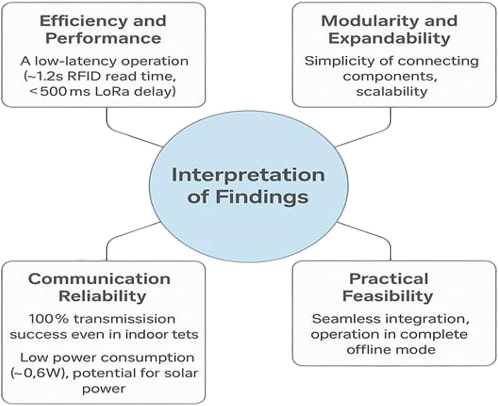
Communication is a critical component of modern life, supporting essential sectors such as business, healthcare, education, and disaster response. However, in rural and remote environments, traditional GSM and Internet-based communication systems often become unreliable due to power outages, network congestion, and physical infrastructure damage. To address these limitations, this study proposes an independent, infrastructure-free communication system integrating RFID and LoRa technologies. The system utilizes an MFRC522 RFID reader for tag identification and an SX1278 LoRa transceiver for long-range data transmission without reliance on Internet or GSM connectivity. Experimental evaluation was conducted in both indoor and outdoor environments to assess system performance under varying conditions. Indoor results across four floor levels show RSSI values ranging from −99 dBm to −81.4 dBm and SNR values from −6.8 dB to 9.6 dB, indicating varying signal quality depending on floor height and obstruction levels. Outdoor testing demonstrated reliable communication up to 500 meters in open-field conditions, with RSSI values between −65 dBm and −85 dBm and SNR ranging from +5.0 dB to −2.5 dB, achieving a packet delivery success rate of 100% under the tested conditions. In more obstructed environments (tree line), signal degradation was observed (RSSI: −92 dBm, SNR: −5.8 dB), resulting in occasional packet drops. Across multiple trials (n = 50), the average RFID read time was measured at 1.2 ± 0.15 seconds, while the average LoRa transmission delay remained below 500 milliseconds (420 ± 60 ms). The total system power consumption was approximately 0.6 ± 0.05 Watts, enabling efficient operation using battery or solar power systems. These results confirm that the proposed RFID–LoRa system is a reliable, energy-efficient, and scalable solution for offline communication in infrastructure-limited and disaster-prone environments, with performance influenced by environmental conditions and physical obstructions.
References
Habibullah Safi, Ali Imran Jehangiri, “Design and Evaluation of a Low-Power Wide-Area Network (LPWAN)-Based Emergency Response System for Individuals with Special Needs in Smart Buildings,” Sensors, vol. 24, no. 11, p. 3433, 2024, doi: https://doi.org/10.3390/s24113433.
Amit Sant, “Wireless Technology in Disaster Management: Innovations for Resilience and Response,” Eur. Mod. Stud. J., vol. 9, no. 5, pp. 694–703, 2025, doi: 10.59573/emsj.9(5).2025.63.
Chan Xin Yen, Kamalanathan Shanmugam, “Short-Term Mobile Ad Hoc Network with LoRa Based Infrastructure in Disaster Relief,” J. Appl. Technol. Innov., vol. 6, no. 2, pp. 55–59, 2022, doi: 10.65136/jati.v6i1.170.
N. T. Nguyen, M. S. Dao, and K. Zettsu, “Leveraging 3d-raster-images and deepcnn with multi-source urban sensing data for traffic congestion prediction,” Lect. Notes Comput. Sci. (including Subser. Lect. Notes Artif. Intell. Lect. Notes Bioinformatics), vol. 12392 LNCS, pp. 396–406, 2020, doi: 10.1007/978-3-030-59051-2_27.
Vinuja Ranasinghe, Nuwan Udara, “Rapid and Resilient LoRa Leap: A Novel Multi-Hop Architecture for Decentralised Earthquake Early Warning Systems,” Sensors, vol. 24, no. 18, p. 5960, 2024, doi: https://doi.org/10.3390/s24185960.
Muhammad Ibrahim Channa, Kazi M. Ahmed, “Emergency Response Communications and Associated Security Challenges,” arXiv:1010.4887, 2010, [Online]. Available: https://arxiv.org/abs/1010.4887
Isadora Rezende Lopes, Paulo Rodolfo da Silva Leite Coelho, “Evaluating the Performance of LoRa Networks: A Study on Disaster Monitoring Scenarios,” IOT, vol. 6, no. 1, p. 14, 2025, doi: https://doi.org/10.3390/iot6010014.
Poonam Maurya, Abhishek Hazra, “A Comprehensive Survey of Data-Driven Solutions for LoRaWAN: Challenges and Future Directions,” ACM Trans. Internet Things, vol. 6, no. 1, pp. 1–36, 2025, [Online]. Available: https://dl.acm.org/doi/full/10.1145/3711953
Lameya Aldhaheri, Noor Alshehhi, Irfana Ilyas Jameela Manzil, Ruhul Amin Khalil, , Shumaila Javaid, , Nasir Saeed, , and Mohamed-Slim Alouini, “LoRa Communication for Agriculture 4.0: Opportunities, Challenges, and Future Directions,” arXiv:2409.11200v1. Accessed: Oct. 08, 2025. [Online]. Available: https://www.researchgate.net/publication/384085702_LoRa_Communication_for_Agriculture_40_Opportunities_Challenges_and_Future_Directions
Fang Yao, Yulong Ding, “A Survey on Evolved LoRa-Based Communication Technologies for Emerging Internet of Things Applications,” Int. J. Netw. Dyn. Intell., vol. 1, no. 1, pp. 4–19, 2022, doi: 10.53941/ijndi0101002.
D. S. Syed, S. B. Hossain, A. Islam, T. A. I. Jim, and M. S. R. Zishan, “Design and Feasibility Analysis of a LoRa Based Communication System for Disaster Management,” AIUB J. Sci. Eng., vol. 23, no. 2, pp. 135–144, 2024, doi: 10.53799/AJSE.V23I2.1055.
Danilo Arregui Almeida, Juan Chafla Altamirano, “Gateway-Free LoRa Mesh on ESP32: Design, Self-Healing Mechanisms, and Empirical Performance,” Sensors, vol. 25, no. 19, p. 6036, 2025, doi: https://doi.org/10.3390/s25196036.
P. Branch, “LoRa as a Mesh Networking Technology,” Int. Conf. Inf. Netw., pp. 24–27, 2025, doi: 10.1109/ICOIN63865.2025.10992870.
Jetmir Haxhibeqiri, Eli De Poorter, “A Survey of LoRaWAN for IoT: From Technology to Application,” Sensors, vol. 18, no. 11, p. 3995, 2018, doi: https://doi.org/10.3390/s18113995.
Priyangshu Sutradhar, “Drone-Assisted Mesh Networks: A Framework for Emergency Connectivity in Remote and Low-Infrastructure Zones,” Int. J. Adv. Res. Sci. Commun. Technol., pp. 113–119, May 2025, doi: 10.48175/IJARSCT-27018.
Halyna Vlakh-Vyhrynovska, Yuriy Rudyy, “Air Raid Alert Mesh Network System: Key Provision,” Electron. Control Syst., vol. 2, no. 84, pp. 57–62, 2025, doi: 10.18372/1990-5548.84.20194.
S. Kumar, E. Swanson, and T. Tran, “RFID in the healthcare supply chain: usage and application,” Int. J. Health Care Qual. Assur., vol. 22, no. 1, pp. 67–81, 2009, doi: 10.1108/09526860910927961.
Kais Mekki, Eddy Bajic, “A comparative study of LPWAN technologies for large-scale IoT deployment,” ICT Express, vol. 5, no. 1, pp. 1–7, 2019, doi: https://doi.org/10.1016/j.icte.2017.12.005.
H. Mohapatra, “A LoRa IoT Framework with Machine Learning for Remote Livestock Monitoring in Smart Agriculture,” Sep. 2025, Accessed: May 16, 2026. [Online]. Available: http://arxiv.org/abs/2510.07322
Juha Petäjäjärvi, Konstantin Mikhaylov, “Performance of a low-power wide-area network based on LoRa technology: Doppler robustness, scalability, and coverage,” Int. J. Distrib. Sens. Networks, vol. 13, no. 3, pp. 1–16, 2017, doi: 10.1177/1550147717699412.
Downloads
Published
How to Cite
Issue
Section
License
Copyright (c) 2026 50sea

This work is licensed under a Creative Commons Attribution 4.0 International License.