Comparative Study of Generative AI and Traditional Tools for Evaluating Creativity and Efficiency in UI/UX Design
DOI:
https://doi.org/10.33411/IJIST/1876Keywords:
Cognitive load, Creativity, Generative AI tool, UI/UX Design Creation, Workflow EfficiencyAbstract
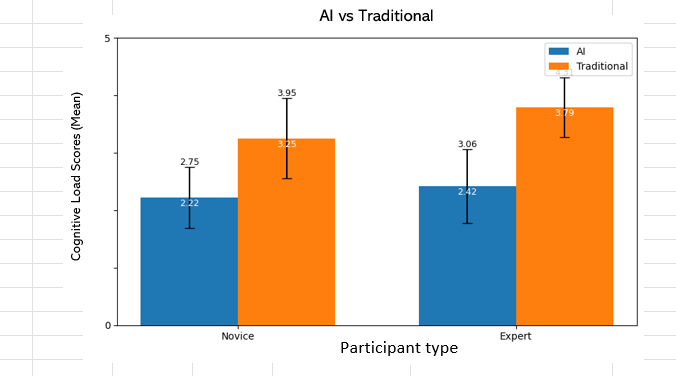
In the modern software industry, the creation of user interface (UI) and user experience (UX) design is an essential activity that is increasingly adopting generative artificial intelligence (AI) tools. With this growing trend, it is crucial to examine the novelty and creativity of AI-generated design outputs in comparison to those produced by traditional workflows without any AI support. The goal of this study is to quantitatively compare the cognitive load, creativity, and task completion time of UI/UX design outputs created using the traditional design tool named Figma and the generative AI tool named Galileo AI. The NASA task load index (NASA-TLX), creative product semantic scale (CPSS), and number of minutes taken to complete a design task are used to quantify cognitive load, creativity, and task completion time, respectively. To compare these three metrics between AI and traditional groups, an experiment is conducted with novice and expert designers, separately. The results reveal that the generative AI tool significantly reduces both the cognitive load of designers and the time required to create UI/UX designs. For instance, independent samples t-tests show that the generative AI tool results in lower cognitive load scores than the traditional tool for both novices (2.22 ± 0.53 vs. 3.25 ± 0.70) and experts (2.42 ± 0.64 vs. 3.79 ± 0.52). Similarly, independent samples t-tests results indicate that the AI tool reduces average task completion time for both novices (24.38 vs. 42.69) and experts (23.78 vs. 48.44) compared to the traditional tool. On the other hand, the traditional tool consistently outperforms the generative AI tool in terms of creativity and innovation. For instance, independent samples t-tests results show that the traditional design tool yields higher creativity scores than the generative AI tool for both novices (3.94 ± 0.66 vs. 3.27 ± 0.74) and experts (4.17 ± 0.39 vs. 3.37 ± 0.44). Overall, the AI tool excels at enhancing efficiency; however, it still faces challenges in replicating the depth of human creativity and emotional understanding that are essential for creating engaging UI/UX designs.
References
H. R. Hartson and P. S. Pyla, “The UX book : Agile UX design for a quality user experience,” 2019.
“Figma: The Collaborative Interface Design Tool.” Accessed: May 19, 2026. [Online]. Available: https://www.figma.com/
“Adobe XD Learn & Support.” Accessed: May 19, 2026. [Online]. Available: https://helpx.adobe.com/support/xd.html
“Sketch · Design, prototype, collaborate and handoff.” Accessed: May 19, 2026. [Online]. Available: https://www.sketch.com/
“Midjourney.” Accessed: May 19, 2026. [Online]. Available: https://www.midjourney.com/home
“DALL·E 2 | OpenAI.” Accessed: May 19, 2026. [Online]. Available: https://openai.com/index/dall-e-2/
“Stable Diffusion Online: The Ultimate AI Image, Video & Editing Platform | Stable Diffusion Online.” Accessed: May 19, 2026. [Online]. Available: https://stablediffusionweb.com/
“Stitch - Design with AI.” Accessed: May 19, 2026. [Online]. Available: https://stitch.withgoogle.com/
M. A. Runco, “Editorial: Creativity Research: Originality, Utility, and Integration,” Creat. Res. J., vol. 1, no. 1, pp. 1–7, Dec. 1988, doi: 10.1080/10400418809534283.
M. A. Runco and G. J. Jaeger, “The Standard Definition of Creativity,” Creat. Res. J., vol. 24, no. 1, pp. 92–96, Jan. 2012, doi: 10.1080/10400419.2012.650092.
J. Sweller, “Cognitive Load During Problem Solving: Effects on Learning,” Cogn. Sci., vol. 12, no. 2, pp. 257–285, Apr. 1988, doi: 10.1207/S15516709COG1202_4.
R. Heigl, “Generative artificial intelligence in creative contexts: a systematic review and future research agenda,” Manag. Rev. Q., vol. 76, pp. 955–992, 2026, [Online]. Available: https://link.springer.com/article/10.1007/s11301-025-00494-9
Y. Luo, “Designing With AI: A Systematic Literature Review on the Use, Development, and Perception of AI-Enabled UX Design Tools,” Adv. Human-Computer Interact., 2025, [Online]. Available: https://onlinelibrary.wiley.com/doi/full/10.1155/ahci/3869207
L. Abrusci, K. Dabaghi, S. D’Urso, and F. Sciarrone, “AI4Design: A generative AI-based system to improve creativity in design–A field evaluation,” Comput. Educ. Artif. Intell., vol. 8, p. 100401, 2025, doi: https://doi.org/10.1016/j.caeai.2025.100401.
F. Buendia-Garcia, “Using Generative AI Tools in Collaborative UX design Courses,” Int. J. Artif. Intell. Educ., vol. 35, 2025, [Online]. Available: https://link.springer.com/article/10.1007/s40593-025-00518-1
W. F. Yu, “AI as a co-creator and a design material: Transforming the design process,” Des. Stud., 2025, doi: 10.1016/j.destud.2025.101303.
M. A. Shahab, “The impact of generative AI on UI design for mobile applications in terms of efficiency using SPACE framework: A survey-based study from mobile application designers/developers,” Master of Science Thesis, Faculty of Information Technology and Communication Sciences, Tampere University, Nov. 2024.
“(PDF) Concerns and Challenges of AI Tools in the UI/UX Design Process: A Cross-Sectional Survey.” Accessed: May 19, 2026. [Online]. Available: https://www.researchgate.net/publication/380522812_Concerns_and_Challenges_of_AI_Tools_in_the_UIUX_Design_Process_A_Cross-Sectional_Survey
J. Li, H. Cao, L. Lin, Y. Hou, R. Zhu, and A. El Ali, “User Experience Design Professionals’ Perceptions of Generative Artificial Intelligence,” Conf. Hum. Factors Comput. Syst. - Proc., pp. 1–18, 2024, [Online]. Available: https://dl.acm.org/doi/10.1145/3613904.3642114
S. Wadinambiarachchi, R. M. Kelly, S. Pareek, Q. Zhou, and E. Velloso, “The Effects of Generative AI on Design Fixation and Divergent Thinking,” Conf. Hum. Factors Comput. Syst., pp. 1–18, 2024, [Online]. Available: https://dl.acm.org/doi/full/10.1145/3613904.3642919
L. Chen, Y. Song, C. Zheng, Q. Jing, P. Hansen, and L. Sun, “Understanding Design Fixation in Generative AI,” arXiv:2502.05870, 2025, [Online]. Available: https://arxiv.org/abs/2502.05870
“Enhancing web UI/UX design with AI tools : an in-depth analysis - Theseus.” Accessed: May 19, 2026. [Online]. Available: https://www.theseus.fi/handle/10024/891768
Y. Wu, Y. Sun, D. Zhou, X. Yuan, and Z. Wei, “Exploring the Mechanisms of Generative AI’s Impact on Design Creativity: An Empirical Investigation Based on the 4P’s Model,” Int. J. Human–Computer Interact., 2026, doi: 10.1080/10447318.2026.2622577.
T. Chandrasekera, Z. Hosseini, and U. Perera, “Can artificial intelligence support creativity in early design processes?,” Int. J. Archit. Comput., vol. 23, no. 1, 2024, [Online]. Available: https://journals.sagepub.com/doi/10.1177/14780771241254637
S. G. Hart and L. E. Staveland, “Development of NASA-TLX (Task Load Index): Results of Empirical and Theoretical Research,” Adv. Psychol., vol. 52, pp. 139–183, 1988, doi: https://doi.org/10.1016/S0166-4115(08)62386-9.
S. P. Besemer and D. J. Treffinger, “Analysis of Creative Products: Review and Synthesis,” J. Creat. Behav., vol. 15, no. 3, pp. 158–178, Sep. 1981, doi: 10.1002/J.2162-6057.1981.TB00287.X;ISSUE:ISSUE:DOI.
J. Carifio and R. Perla, “Resolving the 50-year debate around using and misusing Likert scales,” Med. Educ., vol. 42, no. 12, pp. 1150–1152, Dec. 2008, doi: 10.1111/J.1365-2923.2008.03172.X.
G. Norman, “Likert scales, levels of measurement and the ‘laws’ of statistics,” Adv. Heal. Sci. Educ., vol. 15, no. 5, pp. 625–632, Dec. 2010, doi: 10.1007/S10459-010-9222-Y/METRICS.
G. M. Sullivan and J. A. R. Artino, “Analyzing and Interpreting Data From Likert-Type Scales,” J. Grad. Med. Educ., vol. 5, no. 4, p. 541, Jan. 2013, doi: 10.4300/JGME-5-4-18.
E. T. Berkman and S. P. Reise, “A Conceptual Guide to Statistics Using SPSS,” Sage, 2012, [Online]. Available: https://sk.sagepub.com/book/mono/a-conceptual-guide-to-statistics-using-spss/toc#_
“IBM Solutions.” Accessed: May 19, 2026. [Online]. Available: https://www.ibm.com/solutions
Downloads
Published
How to Cite
Issue
Section
License
Copyright (c) 2026 50sea

This work is licensed under a Creative Commons Attribution 4.0 International License.