Machine Learning-Based Renewable Energy Forecasting and Priority Load Management for Smart Energy Systems
DOI:
https://doi.org/10.33411/IJIST/1881Keywords:
LSTM, XGBoost, High priority load, Low priority load, MATLAB/SimulinkAbstract
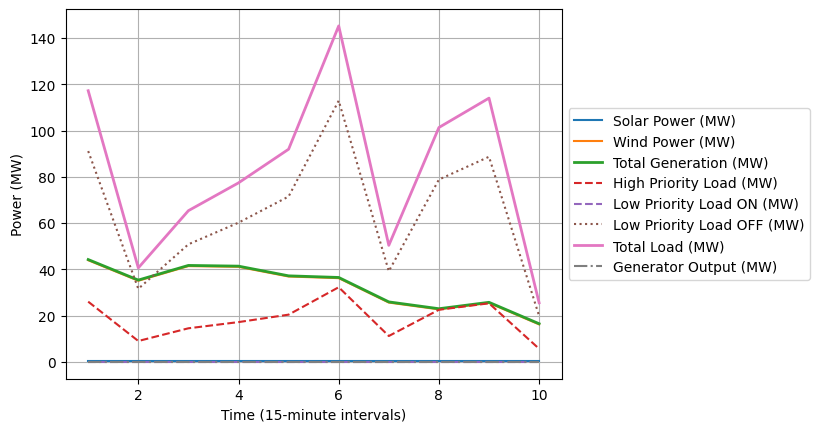
Reliable electricity is not just a convenience; it is a basic human necessity. However, a huge number of people in developing countries face daily power cuts that disrupt their everyday lives. When load demand exceeds the available energy supply, high-priority services such as emergency hospitals (particularly ICUs, ventilators, and surgical units), emergency services, street lighting, railways, airport operations, and critical household appliances such as refrigerators, water pumps, and heating or cooling systems may fail to function properly. This challenge is further worsened by the heavy reliance on costly and environmentally damaging fossil fuels. Although solar and wind energy are cleaner and more affordable, managing them is still a challenge because they do not produce a steady supply of power—their output rises and falls with the weather. This paper introduces a smart energy management system that uses a Long Short-Term Memory (LSTM) model to predict renewable energy output and an XGBoost model to predict electricity consumption by the load. The forecasting models were developed and tested using four real-world datasets that capture solar generation, wind generation, and the electricity needs of both high-priority and low-priority loads. Using these predicted values, a rule-based control system was designed and simulated in MATLAB/Simulink to efficiently manage the distribution of power. The system classifies electrical loads into two groups: high-priority and low-priority loads, and guarantees that high-priority loads are always supplied with power before others. The backup generator kicks in automatically only when renewable power generation is insufficient to supply high-priority loads, which helps keep operational costs low and reduces reliance on non-renewable energy sources. The proposed forecasting models have shown strong and consistent performance on the four datasets. For solar generation forecasting, the LSTM model achieved an R² of 0.9577, MSE of 29.72, RMSE of 5.45, and MAE of 2.75, improving over baseline values of R²=0.94, MSE=45.00, RMSE=20.1, and MAE=15.2. For wind generation forecasting, the LSTM model achieved an R² of 0.9537, MSE of 143.20, RMSE of 11.97, and MAE of 7.83, compared to baseline values of R²=0.94, MSE=180.00, RMSE=20.1, and MAE=15.2. The XGBoost model's results for high priority load demand forecasting were R² =0.9007, MSE=10.32, RMSE=3.21 and MAE=2.61, compared to the baseline R²=0.85, MSE=56.72, RMSE=7.48 and MAE=5.90. For low priority load demand forecasting, the XGBoost model achieved an R² of 0.9004, MSE of 126.78, RMSE of 11.26, and MAE of 9.13, compared to baseline values of R²=0.86, MSE=130.00, RMSE=13.00, and MAE=13.00. The simulation outcomes further validate that the proposed system reliably delivers an uninterrupted power supply to high-priority loads under varying operating conditions, whether renewable generation is high, limited, or completely insufficient, while considerably reducing the unnecessary activation of backup generators
References
M. Naimoglu, “The effect of energy prices, energy losses, and renewable energy use on CO2 emissions in energy-importing developing economies in the presence of an environmental Kuznets curve,” Environ. Sci. Pollut. Res. 2023 3020, vol. 30, no. 20, pp. 58755–58772, Mar. 2023, doi: 10.1007/S11356-023-26656-4.
Jiannan Wang, Waseem Azam, “Natural resource scarcity, fossil fuel energy consumption, and total greenhouse gas emissions in top emitting countries,” Geosci. Front., vol. 15, no. 2, p. 101757, 2024, doi: https://doi.org/10.1016/j.gsf.2023.101757.
Bożena Gajdzik, Radosław Wolniak, “The Influence of the Global Energy Crisis on Energy Efficiency: A Comprehensive Analysis,” Energies, vol. 17, no. 4, p. 947, 2024, doi: https://doi.org/10.3390/en17040947.
Mugheera Ali Mumtaz, Atiq Ur Rehman, Muhammad Ayub, Fazal Muhammad, Muhammad Waleed Raza, “Techno-economic and environmental analysis of hybrid energy system for industrial sector of Pakistan,” Sci. Rep., 2024, [Online]. Available: https://www.nature.com/articles/s41598-024-74540-z
M. A. Hannan, S. B. Wali, “Battery energy-storage system: A review of technologies, optimization objectives, constraints, approaches, and outstanding issues,” J. Energy Storage, vol. 42, p. 103023, 2021, doi: https://doi.org/10.1016/j.est.2021.103023.
Mohammad Liton Hossain, S. M. Nasif Shams & Saeed Mahmud Ullah, “Time-series and deep learning approaches for renewable energy forecasting in Dhaka: a comparative study of ARIMA, SARIMA, and LSTM models,” Discov. Sustain., vol. 6, no. 775, 2025, [Online]. Available: https://link.springer.com/article/10.1007/s43621-025-01733-5
Vidhi Rajeshkumar Patel, Havva Sena Cakar, “Short-Term Solar and Wind Power Forecasting Using Machine Learning Algorithms for Microgrid Operation,” Energies, vol. 19, no. 2, p. 550, 2025, doi: https://doi.org/10.3390/en19020550.
Afsaneh Mollasalehi, Armin Farhadi, “Solar and Wind Power Forecasting: A Comparative Review of LSTM, Random Forest, and XGBoost Models,” arXiv:2509.24059, 2025, [Online]. Available: https://arxiv.org/abs/2509.24059
Hristo Ivanov Beloev, Stanislav Radikovich Saitov, “Short-Term Electrical Load Forecasting Based on XGBoost Model,” Energies, vol. 18, no. 19, p. 5144, 2025, doi: https://doi.org/10.3390/en18195144.
Shuang Zeng, Chang Liu, “Short-Term Load Forecasting in Power Systems Based on the Prophet–BO–XGBoost Model,” Energies, vol. 18, no. 2, p. 227, 2025, doi: https://doi.org/10.3390/en18020227.
V. O. Nyangaresi, “AI-Driven Energy Forecasting Enhancing Smart Grid Efficiency with LSTM Networks,” EDRAAK, vol. 2024, pp. 32–38, Mar. 2024, doi: 10.70470/EDRAAK/2024/005.
S. Jha, S. M. Kolekar, S. Bose, M. H. Kolekar, and D. Swain, “Smart Grid Energy Management: Leveraging Bidirectional LSTM and Attention Mechanism for Accurate Forecasting,” Lect. Notes Comput. Sci., vol. 15618 LNCS, pp. 304–318, 2025, doi: 10.1007/978-3-031-88220-3_22/SAVE-RESEARCH.
Md Tanjil Sarker, Gobbi Ramasamy, Marran Al Qwaid, Md Sabbir Hossen & Md. Golam Sadeque, “AI-driven smart grid optimization for hospital energy systems integrating renewable generation, predictive maintenance, and resilient infrastructure,” Sci. Rep., vol. 15, 2025, [Online]. Available: https://www.nature.com/articles/s41598-025-28907-5
“Short-term and long-term solar irradiance forecasting with advanced machine learning techniques in Zafarana, Egypt | Scientific Reports.” Accessed: May 14, 2026. [Online]. Available: https://www.nature.com/articles/s41598-025-24853-4
T. A. Rajaperumal & C. Christopher Columbus, “Enhanced wind power forecasting using machine learning, deep learning models and ensemble integration,” Sci. Rep., vol. 15, 2025, [Online]. Available: https://www.nature.com/articles/s41598-025-05250-3
S. Rakshit, A. R. Sengupta, “Comparison of Machine Learning and Deep Learning Models Performance in predicting wind energy,” EAI Endorsed Trans. Energy Web, vol. 12, 2025, [Online]. Available: https://publications.eai.eu/index.php/ew/article/view/7114
G. Qiang and S. Tang, “Energy Load Forecast in Green Buildings Based on LSTM Deep Learning Model,” Lect. Notes Electr. Eng., vol. 1336 LNEE, pp. 408–413, 2025, doi: 10.1007/978-981-96-1965-8_37/SAVE-RESEARCH.
E. Meghaa, R. Niranjan, and R. Satheesh, “Deep Learning-Based Load Forecasting in Smart Grid,” ETIS Int. Conf. Emerg. Technol. Intell. Syst. ETIS 2025, 2025, doi: 10.1109/ETIS64005.2025.10961160.
M. Asghar Majeed, S. Phichaisawat, F. Asghar and U. Hussan, “Data-Driven Optimized Load Forecasting: An LSTM-Based RNN Approach for Smart Grids,” IEEE Access, vol. 13, pp. 99018–99031, 2025, doi: 10.1109/ACCESS.2025.3576303.
Pourya Nazartalab & Hosein Alavi-Rad, “Resilience-oriented optimization of hospital microgrids with critical load support using ESS and PV under grid outage conditions,” Sci. Rep., vol. 16, 2026, [Online]. Available: https://www.nature.com/articles/s41598-026-34992-x
Josep Hervás-Zaragoza, Antonio Colmenar-Santos, “Microgrids as a mechanism for improving energy resilience during grid outages: A post COVID-19 case study for hospitals,” Renew. Energy, vol. 199, pp. 308–319, 2022, doi: https://doi.org/10.1016/j.renene.2022.08.132.
Tuohua Jia, Wenhao He, “Optimizing urban energy management: A strategic examination of smart grids and policy regulations,” Sustain. Cities Soc., vol. 106, p. 105379, 2024, doi: https://doi.org/10.1016/j.scs.2024.105379.
M. Elsaraiti and A. Merabet, “Solar Power Forecasting Using Deep Learning Techniques,” IEEE Access, vol. 10, pp. 31692–31698, 2022, doi: 10.1109/ACCESS.2022.3160484.
“(PDF) Understanding the Role of Machine Learning in Renewable Energy Forecasting.” Accessed: May 14, 2026. [Online]. Available: https://www.researchgate.net/publication/384260986_Understanding_the_Role_of_Machine_Learning_in_Renewable_Energy_Forecasting
Saeed Hasan Nabil, “Enhancing Wind and Solar Power Forecasting in Smart Grids Using a Hybrid CNN-LSTM Model for Improved Grid Stability and Renewable Energy Integration,” World J. Adv. Eng. Technol. Sci., vol. 17, no. 3, pp. 213–226, 2025, doi: 10.30574/wjaets.2025.17.3.1552.
Yongbao Chen & Junjie Xu, “Solar and wind power data from the Chinese State Grid Renewable Energy Generation Forecasting Competition,” Sci. Data, 2022, [Online]. Available: https://www.nature.com/articles/s41597-022-01696-6
“IoT-Enabled Smart Grid Dataset.” Accessed: May 13, 2026. [Online]. Available: https://www.kaggle.com/datasets/ziya07/iot-enabled-smart-grid-dataset
M. K. Pasupuleti, “Grid Integration of Intermittent Renewables Using AI-Powered Forecasting Models,” Int. J. Acad. Ind. Res. Innov., vol. 05, no. 06, pp. 492–506, Jun. 2025, doi: 10.62311/NESX/RPHCRCSESRE5.
Falah Dakheel, Mesut Çevik, “Optimizing Smart Grid Load Forecasting via a Hybrid Long Short-Term Memory-XGBoost Framework: Enhancing Accuracy, Robustness, and Energy Management,” Energies, vol. 18, no. 11, p. 2842, 2025, doi: https://doi.org/10.3390/en18112842.
Downloads
Published
How to Cite
Issue
Section
License
Copyright (c) 2026 50sea

This work is licensed under a Creative Commons Attribution 4.0 International License.