Semi-Autonomous In-Pipe Inspection and Monitoring Robot for Gas Pipelines: Design, Development, and Experimental Validation
DOI:
https://doi.org/10.33411/IJIST/1937Keywords:
In-pipe Inspection Robot, Gas Pipeline, Pantograph Mechanism, Ultrasonic Sensing, LoRa CommunicationAbstract
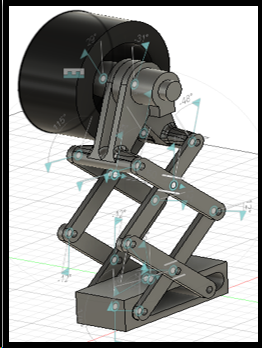
Gas pipelines form an essential component of energy infrastructure, playing a vital role in delivering natural gas safely and economically for industrial, commercial, and domestic use. The networks in Pakistan are owned by Sui Northern Gas Pipelines Limited (SNGPL) and Sui Southern Gas Company (SSGC) which span thousands of kilometers or which have a total length of thousands of kilometers and therefore require periodic inspection, which is a very challenging logistical task. Traditional techniques (manual visual inspection and pipeline inspection gauges (PIGs)) are labor-intensive, dangerous, and often fail to detect defects during their early phase—such as micro-cracks or localized corrosion. This paper describes the design, development, and experimental validation of an in-pipe inspection and monitoring robot that was designed for the 14–16-inch-diameter gas distribution pipelines. The robot incorporates two mechanisms: a pantographic mechanism is used for primary radial traction, and a telescopic mechanism is used for passive wall-contact support for different pipe diameter variations. The built-in inspection equipment includes a 5.8 GHz first-person view (FPV) camera system, a long-range communication module (LoRa SX1278, 433 MHz), a NEO-6M GPS module for defect location, and a wall thickness measurement module (HC-SR04 ultrasonic sensor array). The propulsion system is powered by a set of 6 12V DC gear motors (12V60-70Rpm) which are controlled by an Arduino Mega ATmega2560 microcontroller. The prototype is made of PLA (3D-printed) and acrylic (laser cut), and its overall weight is 3.7kg, with a length of 460 mm. The experimental trials successfully showed that the proposed low-cost design can achieve the following performances to enable real-time inspection of 14–16 inch gas distribution pipelines: mean traversal speed of 0.169 ± 0.002 m/s (n = 5, 95% CI: 0.167–0.171 m/s, coefficient of variation 1.2%); continuous inspection endurance of 21 min 15 s (≈215 m per run at 76 W average power draw); wall-thickness measurement repeatable within 6 mm (≤4.1% of the nominal 145 mm wall distance) at 9 out of 13 test locations; GPS defect localization being accurate to within ±2–3 m; and LoRa telemetry being accurate within sub-100 ms latency and sustained up to 1 km line-of-sight distance and 0.6 km in an urban environment.
References
“Ministry of Finance | Government of Pakistan |.” Accessed: Jul. 26, 2026. [Online]. Available: https://www.finance.gov.pk/survey_archieve.html
“Pakistan - Sui Northern Gas Pipelines Limited Project.” Accessed: Jul. 26, 2026. [Online]. Available: https://documents.worldbank.org/en/publication/documents-reports/documentdetail/260051468284992417
T. T. Nguyen, D. K. Kim, Y. W. Rho, and S. B. Kim, “Dynamic modeling and its analysis for PIG flow through curved section in natural gas pipeline,” Proc. IEEE Int. Symp. Comput. Intell. Robot. Autom. CIRA, vol. 2001-January, pp. 492–497, 2001, doi: 10.1109/CIRA.2001.1013250.
D. Mishra, K. K. Agrawal, A. Abbas, R. Srivastava, and R. S. Yadav, “PIG [Pipe Inspection Gauge]: An Artificial Dustman for Cross Country Pipelines,” Procedia Comput. Sci., vol. 152, pp. 333–340, Jan. 2019, doi: 10.1016/J.PROCS.2019.05.009.
W. M. F. Al-Masri, M. F. Abdel-Hafez, and M. A. Jaradat, “Inertial Navigation System of Pipeline Inspection Gauge,” IEEE Trans. Control Syst. Technol., vol. 28, no. 2, pp. 609–616, Mar. 2020, doi: 10.1109/TCST.2018.2879628.
T. R. Wanasinghe, R. G. Gosine, O. De Silva, G. K. I. Mann, L. A. James, and P. Warrian, “Unmanned aerial systems for the oil and gas industry: Overview, applications, and challenges,” IEEE Access, vol. 8, pp. 166980–166997, 2020, doi: 10.1109/ACCESS.2020.3020593.
W. Jeon, J. Park, I. Kim, Y. K. Kang, and H. Yang, “Development of high mobility in-pipe inspection robot,” 2011 IEEE/SICE Int. Symp. Syst. Integr. SII 2011, pp. 479–484, 2011, doi: 10.1109/SII.2011.6147496.
S. G. Roh, S. M. Ryew, J. H. Yang, and H. R. Choi, “Actively steerable inpipe inspection robots for underground urban gas pipelines,” Proc. - IEEE Int. Conf. Robot. Autom., vol. 1, pp. 761–766, 2001, doi: 10.1109/ROBOT.2001.932642.
S. G. Roh and H. R. Choi, “Differential-drive in-pipe robot for moving inside urban gas pipelines,” IEEE Trans. Robot., vol. 21, no. 1, pp. 1–17, Feb. 2005, doi: 10.1109/TRO.2004.838000.
Y. S. Kwon, B. Lee, I. C. Whang, W. K. Kim, and B. J. Yi, “A flat pipeline inspection robot with two wheel chains,” Proc. - IEEE Int. Conf. Robot. Autom., pp. 5141–5146, 2011, doi: 10.1109/ICRA.2011.5979712.
J. H. Kim, G. Sharma, and S. S. Iyengar, “FAMPER: A fully autonomous mobile robot for pipeline exploration,” Proc. IEEE Int. Conf. Ind. Technol., pp. 517–523, 2010, doi: 10.1109/ICIT.2010.5472748.
K. Hayashi et al., “Improvement of pipe holding mechanism and inchworm type flexible pipe inspection robot,” Int. J. Mech. Eng. Robot. Res., vol. 9, no. 6, pp. 894–899, Jun. 2020, doi: 10.18178/IJMERR.9.6.894-899.
S. Savin and L. Vorochaeva, “Footstep planning for a six-legged in-pipe robot moving in spatially curved pipes,” 2017 Int. Sib. Conf. Control Commun. SIBCON 2017 - Proc., Jul. 2017, doi: 10.1109/SIBCON.2017.7998581.
S. Savin, S. Jatsun, and L. Vorochaeva, “Trajectory generation for a walking in-pipe robot moving through spatially curved pipes,” MATEC Web Conf., vol. 113, Jun. 2017, doi: 10.1051/MATECCONF/201711302016.
T. Nishimura, A. Kakogawa, and S. Ma, “Pathway selection mechanism of a screw drive in-pipe robot in T-branches,” IEEE Int. Conf. Autom. Sci. Eng., pp. 612–617, 2012, doi: 10.1109/COASE.2012.6386388.
A. Verma, A. Kaiwart, N. D. Dubey, F. Naseer, and S. Pradhan, “A review on various types of in-pipe inspection robot,” Mater. Today Proc., vol. 50, pp. 1425–1434, Jan. 2022, doi: 10.1016/J.MATPR.2021.08.335.
R. Sugin Elankavi, D. Dinakaran, A. S. A. Doss, R. M. Kuppan Chetty, and M. M. Ramya, “Design of a wheeled-Type In-Pipe Inspection Robot to overcome motion singularity in curved pipes,” J. Ambient Intell. Smart Environ., vol. 16, no. 1, pp. 43–55, Mar. 2024, doi: 10.3233/AIS-220247;ISSUE:ISSUE:DOI.
J. Park, T. Luong, and H. Moon, “Development of a Wheel-Type In-Pipe Robot Using Continuously Variable Transmission Mechanisms for Pipeline Inspection,” Biomimetics, vol. 9, no. 2, p. 113, Feb. 2024, doi: 10.3390/BIOMIMETICS9020113/S1.
K. Wu, H. Sang, Y. Xing, and Y. Lu, “Design of wireless in-pipe inspection robot for image acquisition,” Ind. Rob., vol. 50, no. 1, pp. 145–161, Jan. 2023, doi: 10.1108/IR-02-2022-0043.
Q. Wang, M. Cai, and Z. Guo, “An enhanced positioning technique for underground pipeline robot based on inertial Sensor/Wheel odometer,” Measurement, vol. 206, p. 112298, Jan. 2023, doi: 10.1016/J.MEASUREMENT.2022.112298.
A. A. A. Eltwab and A. Sameh, “A modular, multi-sensor crawler robot for adaptive pipeline inspection: design and experimental validation,” Sci. Reports 2026 161, vol. 16, no. 1, pp. 880-, Jan. 2026, doi: 10.1038/s41598-025-32719-y.
C. Rusu and M. O. Tatar, “Adapting Mechanisms for In-Pipe Inspection Robots: A Review,” Appl. Sci. 2022, Vol. 12, Page 6191, vol. 12, no. 12, p. 6191, Jun. 2022, doi: 10.3390/APP12126191.
S. Kazeminasab, N. Sadeghi, V. Janfaza, M. Razavi, S. Ziyadidegan, and M. K. Banks, “Localization, Mapping, Navigation, and Inspection Methods in In-Pipe Robots: A Review,” IEEE Access, vol. 9, pp. 162035–162058, 2021, doi: 10.1109/ACCESS.2021.3130233.
W. Zhao, L. Zhang, and J. Kim, “Design and Analysis of Independently Adjustable Large In-Pipe Robot for Long-Distance Pipeline,” Appl. Sci. 2020, Vol. 10, Page 3637, vol. 10, no. 10, p. 3637, May 2020, doi: 10.3390/APP10103637.
S. K. P. Ankit Nayak, “Design of a New In-Pipe Inspection Robot,” Procedia Eng., vol. 97, pp. 2081–2091, 2014, doi: https://doi.org/10.1016/j.proeng.2014.12.451.
A. S. Z. Abidin et al., “Development of In-Pipe Robot D300: Cornering Mechanism,” MATEC Web Conf., vol. 87, 2017, doi: 10.1051/MATECCONF/20178702029.
D. Chablat, S. Venkateswaran, and F. Boyer, “Mechanical Design Optimization of a Piping Inspection Robot,” Procedia CIRP, vol. 70, pp. 307–312, Jan. 2018, doi: 10.1016/J.PROCIR.2018.02.015.
“Different Types of Rubber: Names, Properties, and Uses.” Accessed: Jul. 26, 2026. [Online]. Available: https://flextron.org/blog/different-types-of-rubber-names-properties-uses/
A. Gunatilake, L. Piyathilaka, A. Tran, V. K. Vishwanathan, K. Thiyagarajan, and S. Kodagoda, “Stereo vision combined with laser profiling for mapping of pipeline internal defects,” IEEE Sens. J., vol. 21, no. 10, pp. 11926–11934, May 2021, doi: 10.1109/JSEN.2020.3040396.
S. Kazeminasab and M. K. Banks, “SmartCrawler: A Size-Adaptable In-Pipe Wireless Robotic System with Two-Phase Motion Control Algorithm in Water Distribution Systems,” Sensors 2022, Vol. 22, Page 9666, vol. 22, no. 24, p. 9666, Dec. 2022, doi: 10.3390/S22249666.
Chuka Anthony Arinze, Izionworu, Vincent Onuegbu, Daniel Isong, Cosmas Dominic Daudu, and Adedayo Adefemi, “Predictive maintenance in oil and gas facilities, leveraging ai for asset integrity management,” Int. J. Front. Eng. Technol. Res., vol. 6, no. 1, pp. 016–026, Mar. 2024, doi: 10.53294/IJFETR.2024.6.1.0026.
Y. S. Kwon and B. J. Yi, “Design and motion planning of a two-module collaborative indoor pipeline inspection robot,” IEEE Trans. Robot., vol. 28, no. 3, pp. 681–696, 2012, doi: 10.1109/TRO.2012.2183049.
S. Savin, “RRT-based Motion Planning for In-pipe Walking Robots,” 12th Int. Sci. Tech. Conf. "Dynamics Syst. Mech. Mach. Dyn. 2018, Jul. 2018, doi: 10.1109/DYNAMICS.2018.8601473.
Downloads
Published
How to Cite
Issue
Section
License
Copyright (c) 2026 50sea

This work is licensed under a Creative Commons Attribution 4.0 International License.