MUETHUB: A Web App for University Communication and Collaboration
DOI:
https://doi.org/10.33411/IJIST/1945Keywords:
University Communication, Academic Collaboration, MERN Stack, Artificial Intelligence, Web ApplicationAbstract
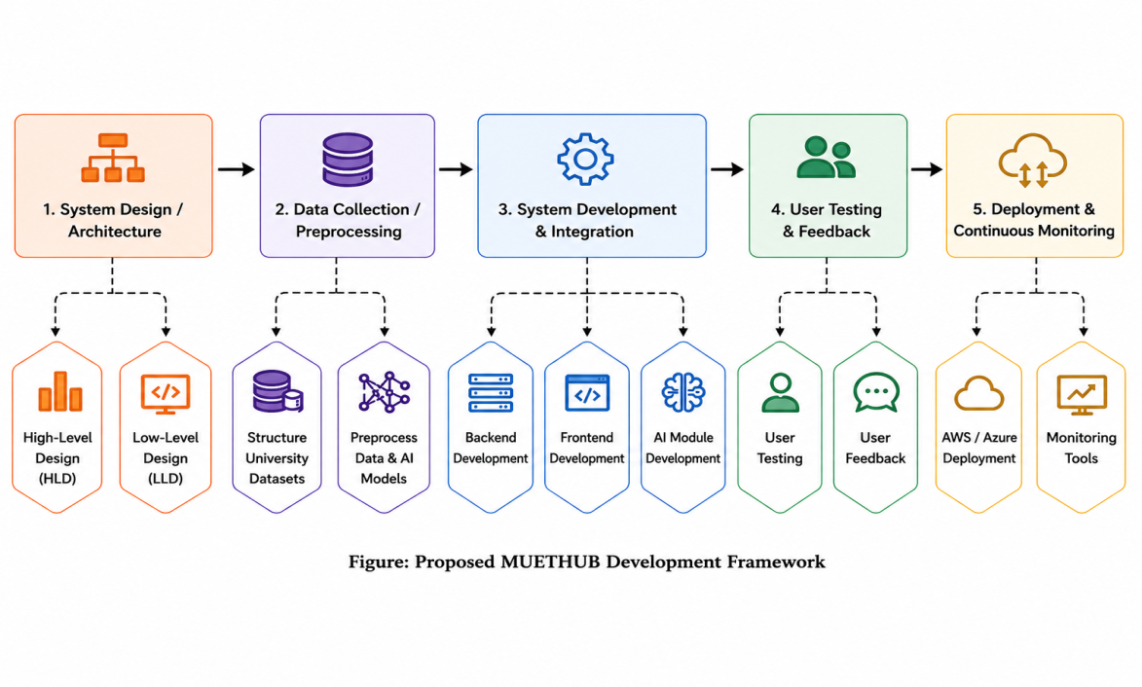
Effective communication and collaboration are vital aspects for facilitating academic activities at universities. However, at Mehran University of Engineering and Technology (MUET), the current means of communication are rather decentralized and include the use of WhatsApp groups, social media pages, manual announcements, and informal student interaction, which often results in disinformation, delays, and lack of structured collaboration. Hence, the purpose of the current research project is to develop a centralized platform for MUET-specific communication and collaboration. The main novelty of MUETHUB is that it includes an authenticated student-to-teacher communication system, departmental forums, a community management module, an academic resource sharing section, public forums, and AI chatbot. The platform was developed using the MERN stack (MongoDB, Express.js, React.js, Node.js), TypeScript, and the Tailwind CSS framework for application development. The official information about MUET was taken from the university sources. The information about the communities was checked through the approval system. Separate modules, including the authentication module, messaging module, resource-sharing module, community management module, and AI chatbot, were designed and implemented into one unified platform and tested through user testing and feedback. A test with the participation of 30 participants demonstrated a user satisfaction of 92%, while AI chatbot was rated positively by 88%. Performance tests done in a controlled environment gave the following results: average page loading time is 2.1 sec, average system reaction time is 1.8 sec, and the accuracy of response of the chatbot is 88%. Thus, students and teachers of MUET can use MUETHUB to communicate with each other through authenticated departmental and private messages, share academic resources, get involved in university communities, and access official information about MUET. The AI chatbot provides immediate responses to university-related questions based on verified information of the institution, thus assisting new students with onboarding. The administrative modules allow managing departments, communities, public forums, and chatbot training data.
References
L. Terletska, S. Sobolieva, M. Hryshchuk, Y. Haidenko, and Y. Dankevych, “Chatbots and virtual assistants in higher education: supporting academic writing and research,” Rev. Eduweb, vol. 20, no. 1, p. 382, Mar. 2026, doi: 10.46502/ISSN.1856-7576/2026.20.01.23.
Mrs. Divya P, “The Role of AI in Education: Opportunities and Challenges,” Int. J. Sci. Technol., vol. 17, no. 1, 2026, [Online]. Available: https://www.ijsat.org/papers/2026/1/10240.pdf
R. Sajja, Y. Sermet, D. Cwiertny, and I. Demir, “Platform-independent and curriculum-oriented intelligent assistant for higher education,” Int. J. Educ. Technol. High. Educ. 2023 201, vol. 20, no. 1, pp. 42-, Jul. 2023, doi: 10.1186/S41239-023-00412-7.
C. McGrath, A. Farazouli, and T. Cerratto-Pargman, “Generative AI chatbots in higher education: a review of an emerging research area,” High. Educ. 2024 896, vol. 89, no. 6, pp. 1533–1549, Aug. 2024, doi: 10.1007/S10734-024-01288-W.
L. M. Lasha Labadze, Maya Grigolia, “Role of AI chatbots in education: systematic literature review,” Int. J. Educ. Technol. High. Educ., vol. 20, no. 56, 2023, [Online]. Available: https://link.springer.com/article/10.1186/s41239-023-00426-1
S. krishna Chanamolu, “AI-Driven Personalized Learning Platforms for Enhanced Student Engagement and Performance in Virtual Classrooms,” J. Comput. Educ. Sport. Heal. (JCESH, ISSN 3049-4273), vol. 2, no. 3, pp. 15–27, Dec. 2025, doi: 10.69996/JCESH.2025012.
S. Boonying, S. Somsuphaprungyot, A. Putthidech, A. Sookjam, and P. Natho, “The Development of an Automated Response System Using AI Chatbot to Support and Resolving Network-Related Problems at Thai University,” Asian Conf. Educ. 2024 Off. Conf. Proc., pp. 1621–1633, Mar. 2025, doi: 10.22492/ISSN.2186-5892.2025.136.
A. Althunibat et al., “Learning Experience of Students Using the Learning Management System: User’s Perspective on the Use of Moodle in the University of Jordan,” Adv. Human-Computer Interact., vol. 2023, no. 1, p. 6659245, Jan. 2023, doi: 10.1155/2023/6659245.
G. Sedrakyan, S. Borsci, M. Machado, P. Rogetzer, and M. Mes, “Design Implications for Integrating AI Chatbot Technology with Learning Management Systems: A Study-based Analysis on Perceived Benefits and Challenges in Higher Education,” ICAITE 2024 - 2024 Int. Conf. Artif. Intell. Teach. Educ., vol. 1, pp. 1–8, Jan. 2025, doi: 10.1145/3702386.3702405;Csubtype:String:Conference.
Huy Dang Truong, Tran Thi-Yen-Linh, Nguyen Thi-Duyen-Ngoc, “Development of an AI Chatbot to Support Admissions and Career Guidance for Universities,” Int. J. Emerg. Multidiscip. Fluid Sci., 2020, doi: 10.22662/IJEMR.2020.4.2.013.
G. Bilquise, S. Ibrahim, and S. M. Salhieh, “Investigating student acceptance of an academic advising chatbot in higher education institutions,” Educ. Inf. Technol. 2023 295, vol. 29, no. 5, pp. 6357–6382, Aug. 2023, doi: 10.1007/s10639-023-12076-x.
R. T. Williams, “The ethical implications of using generative chatbots in higher education,” Front. Educ., vol. 8, p. 1331607, Jan. 2023, doi: 10.3389/FEDUC.2023.1331607/TEXT.
T. Kingchang, P. Chatwattana, and P. Wannapiroon, “Artificial Intelligence Chatbot Platform: AI Chatbot Platform for Educational Recommendations in Higher Education,” Int. J. Inf. Educ. Technol., vol. 14, no. 1, pp. 34–41, 2024, doi: 10.18178/IJIET.2024.14.1.2021.
J. Dempere, K. Modugu, A. Hesham, and L. K. Ramasamy, “The impact of ChatGPT on higher education,” Front. Educ., vol. 8, p. 1206936, Sep. 2023, doi: 10.3389/FEDUC.2023.1206936/TEXT.
Q. A. Mohammed et al., “Role of Online Collaborative Platform in Higher Education Context,” IJAEDU-International E-Journal Adv. Educ., vol. VI, 2020, Accessed: Jul. 24, 2026. [Online]. Available: http://ijaedu.ocerintjournals.org
R. Al-Jarf, “Collaborative Learning and Teaching in Digital Environments: A Systematic Review of Two Decades of Research,” J. Comput. Sci. Technol. Stud., vol. 8, no. 4, pp. 25–40, Feb. 2026, doi: 10.32996/JCSTS.2026.8.4.2.
Y. Xiaodi, M. Md Yunus, and K. Rafiqah M. Rafiq, “Digital Collaborative Learning in Higher Education: A Systematic Review,” Int. J. Acad. Res. Progress. Educ. Dev., vol. 13, no. 1, Feb. 2024, doi: 10.6007/IJARPED/V13-I1/20697.
A. S. Almogren, W. M. Al-Rahmi, and N. A. Dahri, “Integrated Technological Approaches to Academic Success: Mobile Learning, Social Media, and AI in Visual Art Education,” IEEE Access, vol. 12, pp. 175391–175413, 2024, doi: 10.1109/ACCESS.2024.3498047.
Z. Huang and C. C. Cao, “Federated Learning for AI-Assisted Education: Privacy-Preserving and Cross-Platform Collaborative Modeling in Higher Education,” Proc. 2nd Int. Conf. Mach. Intell. Digit. Appl. MIDA 2025, vol. 1, pp. 146–151, Jul. 2025, doi: 10.1145/3744464.3744487;Journal:Acmotherconferences;Ctype:String:Book.
A. I. Jony and S. A. Hamim, “Empowering virtual collaboration: harnessing AI for enhanced teamwork in higher education,” Educ. Technol. Q., vol. 2024, no. 3, pp. 337–359, Sep. 2024, doi: 10.55056/ETQ.746.
O. V. Sergeeva, M. R. Zheltukhina, and S. Demir, “From assistance to integrity: exploring the role of AI in academic communication across Russian and Turkish campuses,” Front. Commun., vol. 10, p. 1479813, May 2025, doi: 10.3389/FCOMM.2025.1479813/PDF.
M. Mohammad, N. Sadat, M. Tokhi, M. A. Azizi, S. Esmati, and R. Hanginiaina Emynorane, “Evaluating the Impact of AI-Enabled Cloud Communication Platforms on Student Engagement in Higher Education: A Case of Afghanistan Private Universities,” Glob. Educ. Trends, vol. 3, no. 2, pp. 113–127, Oct. 2025, doi: 10.61798/GET.V3I2.391.
“Mehran University of Engineering & Technology | Mehran University.” Accessed: Jul. 24, 2026. [Online]. Available: https://www.muet.edu.pk/
Downloads
Published
How to Cite
Issue
Section
License
Copyright (c) 2026 50sea

This work is licensed under a Creative Commons Attribution 4.0 International License.