A Machine Learning-Based Early Warning System for Rainfall Level and Cloudburst Prediction
DOI:
https://doi.org/10.33411/IJIST/1948Keywords:
Cloudburst Prediction, Rainfall Forecasting, CNN-LSTM, Early Warning System, Risk Rating Score, Deep LearningAbstract
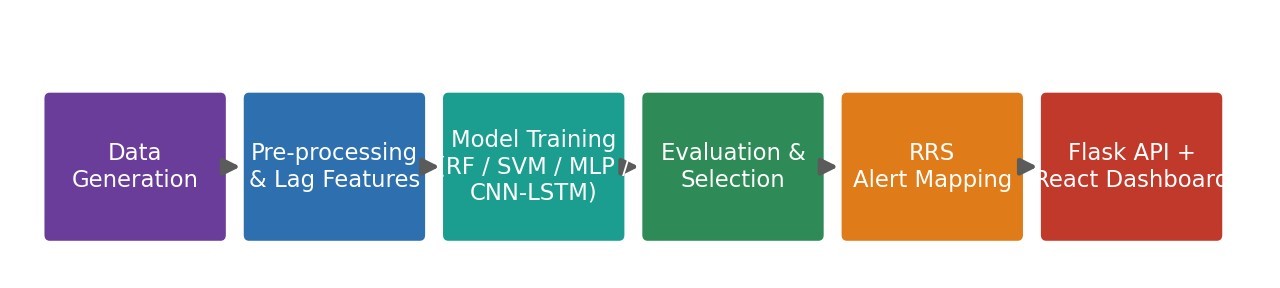
Extreme rainfall events and cloudbursts pose a severe threat to human life, infrastructure, agriculture and environmental sustainability particularly in regions of complex terrain such as northern Pakistan. Traditional Numerical Weather Prediction (NWP) systems struggle to resolve localized short-duration convective events because of their coarse spatial resolution and high computational latency leaving vulnerable populations with little lead time to respond. This study presents a full- stack machine learning -based Early Warning System (EWS) for predicting rainfall levels and detecting potential cloudburst events. To overcome the scarcity of high resolution localized meteorological records a physically informed data simulator was engineered to generate more than 145000 daily observations spanning nine years across 49 distinct locations covering temperature, humidity, pressure and wind parameters. Four predictive models Random Forest, Support Vector Machine (SVM), Logistic Regression and a hybrid Convolutional Neural Network with Bidirectional Long Short-Term Memory (CNN-LSTM) were trained and benchmarked on both rainfall magnitude regression and cloudburst classification. The CNN-LSTM model delivered the best performance with 99.1% accuracy, 98.5% precision, 97.2% recall, a 97.8% F1 score and an AUC of 0.99 while maintaining a low false negative rate. The trained intelligence was deployed through a Python Flask REST API for real time inference and a Risk Rating Score (RRS) algorithm was introduced to translate raw model outputs into four actionable color-coded alert levels (Green, Yellow, Orange, Red). An interactive React dashboard lets disaster management officials enter live weather metrics and instantly receive visual warnings. The proposed system provides a practical link between complex meteorological artificial intelligence and user-friendly emergency response platform synoptic macro scale forecasting.
References
H. Singh, D. Varade, and P. K. Mishra, “Cloudburst Events in the Indian Himalayas: A Historical Geospatial Perspective,” Int. Handb. Disaster Res., pp. 777–798, Jan. 2023, doi: 10.1007/978-981-19-8388-7_192/SAVE-RESEARCH.
Muhammad Atiq Ur Rehman Tariq, Nick Van de Giesen, “Floods and flood management in Pakistan,” Phys. Chem. Earth, Parts A/B/C, vol. 47–48, pp. 11–20, 2012, [Online]. Available: https://www.sciencedirect.com/science/article/abs/pii/S1474706511002348
“Mesoscale Meteorological Modeling, Volume 98 - 3rd Edition | Elsevier Shop.” Accessed: Jul. 12, 2026. [Online]. Available: https://shop.elsevier.com/books/mesoscale-meteorological-modeling/pielke-sr/978-0-12-385237-3
Stephan Rasp, Michael S. Pritchard, “Deep learning to represent subgrid processes in climate models,” Proc. Natl. Acad. Sci. U. S. A., vol. 115, no. 39, pp. 9684–9689, 2018, doi: ttps://doi.org/10.1073/pnas.1810286115.
Y. Lecun, Y. Bengio, and G. Hinton, “Deep learning,” Nature, vol. 521, no. 7553, pp. 436–444, May 2015, doi: 10.1038/NATURE14539;SUBJMETA=117,639,705;KWRD=COMPUTER+SCIENCE,MATHEMATICS+AND+COMPUTING.
M. Reichstein et al., “Deep learning and process understanding for data-driven Earth system science,” Nat. 2019 5667743, vol. 566, no. 7743, pp. 195–204, Feb. 2019, doi: 10.1038/s41586-019-0912-1.
“Flash Flood Forecasting: An Ingredients-Based Methodology in: Weather and Forecasting Volume 11 Issue 4 (1996).” Accessed: Jul. 12, 2026. [Online]. Available: https://journals.ametsoc.org/view/journals/wefo/11/4/1520-0434_1996_011_0560_fffaib_2_0_co_2.xml
L. Breiman, “Random forests,” Mach. Learn., vol. 45, no. 1, pp. 5–32, Oct. 2001, doi: 10.1023/A:1010933404324/METRICS.
T. Chen and C. Guestrin, “XGBoost: A Scalable Tree Boosting System,” Proc. ACM SIGKDD Int. Conf. Knowl. Discov. Data Min., vol. 13-17-August-2016, pp. 785–794, Mar. 2016, doi: 10.1145/2939672.2939785.
Muhammad Ali Musarat, Wesam Salah Alaloul, “Kabul River Flow Prediction Using Automated ARIMA Forecasting: A Machine Learning Approach,” Sustainability, vol. 13, no. 19, 2021, doi: 10.3390/su131910720.
J. Hochreiter, S., & Schmidhuber, “Long short-term memory,” Neural Comput., vol. 9, no. 8, pp. 1735–1780, 1997, doi: https://doi.org/10.1162/neco.1997.9.8.1735.
Klaus Greff, Rupesh Kumar Srivastava, “LSTM: A Search Space Odyssey,” arXiv:1503.04069, 2017, [Online]. Available: https://arxiv.org/abs/1503.04069
Frederik Kratzert, Daniel Klotz, Claire Brenner, Karsten Schulz, “Rainfall–runoff modelling using Long Short-Term Memory (LSTM) networks,” Hydrol. Earth Syst. Sci., vol. 22, no. 11, 2018, doi: https://doi.org/10.5194/hess-22-6005-2018.
S. Nevo et al., “Flood forecasting with machine learning models in an operational framework,” Hydrol. Earth Syst. Sci., vol. 26, no. 15, pp. 4013–4032, Aug. 2022, doi: 10.5194/HESS-26-4013-2022.
W. W. X Shi, Z Chen, H Wang, DY Yeung, WK Wong, “Convolutional LSTM network: A machine learning approach for precipitation nowcasting,” Adv. Neural Inf. Process. Syst., vol. 28, pp. 802–810, 2015, [Online]. Available: https://proceedings.neurips.cc/paper/2015/hash/07563a3fe3bbe7e3ba84431ad9d055af-Abstract.html
Xiaoli Ren, Xiaoyong Li, “Deep Learning-Based Weather Prediction: A Survey,” Big Data Res., vol. 23, no. 7743, p. 100178, 2020, doi: 10.1016/j.bdr.2020.100178.
Yuchen Wang, Pengfei Jia, Zhitao Shu, Keyan Liu, Abdul Rashid Mohamed Shariff, “Multidimensional precipitation index prediction based on CNN-LSTM hybrid framework,” arXiv:2504.20442, 2025, [Online]. Available: https://arxiv.org/abs/2504.20442
Mahdi Panahi, Abolfazl Jaafari, “Deep learning neural networks for spatially explicit prediction of flash flood probability,” Geosci. Front., vol. 12, no. 3, p. 101076, 2021, doi: https://doi.org/10.1016/j.gsf.2020.09.007.
S. P. Siddique Ibrahim, N. Venkata Harika, N. Mohitha Reddy, K. Srija, P. S. Sahithi, and A. Kohima, “Application of Machine Learning and Data Mining Techniques for Accurate Cloud Burst Prediction,” Proc. 5th Int. Conf. IoT Based Control Networks Intell. Syst. ICICNIS 2024, pp. 1117–1124, 2024, doi: 10.1109/ICICNIS64247.2024.10823388.
M. Sivagami, P. Radha, and A. Balasundaram, “Sequence model based cloudburst prediction for the Indian state of Uttarakhand,” Disaster Adv., vol. 14, no. 7, pp. 1–9, Jul. 2021, doi: 10.25303/F2512105.
Kishan Singh Rawat, Smruti Ranjan Sahu, Sudhir Kumar Singh & Anil Kumar Mishra, “Cloudburst analysis in the Nainital district, Himalayan Region, 2021,” Discov. Water, vol. 2, no. 12, 2022, [Online]. Available: https://link.springer.com/article/10.1007/s43832-022-00020-y
Guru Dayal Kumar, Shekhar Tyagi, “District-Level Rainfall and Cloudburst Prediction Using XGBoost: A Machine Learning Approach for Early Warning Systems,” Informatica, vol. 49, no. 2, 2025, doi: 10.31449/inf.v49i2.7612.
K. W. B. Nitesh V. Chawla, “SMOTE: Synthetic Minority Over-sampling Technique,” J. Artif. Intell. Res., vol. 16, pp. 321–357, 2002, [Online]. Available: https://www.jair.org/index.php/jair/article/view/10302
Martín Abadi, Ashish Agarwal, Paul Barham, “TensorFlow: Large-Scale Machine Learning on Heterogeneous Distributed Systems,” arXiv:1603.04467, 2016, [Online]. Available: https://arxiv.org/abs/1603.04467
Fabian Pedregosa, Gaël Varoquaux, Alexandre Gramfort, “Scikit-learn: Machine Learning in Python,” arXiv:1201.0490, 2018, [Online]. Available: https://arxiv.org/abs/1201.0490
C. J. Willmott and K. Matsuura, “Advantages of the mean absolute error (MAE) over the root mean square error (RMSE) in assessing average model performance,” Clim. Res., vol. 30, no. 1, pp. 79–82, Dec. 2005, doi: 10.3354/CR030079.
Diederik P. Kingma, Jimmy Ba, “Adam: A Method for Stochastic Optimization,” arXiv:1412.6980, 2017, [Online]. Available: https://arxiv.org/abs/1412.6980
Downloads
Published
How to Cite
Issue
Section
License
Copyright (c) 2026 50sea

This work is licensed under a Creative Commons Attribution 4.0 International License.