An End-to-End 3D-CNN Framework for Silhouette-Based Human Gait Recognition
DOI:
https://doi.org/10.33411/IJIST/1953Keywords:
Human Gait Recognition, Biometric, Computer Vision, and Deep LeaningAbstract
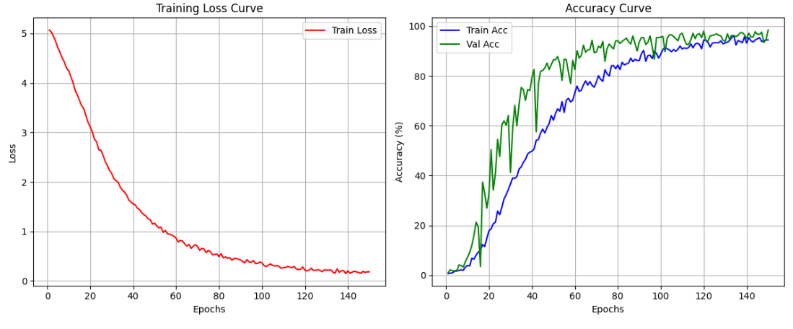
Human gait recognition (HGR) is a method of biometric identification that is widely adopted in fields of identification and authentication. Despite the fact that such a method is effective, it suffers from certain limitations caused by common variations, including illumination, carrying-condition, and walking-speed variations. In this paper, a new method called the 3D-CNN model is designed from scratch to overcome this problem. The proposed model uses silhouettes to obtain both spatial and temporal features. The proposed approach is based on some steps, such as acquisition of data, preprocessing, augmentation, designing of the 3D-CNN model, training of the model, and evaluation. The 3D-CNN model comprises four convolution blocks followed by a classification head. Experimental evaluation on the CASIA-C dataset demonstrated a validation accuracy of 98.48%, with a macro precision of 98.22%, macro recall of 97.60%, and macro F1-score of 97.53% by setting the number of epochs to 150. While accuracies of 95.87% and 96.52% were achieved using 100 and 200 epochs,respectively
References
“Biometric Recognition - an overview | ScienceDirect Topics.” Accessed: Jul. 16, 2026. [Online]. Available: https://www.sciencedirect.com/topics/engineering/biometric-recognition
C. Filipi Gonçalves Dos Santos et al., “Gait Recognition Based on Deep Learning: A Survey,” ACM Comput. Surv., vol. 55, no. 2, Feb. 2023, doi: 10.1145/3490235;SERIALTOPIC:TOPIC:ACM-PUBTYPE.
“Gait Recognition with Self-Supervised Learning of Gait Features Based on Vision Transformers.” Accessed: Jul. 16, 2026. [Online]. Available: https://www.mdpi.com/1424-8220/22/19/7140
N. V. Boulgouris, D. Hatzinakos, and K. N. Plataniotis, “Gait recognition: A challening signal processing technology for biometric identification,” IEEE Signal Process. Mag., vol. 22, no. 6, pp. 78–90, 2005, doi: 10.1109/MSP.2005.1550191.
Munish Kumar, Navdeep Singh, “Gait recognition based on vision systems: A systematic survey,” J. Vis. Commun. Image Represent., vol. 75, 2021, [Online]. Available: https://www.sciencedirect.com/science/article/pii/S1047320321000249
“A wearable system for gait training in subjects with Parkinson’s disease - PubMed.” Accessed: Jul. 16, 2026. [Online]. Available: https://pubmed.ncbi.nlm.nih.gov/24686731/
Michal Balazia, Konstantinos N. Plataniotis, “Human gait recognition from motion capture data in signature poses,” IET Biometrics, 2016.
Rijun Liao, Shiqi Yu, “A model-based gait recognition method with body pose and human prior knowledge,” Pattern Recognit., vol. 98, 2020, [Online]. Available: https://www.sciencedirect.com/science/article/pii/S003132031930370X
A. J. Muhammad Zeeshan Arshad, “Gait Events Prediction Using Hybrid CNN-RNN-Based Deep Learning Models through a Single Waist-Worn Wearable Sensor,” Sensors, vol. 22, no. 21, p. 8226, 2022, doi: https://doi.org/10.3390/s22218226.
J. Li et al., “Rethinking Appearance-Based Deep Gait Recognition: Reviews, Analysis, and Insights From Gait Recognition Evolution,” IEEE Trans. Neural Networks Learn. Syst., vol. 36, no. 6, pp. 9777–9797, 2025, doi: 10.1109/TNNLS.2025.3526815.
Vaishnavi Munusamy, Sudha Senthilkumar, “Emerging trends in gait recognition based on deep learning: a survey,” PeerJ. Comput. Sci., vol. 10, 2024, [Online]. Available: https://pubmed.ncbi.nlm.nih.gov/39145199/
C. Shen, S. Yu, J. Wang, G. Q. Huang, and L. Wang, “A Comprehensive Survey on Deep Gait Recognition: Algorithms, Datasets, and Challenges,” IEEE Trans. Biometrics, Behav. Identity Sci., vol. 7, no. 2, pp. 270–292, 2025, doi: 10.1109/TBIOM.2024.3486345.
Pınar Güner Şahan, Suhap Şahin & Fidan Kaya Gülağız, “A survey of appearance-based approaches for human gait recognition: techniques, challenges, and future directions,” J. Supercomput., vol. 80, 2024, [Online]. Available: https://link.springer.com/article/10.1007/s11227-024-06172-z
Anubha Parashar, Apoorva Parashar, “Advancements in artificial intelligence for biometrics: A deep dive into model-based gait recognition techniques,” Eng. Appl. Artif. Intell., vol. 130, p. 107712, 2024, doi: https://doi.org/10.1016/j.engappai.2023.107712.
Haoran Zhan, Jiange Kou, “Human Gait phases recognition based on multi-source data fusion and BILSTM attention neural network,” Measurement, vol. 238, no. 115396, 2024, [Online]. Available: https://www.sciencedirect.com/science/article/pii/S0263224124012818
Muqing Deng, Zebang Zhong, Yi Zou, Yanjiao Wang, Kaiwei Wang & Junrong Liao, “Human Gait Recognition Based on Frontal-View Walking Sequences Using Multi-modal Feature Representations and Learning,” Neural Process. Lett., vol. 56, no. 133, 2024, [Online]. Available: https://link.springer.com/article/10.1007/s11063-024-11554-8
Mohammad Iman Junaid, Sandeep Madarapu, “Human gait recognition using dense residual network and hybrid attention technique with back-flow mechanism,” Digit. Signal Process., vol. 166, p. 105401, 2025, doi: https://doi.org/10.1016/j.dsp.2025.105401.
Muqing Deng, Yi Zou, “Human gait recognition based on frontal-view sequence using discriminative optical flow feature representations and learning,” Eng. Appl. Artif. Intell., vol. 145, p. 110213, 2025, doi: https://doi.org/10.1016/j.engappai.2025.110213.
H. Kuduz and F. Kaçar, “Human gait recognition using STFT-CNN approach based on wearable biomechanical sensor data,” Trans. Inst. Meas. Control, vol. 1, 2025, doi: 10.1177/01423312251341776.
Muhammad Abrar Ahmad Khan, Muhammad Attique Khan, “BAHGRF3: Human gait recognition in the indoor environment using deep learning features fusion assisted framework and posterior probability moth flame optimisation,” CAAI Trans. Intell. Technol., 2024, [Online]. Available: https://ietresearch.onlinelibrary.wiley.com/doi/10.1049/cit2.12368
A. K. Jhapate and H. Shrivastava, “Deep Learning Empowered Human Gait Recognition with Improved Dense Capsule Networks,” SN Comput. Sci. 2025 66, vol. 6, no. 6, pp. 596-, Jun. 2025, doi: 10.1007/S42979-025-04123-W.
J. A. Hamid et al., “CASIA-A Gait: Human Identification Through Gait Analysis With FAST and Harris Corner Detector Algorithms,” Natl. Acad. Sci. Lett. 2025 493, vol. 49, no. 3, pp. 419–423, Mar. 2025, doi: 10.1007/S40009-025-01631-4.
Mohammad Iman Junaid, Allam Jaya Prakash, “Human gait recognition using joint spatiotemporal modulation in deep convolutional neural networks,” J. Vis. Commun. Image Represent., vol. 105, 2024, [Online]. Available: https://www.sciencedirect.com/science/article/pii/S1047320324002785
X. Shi, J. Yun, L. Liu, Z. Ma, X. Liu, and Y. Zhang, “CT-Gait: Human Gait Recognition Based on Convolutional Networks with Channel Topology Map,” Lect. Notes Comput. Sci., vol. 15858 LNCS, pp. 27–40, 2025, doi: 10.1007/978-981-96-9805-9_3/SAVE-RESEARCH.
Asif Mehmood, Javeria Amin, “Human gait recognition by using two stream neural network along with spatial and temporal features,” Pattern Recognit. Lett., vol. 180, pp. 16–25, 2024, [Online]. Available: https://www.sciencedirect.com/science/article/pii/S0167865524000436
A. Mehmood, N. Yousuf, and M. Yousaf, “Gait-CNN21: A Two-Phase Human Gait Recognition Technique for Frontal View Analysis,” 2024 3rd Int. Conf. Emerg. Trends Electr. Control. Telecommun. Eng. ETECTE 2024 - Proc., 2024, doi: 10.1109/ETECTE63967.2024.10823958.
D. Tan, K. Huang, S. Yu, and T. Tan, “Efficient night gait recognition based on template matching,” Proc. - Int. Conf. Pattern Recognit., vol. 3, pp. 1000–1003, 2006, doi: 10.1109/ICPR.2006.478.
K. Xu, X. Jiang, and T. Sun, “Gait Recognition Based on Local Graphical Skeleton Descriptor With Pairwise Similarity Network,” IEEE Trans. Multimed., vol. 24, pp. 3265–3275, 2022, doi: 10.1109/TMM.2021.3095809.
Zill e Haseeb, Shafaan Khaliq, “Intelligent Security In The Maritime Sector Through Artificial Intelligence-Based Gait Analysis,” Polaris J. Marit. Res., 2025, doi: 10.53963/pjmr.2025.001.1.
Hongru Wang, Lingui Xiao, “Few-shot gait recognition based on the Almost No Inner Loop algorithm,” Proc. 5th Int. Conf. Comput. Artif. Intell. Control Eng., 2026, doi: 10.1145/3804601.3804717.
Hongyi Ye, Tanfeng Sun, “Gait Recognition Based on Gait Optical Flow Network with Inherent Feature Pyramid,” Appl. Sci., vol. 13, no. 19, p. 10975, 2023, doi: https://doi.org/10.3390/app131910975.
Downloads
Published
How to Cite
Issue
Section
License
Copyright (c) 2026 50sea

This work is licensed under a Creative Commons Attribution 4.0 International License.