Design, Fabrication and Performance Analysis of a Solar Powered Outdoor Air Purifier Integrating HEPA Filtration and Lime-Soda CO₂ Absorption
Keywords:
Outdoor Air Purifier, HEPA Filtration, Lime-Soda CO₂ Absorption, Solar Power, Air Quality MonitoringAbstract
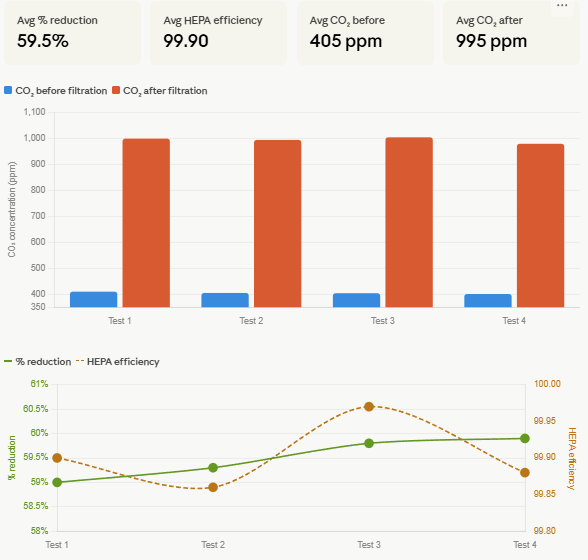
Rising air pollution in South Asian cities such as Peshawar, Pakistan, frequently pushes Air Quality Index levels far beyond WHO limits, yet commercial air purifiers, being grid-dependent and built for enclosed spaces, cannot protect people at high-exposure outdoor sites such as traffic intersections, bus stops, and school courtyards. No previously published system has been found to integrate HEPA particulate filtration with lime-soda chemical CO₂ absorption within a single solar-powered, grid-independent outdoor unit, forming the core novelty of this work. A prototype was modeled in SolidWorks and fabricated with a welded 304 stainless-steel frame housing an H-13 HEPA filter and a Ca (OH)₂ lime-soda bed, powered by two 200 W PV panels, an MPPT controller (93–97% conversion efficiency), and a 35 Ah battery, with monitoring via NDIR CO₂ and optical PM2.5 sensors, and evaluated through four replicate laboratory and field trials. The HEPA stage achieved a mean PM2.5 removal efficiency of 95.6% ± 0.86% (range 94.6–96.9%), reducing outlet concentrations to 1.5–8.5 µg/m³, within the WHO 24-hour guideline of 15 µg/m³. The lime-soda bed achieved a mean CO₂ reduction of 59.5% ± 0.37% (range 59.0–59.9%), lowering CO₂ from 995 ± 9.4 ppm to 405 ± 3.2 ppm, confirmed by mass-balance verification. The integrated system delivered a Clean Air Delivery Rate (CADR) of 286 m³/h, comparable to commercial units, and the solar-battery subsystem recharged fully within approximately 2 hours under typical local irradiance, sustaining continuous grid-independent operation with battery levels maintained above 70% throughout testing. These findings show the proposed purifier is a technically feasible, cost-effective, locally manufacturable solution for outdoor air quality improvement in developing countries, directly supporting the UN Sustainable Development Goals (SDGs).
References
H. Irfan, “Air pollution and cardiovascular health in South Asia: A comprehensive review,” Curr. Probl. Cardiol., vol. 49, no. 2, Feb. 2024, doi: 10.1016/j.cpcardiol.2023.102199.
J. Wei et al., “First close insight into global daily gapless 1 km PM2.5 pollution, variability, and health impact,” Nat. Commun. 2023 141, vol. 14, no. 1, pp. 8349-, Dec. 2023, doi: 10.1038/s41467-023-43862-3.
G. Gamal, N. Zanaty, and P. Nejedlik, “Long-term spatiotemporal trends and population-weighted exposure to PM2.5 in Greater Cairo (2000–2020),” Sci. African, vol. 31, p. e03150, Mar. 2026, doi: 10.1016/J.SCIAF.2025.E03150.
J. Rentschler and N. Leonova, “Global air pollution exposure and poverty,” Nat. Commun. 2023 141, vol. 14, no. 1, pp. 4432-, Jul. 2023, doi: 10.1038/s41467-023-39797-4.
W. Batool Awan and Z. Ali, “Development of standardized PM2.5 concentration index (SPM2.5I) for monitoring and forecasting air pollution characteristics,” Theor. Appl. Climatol. 2025 15610, vol. 156, no. 10, pp. 504-, Sep. 2025, doi: 10.1007/S00704-025-05798-0.
P. Badida, A. Krishnamurthy, and J. Jayaprakash, “Meta analysis of health effects of ambient air pollution exposure in low- and middle-income countries,” Environ. Res., vol. 216, no. Pt 4, Jan. 2023, doi: 10.1016/j.envres.2022.114604.
M. T. Nejad, K. J. Ghalehteimouri, H. Talkhabi, and Z. Dolatshahi, “The relationship between atmospheric temperature inversion and urban air pollution characteristics: a case study of Tehran, Iran,” Discov. Environ. 2023 11, vol. 1, no. 1, pp. 17-, Oct. 2023, doi: 10.1007/S44274-023-00018-W.
I. Veza, M. Z. Asy’ari, M. Idris, V. Epin, I. M. Rizwanul Fattah, and M. Spraggon, “Electric vehicle (EV) and driving towards sustainability: Comparison between EV, HEV, PHEV, and ICE vehicles to achieve net zero emissions by 2050 from EV,” Alexandria Eng. J., vol. 82, pp. 459–467, Nov. 2023, doi: 10.1016/j.aej.2023.10.020.
M. V. Deshpande, N. Kumar, D. Pillai, V. V. Krishna, and M. Jain, “Greenhouse gas emissions from agricultural residue burning have increased by 75 % since 2011 across India,” Sci. Total Environ., vol. 904, p. 166944, Dec. 2023, doi: 10.1016/J.SCITOTENV.2023.166944.
Q. Long, J. Ma, C. Guo, M. Wang, and Q. Wang, “High-resolution spatio-temporal estimation of street-level air pollution using mobile monitoring and machine learning,” J. Environ. Manage., vol. 377, Mar. 2025, doi: 10.1016/j.jenvman.2025.124642.
X. Liu, M. Yang, and X. Nie, “Can city brand reduce urban air pollution? — An empirical research based on ‘National Civilized City’ in China,” Technol. Forecast. Soc. Change, vol. 186, p. 122179, Jan. 2023, doi: 10.1016/J.TECHFORE.2022.122179.
Z. Khanam, F. M. Sultana, and F. Mushtaq, “Environmental Pollution Control Measures and Strategies: An Overview of Recent Developments,” Geospatial Anal. Environ. Pollut. Model. Anal. Control Manag., pp. 385–414, Jan. 2023, doi: 10.1007/978-3-031-45300-7_15/SAVE-RESEARCH.
Y. Kang, Z. X. Low, D. Zou, Z. Zhong, and W. Xing, “Multifunctional Nanofibrous Membranes for Integrated Air Purification,” Adv. Fiber Mater. 2024 65, vol. 6, no. 5, pp. 1306–1342, May 2024, doi: 10.1007/S42765-024-00427-3.
F. de A. Lima, G. B. Medeiros, P. A. M. Chagas, M. L. Aguiar, and V. G. Guerra, “Aerosol Nanoparticle Control by Electrostatic Precipitation and Filtration Processes—A Review,” Powders 2023, Vol. 2, Pages 259-298, vol. 2, no. 2, pp. 259–298, Apr. 2023, doi: 10.3390/POWDERS2020017.
Y. Xiong, J. Luo, Z. Xiao, S. Li, and X. Wang, “Scalable Cationic-Polyurea Adhesive Engineering Enabling Glass-Fiber HEPA Filters with Mechanically Robust, High-Efficiency Microbial Capture and Rapid Inactivation,” Adv. Funct. Mater., vol. 36, no. 52, p. e32093, Jun. 2026, doi: 10.1002/ADFM.202532093.
I. P. Beckman, G. Berry, H. Cho, and G. Riveros, “Alternative High-Performance Fibers for Nonwoven HEPA Filter Media,” Aerosol Sci. Eng. 2022 71, vol. 7, no. 1, pp. 36–58, Oct. 2022, doi: 10.1007/S41810-022-00161-6.
S. Zide, H. J. Ho, L. F. Petrik, T. V. Ojumu, and A. Iizuka, “Assessment of the potential industrial applications of calcium carbonate derived from mineral carbonation of alkaline waste material,” Int. J. Environ. Sci. Technol. 2025 231, vol. 23, no. 1, pp. 82-, Dec. 2025, doi: 10.1007/S13762-025-06922-3.
“(PDF) Solar Outdoor Air Purifier with Air Quality Monitoring System.” Accessed: Jul. 25, 2026. [Online]. Available: https://www.researchgate.net/publication/383631190_Solar_Outdoor_Air_Purifier_with_Air_Quality_Monitoring_System
M. S. Endiz, “Design and implementation of microcontroller-based solar charge controller using modified incremental conductance MPPT algorithm,” J. Radiat. Res. Appl. Sci., vol. 17, no. 2, p. 100938, Jun. 2024, doi: 10.1016/J.JRRAS.2024.100938.
S. Singh, P. Vishwakarma, and T. Gupta, “Review of Current and Future Indoor Air PurifyingTechnologies,” ACS ES&T Eng., vol. 4, no. 11, pp. 2607–2630, Nov. 2024, doi: 10.1021/ACSESTENGG.4C00460.
A. Chowdhury, S. Bit, A. Majee, A. Biswas, and M. Sarkar, “Solar-Powered IoT-Based Air Quality Regulator for Indoor Air Purification,” 2026 9th Int. Conf. Electron. Mater. Eng. Nano-Technology, IEMENTech 2026, 2026, doi: 10.1109/IEMENTECH202669403.2026.11434206.
K. Mhalshekar, A. Krishan, M. Gaydhane, S. Sontakke, and V. Pawar, “Advanced ElectrospunNanofibers for PhotocatalyticDegradation: Sustainable Solutions for Wastewater Remediation,” ACS Omega, vol. 11, no. 5, pp. 6954–6985, Feb. 2026, doi: 10.1021/ACSOMEGA.5C10970.
V. Anupriya, M. Selvaganesh, E. Shirley, M. Udhaya Arthi, and G. Vivitha, “Solar Boosted AI Air Cleanser for Textile Sector,” Proc. 6th Int. Conf. Inven. Res. Comput. Appl. ICIRCA 2025, pp. 729–736, 2025, doi: 10.1109/ICIRCA65293.2025.11089845.
A. Jose, C. Abraham, A. K. Soman, T. J. Ajumal, Anandakrishna, and A. Shibu, “IoT based solar powered air purifier with air quality monitoring system,” E3S Web Conf., vol. 529, May 2024, doi: 10.1051/E3SCONF/202452904016.
B. M. Hemanth Kumar, N. Prakash, C. Namitha, H. R. Chandana, G. Jeevan, and G. Manjunath, “Solar Harmoni Air: The Integration of Solar Power for Intelligent Outdoor Air Purification and Monitoring System,” IEEE Int. Conf. Recent Adv. Sci. Eng. Technol. ICRASET 2024, 2024, doi: 10.1109/ICRASET63057.2024.10895174.
R. Yasmin, M. N. Nabi, F. Rashid, and M. A. Hossain, “Solar, Wind, Hydrogen, and Bioenergy-Based Hybrid System for Off-Grid Remote Locations: Techno-Economic and Environmental Analysis,” Clean Technol., vol. 7, no. 2, p. 36, Jun. 2025, doi: 10.3390/CLEANTECHNOL7020036/S1.
X. Zhang, M. Zhang, Y. Cui, and Y. He, “Estimation of Daily Ground-Received Global Solar Radiation Using Air Pollutant Data,” Front. Public Heal., vol. 10, p. 860107, Apr. 2022, doi: 10.3389/FPUBH.2022.860107/TEXT.
R. Cao et al., “A Novel MethodCoupled Atomization-Bubbling Loop Interfacefor Enhanced Capture of Fly Ash Fine Particles (PM2.5):Mechanism and Removal Efficiency Modeling,” Ind. Eng. Chem. Res., vol. 65, no. 11, pp. 6286–6296, Mar. 2026, doi: 10.1021/ACS.IECR.5C05430.
M. Xu, W. Tian, Y. Lin, Y. Xu, and J. Tao, “Development of a Compact NDIR CO2 Gas Sensor for a Portable Gas Analyzer,” Micromachines 2024, Vol. 15, Page 1203, vol. 15, no. 10, p. 1203, Sep. 2024, doi: 10.3390/MI15101203.
M. N. M. Aashiq et al., “An IoT-based handheld environmental and air quality monitoring station,” Acta IMEKO, vol. 12, no. 3, pp. 1–9, Aug. 2023, doi: 10.21014/ACTAIMEKO.V12I3.1487.
“Method of Testing General Ventilation Air-Cleaning Devices for Removal Efficiency by Particle Size | Request PDF.” Accessed: Aug. 02, 2026. [Online]. Available: https://www.researchgate.net/publication/332144550_Method_of_Testing_General_Ventilation_Air-Cleaning_Devices_for_Removal_Efficiency_by_Particle_Size
A. Y. Mendell, S. Lee, and J. A. Siegel, “The impact of portable air cleaners on indoor particulate matter concentrations and perceptions of indoor air quality: a randomized crossover trial in three multifamily buildings,” J. Expo. Sci. Environ. Epidemiol. 2026, pp. 1–15, Apr. 2026, doi: 10.1038/s41370-026-00894-3.
A. Buonomano, C. Forzano, G. F. Giuzio, and A. Palombo, “New ventilation design criteria for energy sustainability and indoor air quality in a post Covid-19 scenario,” Renew. Sustain. Energy Rev., vol. 182, p. 113378, Aug. 2023, doi: 10.1016/J.RSER.2023.113378.
F. Parveen and S. J. Khan, “Wastewater Treatment in Pakistan: Issues, Challenges and Solutions,” Glob. Issues Water Policy, vol. 30, pp. 323–349, 2023, doi: 10.1007/978-3-031-36131-9_12.
L. Bogdanffy, C. R. Lorinț, and A. Nicola, “Development of a Low-Cost Traffic and Air Quality Monitoring Internet of Things (IoT) System for Sustainable Urban and Environmental Management,” Sustain. 2025, Vol. 17, Page 5003, vol. 17, no. 11, p. 5003, May 2025, doi: 10.3390/SU17115003.
“Solar Panel Price in Pakistan Today August 2, 2026 - Daily Update.” Accessed: Aug. 02, 2026. [Online]. Available: https://solarpanelprices.pk/
“Buy castor wheels Online at Best Price in Pakistan - Daraz.pk.” Accessed: Aug. 02, 2026. [Online]. Available: https://www.daraz.pk/tag/castor-wheels/
“Mppt Solar Controller – Simtek Power Services.” Accessed: Aug. 02, 2026. [Online]. Available: https://simtek.com.pk/product-category/mppt-solar-controller/
Downloads
Published
How to Cite
Issue
Section
License
Copyright (c) 2026 50sea

This work is licensed under a Creative Commons Attribution 4.0 International License.