Explainable AI-Driven Clinical Decision Support System for Cardiovascular Disease Prediction Using Hybrid Models
DOI:
https://doi.org/10.33411/IJIST/1962Keywords:
Cardiovascular Disease Risk Prediction, Explainable Artificial Intelligence (XAI), Clinical Decision Support System (CDSS), Ensemble LearningAbstract
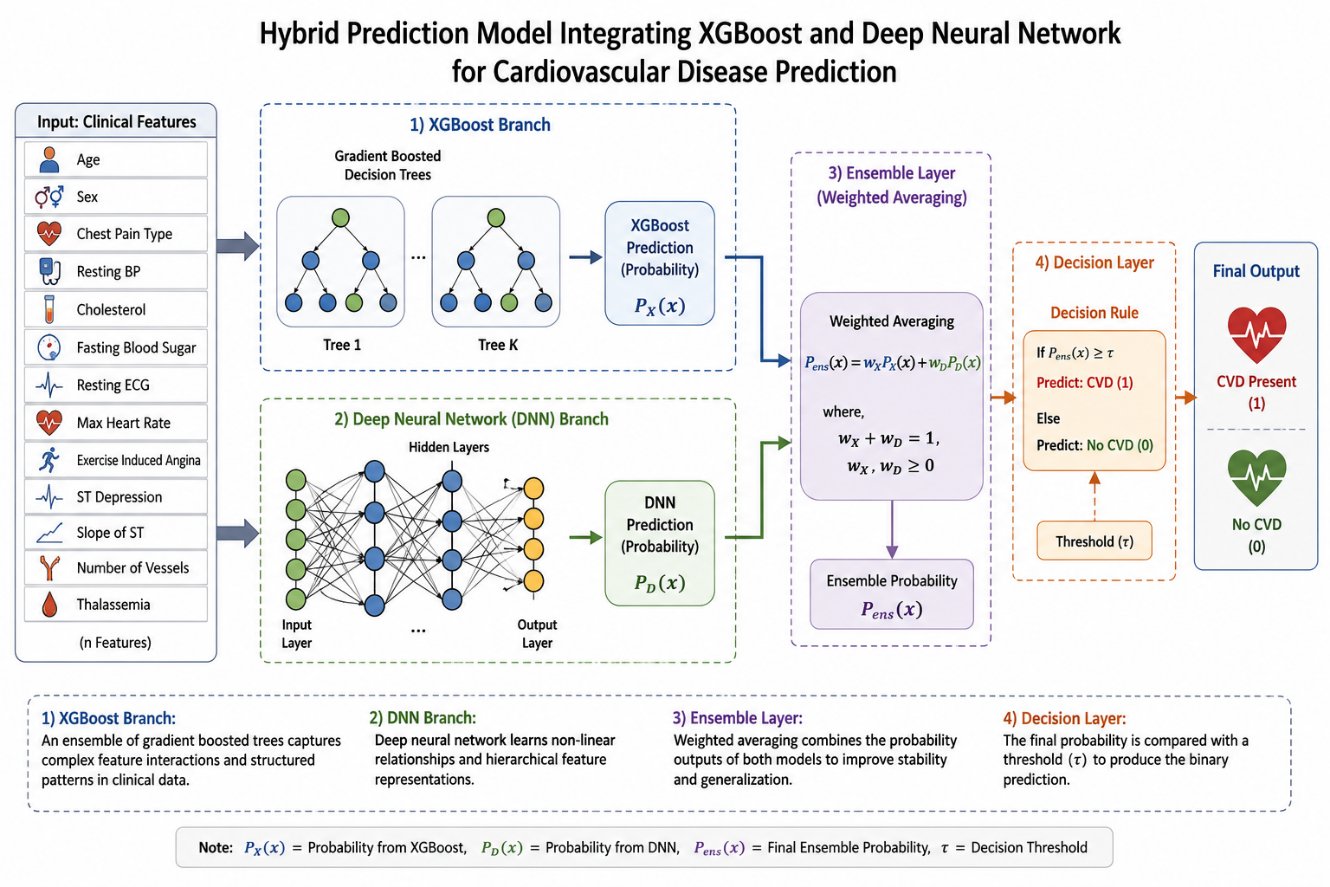
Artificial intelligence (AI) and machine learning have played increasingly important roles in healthcare, particularly in disease risk prediction, clinical data analysis, and decision support. Recent advances in ensemble learning and explainable AI (XAI) have created new opportunities to improve predictive performance and transparency in cardiovascular disease (CVD) risk assessment. However, conventional machine learning models may inadequately capture complex nonlinear relationships, while deep learning models often lack interpretability, limiting their reliability for clinical decision support. To address these limitations, this paper proposed an XAI-CDSS, an explainable ensemble learning framework for cardiovascular disease risk prediction and clinical decision support. First, cardiovascular clinical data are systematically preprocessed through data cleaning, normalization, categorical encoding, outlier handling, and class balancing. Secondly, Extreme Gradient Boosting (XGBoost) and a deep neural network (DNN) are employed as complementary learners, and their prediction probabilities are integrated through a weighted ensemble strategy to improve predictive robustness and generalization. Thirdly, Shapley Additive Explanations (SHAP) and Local Interpretable Model-Agnostic Explanations (LIME) provide global feature-level and patient-specific explanations, respectively. Finally, the framework is evaluated on a benchmark CVD dataset comprising 1,025 patient records, including an independent test set of 205 records. Experimental results demonstrate that XAI-CDSS achieves an accuracy of 94.63%, precision of 96.94%, recall of 92.23%, and F1-score of 94.53%. Compared with the individual constituent models and existing CVD prediction approaches considered in this study, XAI-CDSS demonstrates competitive predictive performance while providing complementary global and patient-specific explainability, highlighting its potential for transparent and reliable clinical decision support.
References
O. Gaidai, Y. Cao, and S. Loginov, “Global Cardiovascular Diseases Death Rate Prediction,” Curr. Probl. Cardiol., vol. 48, no. 5, May 2023, doi: 10.1016/j.cpcardiol.2023.101622.
V. Vaccarino and J. D. Bremner, “Stress and cardiovascular disease: an update,” Nat. Rev. Cardiol., vol. 21, no. 9, pp. 603–616, Sep. 2024, doi: 10.1038/S41569-024-01024-Y.
N. Kalra, P. Verma, and S. Verma, “Advancements in AI based healthcare techniques with FOCUS ON diagnostic techniques,” Comput. Biol. Med., vol. 179, p. 108917, Sep. 2024, doi: 10.1016/J.COMPBIOMED.2024.108917.
J. Ferdush, M. Begum, and S. T. Hossain, “ChatGPT and Clinical Decision Support: Scope, Application, and Limitations,” Ann. Biomed. Eng., vol. 52, no. 5, pp. 1119–1124, May 2024, doi: 10.1007/S10439-023-03329-4.
L. Rubinger, A. Gazendam, S. Ekhtiari, and M. Bhandari, “Machine learning and artificial intelligence in research and healthcare,” Injury, vol. 54, pp. S69–S73, May 2023, doi: 10.1016/J.INJURY.2022.01.046.
N. R. & H. A. H. Mohammed Badawy, “Healthcare predictive analytics using machine learning and deep learning techniques: a survey,” J. Electr. Syst. Inf. Technol., vol. 10, no. 40, 2023, doi: https://doi.org/10.1186/s43067-023-00108-y.
“(PDF) Transforming Healthcare with AI and Machine Learning: Revolutionizing Patient Care Through Advanced Analytics.” Accessed: Jul. 25, 2026. [Online]. Available: https://www.researchgate.net/publication/387303877_Transforming_
Healthcare_with_AI_and_Machine_Learning_Revolutionizing_Patient_Care_Through_Advanced_Analytics
Roy Okonkwo, Adebola Folorunso, Foyeke Ogundipe, and Clement Yayra Tettey, “Explainable Artificial Intelligence (Al) through human-AI collaborative frameworks: Quantifying trust and interpretability in high-stakes decisions,” Comput. Sci. IT Res. J., vol. 6, no. 5, pp. 333–354, Jun. 2025, doi: 10.51594/CSITRJ.V6I5.1934.
I. Uddin et al., “A hybrid residue based sequential encoding mechanism with XGBoost improved ensemble model for identifying 5-hydroxymethylcytosine modifications,” Sci. Reports 2024 141, vol. 14, no. 1, pp. 20819-, Sep. 2024, doi: 10.1038/s41598-024-71568-z.
I. Uddin, N. Iqbal, and S. A. C. Bukhari, “Discriminative Sequence Features for DNA-Binding Protein Detection Using ML and DL Techniques,” Proc. - 2025 IEEE Int. Conf. Futur. Mach. Learn. Data Sci. FMLDS 2025, pp. 416–421, 2025, doi: 10.1109/FMLDS67896.2025.00078.
S. C. E. Nouis, V. Uren, and S. Jariwala, “Evaluating accountability, transparency, and bias in AI-assisted healthcare decision- making: a qualitative study of healthcare professionals’ perspectives in the UK,” BMC Med. Ethics, vol. 26, no. 1, Dec. 2025, doi: 10.1186/S12910-025-01243-Z.
D. Minh, H. X. Wang, Y. F. Li, and T. N. Nguyen, “Explainable artificial intelligence: a comprehensive review,” Artif. Intell. Rev. 2021 555, vol. 55, no. 5, pp. 3503–3568, Nov. 2021, doi: 10.1007/S10462-021-10088-Y.
S. Dhanka, A. Sharma, A. Kumar, S. Maini, and H. Vundavilli, “Advancements in Hybrid Machine Learning Models for Biomedical Disease Classification Using Integration of Hyperparameter-Tuning and Feature Selection Methodologies: A Comprehensive Review,” Arch. Comput. Methods Eng. 2025 331, vol. 33, no. 1, pp. 289–324, Jun. 2025, doi: 10.1007/S11831-025-10309-5.
Y. Huang, J. Li, M. Li, and R. R. Aparasu, “Application of machine learning in predicting survival outcomes involving real-world data: a scoping review,” BMC Med. Res. Methodol., vol. 23, no. 1, Dec. 2023, doi: 10.1186/S12874-023-02078-1.
F. Valente, S. Paredes, J. Henriques, T. Rocha, P. de Carvalho, and J. Morais, “Interpretability, personalization and reliability of a machine learning based clinical decision support system,” Data Min. Knowl. Discov. 2022 363, vol. 36, no. 3, pp. 1140–1173, Apr. 2022, doi: 10.1007/S10618-022-00821-8.
A. Leiva-Araos, C. Contreras, H. Kaushal, and Z. Prodanoff, “Predictive Optimization of Patient No-Show Management in Primary Healthcare Using Machine Learning,” J. Med. Syst., vol. 49, no. 1, Dec. 2025, doi: 10.1007/S10916-025-02143-W.
Adewale Abayomi Adeniran, Amaka Peace Onebunne, and Paul William, “Explainable AI (XAI) in healthcare: Enhancing trust and transparency in critical decision-making,” World J. Adv. Res. Rev., vol. 23, no. 3, pp. 2447–2658, Sep. 2024, doi: 10.30574/WJARR.2024.23.3.2936.
P. S. Asih, Y. Azhar, G. W. Wicaksono, and D. R. Akbi, “Interpretable Machine Learning Model For Heart Disease Prediction,” Procedia Comput. Sci., vol. 227, pp. 439–445, Jan. 2023, doi: 10.1016/J.PROCS.2023.10.544.
A. Adekoya, F. Saeed, W. Ghaban, and S. N. Qasem, “Ensemble learning approach with explainable AI for improved heart disease prediction,” Front. Pharmacol., vol. 16, p. 1654681, Dec. 2025, doi: 10.3389/FPHAR.2025.1654681/TEXT.
S. Walia, S. Walia, A. Bhardwaj, S. Arora, S. Aggarwal, and P. Siwach, “Explainable soft-voting classifier for heart disease prediction using SHAP and LIME,” Discov. Comput. 2026 291, vol. 29, no. 1, pp. 83-, Feb. 2026, doi: 10.1007/S10791-026-09972-4.
P. H. Hutagalung and A. Andrianingsih, “Heart Disease Classification Using Optimised XGBoost and Random Forest with SHAP Explanations,” sinkron, vol. 10, no. 1, pp. 330–342, Jan. 2026, doi: 10.33395/SINKRON.V10I1.15544.
M. A. Hasnat, M. Jobayer, M. M. H. Shawon, and M. G. R. Alam, “Interpretable Heart Disease Prediction via a Weighted Ensemble Model: A Large-Scale Study with SHAP and Surrogate Decision Trees,” Nov. 2025, Accessed: Jul. 25, 2026. [Online]. Available: https://arxiv.org/pdf/2511.01947
R. Agrawal, T. Gupta, S. Gupta, S. Chauhan, P. Patel, and S. Hamdare, “Fostering trust and interpretability: integrating explainable AI (XAI) with machine learning for enhanced disease prediction and decision transparency,” Diagnostic Pathol. 2025 201, vol. 20, no. 1, pp. 105-, Sep. 2025, doi: 10.1186/S13000-025-01686-3.
S. Khan, I. Uddin, F. K. Alarfaj, and N. Almusallam, “A novel computational framework for tumor-specific T cell antigen identification using a deep neural network,” J. Comput. Mol. Des. 2026 401, vol. 40, no. 1, pp. 150-, Jun. 2026, doi: 10.1007/S10822-026-00861-Y.
M. Alzamel, I. Uddin, S. Khan, N. Dilshad, and N. Ahmad, “Deep learning-based identification of N6-methyladenine sites via hybrid feature fusion and SHAP-driven feature selection,” Sci. Reports 2026 161, vol. 16, no. 1, pp. 22385-, May 2026, doi: 10.1038/s41598-026-50667-z.
M. Athanasiou, K. Sfrintzeri, K. Zarkogianni, A. C. Thanopoulou, and K. S. Nikita, “An explainable XGBoost-based approach towards assessing the risk of cardiovascular disease in patients with Type 2 Diabetes Mellitus,” Sep. 2020, Accessed: Jul. 25, 2026. [Online]. Available: https://arxiv.org/pdf/2009.06629
I. Uddin et al., “Deep-m6Am: a deep learning model for identifying N6, 2′-O-Dimethyladenosine (m6Am) sites using hybrid features,” AIMS Bioeng. 2025 1145, vol. 12, no. 1, pp. 145–161, 2025, doi: 10.3934/BIOENG.2025006.
P. Shah, M. Shukla, N. H. Dholakia, and H. Gupta, “Predicting cardiovascular risk with hybrid ensemble learning and explainable AI,” Sci. Reports 2025 151, vol. 15, no. 1, pp. 17927-, May 2025, doi: 10.1038/s41598-025-01650-7.
A. Ur Rahman, N. Iqbal, I. Uddin, and S. A. C. Bukhari, “Multifaceted Fusion of Glove and Additive Attention Models for Scalable Fake News Detection,” Proc. - 2025 IEEE Int. Conf. Futur. Mach. Learn. Data Sci. FMLDS 2025, pp. 363–368, 2025, doi: 10.1109/FMLDS67896.2025.00069.
S. Anbazhagan, S. S. Ranganathan, M. Alagarsamy, and R. Kuppusamy, “A comprehensive hybrid model for early detection of cardiovascular diseases using integrated CardioXGBoost and long short-term memory networks,” Biomed. Signal Process. Control, vol. 95, p. 106281, Sep. 2024, doi: 10.1016/J.BSPC.2024.106281.
M. A. Talukder, A. S. Talaat, M. Kazi, and A. Khraisat, “XAI-HD: an explainable artificial intelligence framework for heart disease detection,” Artif. Intell. Rev. 2025 5812, vol. 58, no. 12, pp. 385-, Oct. 2025, doi: 10.1007/S10462-025-11385-6.
J. Boobalan and L. Kiruthika, “Explainable AI for CVD Risk Prediction: An Ensemble Learning Approach with Clinical Interpretability,” Proc. 3rd Int. Conf. Sustain. Comput. Data Commun. Syst. ICSCDS 2025, pp. 1036–1043, 2025, doi: 10.1109/ICSCDS65426.2025.11167113.
Masroor Shah, Fazal Malik, Muhammad Suliman, Noor Rahman, Irfan Ullah, Sana Ullah, Romaan Khan, & Salman Alam, “Dark Data in Accident Prediction: Using AdaBoost and Random Forest for Improved Accuracy,” J. Comput. Biomed. Informatics, vol. 7, no. 2, 2024, [Online]. Available: https://jcbi.org/index.php/Main/article/view/531
I. Uddin, S. Noor, Y. A. Ali, S. Khan, and M. Al-Razgan, “A hybrid deep learning framework for accurate N6,2′-O-Dimethyladenosine site prediction,” Biophys. Chem., vol. 335, p. 107639, Aug. 2026, doi: 10.1016/J.BPC.2026.107639.
S. Khan, I. Uddin, S. Noor, S. A. AlQahtani, and N. Ahmad, “N6-methyladenine identification using deep learning and discriminative feature integration,” BMC Med. Genomics 2025 181, vol. 18, no. 1, pp. 58-, Mar. 2025, doi: 10.1186/S12920-025-02131-6.
Downloads
Published
How to Cite
Issue
Section
License
Copyright (c) 2026 50sea

This work is licensed under a Creative Commons Attribution 4.0 International License.