CARTA: A Framework for Change-Aware Regression Testing of Android Applications Through Machine Learning-Based Test Case Prioritization
DOI:
https://doi.org/10.33411/IJIST/2001Keywords:
Android testing, Regression test prioritization, Random Forest, APFD, Fault detection rate, Continuous integration, Machine learning, Mobile software engineeringAbstract
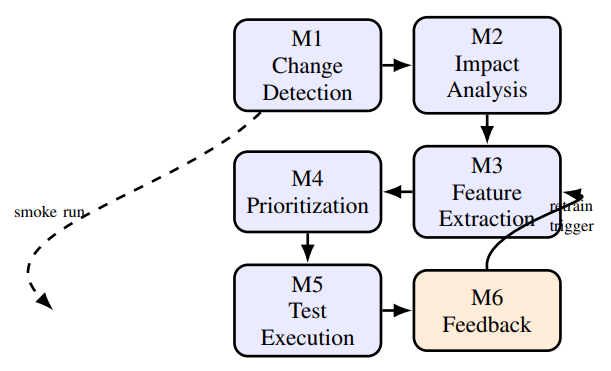
Mobile software engineering has moved to agile development cycles, which have significantly reduced the window available for regression testing, making a compelling case for smarter and targeted test execution approaches. Existing techniques typically execute a fixed test suite and do not consider the specific changes made in a commit, wasting resources on tests that will not find new defects. In this work we present CARTA (Change-Aware Regression Testing for Android), a six-module pipeline that performs dependency-based change impact analysis in a static manner and uses a Random Forest classifier trained to predict the likelihood that test cases detect faults introduced by changes in an application. We evaluated the pipeline on three open-source Android projects, AntennaPod, Wikipedia Android and Signal Android using 164,720 historical execution records collected from 7,080 commits. Features engineered from commit metadata and execution history (nine in total) passed through recursive feature elimination to identify features for inclusion in the final model; three such features were Direct Impact Flag (23.4%), Past Failure Rate (19.7%), and Code Coverage of Modified Lines (16.4%). The classifier reached a mean accuracy of 0.889 ± 0.007, an F1-score of 0.877 ± 0.006, and an AUC-ROC of 0.924 ± 0.006, respectively (95% CI, 30 replications). Under the APFD criterion, CARTA achieved a score of 0.847 ± 0.009 on average, beating history-based ordering by 27.1%, coverage-based ordering by 34.2% and random ordering by 66.1% (all p>0.71). An extensive ablation study further indicates the combination of change-impact filtering with learned ranking is significantly better than either mechanism used alone (p<0.001), confirming a true complementary effect rather than redundancy between the two techniques. At the same time, this framework reduced mean execution time per commit of tests from 57.2 to 24.1 minutes (a 57.5% reduction) while keeping a fault detection rate of 94.3% within that timeframe. The results show gains in efficiency and coverage from tightly coupling change impact analysis with learned prioritization that neither achieves alone with direct implications for Android continuous-integration pipelines.
References
H. A. Ramzan, K. Islam, M. A. Hussain, R. M. Monim, S. M. Asad, and S. Ramzan, “Data-driven test case prioritization (DD-TCP): A machine learning framework for intelligent software quality assurance,” Comput. Mater. Contin., vol. 88, no. 1, 2026.
M. Singh, N. Chauhan, and R. Popli, “Test case reduction and SWOA optimization for distributed agile software development using regression testing,” Multimed. Tools Appl., vol. 84, no. 10, pp. 7065–7090, 2025.
A. Poth, O. Rrjolli, and A. Arcuri, “Technology adoption performance evaluation applied to testing industrial REST APIs,” Autom. Softw. Eng., vol. 32, no. 1, Art. no. 14, 2025.
S. Kiran, I. E. Emre, and S. Taşdelen, “Prioritization of regression test cases based on machine learning methods,” Gazi Univ. J. Sci., vol. 38, no. 1, pp. 131–144, 2025.
A. Vescan and C. Tiutin, “Test case prioritization based on neural networks classification: A replication study and hyper-parameter optimization using Taguchi methods,” IEEE Access, vol. 13, pp. 118082–118095, 2025.
T. A. Ghaleb, O. Abduljalil, and S. Hassan, “CI/CD configuration practices in open-source Android apps: An empirical study,” ACM Trans. Softw. Eng. Methodol., 2025, 40 pages.
G. Rao and D. Nandal, “Dynamic prioritization of test cases for regression testing using machine learning,” Int. J. Syst. Assur. Eng. Manag., 2026.
H. Parsazadeh, T. A. Ghaleb, and S. Hassan, “Android instrumentation testing in continuous integration: Practices, patterns, and performance,” arXiv preprint arXiv:2604.03438, 2026.
A. Bauer, J. Frattini, and E. Alégroth, “Augmented testing to support manual GUI-based regression testing: An empirical study,” Empir. Softw. Eng., vol. 29, no. 6, Art. no. 140, 2024.
X. Wang and S. Zhang, “Cluster-based adaptive test case prioritization,” Inf. Softw. Technol., vol. 165, Art. no. 107339, 2024.
I. Ghani, W. M. N. Wan Kadir, A. F. Arbain, and I. Ghani, “A detection-based multi-objective test case selection algorithm to improve time and efficiency in regression testing,” IEEE Access, vol. 12, pp. 114974–114994, 2024.
S. Talakola, “The optimization of software testing efficiency and effectiveness using AI techniques,” Int. J. Artif. Intell. Data Sci. Mach. Learn., vol. 5, no. 3, 2024.
R. Greca, B. Miranda, and A. Bertolino, “State of practical applicability of regression testing research: A live systematic literature review,” ACM Comput. Surv., vol. 55, no. 13, pp. 1–36, 2023.
M. Iqbal, Y. Hafeez, N. Almashfi, F. Alserhani, S. Ali, M. Humayun, and M. Jamal, “Enhancing secure development in globally distributed software product lines: A machine learning-powered framework for cyber-resilient ecosystems,” Comput. Mater. Contin., vol. 79, no. 3, pp. 5031–5049, 2024.
D. W. Kenya, A. W. Wambua, and G. M. Wambugu, “A comparative analysis of bat and genetic algorithms for test case prioritization in regression testing,” Int. J. Intell. Syst. Appl., vol. 15, no. 1, pp. 13–21, 2023.
Q. Do, G. Yang, M. Che, D. Hui, and J. Ridgeway, “Regression test selection for Android applications,” in Proc. Int. Conf. Mobile Software Engineering and Systems (MOBILESoft), May 2016, pp. 27–28.
M. A. Siddique, “The state-of-the-art hybrid approaches in regression testing,” Int. J. Ind. Eng. Prod. Res., vol. 34, no. 4, 2023.
M. Iqbal, Y. Hafeez, S. Ali, and Z. Gul, “Towards mining variable features in software product lines during development,” Foundation Univ. J. Eng. Appl. Sci., vol. 5, no. 1, pp. 47–67, 2024, doi: 10.33897/fujeas.v5i1.918.
A. S. Yaragh, M. Bagherzadeh, N. Kahani, and L. C. Briand, “Scalable and accurate test case prioritization in continuous integration contexts,” IEEE Trans. Softw. Eng., vol. 49, no. 4, pp. 1615–1639, 2023.
H. V. R. Kavuluri, “Test case prioritization with genetic algorithms for regression testing,” Trans. Smart Electr. Comput. Syst., vol. 8, pp. 1–6, 2021.
W. Zhou, X. Jiang, and C. Qin, “C-CORE: Clustering by code representation to prioritize test cases in compiler testing,” Comput. Model. Eng. Sci., vol. 139, no. 2, pp. 2069–2093, 2024.
M. Bagherzadeh, N. Kahani, and L. Briand, “Reinforcement learning for test case prioritization,” IEEE Trans. Softw. Eng., vol. 48, no. 8, pp. 2836–2856, 2021.
F. Altiero, A. Corazza, S. Di Martino, A. Peron, and L. L. Starace, “Regression test prioritization leveraging source code similarity with tree kernels,” J. Softw. Evol. Process., vol. 36, no. 8, Art. no. e2653, 2024.
R. Gao, Y. Wang, Y. Feng, Z. Chen, and W. W. Eric Wong, “Successes, challenges, and rethinking—an industrial investigation on crowdsourced mobile application testing,” Empir. Softw. Eng., vol. 24, no. 2, pp. 537–561, 2019.
A. Rahmani, S. Ahmad, I. E. A. Jalil, and A. P. Herawan, “A systematic literature review on regression test case prioritization,” Int. J. Adv. Comput. Sci. Appl., vol. 12, no. 9, 2021.
R. Z. Qaisar, S. Ali, Y. Hafeez, R. Bibi, M. Iqbal, A. Ali, and S. M. Hussain, “Improving requirement prioritization in global software development using hybrid technique,” J. Comput. Biomed. Inform., vol. 10, no. 1, 2025.
A. Samad, H. Mahdin, R. Kazmi, and R. Ibrahim, “Regression test case prioritization: A systematic literature review,” Int. J. Adv. Comput. Sci. Appl., vol. 12, no. 2, 2021.
I. Saidani, A. Ouni, and M. W. Mkaouer, “Improving the prediction of continuous integration build failures using deep learning,” Autom. Softw. Eng., vol. 29, no. 1, Art. no. 21, 2022.
R. Lachmann, S. Schulze, M. Nieke, C. Seidl, and I. Schaefer, “System-level test case prioritization using machine learning,” in Proc. ICMLA, 2020, pp. 361–368.
Q. Su, X. Li, Y. Ren, R. Qiu, C. Hu, and Y. Yin, “Attention transfer reinforcement learning for test case prioritization in continuous integration,” Appl. Sci., vol. 15, no. 4, Art. no. 2243, 2025.
R. Kazmi, D. N. A. Jawawi, R. Mohamad, and I. Ghani, “Effective regression test case selection: A systematic literature review,” ACM Comput. Surv., vol. 50, no. 2, pp. 1–32, 2018.
C. Wohlin, P. Runeson, M. Höst, M. C. Ohlsson, B. Regnell, and A. Wesslén, Experimentation in Software Engineering. Berlin, Germany: Springer, 2012.
T. Zimmermann, N. Nagappan, and A. Zeller, “Predicting defects for eclipse,” in Proc. PROMISE, 2008, pp. 61–65.
S. Dalal, S. Hooda, and K. Solanki, “Comparative analysis of various testing techniques used for aspect-oriented software system,” Indones. J. Electr. Eng. Comput. Sci., vol. 12, no. 1, pp. 51–60, 2018, doi: 10.11591/ijeecs.v12.i1.pp51-60.
G. Rothermel, R. H. Untch, C. Chu, and M. J. Harrold, “Prioritizing test cases for regression testing,” IEEE Trans. Softw. Eng., vol. 27, no. 10, pp. 929–948, 2001.
H. Zhu, P. A. V. Hall, and J. H. R. May, “Software unit test coverage and adequacy,” ACM Comput. Surv., vol. 29, no. 4, pp. 366–427, 1997.
G. Rothermel and M. J. Harrold, “Analyzing regression test selection techniques,” IEEE Trans. Softw. Eng., vol. 22, no. 8, pp. 529–551, 1996.
Downloads
Published
How to Cite
Issue
Section
License
Copyright (c) 2026 50sea

This work is licensed under a Creative Commons Attribution 4.0 International License.