Influence of Suction and Porous Medium on MHD Thermal Transport of a Non-Newtonian Ternary Hybrid Nanofluid over a Nonlinearly Stretching Surface
DOI:
https://doi.org/10.33411/IJIST/2006Keywords:
Tri-hybrid particles, Kerosene oil, Non-linear, Permeable mediumAbstract
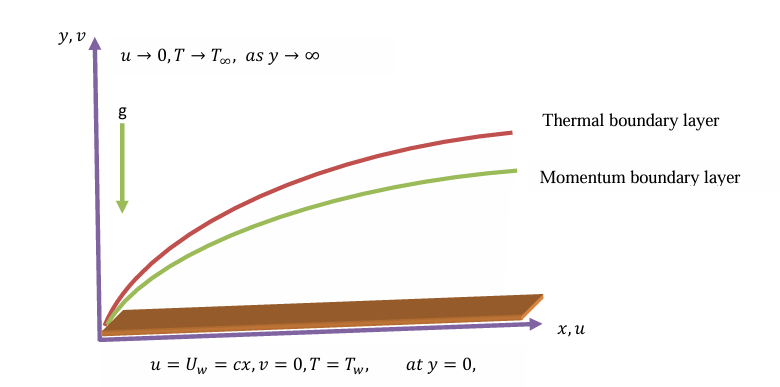
This study investigates the momentum and thermal transport characteristics of a ternary hybrid non-Newtonian Maxwell fluid containing spherical Ag–Cu–TiO₂ nanoparticles dispersed in kerosene oil. The flow is considered over a nonlinearly stretching flexible sheet embedded in a porous medium under the combined effects of wall suction, an externally applied magnetic field, and buoyancy. Appropriate similarity transformations are employed to reduce the governing nonlinear partial differential equations for momentum and energy into a coupled system of ordinary differential equations, which is subsequently solved numerically using the MATLAB bvp4c solver. The effects of the Maxwell relaxation parameter, magnetic parameter M, buoyancy parameter, Prandtl number Pr, porous-medium parameter K, suction parameter S, and inclination angle are systematically examined. The numerical results demonstrate that increasing M suppresses the velocity field while enhancing the temperature distribution because of the increased Lorentz-force resistance. Over the investigated magnetic-parameter range, the velocity decreases, whereas the temperature increases. Increasing the porous-medium parameter K similarly reduces the velocity and enhances the temperature distribution; quantitatively, the corresponding changes, respectively. In contrast, increasing the Maxwell relaxation-time parameter enhances the velocity throughout the boundary layer, while increasing the inclination angle from =0 to ℼ/2 produces a continuous acceleration of the flow. The Ag/kerosene-oil nanofluid exhibits a consistently higher velocity than the Ag–Cu/kerosene-oil hybrid nanofluid, whereas the latter produces a higher temperature distribution. The surface-transport characteristics further reveal that increasing K raises the wall shear-stress coefficient and reduces the Nusselt number. Likewise, increasing Pr enhances the wall shear coefficient, while the reduced Nusselt number decreases accordingly. Stronger wall suction further restricts the thermal boundary-layer thickness. These findings demonstrate that magnetic forcing, porous-medium resistance, viscoelastic relaxation, inclination, suction, and thermal diffusivity provide effective mechanisms for controlling momentum and heat transfer in nanoparticle-enhanced Maxwell fluids, highlighting their potential for advanced thermal-management and energy-conversion applications.
References
Animasaun, I.L.; Al-Mdallal, Q.M.; Khan, U.; Alshomrani, A.S, “Unsteady Water-Based Ternary Hybrid Nanofluids on Wedges by Bioconvection and Wall Stretching Velocity: Thermal Analysis and Scrutinization of Small and Larger Magnitudes of the Thermal Conductivity of Nanoparticles,” Mathematics, vol. 10, no. 22, 2022, doi: https://doi.org/10.3390/math10224309.
S. Nasir, S. Sirisubtawee, P. Juntharee, A. S. Berrouk, S. Mukhtar, and T. Gul, “Heat transport study of ternary hybrid nanofluid flow under magnetic dipole together with nonlinear thermal radiation,” Appl. Nanosci. 2022 129, vol. 12, no. 9, pp. 2777–2788, Aug. 2022, doi: 10.1007/S13204-022-02583-7.
M. Shanmugapriya, R. Sundareswaran, P. Senthil Kumar, and G. Rangasamy, “Impact of nanoparticle shape in enhancing heat transfer of magnetized ternary hybrid nanofluid,” Sustain. Energy Technol. Assessments, vol. 53, p. 102700, Oct. 2022, doi: 10.1016/J.SETA.2022.102700.
M. Arif, P. Kumam, W. Kumam, and Z. Mostafa, “Heat transfer analysis of radiator using different shaped nanoparticles water-based ternary hybrid nanofluid with applications: A fractional model,” Case Stud. Therm. Eng., vol. 31, p. 101837, Mar. 2022, doi: 10.1016/J.CSITE.2022.101837.
I. Zahan, R. Nasrin, and S. Khatun, “Thermal performance of ternary-hybrid nanofluids through a convergent-divergent nozzle using distilled water - ethylene glycol mixtures,” Int. Commun. Heat Mass Transf., vol. 137, p. 106254, Oct. 2022, doi: 10.1016/J.ICHEATMASSTRANSFER.2022.106254.
P. Priyadharshini, M. V. Archana, N. A. Shah, and M. H. Alshehri, “Ternary Hybrid Nanofluid Flow Emerging on a Symmetrically Stretching Sheet Optimization with Machine Learning Prediction Scheme,” Symmetry 2023, Vol. 15, Page 1225, vol. 15, no. 6, p. 1225, Jun. 2023, doi: 10.3390/SYM15061225.
J. K. Madhukesh, I. E. Sarris, B. C. Prasannakumara, and A. Abdulrahman, “Investigation of Thermal Performance of Ternary Hybrid Nanofluid Flow in a Permeable Inclined Cylinder/Plate,” Energies 2023, Vol. 16, Page 2630, vol. 16, no. 6, p. 2630, Mar. 2023, doi: 10.3390/EN16062630.
M. Arif, L. Di Persio, P. Kumam, W. Watthayu, and A. Akgül, “Heat transfer analysis of fractional model of couple stress Casson tri-hybrid nanofluid using dissimilar shape nanoparticles in blood with biomedical applications,” Sci. Reports 2023 131, vol. 13, no. 1, pp. 4596-, Mar. 2023, doi: 10.1038/s41598-022-25127-z.
M. Z. Ullah, “Irreversibility Marangoni Tri-Hybrid Nanoflow Analysis for Thermal Enhancement Applications,” Nanomater. 2023, Vol. 13, Page 423, vol. 13, no. 3, p. 423, Jan. 2023, doi: 10.3390/NANO13030423.
V. Rajesh and M. Sheremet, “Natural Convection of Ternary Hybrid Nanofluid in a Differential-Heated Enclosure with Non-Uniform Heating Wall,” Micromachines 2023, Vol. 14, Page 1049, vol. 14, no. 5, p. 1049, May 2023, doi: 10.3390/MI14051049.
M. Mahboobtosi, K. Hosseinzadeh, and D. D. Ganji, “Entropy generation analysis and hydrothermal optimization of ternary hybrid nanofluid flow suspended in polymer over curved stretching surface,” Int. J. Thermofluids, vol. 20, p. 100507, Nov. 2023, doi: 10.1016/J.IJFT.2023.100507.
M. Mumtaz, S. Islam, H. Ullah, and Z. Shah, “Chemically reactive MHD convective flow and heat transfer performance of ternary hybrid nanofluid past a curved stretching sheet,” J. Mol. Liq., vol. 390, p. 123179, Nov. 2023, doi: 10.1016/J.MOLLIQ.2023.123179.
A. A. Alharbi, “Thermal analysis of heat transport in a slip flow of ternary hybrid nanofluid with suction upon a stretching/shrinking sheet,” Case Stud. Therm. Eng., vol. 54, p. 103965, Feb. 2024, doi: 10.1016/J.CSITE.2023.103965.
Shilpa, R. Mehta, and K. Senthilvadivu, “Artificial neural network analysis on heat and mass transfer in MHD Carreau ternary hybrid nanofluid flow across a vertical cylinder: A numerical computation,” Int. J. Thermofluids, vol. 27, p. 101171, May 2025, doi: 10.1016/J.IJFT.2025.101171.
A. M. Obalalu, U. Khan, E. O. Fatunmbi, N. S. Khashi’ie, and J. A. Bashatah, “MHD heat and mass transfer of a ternary hybrid nanofluid over a rotating sphere,” Discov. Nano 2026 211, vol. 21, no. 1, pp. 163-, May 2026, doi: 10.1186/S11671-026-04597-4.
K. A. M. Alharbi et al., “Computational Valuation of Darcy Ternary-Hybrid Nanofluid Flow across an Extending Cylinder with Induction Effects,” Micromachines 2022, Vol. 13, Page 588, vol. 13, no. 4, p. 588, Apr. 2022, doi: 10.3390/MI13040588.
M. Bilal et al., “Numerical Analysis of an Unsteady, Electroviscous, Ternary Hybrid Nanofluid Flow with Chemical Reaction and Activation Energy across Parallel Plates,” Micromachines 2022, Vol. 13, Page 874, vol. 13, no. 6, p. 874, May 2022, doi: 10.3390/MI13060874.
M. Nagapavani, G. Venkata Ramana Reddy, A. Verma, R. Mishra, and T. Kumar, “Significance of Arrhenius activation energy and binary chemical reaction in ternary hybrid nanofluid flow over a convectively heated porous curved surface: A passive control strategy,” Int. J. Mod. Phys. B, vol. 37, no. 25, Oct. 2023, doi: 10.1142/S0217979223502910.
B. Ali, S. Jubair, A. Aluraikan, M. A. El-Rahman, S. M. Eldin, and H. Abd El-Wahed Khalifa, “Numerical investigation of heat source induced thermal slip effect on trihybrid nanofluid flow over a stretching surface,” Results Eng., vol. 20, p. 101536, Dec. 2023, doi: 10.1016/J.RINENG.2023.101536.
S. Murtaza, P. Kumam, T. Sutthibutpong, P. Suttiarporn, T. Srisurat, and Z. Ahmad, “Fractal-fractional analysis and numerical simulation for the heat transfer of ZnO + Al2O3 + TiO2/DW based ternary hybrid nanofluid,” ZAMM - J. Appl. Math. Mech. / Zeitschrift für Angew. Math. und Mech., vol. 104, no. 2, p. e202300459, Feb. 2024, doi: 10.1002/ZAMM.202300459.
F. A. Shah, T. Zamir, N. S. Akbar, and A. Mikhaylov, “Levenberg-marquardt design for analysis of maxwell fluid flow on ternary hybrid nanoparticles passing over a riga plate under convective boundary conditions,” Results Eng., vol. 24, p. 103502, Dec. 2024, doi: 10.1016/J.RINENG.2024.103502.
M. Mahboobtosi, K. Hosseinzadeh, and D. D. Ganji, “Investigating the convective flow of ternary hybrid nanofluids and single nanofluids around a stretched cylinder: Parameter analysis and performance enhancement,” Int. J. Thermofluids, vol. 23, p. 100752, Aug. 2024, doi: 10.1016/J.IJFT.2024.100752.
N. S. Wahid, N. M. Arifin, R. I. Yahaya, N. S. Khashi’ie, and I. Pop, “Impact of suction and thermal radiation on unsteady ternary hybrid nanofluid flow over a biaxial shrinking sheet,” Alexandria Eng. J., vol. 96, pp. 132–141, Jun. 2024, doi: 10.1016/J.AEJ.2024.03.079.
H. AL Garalleh, “Numerical simulation of heat transport mechanism in chemically influenced ternary hybrid nanofluid flow over a wedge geometry,” Discov. Appl. Sci. 2024 69, vol. 6, no. 9, pp. 449-, Aug. 2024, doi: 10.1007/S42452-024-06141-4.
A. U. Hayat, H. Khan, I. Ullah, H. Ahmad, M. M. Alam, and M. Bilal, “Numerical exploration of the entropy generation in tri-hybrid nanofluid flow across a curved stretching surface subject to exponential heat source/sink,” J. Therm. Anal. Calorim. 2024 14917, vol. 149, no. 17, pp. 10017–10029, Jul. 2024, doi: 10.1007/S10973-024-13358-3.
S. Dey, S. Ontela, P. K. Pattnaik, and S. R. Mishra, “Convective heat transfer of tri-hybrid nanofluid through a curved expanding surface with the impact of velocity slip and exponential heat source,” Colloid Polym. Sci. 2024 30210, vol. 302, no. 10, pp. 1573–1590, Jul. 2024, doi: 10.1007/S00396-024-05291-6.
M. Mumtaz, “Hydrothermal dynamics of darcy Forchheimer ternary hybrid nanofluid flow past bended surface with active—passive controls,” Adv. Mech. Eng., vol. 16, no. 10, Oct. 2024, doi: 10.1177/16878132241293958;
S. Z. Hussain Shah, A. Ayub, U. Khan, A. Darvesh, E. S. M. Sherif, and I. Pop, “Thermal transport exploration of ternary hybrid nanofluid flow in a non-Newtonian model with homogeneous-heterogeneous chemical reactions induced by vertical cylinder,” Adv. Mech. Eng., vol. 16, no. 5, May 2024, doi: 10.1177/16878132241252229;
S. K. Rawat et al., “Designing artificial intelligence computing techniques to study heat transfer of a ternary hybrid nanofluid flow: Application of particle swarm optimization and artificial neural network,” MPLB, vol. 39, no. 24, pp. 2550114–105, Aug. 2025, doi: 10.1142/S0217984925501143.
A. B. Sadiya and G. Sucharitha, “Computational analysis of MHD ternary hybrid nanofluid flow with thermochemical reactions through a porous medium on a rotating stretching sheet,” Discov. Nano 2025 201, vol. 20, no. 1, pp. 168-, Sep. 2025, doi: 10.1186/S11671-025-04353-0.
T. Sindhu and K. Jagadeeshkumar, “Entropy generation and regression analysis of unsteady Carreau ternary hybrid nanofluid flow with electromagnetic and thermal influences,” Discov. Nano 2025 201, vol. 20, no. 1, pp. 231-, Dec. 2025, doi: 10.1186/S11671-025-04408-2.
N. Sarwar, S. Jahangir, M. I. Asjad, and S. M. Eldin, “Application of Ternary Nanoparticles in the Heat Transfer of an MHD Non-Newtonian Fluid Flow,” Micromachines 2022, Vol. 13, Page 2149, vol. 13, no. 12, p. 2149, Dec. 2022, doi: 10.3390/MI13122149.
Downloads
Published
How to Cite
Issue
Section
License
Copyright (c) 2026 50sea

This work is licensed under a Creative Commons Attribution 4.0 International License.