Adaptive Honey-Memory: A Semantic Deception Framework for Disrupting Agentic Malware
DOI:
https://doi.org/10.33411/IJIST/2010Keywords:
Agentic AI Security, Honey-Memory, Contextual Sabotage, LLM Malware, Adversarial Agents, Deception-Based Defense, Memory Poisoning, AI Lifecycle DisruptionAbstract
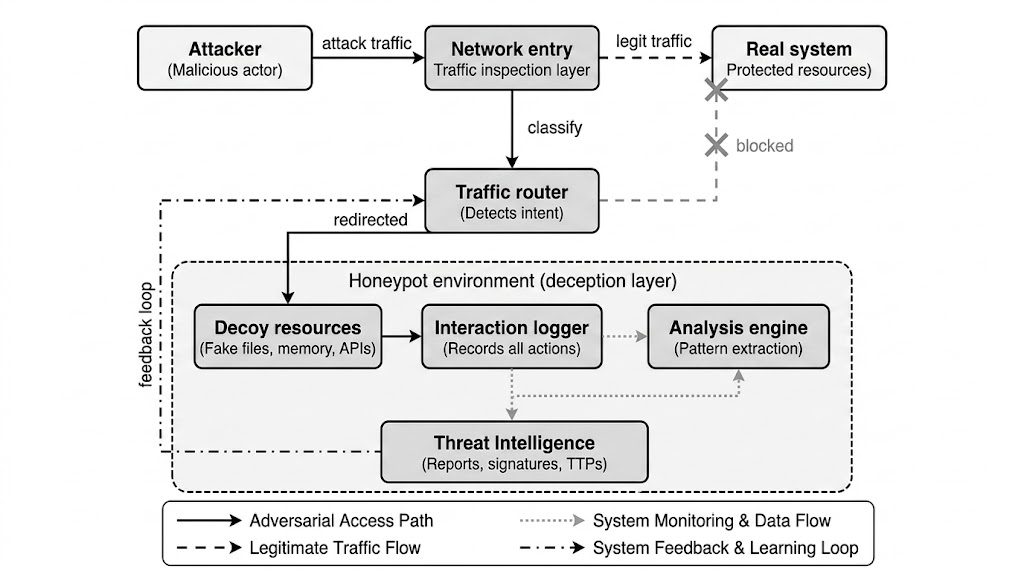
The rise of agentic AI systems, which are autonomous agents capable of reasoning, planning, and carrying out multi-step tasks, has opened up a previously unknown attack surface: memory-based malware spreading. Traditional intrusion detection systems are not designed to detect attacks that exploit the contextual memory layers of agents powered by large language models (LLMs). The proactive defense strategy, called Contextual Sabotage, is described, which disrupts the agentic malicious life cycle utilizing Adaptive Honey-Memory (AHM), a dynamically generated semantically realistic yet intentionally deceptive layer of memory that intercepts, confuses, and neutralizes malicious agent behavior. AHM modifies the operational environment that adversarial agents can access to create logical inconsistencies, disrupt execution sequences, and create failure conditions within the attacker's operational environment without divulging any actual memory in the system. The study models the agentic threat model, introduces the honey-memory injection framework and experiments with the proposed approach using simulated adversarial agents under three attack scenarios: context hijacking, propagation of goal misalignment, and permanent memory poisoning. Experimental results show that AHM is able to disrupt the target with a high disruption rate of over 87% on all attack categories, and at the same time, it does not interfere with the legitimate agent operations with a rate of less than 3%. The proposed architecture provides a foundation for semantically aware, deception-enabled protection mechanisms for future autonomous AI settings. Evaluation is based on 1200 trials of adversarial attacks across all three attack classes and 800 trials of benign tasks and reported as mean ± standard deviation over 10 trials per condition.
References
J. S. Park, J. O’Brien, C. J. Cai, M. R. Morris, P. Liang, and M. S. Bernstein, “Generative Agents: Interactive Simulacra of Human Behavior,” UIST 2023 - Proc. 36th Annu. ACM Symp. User Interface Softw. Technol., vol. 1, Apr. 2023, doi: 10.1145/3586183.3606763.
Y. C. Shunyu Yao, Jeffrey Zhao, Dian Yu, Nan Du, Izhak Shafran, Karthik Narasimhan, “ReAct: Synergizing Reasoning and Acting in Language Models,” arXiv:2210.03629, 2023, [Online]. Available: https://arxiv.org/abs/2210.03629
“LangChain: Building LLM Applications through Composability - DataRoot Labs.” Accessed: Aug. 28, 2026. [Online]. Available: https://datarootlabs.com/blog/langchain-building-llm-applications-through-composability
Y. Shen, K. Song, X. Tan, D. Li, W. Lu, and Y. Zhuang, “HuggingGPT: Solving AI Tasks with ChatGPT and its Friends in Hugging Face,” Adv. Neural Inf. Process. Syst., vol. 36, Mar. 2023, doi: 10.52202/075280-1657.
H. Yang, S. Yue, and Y. He, “Auto-GPT for Online Decision Making: Benchmarks and Additional Opinions,” Proc. Make sure to enter correct Conf. title from your rights confirmation emai (Conference Acron. ’XX), vol. 1, Jun. 2023
T. Schick et al., “Toolformer: Language Models Can Teach Themselves to Use Tools,” Adv. Neural Inf. Process. Syst., vol. 36, Feb. 2023, doi: 10.52202/075280-2997.
Jason Wei, Xuezhi Wang, Dale Schuurmans, Maarten Bosma, Brian Ichter, “Chain-of-Thought Prompting Elicits Reasoning in Large Language Models,” arXiv:2201.11903, 2023, [Online]. Available: https://arxiv.org/abs/2201.11903
F. Perez and I. Ribeiro, “Ignore Previous Prompt: Attack Techniques For Language Models,” Nov. 2022, Accessed: Aug. 28, 2026. [Online]. Available: https://arxiv.org/pdf/2211.09527
S. Abdelnabi, K. Greshake, S. Mishra, C. Endres, T. Holz, and M. Fritz, “Not what you’ve signed up for: Compromising Real-World LLM-Integrated Applications with Indirect Prompt Injection,” AISec 2023 - Proc. 16th ACM Work. Artif. Intell. Secur., pp. 79–90, Feb. 2023, doi: 10.1145/3605764.3623985.
P. Lewis et al, “Retrieval-augmented generation for knowledge-intensive NLP tasks,” Adv. neural Inf. Process. Syst., pp. 9459–9474, 2020.
W. Xu and K. K. Parhi, “A Survey of Attacks on Large Language Models,” May 2025, Accessed: Aug. 28, 2026. [Online]. Available: https://arxiv.org/pdf/2505.12567
D. A. H. Rishi Bommasani, “On the Opportunities and Risks of Foundation Models,” arXiv:2108.07258, 2022, doi: https://doi.org/10.48550/arXiv.2108.07258.
S. Bubeck et al., “Sparks of Artificial General Intelligence: Early experiments with GPT-4,” Mar. 2023, Accessed: Aug. 28, 2026. [Online]. Available: https://arxiv.org/pdf/2303.12712
Y. Liu et al., “Prompt Injection attack against LLM-integrated Applications,” Jun. 2023, Accessed: Aug. 28, 2026. [Online]. Available: https://arxiv.org/pdf/2306.05499
Z. Chen, Z. Xiang, C. Xiao, D. Song, and B. Li, “AgentPoison: Red-teaming LLM Agents via Poisoning Memory or Knowledge Bases,” Adv. Neural Inf. Process. Syst., vol. 37, Jul. 2024, doi: 10.52202/079017-4136.
“A Practical Memory Injection Attack against LLM Agents.” Accessed: Aug. 28, 2026. [Online]. Available: https://arxiv.org/html/2503.03704v1
S. S. Srivastava and H. He, “MemoryGraft: Persistent Compromise of LLM Agents via Poisoned Experience Retrieval,” Dec. 2025, Accessed: Aug. 28, 2026. [Online]. Available: https://arxiv.org/pdf/2512.16962
E. Debenedetti, J. Zhang, M. Balunovic, L. Beurer-Kellner, M. Fischer, and F. Tramèr, “AgentDojo: A Dynamic Environment to Evaluate Prompt Injection Attacks and Defenses for LLM Agents,” Adv. Neural Inf. Process. Syst., vol. 37, Jun. 2024, doi: 10.52202/079017-2636.
W. Zou, R. Geng, B. Wang, and J. Jia, “PoisonedRAG: Knowledge Corruption Attacks to Retrieval-Augmented Generation of Large Language Models,” Proc. 34th USENIX Secur. Symp., pp. 3827–3844, Feb. 2024, Accessed: Aug. 28, 2026. [Online]. Available: https://arxiv.org/pdf/2402.07867
E. Hubinger et al., “Sleeper Agents: Training Deceptive LLMs that Persist Through Safety Training,” Jan. 2024, Accessed: Aug. 28, 2026. [Online]. Available: https://arxiv.org/pdf/2401.05566
Y. Tang, Y. Liu, J. Lan, Z. Yan, and E. Gelenbe, “Security of LLM-based agents regarding attacks, defenses, and applications: A comprehensive survey,” Inf. Fusion, vol. 127, p. 103941, Mar. 2026, doi: 10.1016/J.INFFUS.2025.103941.
V. Benjamin et al., “Systematically Analyzing Prompt Injection Vulnerabilities in Diverse LLM Architectures,” Int. Conf. Cyber Warf. Secur., vol. 20, no. 1, pp. 142–150, Oct. 2024, doi: 10.34190/iccws.20.1.3292.
M. Q. Li and B. C. M. Fung, “Security concerns for Large Language Models: A survey,” J. Inf. Secur. Appl., vol. 95, p. 104284, Dec. 2025, doi: 10.1016/J.JISA.2025.104284.
N. Carlini and D. Wagner, “Towards Evaluating the Robustness of Neural Networks,” Proc. - IEEE Symp. Secur. Priv., pp. 39–57, Aug. 2016, doi: 10.1109/SP.2017.49.
N. Papernot, P. Mcdaniel, S. Jha, M. Fredrikson, Z. B. Celik, and A. Swami, “The Limitations of Deep Learning in Adversarial Settings,” Proc. - 2016 IEEE Eur. Symp. Secur. Privacy, EURO S P 2016, pp. 372–387, Nov. 2015, doi: 10.1109/EuroSP.2016.36.
I. J. Goodfellow, J. Shlens, and C. Szegedy, “Explaining and harnessing adversarial examples,” 3rd Int. Conf. Learn. Represent. ICLR 2015 - Conf. Track Proc., 2015, Accessed: Apr. 22, 2026. [Online]. Available: https://www.researchgate.net/publication/403853041_Adversarial_Attacks_on_AI-Based_Intrusion_Detection_Systems
Y. Bai et al., “Constitutional AI: Harmlessness from AI Feedback,” Dec. 2022, Accessed: Aug. 28, 2026. [Online]. Available: https://arxiv.org/pdf/2212.08073
Clifford Stoll, “Stalking The Wily Hacker,” Commun. ACM, 1988, [Online]. Available: https://dl.acm.org/doi/pdf/10.1145/42411.42412
L. Spitzner, “Honeypots : tracking hackers,” p. 452, 2003.
S. Diego and N. Provos, “A Virtual Honeypot Framework,” 2004.
T. Gu, B. Dolan-Gavitt, and S. Garg, “BadNets: Identifying Vulnerabilities in the Machine Learning Model Supply Chain,” Aug. 2017, Accessed: Aug. 28, 2026. [Online]. Available: https://arxiv.org/pdf/1708.06733
N. Papernot, P. McDaniel, A. Sinha, and M. P. Wellman, “SoK: Security and Privacy in Machine Learning,” Proc. - 3rd IEEE Eur. Symp. Secur. Privacy, EURO S P 2018, pp. 399–414, Jul. 2018, doi: 10.1109/EUROSP.2018.00035.
L. Weidinger et al., “Taxonomy of Risks posed by Language Models,” ACM Int. Conf. Proceeding Ser., pp. 214–229, Jun. 2022, doi: 10.1145/3531146.3533088
G. I. Daniel M. Ziegler, Nisan Stiennon, Jeffrey Wu, Tom B. Brown, Alec Radford, Dario Amodei, Paul Christiano, “Fine-Tuning Language Models from Human Preferences,” arXiv:1909.08593, 2019, [Online]. Available: https://arxiv.org/abs/1909.08593
J. W. Long Ouyang, “Training language models to follow instructions with human feedback,” Adv. Neural Inf. Process. Syst., 2022, doi: https://doi.org/10.48550/arXiv.2203.02155.
N. Shinn, F. Cassano, A. Gopinath, K. Narasimhan, and S. Yao, “Reflexion: Language Agents with Verbal Reinforcement Learning,” Adv. Neural Inf. Process. Syst., vol. 36, Mar. 2023, doi: 10.52202/075280-0377.
R. A. Bridges, T. R. Mitchell, M. Muñoz, and T. Henriksson, “SoK: Honeypots & LLMs, More Than the Sum of Their Parts?,” Oct. 2025, Accessed: Aug. 28, 2026. [Online]. Available: https://arxiv.org/pdf/2510.25939
D. Ayzenshteyn, R. Weiss, and Y. Mirsky, Cloak, Honey, Trap: Proactive Defenses Against {LLM} Agents. 2025.
B. Peng et al., “Check Your Facts and Try Again: Improving Large Language Models with External Knowledge and Automated Feedback,” Feb. 2023, Accessed: Aug. 28, 2026. [Online]. Available: https://arxiv.org/pdf/2302.12813
T. Mikolov, E. Grave, P. Bojanowski, C. Puhrsch, and A. Joulin, “Advances in Pre-Training Distributed Word Representations,” Lr. 2018 - 11th Int. Conf. Lang. Resour. Eval., pp. 52–55, Dec. 2017, doi: 10.63317/4b3prw5a5tze.
Q. Wei et al., “A-MemGuard: A Proactive Defense Framework for LLM-Based Agent Memory,” Sep. 2025, Accessed: Aug. 28, 2026. [Online]. Available: https://arxiv.org/pdf/2510.02373
J. Kim, W. Choi, and B. Lee, “Prompt Flow Integrity to Prevent Privilege Escalation in LLM Agents,” Mar. 2025, Accessed: Aug. 28, 2026. [Online]. Available: https://arxiv.org/pdf/2503.15547
D. Jacob, H. Alzahrani, Z. Hu, B. Alomair, and D. Wagner, “PromptShield: Deployable Detection for Prompt Injection Attacks,” Jan. 2025, Accessed: Aug. 28, 2026. [Online]. Available: https://arxiv.org/pdf/2501.15145
Downloads
Published
How to Cite
Issue
Section
License
Copyright (c) 2026 50sea

This work is licensed under a Creative Commons Attribution 4.0 International License.