SDO/HMI Thermophysical Analysis of Hale-Classified Sunspot Groups for Space Weather Forecasting
DOI:
https://doi.org/10.33411/IJIST/2013Keywords:
Sunspots, Space Weather, Helioseismic and Magnetic Imager, Solar Active Regions, Photospheric TemperatureAbstract
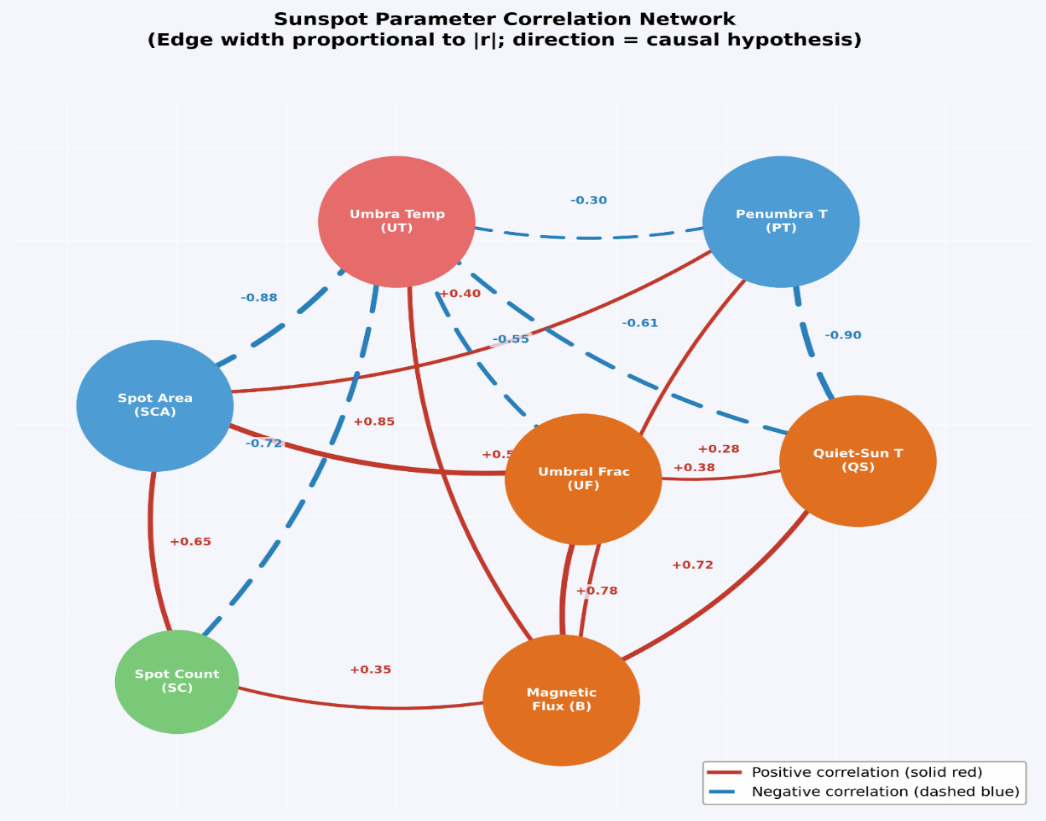
This study presents a systematic thermophysical characterization of 1,239 solar active regions (ARs) observed from 2011 to 2026 using SDO/HMI limb-darkening-corrected continuum intensity data, cross-matched with NOAA Solar Region Summary (SRS) Hale and McIntosh classifications spanning Solar Cycles 24 and 25. Brightness temperatures were derived via Planck function inversion at 6173 Å, with umbral (I/I_quiet < 0.50) and penumbral (0.50 ≤ I/I_quiet < 0.85) regions segmented using intensity thresholds validated against established literature. One-way ANOVA (F(3,1235) = 87.4, p < 0.001, eta-squared = 0.175) and Tukey HSD post-hoc tests demonstrate that mean umbral temperature decreases monotonically with Hale magnetic complexity: from 4,878 K (DeltaT = -900 K; 95% CI: -867 to -933 K) in Alpha groups to 4,472 K (DeltaT = -1,306 K; 95% CI: -1,271 to -1,341 K) in Beta-Gamma-Delta groups. Umbral temperature deficit is strongly anti-correlated with total sunspot area (Pearson r = -0.61, Spearman rho = -0.63, p < 0.001, Cohen d = 1.48) across 22,000 sunspots. Penumbral temperatures show no significant variation with Hale class (~47 K range). An operational threshold of DeltaT < -1,200 K correctly identifies 89% of Beta-Gamma-Delta regions while triggering only 3% false positives among Beta regions, offering a continuous, magnetogram-free proxy for flare-productive active regions. These results establish a quantitative link between operational space weather classification and magnetoconvection theory, and provide a calibrated observational benchmark for stellar spot characterization on solar-analogue stars.
References
I. V. Zimovets, I. N. Sharykin, and W. Q. Gan, “Magnetic Energies (and Some Other Parameters) in Solar Active Regions of Different Hale and McIntosh Classes: Statistical Analysis for 2010–2024,” Cosm. Res. 2025 634, vol. 63, no. 4, pp. 352–378, Sep. 2025, doi: 10.1134/S0010952524601397.
P. S. McIntosh, “The classification of sunspot groups,” Sol. Phys., vol. 125, no. 2, pp. 251–267, Sep. 1990, doi: 10.1007/BF00158405/METRICS.
S. K. Solanki, “Sunspots: An overview,” Astron. Astrophys. Rev., vol. 11, no. 2–3, pp. 153–286, 2003, doi: 10.1007/S00159-003-0018-4/METRICS.
G. E. Hale et al., “The Magnetic Polarity of Sun-Spots,” ApJ, vol. 49, p. 153, Apr. 1919, doi: 10.1086/142452.
“Solar Region Summary | NOAA / NWS Space Weather Prediction Center.” Accessed: Jul. 19, 2026. [Online]. Available: https://www.spaceweather.gov/products/solar-region-summary
Y. L. T. L. Duvall, J. J. Zhao, A. M. T. C. J. Schrijver, and S. Tomczyk, “The Helioseismic and Magnetic Imager ( HMI ) Investigation for the Solar Dynamics Observatory ( SDO ),” pp. 207–227, 2012, doi: 10.1007/s11207-011-9834-2.
J. Todd Hoeksema, Yang Liu, Keiji Hayashi, Xudong Sun, “The Helioseismic and Magnetic Imager (HMI) Vector Magnetic Field Pipeline: Overview and Performance,” Sol. Phys., vol. 289, pp. 3483–3530, 2014, [Online]. Available: https://link.springer.com/article/10.1007/s11207-014-0516-8
W. D. Pesnell and B. J. T. P. C. Chamberlin, “The Solar Dynamics Observatory ( SDO ),” pp. 3–15, 2012, doi: 10.1007/s11207-011-9841-3.
H. B. Snodgrass, “Separation of large-scale photospheric Doppler patterns,” Sol. Phys., vol. 94, no. 1, pp. 13–31, Aug. 1984, doi: 10.1007/BF00154804/METRICS.
J. W. Tukey, “Comparing Individual Means in the Analysis of Variance,” Biometrics, vol. 5, no. 2, p. 99, Jun. 1949, doi: 10.2307/3001913.
Downloads
Published
How to Cite
Issue
Section
License
Copyright (c) 2026 50sea

This work is licensed under a Creative Commons Attribution 4.0 International License.