Green Hydrogen Production Using a Low-Cost HHO Generator: Design, Fabrication, and Performance Analysis
DOI:
https://doi.org/10.33411/IJIST/2020Keywords:
Green Hydrogen, HHO Generator, Alkaline Water Electrolysis, SS-316L Electrodes, Hydrogen Production Rate, System Efficiency, Renewable EnergyAbstract
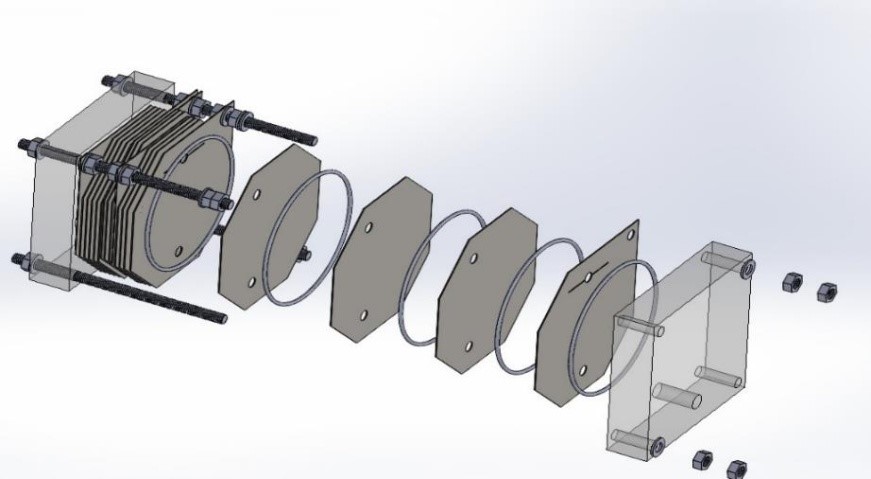
Green hydrogen is seen as one of the few viable routes to decarbonizing sectors that are difficult to electrify directly, but high capital and catalyst costs still put a working electrolyzer out of reach for many smaller laboratories and developing economies. This paper reports the design, fabrication, and performance characterization of a low-cost HHO Generator that produces hydrogen through alkaline water electrolysis, using bare, uncatalyzed SS-316L stainless-steel bipolar electrodes in a 30 wt% aqueous NaOH electrolyte (70:30 v/v tap-water-to-NaOH stock mixture). The system integrates a closed electrolyte circulation loop, a gas–water separator, and a low-pressure hydrogen storage vessel; the complete assembly was modeled in SolidWorks prior to fabrication to verify sealing and fastener alignment before any metal was cut. Under a fixed 12 V, 22 A DC input, the finished unit produced hydrogen at a measured rate of 0.01 L/s (0.6 L/min), corresponding to an electrical input power of 264 W and a recovered hydrogen energy output of 108 W (lower heating value basis), for an overall system efficiency of 41%. This is below the 65–75% typical of commercial alkaline electrolyzers and the 70–82% typical of PEM systems, consistent with the expected penalty of omitting a catalyst coating entirely. All reported values reflect a single measurement run at one fixed operating point; repeat-trial statistics and formal measurement uncertainty were not part of the original test protocol, and this is stated explicitly here as a limitation rather than masked with unreported error bars. The central finding is that a complete, working hydrogen generator—electrode stack, circulation, separation, and storage—can be built end to end from components available in local Pakistani markets at a small fraction of commercial cost, providing a reproducible baseline for future catalyst-coating and design studies.
References
I. Dincer and C. Acar, “Review and evaluation of hydrogen production methods for better sustainability,” Int. J. Hydrogen Energy, vol. 40, no. 34, pp. 11094–11111, Sep. 2015, doi: 10.1016/J.IJHYDENE.2014.12.035.
I. Staffell et al., “The role of hydrogen and fuel cells in the global energy system,” Energy Environ. Sci., vol. 12, no. 2, pp. 463–491, Feb. 2019, doi: 10.1039/C8EE01157E.
T. T. Jörn Brauns, “Alkaline Water Electrolysis Powered by Renewable Energy: A Review,” Processes, vol. 8, no. 2, p. 248, 2020, doi: https://doi.org/10.3390/pr8020248.
M. Carmo, D. L. Fritz, J. Mergel, and D. Stolten, “A comprehensive review on PEM water electrolysis,” Int. J. Hydrogen Energy, vol. 38, no. 12, pp. 4901–4934, Apr. 2013, doi: 10.1016/J.IJHYDENE.2013.01.151.
C. Minke, M. Suermann, B. Bensmann, and R. Hanke-Rauschenbach, “Is iridium demand a potential bottleneck in the realization of large-scale PEM water electrolysis?,” Int. J. Hydrogen Energy, vol. 46, no. 46, pp. 23581–23590, Jul. 2021, doi: 10.1016/J.IJHYDENE.2021.04.174.
D. Hua, J. Huang, E. Fabbri, M. Rafique, and B. Song, “Development of Anion Exchange Membrane Water Electrolysis and the Associated Challenges: A Review,” ChemElectroChem, vol. 10, no. 1, p. e202200999, Jan. 2023, doi: 10.1002/CELC.202200999;SUBPAGE:STRING:FULL.
D. S. Falcão, “Green Hydrogen Production by Anion Exchange Membrane Water Electrolysis: Status and Future Perspectives,” Energies 2023, Vol. 16, Page 943, vol. 16, no. 2, p. 943, Jan. 2023, doi: 10.3390/EN16020943.
I. Vincent and D. Bessarabov, “Low cost hydrogen production by anion exchange membrane electrolysis: A review,” Renew. Sustain. Energy Rev., vol. 81, pp. 1690–1704, Jan. 2018, doi: 10.1016/J.RSER.2017.05.258.
M. A. Laguna-Bercero, “Recent advances in high temperature electrolysis using solid oxide fuel cells: A review,” J. Power Sources, vol. 203, pp. 4–16, Apr. 2012, doi: 10.1016/J.JPOWSOUR.2011.12.019.
“Water Electrolysis - an overview | ScienceDirect Topics.” Accessed: Aug. 29, 2026. [Online]. Available: https://www.sciencedirect.com/topics/engineering/water-electrolysis
O. Schmidt, A. Gambhir, I. Staffell, A. Hawkes, J. Nelson, and S. Few, “Future cost and performance of water electrolysis: An expert elicitation study,” Int. J. Hydrogen Energy, vol. 42, no. 52, pp. 30470–30492, Dec. 2017, doi: 10.1016/J.IJHYDENE.2017.10.045.
G. Sakas, A. Ibáñez-Rioja, V. Ruuskanen, A. Kosonen, J. Ahola, and O. Bergmann, “Dynamic energy and mass balance model for an industrial alkaline water electrolyzer plant process,” Int. J. Hydrogen Energy, vol. 47, no. 7, pp. 4328–4345, Jan. 2022, doi: 10.1016/J.IJHYDENE.2021.11.126.
U. K. Mirza, N. Ahmad, K. Harijan, and T. Majeed, “Identifying and addressing barriers to renewable energy development in Pakistan,” Renew. Sustain. Energy Rev., vol. 13, no. 4, pp. 927–931, May 2009, doi: 10.1016/J.RSER.2007.11.006.
S. A. M. Irfan Ahmad Gondal, “Green hydrogen production potential for developing a hydrogen economy in Pakistan,” Int. J. Hydrogen Energy, vol. 43, no. 12, pp. 6011–6039, 2018, [Online]. Available: https://www.sciencedirect.com/science/article/abs/pii/S0360319918302258
P. C. Okonkwo, H. Bhowmik, I. B. Mansir, M. A. A. Al Sarj Al Marhoon, and N. F. A. Al Sfarini, “Effect of electrode spacing on hydrogen production using a home-made alkaline electrolyzer,” Mater. Lett., vol. 306, p. 130841, Jan. 2022, doi: 10.1016/J.MATLET.2021.130841.
P. C. Okonkwo, E. M. Barhoumi, I. B. Mansir, W. Emori, and H. Bhowmik, “Effect of electrode material on the hydrogen production using a low-cost home-made alkaline electrolyzer,” Vacuum, vol. 198, p. 110878, Apr. 2022, doi: 10.1016/J.VACUUM.2022.110878.
L. Bunge, H. G. Silva, P. L. Cruz, and M. Iten, “Testing of a Low-Cost Dry Cell Prototype for Oxyhydrogen Production,” Designs, vol. 6, no. 5, p. 79, Oct. 2022, doi: 10.3390/DESIGNS6050079/S1.
A. M. Mousa, H. A. A. Sayed, K. A. M. Ali, N. S. Elkaoud, and W. A. E. Mahmoud, “Energy-conversion efficiency for producing oxy-hydrogen gas using a simple generator based on water electrolysis,” Sci. Rep., vol. 14, no. 1, Dec. 2024, doi: 10.1038/S41598-024-73534-1.
M. S. Gad, A. K. El Soly, S. Singh, K. Sharma, S. Dixit, and M. irfanul H. Siddiqui, “Examining oxyhydrogen gas generation experimentally using wet cell design,” PLoS One, vol. 20, no. 6, p. e0324921, Jun. 2025, doi: 10.1371/JOURNAL.PONE.0324921.
N. H. A. Fayez, M. Qenawy, H. M. M. Mustafa, M. Shehadeh, M. Taha, and A. H. Abdelbaky Elbatran, “Optimization of a wet-cell electrolyzer for efficient oxyhydrogen (HHO) gas production: a step towards sustainable green energy solutions,” Sci. Reports 2026 161, vol. 16, no. 1, pp. 12374-, Apr. 2026, doi: 10.1038/s41598-026-45418-z.
A. Lasia, “Mechanism and kinetics of the hydrogen evolution reaction,” Int. J. Hydrogen Energy, vol. 44, no. 36, pp. 19484–19518, Jul. 2019, doi: 10.1016/J.IJHYDENE.2019.05.183.
C. C. L. McCrory, S. Jung, J. C. Peters, and T. F. Jaramillo, “BenchmarkingHeterogeneous Electrocatalysts for theOxygen Evolution Reaction,” J. Am. Chem. Soc., vol. 135, no. 45, pp. 16977–16987, Nov. 2013, doi: 10.1021/JA407115P.
N. Mostafa, H. Emad, M. Eltaweel, and M. Chizari, “Statistical Analysis of the Operating Conditions Influencing Green Hydrogen Production by a Reversible PEM Water Electrolyser,” Process. 2026, Vol. 14, Page 2661, vol. 14, no. 16, p. 2661, Aug. 2026, doi: 10.3390/PR14162661.
L. Rabillard et al., “Experimental Investigation of two low-cost 5 kW alkaline electrolyzer prototypes’ performances depending on size and applied voltage,” Int. J. Hydrogen Energy, vol. 125, pp. 100–107, May 2025, doi: 10.1016/J.IJHYDENE.2025.03.418.
P. A. Kempler and A. C. Nielander, “Reliable reporting of Faradaic efficiencies for electrocatalysis research,” Nat. Commun. 2023 141, vol. 14, no. 1, pp. 1158-, Mar. 2023, doi: 10.1038/s41467-023-36880-8.
E. N. Aminaho, N. S. Aminaho, and F. Aminaho, “Techno-economic assessments of electrolyzers for hydrogen production,” Appl. Energy, vol. 399, p. 126515, Dec. 2025, doi: 10.1016/J.APENERGY.2025.126515.
S. Mushtaq et al., “Sustainability of green hydrogen: A viewpoint in Pakistan,” Energy Environ., vol. 36, no. 2, pp. 1063–1079, Mar. 2025, doi: 10.1177/0958305X251315405;
Y. Xia, H. Cheng, H. He, and W. Wei, “Efficiency and consistency enhancement for alkaline electrolyzers driven by renewable energy sources,” Commun. Eng. 2023 21, vol. 2, no. 1, pp. 22-, May 2023, doi: 10.1038/s44172-023-00070-7.
N. Nagai, M. Takeuchi, T. Kimura, and T. Oka, “Existence of optimum space between electrodes on hydrogen production by water electrolysis,” Int. J. Hydrogen Energy, vol. 28, no. 1, pp. 35–41, Jan. 2003, doi: 10.1016/S0360-3199(02)00027-7.
M. Luberti and H. Ahn, “Review of Polybed pressure swing adsorption for hydrogen purification,” Int. J. Hydrogen Energy, vol. 47, no. 20, pp. 10911–10933, Mar. 2022, doi: 10.1016/J.IJHYDENE.2022.01.147.
“ISO/TS 19883:2017 - Safety of pressure swing adsorption systems for hydrogen separation and purification.” Accessed: Aug. 31, 2026. [Online]. Available: https://www.iso.org/standard/61169.html
Downloads
Published
How to Cite
Issue
Section
License
Copyright (c) 2026 50sea

This work is licensed under a Creative Commons Attribution 4.0 International License.