IoT-Based Transformer-to-Consumer Comparative Analysis for Real-Time Electricity Theft Detection
DOI:
https://doi.org/10.33411/IJIST/2021Keywords:
Electricity Theft; Non-Technical Losses; Internet of Things; ESP32; PZEM-004T; Transformer Monitoring; Comparative Analysis; Cloud MonitoringAbstract
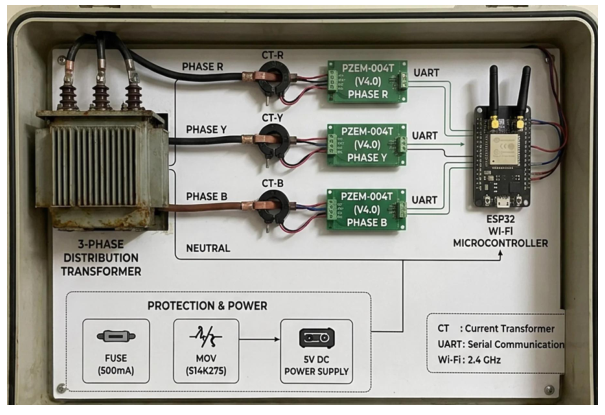
Electricity theft is a significant source of non-technical losses in electrical distribution networks, particularly when unmetered loads or illegal connections occur between distribution transformers and registered consumers. This paper presents a low-cost IoT-based transformer-to-consumer comparative monitoring system for real-time screening of unexplained electricity losses. The proposed system uses ESP32 microcontrollers and PZEM-004T energy-monitoring modules to measure the output of a three-phase transformer and the consumption of individual single-phase consumers. Measurements are transmitted through Wi-Fi to a Supabase/PostgreSQL cloud backend at approximately five-second intervals, where aggregated registered-consumer power is compared with transformer output power. During the controlled proof-of-concept experiment, unaccounted power was approximately 0.13 kW under nominal operation. After introducing an additional unmetered load, the residual increased to 3.22 kW, exceeding the 0.5 kW experimental threshold. The PostgreSQL trigger consequently changed the theft status from false to true, and the dashboard displayed the alert during the next monitoring cycle. These results demonstrate the functional operation of the sensing, communication, cloud-processing, decision, and visualisation stages. However, structured measurement-error statistics, packet-delivery reliability, precise end-to-end response time, and statistical detection performance were not established during the present prototype experiment. Therefore, the generated alert should be interpreted as a potential theft or abnormal-loss inspection flag rather than conclusive evidence of electricity theft. Repeated calibration, communication-reliability testing, response-time analysis, and field-scale validation are recommended for future work.
References
J. Nagi, K. S. Yap, S. K. Tiong, S. K. Ahmed, and M. Mohamad, “Nontechnical loss detection for metered customers in power utility using support vector machines,” IEEE Trans. Power Deliv., vol. 25, no. 2, pp. 1162–1171, Apr. 2010, doi: 10.1109/TPWRD.2009.2030890.
S. S. S. R. Depuru, L. Wang, and V. Devabhaktuni, “Electricity theft: Overview, issues, prevention and a smart meter based approach to control theft,” Energy Policy, vol. 39, no. 2, pp. 1007–1015, Feb. 2011, doi: 10.1016/J.ENPOL.2010.11.037.
S. S. S. R. Depuru, L. Wang, and V. Devabhaktuni, “Support vector machine based data classification for detection of electricity theft,” 2011 IEEE/PES Power Syst. Conf. Expo. PSCE 2011, 2011, doi: 10.1109/PSCE.2011.5772466.
P. Jokar, N. Arianpoo, and V. C. M. Leung, “Electricity theft detection in AMI using customers’ consumption patterns,” IEEE Trans. Smart Grid, vol. 7, no. 1, pp. 216–226, Jan. 2016, doi: 10.1109/TSG.2015.2425222.
P. Glauner, J. A. Meira, P. Valtchev, R. State, and F. Bettinger, “The Challenge of Non-Technical Loss Detection using Artificial Intelligence: A Survey,” Int. J. Comput. Intell. Syst., vol. 10, no. 1, pp. 760–775, Jul. 2017, doi: 10.2991/ijcis.2017.10.1.51.
T. Ahmad, H. Chen, J. Wang, and Y. Guo, “Review of various modeling techniques for the detection of electricity theft in smart grid environment,” Renew. Sustain. Energy Rev., vol. 82, pp. 2916–2933, Feb. 2018, doi: 10.1016/J.RSER.2017.10.040.
G. M. Messinis and N. D. Hatziargyriou, “Review of non-technical loss detection methods,” Electr. Power Syst. Res., vol. 158, pp. 250–266, May 2018, doi: 10.1016/J.EPSR.2018.01.005.
S. C. Yip, W. N. Tan, C. K. Tan, M. T. Gan, and K. S. Wong, “An anomaly detection framework for identifying energy theft and defective meters in smart grids,” Int. J. Electr. Power Energy Syst., vol. 101, pp. 189–203, Oct. 2018, doi: 10.1016/J.IJEPES.2018.03.025.
F. Xiao and Q. Ai, “Electricity theft detection in smart grid using random matrix theory,” IET Gener. Transm. Distrib., vol. 12, no. 2, pp. 371–378, Jan. 2018, doi: 10.1049/IET-GTD.2017.0898;PAGE:STRING:ARTICLE/CHAPTER.
S. Li, Y. Han, X. Yao, S. Yingchen, J. Wang, and Q. Zhao, “Electricity Theft Detection in Power Grids with Deep Learning and Random Forests,” J. Electr. Comput. Eng., vol. 2019, no. 1, p. 4136874, Jan. 2019, doi: 10.1155/2019/4136874.
M. Nazmul Hasan, R. N. Toma, A. Al Nahid, M. M. Manjurul Islam, and J. M. Kim, “Electricity Theft Detection in Smart Grid Systems: A CNN-LSTM Based Approach,” Energies 2019, Vol. 12, Page 3310, vol. 12, no. 17, p. 3310, Aug. 2019, doi: 10.3390/EN12173310.
M. S. Saeed et al., “Detection of Non-Technical Losses in Power Utilities—A Comprehensive Systematic Review,” Energies 2020, Vol. 13, Page 4727, vol. 13, no. 18, p. 4727, Sep. 2020, doi: 10.3390/EN13184727.
P. R. Jeyaraj, E. R. S. Nadar, A. C. Kathiresan, and S. P. Asokan, “Smart grid security enhancement by detection and classification of non-technical losses employing deep learning algorithm,” Int. Trans. Electr. Energy Syst., vol. 30, no. 9, p. e12521, Sep. 2020, doi: 10.1002/2050-7038.12521;ISSUE:ISSUE:DOI.
S. O. Tehrani, M. H. Y. Moghaddam, and M. Asadi, “Decision Tree based Electricity Theft Detection in Smart Grid,” Proceeding 4th Int. Conf. Smart Cities, Internet Things Appl. SCIoT 2020, pp. 46–51, Sep. 2020, doi: 10.1109/SCIOT50840.2020.9250194.
M. S. Iqbal, S. Munawar, M. Adnan, A. Raza, M. A. Akbar, and A. Bermak, “A critical review of technical case studies for electricity theft detection in smart grids: A new paradigm based transformative approach,” Energy Convers. Manag. X, vol. 26, p. 100965, Apr. 2025, doi: 10.1016/J.ECMX.2025.100965.
A. Ullah, N. Javaid, M. Asif, M. U. Javed, and A. S. Yahaya, “AlexNet, AdaBoost and Artificial Bee Colony Based Hybrid Model for Electricity Theft Detection in Smart Grids,” IEEE Access, vol. 10, pp. 18681–18694, 2022, doi: 10.1109/ACCESS.2022.3150016.
M. Irfan et al., “Energy Theft Identification Using Adaboost Ensembler in the Smart Grids,” Comput. Mater. Contin., vol. 72, no. 1, pp. 2141–2158, Feb. 2022, doi: 10.32604/CMC.2022.025466.
F. Shehzad, N. Javaid, S. Aslam, and M. Umar Javaid, “Electricity theft detection using big data and genetic algorithm in electric power systems,” Electr. Power Syst. Res., vol. 209, p. 107975, Aug. 2022, doi: 10.1016/J.EPSR.2022.107975.
L. Wu, H. Shi, S. Fu, Y. Luo, and M. Xu, “p2Detect: Electricity Theft Detection With Privacy Preservation for Both Data and Model in Smart Grid,” IEEE Trans. Smart Grid, vol. 14, no. 3, pp. 2301–2312, May 2023, doi: 10.1109/TSG.2022.3214194.
Z. Liu, W. Ding, T. Chen, M. Sun, H. Cai, and C. Liu, “A electricity theft detection method through contrastive learning in smart grid,” EURASIP J. Wirel. Commun. Netw. 2023 20231, vol. 2023, no. 1, pp. 54-, Jun. 2023, doi: 10.1186/S13638-023-02258-Z.
Pamir, N. Javaid, M. U. Javed, M. A. Houran, A. M. Almasoud, and M. Imran, “Electricity theft detection for energy optimization using deep learning models,” Energy Sci. Eng., vol. 11, no. 10, pp. 3575–3596, Oct. 2023, doi: 10.1002/ESE3.1541;WGROUP:STRING:PUBLICATION.
A. I. Kawoosa, D. Prashar, M. Faheem, N. Jha, and A. A. Khan, “Using machine learning ensemble method for detection of energy theft in smart meters,” IET Gener. Transm. Distrib., vol. 17, no. 21, pp. 4794–4809, Nov. 2023, doi: 10.1049/GTD2.12997;WGROUP:STRING:PUBLICATION.
H. Iftikhar et al., “Electricity theft detection in smart grid using machine learning,” Front. Energy Res., vol. 12, p. 1383090, Mar. 2024, doi: 10.3389/FENRG.2024.1383090/TEXT.
A. Ullah, I. U. Khan, M. Z. Younas, M. Ahmad, and N. Kryvinska, “Robust resampling and stacked learning models for electricity theft detection in smart grid,” Energy Reports, vol. 13, pp. 770–779, Jun. 2025, doi: 10.1016/J.EGYR.2024.12.041.
S. Nirmal, P. Patil, and J. R. R. Kumar, “CNN-AdaBoost based hybrid model for electricity theft detection in smart grid,” e-Prime - Adv. Electr. Eng. Electron. Energy, vol. 7, p. 100452, Mar. 2024, doi: 10.1016/J.PRIME.2024.100452.
S. A. Abro et al., “Non-technical loss detection in power distribution networks using machine learning,” Sci. Rep., vol. 15, no. 1, pp. 36189-, Dec. 2025, doi: 10.1038/S41598-025-20048-Z;SUBJMETA.
S. Kim et al., “Data-Driven Approaches for Energy Theft Detection: A Comprehensive Review,” Energies 2024, Vol. 17, Page 3057, vol. 17, no. 12, p. 3057, Jun. 2024, doi: 10.3390/EN17123057.
P. M. Kgaphola, S. M. Marebane, and R. T. Hans, “Electricity Theft Detection and Prevention Using Technology-Based Models: A Systematic Literature Review,” Electr. 2024, Vol. 5, Pages 334-350, vol. 5, no. 2, pp. 334–350, Jun. 2024, doi: 10.3390/ELECTRICITY5020017.
Downloads
Published
How to Cite
Issue
Section
License
Copyright (c) 2026 50sea

This work is licensed under a Creative Commons Attribution 4.0 International License.