Explainable Behavioral Analytics for Users and Entities Using Hybrid AI Models: A MUEBA-XAI Framework Integrating LSTM, Isolation Forest, SHAP, and LIME
DOI:
https://doi.org/10.33411/IJIST/2033Keywords:
Insider threat detection, Explainable AI, Isolation Forest, Behavioral analytics, Deep learningAbstract
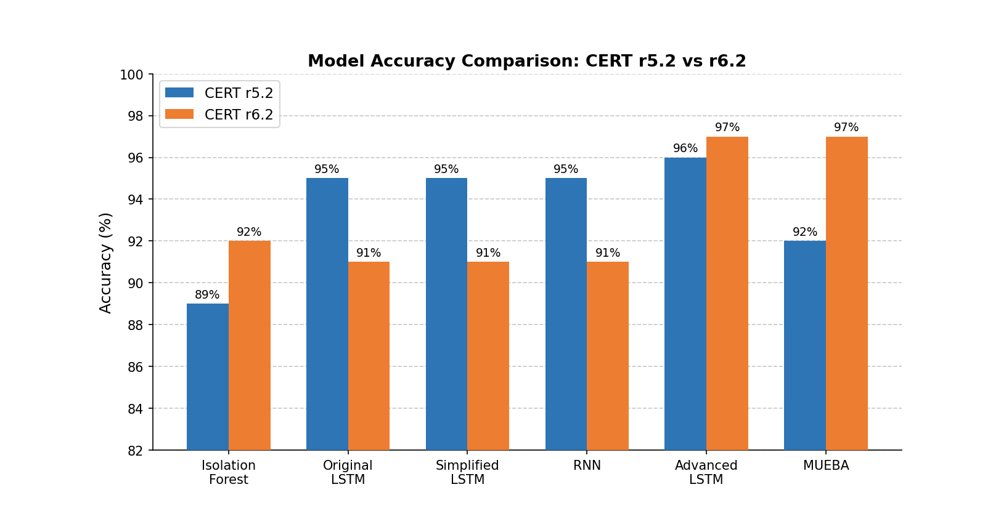
Insider threats represent a critical and growing risk to organizational security, originating from trusted personnel with legitimate system access. Conventional User and Entity Behavior Analytics solutions rely on single-model pipelines and rule-based thresholds that fail to capture subtle, multi-stage threat patterns. This paper proposes MUEBA-XAI, a Multi-model User and Entity Behavior Analytics framework that fuses Long Short-Term Memory (LSTM) networks for temporal sequence modeling with Isolation Forest (iForest) for density-based anomaly isolation, interpreted through SHapley Additive exPlanations and Local Interpretable Model-Agnostic Explanations. Evaluated on the CERT Insider Threat Dataset versions r5.2 and r6.2, the Advanced LSTM achieves 97.5–98.9% accuracy and 0.98–0.99 AUC-ROC, while the Enhanced MUEBA model achieves 97% accuracy and 0.99 AUC-ROC on CERT r6.2. SHAP analysis identifies file modifications, logon frequency, and session duration as the dominant predictive features, and LIME reveals three behaviorally distinct anomaly subtypes among flagged sessions. The proposed framework delivers both high detection performance and actionable interpretability, enabling security analysts to understand, audit, and act on anomaly decisions in real-world deployments.
References
Y. GÖRMEZ, H. ARSLAN, Y. E. IŞIK, and V. GÜNDÜZ, “Developing Novel Deep Learning Models to Detect Insider Threats and Comparing the Models from Different Perspectives,” Bilişim Teknol. Derg., vol. 17, no. 1, pp. 31–43, Jan. 2024, doi: 10.17671/GAZIBTD.1386734.
P. Manoharan, J. Yin, H. Wang, Y. Zhang, and W. Ye, “Insider threat detection using supervised machine learning algorithms,” Telecommun. Syst. 2023 874, vol. 87, no. 4, pp. 899–915, Dec. 2023, doi: 10.1007/S11235-023-01085-3.
M. AlSlaiman, M. I. Salman, M. M. Saleh, and B. Wang, “Enhancing false negative and positive rates for efficient insider threat detection,” Comput. Secur., vol. 126, p. 103066, Mar. 2023, doi: 10.1016/J.COSE.2022.103066.
P. Lavanya, H. Anila Glory, and V. S. Shankar Sriram, “Mitigating Insider Threat: A Neural Network Approach for Enhanced Security,” IEEE Access, vol. 12, pp. 73752–73768, 2024, doi: 10.1109/ACCESS.2024.3404814.
P. Pal, P. Chattopadhyay, and M. Swarnkar, “Temporal feature aggregation with attention for insider threat detection from activity logs,” Expert Syst. Appl., vol. 224, p. 119925, Aug. 2023, doi: 10.1016/J.ESWA.2023.119925.
R. A. Alsowail and T. Al-Shehari, “Techniques and countermeasures for preventing insider threats,” PeerJ. Comput. Sci., vol. 8, 2022, doi: 10.7717/PEERJ-CS.938.
T. T. & Z. Z. Fabien Charmet, Harry Chandra Tanuwidjaja, Solayman Ayoubi, Pierre-François Gimenez, Yufei Han, Houda Jmila, Gregory Blanc, “Explainable artificial intelligence for cybersecurity: a literature survey,” Ann. Telecommun., vol. 77, pp. 789–812, 2022, doi: https://doi.org/10.1007/s12243-022-00926-7.
Z. Zhang, H. Al Hamadi, E. Damiani, C. Y. Yeun, and F. Taher, “Explainable Artificial Intelligence Applications in Cyber Security: State-of-the-Art in Research,” IEEE Access, vol. 10, pp. 93104–93139, 2022, doi: 10.1109/ACCESS.2022.3204051.
Scott Lundberg, Su-In Lee, “A Unified Approach to Interpreting Model Predictions,” arXiv:1705.07874, 2017, [Online]. Available: https://arxiv.org/abs/1705.07874
Marco Tulio Ribeiro, Sameer Singh, Carlos Guestrin, “‘Why Should I Trust You?’: Explaining the Predictions of Any Classifier,” arXiv:1602.04938, 2016, [Online]. Available: https://arxiv.org/abs/1602.04938
M. Villarreal-Vasquez, G. Modelo-Howard, S. Dube, and B. Bhargava, “Hunting for Insider Threats Using LSTM-Based Anomaly Detection,” IEEE Trans. Dependable Secur. Comput., vol. 20, no. 1, pp. 451–462, Jan. 2023, doi: 10.1109/TDSC.2021.3135639.
S. Zou, H. Sun, G. Xu, and R. Quan, “Ensemble strategy for insider threat detection from user activity logs,” Comput. Mater. Contin., vol. 65, no. 2, pp. 1321–1334, 2020, doi: 10.32604/CMC.2020.09649.
M. Dosh, “Detecting insider threat within institutions using CERT dataset and different ML techniques,” Period. Eng. Nat. Sci., vol. 9, no. 2, pp. 873–884, May 2021, doi: 10.21533/PEN.V9.I2.791.
F. Yuan, Y. Cao, Y. Shang, Y. Liu, J. Tan, and B. Fang, “Insider threat detection with deep neural network,” Lect. Notes Comput. Sci. (including Subser. Lect. Notes Artif. Intell. Lect. Notes Bioinformatics), vol. 10860 LNCS, pp. 43–54, 2018, doi: 10.1007/978-3-319-93698-7_4/FIGURES/5.
W. He, X. Wu, J. Wu, X. Xie, L. Qiu, and L. Sun, “Insider Threat Detection Based on User Historical Behavior and Attention Mechanism,” Proc. - 2021 IEEE 6th Int. Conf. Data Sci. Cyberspace, DSC 2021, pp. 564–569, 2021, doi: 10.1109/DSC53577.2021.00089.
P. Manoharan, W. Hong, J. Yin, H. Wang, Y. Zhang, and W. Ye, “Optimising Insider Threat Prediction: Exploring BiLSTM Networks and Sequential Features,” Data Sci. Eng. 2024 94, vol. 9, no. 4, pp. 393–408, Nov. 2024, doi: 10.1007/S41019-024-00260-Z.
D. C. Le and N. Zincir-Heywood, “Anomaly Detection for Insider Threats Using Unsupervised Ensembles,” IEEE Trans. Netw. Serv. Manag., vol. 18, no. 2, pp. 1152–1164, Jun. 2021, doi: 10.1109/TNSM.2021.3071928.
M. N. Al-Mhiqani et al., “A new intelligent multilayer framework for insider threat detection,” Comput. Electr. Eng., vol. 97, p. 107597, Jan. 2022, doi: 10.1016/J.COMPELECENG.2021.107597.
W. Hong et al., “A graph empowered insider threat detection framework based on daily activities,” ISA Trans., vol. 141, pp. 84–92, Oct. 2023, doi: 10.1016/J.ISATRA.2023.06.030.
B. Bose, B. Avasarala, S. Tirthapura, Y. Y. Chung, and D. Steiner, “Detecting Insider Threats Using RADISH: A System for Real-Time Anomaly Detection in Heterogeneous Data Streams,” IEEE Syst. J., vol. 11, no. 2, pp. 471–482, Jun. 2017, doi: 10.1109/JSYST.2016.2558507.
M. Garchery and M. Granitzer, “ADSAGE: Anomaly Detection in Sequences of Attributed Graph Edges applied to insider threat detection at fine-grained level,” Jul. 2020, Accessed: Sep. 04, 2026. [Online]. Available: https://arxiv.org/pdf/2007.06985
M. Singh, B. M. Mehtre, and S. Sangeetha, “User Behaviour based Insider Threat Detection in Critical Infrastructures,” ICSCCC 2021 - Int. Conf. Secur. Cyber Comput. Commun., pp. 489–494, May 2021, doi: 10.1109/ICSCCC51823.2021.9478137.
C. Y. Y. and F. T. Z. Zhang, H. A. Hamadi, E. Damiani, “Explainable Artificial Intelligence Applications in Cyber Security: State-of-the-Art in Research,” IEEE Access, vol. 10, pp. 93104–93139, 2022, doi: 10.1109/ACCESS.2022.3204051.
A. Nicolaou, S. Shiaeles, and N. Savage, “Mitigating Insider Threats Using Bio-Inspired Models,” Appl. Sci. 2020, Vol. 10, Page 5046, vol. 10, no. 15, p. 5046, Jul. 2020, doi: 10.3390/APP10155046.
“A Predictive User Behaviour Analytic Model for Insider Threats in Cyberspace | Request PDF.” Accessed: Sep. 04, 2026. [Online]. Available: https://www.researchgate.net/publication/361650711_A_Predictive_User_Behaviour_Analytic_Model_for_Insider_Threats_in_Cyberspace
F. Janjua, A. Masood, H. Abbas, and I. Rashid, “Handling Insider Threat Through Supervised Machine Learning Techniques,” Procedia Comput. Sci., vol. 177, pp. 64–71, Jan. 2020, doi: 10.1016/J.PROCS.2020.10.012.
D. Zhu, X. Huang, N. Li, H. Sun, M. Liu, and J. Liu, “RAP-Net: A Resource Access Pattern Network for Insider Threat Detection,” Proc. Int. Jt. Conf. Neural Networks, 2022, doi: 10.1109/IJCNN55064.2022.9892183.
I. Benchaji, S. Douzi, B. El Ouahidi, and J. Jaafari, “Enhanced credit card fraud detection based on attention mechanism and LSTM deep model,” J. Big Data 2021 81, vol. 8, no. 1, pp. 151-, Dec. 2021, doi: 10.1186/S40537-021-00541-8.
B. Sharma, P. Pokharel, and B. Joshi, “User Behavior Analytics for Anomaly Detection Using LSTM Autoencoder-Insider Threat Detection,” ACM Int. Conf. Proceeding Ser., Jul. 2020, doi: 10.1145/3406601.3406610;
D. Li, L. Yang, H. Zhang, X. Wang, L. Ma, and J. Xiao, “Image-Based Insider Threat Detection via Geometric Transformation,” Secur. Commun. Networks, vol. 2021, no. 1, p. 1777536, Jan. 2021, doi: 10.1155/2021/1777536.
X. Zuo, F. Yan, B. Hou, Z. Chen, and Y. Guo, “Insider Threat Detection Model Of Power System Based On Lstm-Attention”.
D. C. Le and N. Zincir-Heywood, “Exploring anomalous behaviour detection and classification for insider threat identification,” Int. J. Netw. Manag., vol. 31, no. 4, Jul. 2021, doi: 10.1002/NEM.2109.
R. G. Gayathri, A. Sajjanhar, and Y. Xiang, “Adversarial Training for Robust Insider Threat Detection,” Proc. Int. Jt. Conf. Neural Networks, 2022, doi: 10.1109/IJCNN55064.2022.9892059.
K. Al tabash and J. Happa, “Insider-threat detection using Gaussian Mixture Models and Sensitivity Profiles,” Comput. Secur., vol. 77, pp. 838–859, Aug. 2018, doi: 10.1016/J.COSE.2018.03.006.
C. Zhang, S. Wang, D. Zhan, T. Yu, T. Wang, and M. Yin, “Detecting Insider Threat from Behavioral Logs Based on Ensemble and Self-Supervised Learning,” Secur. Commun. Networks, vol. 2021, no. 1, p. 4148441, Jan. 2021, doi: 10.1155/2021/4148441.
R. B. Peccatiello, J. J. C. Gondim, and L. P. F. Garcia, “Applying One-Class Algorithms for Data Stream-Based Insider Threat Detection,” IEEE Access, vol. 11, pp. 70560–70573, 2023, doi: 10.1109/ACCESS.2023.3293825.
D. Ge, S. Zhong, and K. Chen, “Multi-source data fusion for insider threat detection using residual networks,” Proc. - 2022 3rd Int. Conf. Electron. Commun. Inf. Technol. CECIT 2022, pp. 359–366, 2022, doi: 10.1109/CECIT58139.2022.00069.
P. Moriano, J. Pendleton, S. Rich, and L. Jean Camp, “Stopping the insider at the gates: Protecting organizational assets through graph mining,” J. Wirel. Mob. Networks, Ubiquitous Comput. Dependable Appl., vol. 9, no. 1, pp. 4–29, Mar. 2018, doi: 10.22667/JOWUA.2018.03.31.004.
M. T. Ribeiro, S. Singh, and C. Guestrin, “‘Why Should I Trust You?’ Explaining the Predictions of Any Classifier,” NAACL-HLT 2016 - 2016 Conf. North Am. Chapter Assoc. Comput. Linguist. Hum. Lang. Technol. Proc. Demonstr. Sess., pp. 97–101, 2016, doi: 10.18653/v1/n16-3020.
Mohammed Nasser Al-Mhiqani, Rabiah Ahmad, “A Review of Insider Threat Detection: Classification, Machine Learning Techniques, Datasets, Open Challenges, and Recommendations,” Appl. Sci., vol. 10, no. 15, p. 5208, 2020, doi: https://doi.org/10.3390/app10155208.
R. Yumlembam, B. Issac, S. M. Jacob, L. Yang, and D. Krishnan, “Insider Threat Detection Using GCN and Bi-LSTM with Explicit and Implicit Graph Representations,” IEEE Trans. Artif. Intell., Jul. 2025, doi: 10.1109/TAI.2025.3647418.
Vincent Zibi Mohale, Ibidun Christiana Obagbuwa, “A systematic review on the integration of explainable artificial intelligence in intrusion detection systems to enhancing transparency and interpretability in cybersecurity,” Front. Artif. Intell., vol. 8, 2025, doi: https://doi.org/10.3389/frai.2025.1526221.
K. S. Alketbi and A. Mehmood, “A Comprehensive Survey of Explainable Artificial Intelligence Techniques for Malicious Insider Threat Detection,” IEEE Access, vol. 13, pp. 121772–121798, 2025, doi: 10.1109/ACCESS.2025.3587114.
R. Grzeczkowicz, C. Neal, N. Baghalizadeh-Moghadam, N. B. Cuppens, and F. Cuppens, “Classifying Insider Threat Scenarios Through Explainable Articial Intelligence,” pp. 157–172, 2025, doi: 10.1007/978-3-031-89350-6_10;
D. C. Le, N. Zincir-Heywood, and M. I. Heywood, “Analyzing Data Granularity Levels for Insider Threat Detection Using Machine Learning,” IEEE Trans. Netw. Serv. Manag., vol. 17, no. 1, pp. 30–44, Mar. 2020, doi: 10.1109/TNSM.2020.2967721.
T. Al‐shehari and R. A. Alsowail, “An Insider Data Leakage Detection Using One-Hot Encoding, Synthetic Minority Oversampling and Machine Learning Techniques,” Entropy 2021, Vol. 23, Page 1258, vol. 23, no. 10, p. 1258, Sep. 2021, doi: 10.3390/E23101258.
M. Nasser Al-Mhiqani, R. Ahmed, Z. A. Zainal Abidin, and S. N. Isnin, “An Integrated Imbalanced Learning and Deep Neural Network Model for Insider Threat Detection,” Int. J. Adv. Comput. Sci. Appl., vol. 12, no. 1, pp. 573–577, 2021, doi: 10.14569/IJACSA.2021.0120166.
T. Al-Shehari and R. A. Alsowail, “Random resampling algorithms for addressing the imbalanced dataset classes in insider threat detection,” Int. J. Inf. Secur. 2022 223, vol. 22, no. 3, pp. 611–629, Dec. 2022, doi: 10.1007/S10207-022-00651-1.
F. Charmet et al., “Explainable artificial intelligence for cybersecurity: a literature survey,” Ann. Telecommun. 2022 7711, vol. 77, no. 11, pp. 789–812, Oct. 2022, doi: 10.1007/S12243-022-00926-7.
Downloads
Published
How to Cite
Issue
Section
License
Copyright (c) 2026 50sea

This work is licensed under a Creative Commons Attribution 4.0 International License.