Data Hiding and Retrieval Using Edge-Guided LSB Image Steganography
Keywords:
Canny Edge Detection, Data Hiding, Image Steganography, Laplacian Of Gaussian, Least Significant Bit, MSE, PSNR, RGB Images, SSIMAbstract
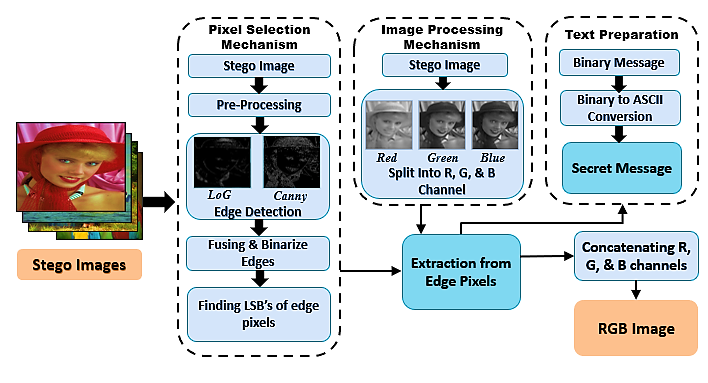
This paper presents an edge-guided Least-Significant-Bit (LSB) method for hiding and retrieving text in Red-Green-Blue (RGB) images. A common embedding mask is generated through grayscale conversion, noise suppression, and fusion and binarization of Canny and Laplacian-of-Gaussian edge maps. The secret text is converted into a binary stream and embedded in selected low-order bit positions at edge locations across the color channels. The channel-processing stage incorporates discrete cosine transform and inverse-transform operations. The method is evaluated using 24 Kodak images, 500 BSD500 images, and an 8,104-image subset of IStego 100K. The average Peak Signal-To-Noise Ratios (PSNRs) are 70.1028, 70.0841, and 71.5475 dB, respectively, with corresponding mean squared errors of 0.0065, 0.0066, and 0.0051. Benchmark structural similarity index (SSIM) values round to 1.000 at three decimal places. Bit-plane sensitivity tests show that, for a 96-bit message, average PSNR increases from 81.3219 dB with four low-order bit positions to 86.4936 dB with two. These results indicate low image distortion under the tested conditions and demonstrate the influence of bit-plane selection on visual fidelity.
References
P. C. Mandal, I. Mukherjee, G. Paul, and B. N. Chatterji, “Digital image steganography: A literature survey,” Inf. Sci. (Ny)., vol. 609, pp. 1451–1488, Sep. 2022, doi: 10.1016/j.ins.2022.07.120.
N. Ayub and A. Selwal, “An improved image steganography technique using edge based data hiding in DCT domain,” J. Interdiscip. Math., vol. 23, no. 2, pp. 357–366, Feb. 2020, doi: 10.1080/09720502.2020.1731949.
C. S. Fernandes, “Steganography and Computer Forensics - the art of hiding information: a systematic review,” ARIS2 - Adv. Res. Inf. Syst. Secur., vol. 2, no. 2, pp. 31–38, Dec. 2022, doi: 10.56394/aris2.v2i2.20.
S. Atawneh, A. Almomani, and P. Sumari, “Steganography in digital images: Common approaches and tools,” IETE Tech. Rev. (Institution Electron. Telecommun. Eng. India), vol. 30, no. 4, pp. 344–358, Jul. 2013, doi: 10.4103/0256-4602.116724.
O. Evsutin, A. Melman, and R. Meshcheryakov, “Digital steganography and watermarking for digital images: A review of current research directions,” IEEE Access, vol. 8, pp. 166589–166611, 2020, doi: 10.1109/ACCESS.2020.3022779.
N. Subramanian, O. Elharrouss, S. Al-Maadeed, and A. Bouridane, “Image Steganography: A Review of the Recent Advances,” IEEE Access, vol. 9, pp. 23409–23423, 2021, doi: 10.1109/ACCESS.2021.3053998.
A. A. J. Altaay, S. Bin Sahib, and M. Zamani, “An introduction to image steganography techniques,” Proc. - 2012 Int. Conf. Adv. Comput. Sci. Appl. Technol. ACSAT 2012, pp. 122–126, 2012, doi: 10.1109/ACSAT.2012.25.
M. Hussain, M. H.-I. J. of A. S. and, and undefined 2013, “A survey of image steganography techniques,” earticle.net, Accessed: Sep. 08, 2026. [Online]. Available: https://www.earticle.net/Article/A206914
Gandharba Swain, Saroj Kumar Lenka, “Classification image steganography techniques in spatial domain: A study,” Int. J. Comput. Sci. Eng. Technol., 2014, [Online]. Available: https://www.researchgate.net/publication/303751769_Classification_
image_steganography_techniques_in_spatial_domain_A_study
D. Samidha and D. Agrawal, “Random image steganography in spatial domain,” 2013 Int. Conf. Emerg. Trends VLSI, Embed. Syst. Nano Electron. Telecommun. Syst. ICEVENT 2013, 2013, doi: 10.1109/ICEVENT.2013.6496564.
M. N. Abdulwahedand, S. T. Mustafa, and M. S. M. Rahim, “Image spatial domain steganography: A study of performance evaluation parameters,” 2019 IEEE 9th Int. Conf. Syst. Eng. Technol. ICSET 2019 - Proceeding, pp. 309–314, Oct. 2019, doi: 10.1109/ICSENGT.2019.8906402.
F. Q. A. Alyousuf, R. Din, and A. J. Qasim, “Analysis review on spatial and transform domain technique in digital steganography,” Bull. Electr. Eng. Informatics, vol. 9, no. 2, pp. 573–581, Apr. 2020, doi: 10.11591/EEI.V9I2.2068.
T. C. Lu and T. N. Vo, “Reversible steganography techniques: A survey,” Digit. Media Steganography Princ. Algorithms, Adv., pp. 189–213, Jan. 2020, doi: 10.1016/B978-0-12-819438-6.00018-9.
R. Adee and H. Mouratidis, “A Dynamic Four-Step Data Security Model for Data in Cloud Computing Based on Cryptography and Steganography,” Sensors 2022, Vol. 22, Page 1109, vol. 22, no. 3, p. 1109, Feb. 2022, doi: 10.3390/S22031109.
V. K. Trivedi, S. Stalin, S. Joshi, M. H. Alkinani, P. K. Shukla, and B. Gaur, “User data privacy in multimedia domain using 3–3 LSB-based color image steganography with RC4 and Bernoulli map protection,” J. Electron. Imaging, vol. 31, no. 03, May 2022, doi: 10.1117/1.JEI.31.3.033021.
O. Y. Abdulhammed, “A novel approach of steganography by using strong edge detection and chaos theory,” Multimed. Tools Appl. 2022 8113, vol. 81, no. 13, pp. 17875–17888, Mar. 2022, doi: 10.1007/S11042-022-12643-3.
A. AbdelRaouf, “A new data hiding approach for image steganography based on visual color sensitivity,” Multimed. Tools Appl., vol. 80, no. 15, pp. 23393–23417, Jun. 2021, doi: 10.1007/S11042-020-10224-W.
A. Jan, S. A. Parah, M. Hassan, and B. A. Malik, “Realization of Efficient Steganographic Scheme Using Hybrid Edge Detection and Chaos,” Arab. J. Sci. Eng. 2022 482, vol. 48, no. 2, pp. 1859–1872, Jul. 2022, doi: 10.1007/S13369-022-06960-W.
S. K. Ghosal, A. Chatterjee, and R. Sarkar, “Image steganography based on Kirsch edge detection,” Multimed. Syst. 2020 271, vol. 27, no. 1, pp. 73–87, Oct. 2020, doi: 10.1007/S00530-020-00703-3.
S. Mukherjee and G. Sanyal, “Edge based image steganography with variable threshold,” Multimed. Tools Appl. 2018 7812, vol. 78, no. 12, pp. 16363–16388, Dec. 2018, doi: 10.1007/S11042-018-6975-4.
C. T. Huang, M. Y. Tsai, L. C. Lin, W. J. Wang, and S. J. Wang, “VQ-based data hiding in IoT networks using two-level encoding with adaptive pixel replacements,” J. Supercomput. 2016 749, vol. 74, no. 9, pp. 4295–4314, Sep. 2016, doi: 10.1007/S11227-016-1874-9.
R. Kumar, D. S. Kim, and K. H. Jung, “Enhanced AMBTC based data hiding method using hamming distance and pixel value differencing,” J. Inf. Secur. Appl., vol. 47, pp. 94–103, Aug. 2019, doi: 10.1016/J.JISA.2019.04.007.
A. Malik, G. Sikka, and H. K. Verma, “An AMBTC compression based data hiding scheme using pixel value adjusting strategy,” Multidimens. Syst. Signal Process. 2017 294, vol. 29, no. 4, pp. 1801–1818, Nov. 2017, doi: 10.1007/S11045-017-0530-8.
M. M. Hashim, M. S. M. Rahim, F. A. Johi, M. S. Taha, and H. S. Hamad, “(PDF) Performance evaluation measurement of image steganography techniques with analysis of LSB based on variation image formats,” International Journal of Engineering and Technology. Accessed: Sep. 08, 2026. [Online]. Available: https://www.researchgate.net/publication/343714046_Performance_evaluation_measurement_of_image_steganography_techniques_with_analysis_of_LSB_based_on_variation_image_formats
A. Chatterjee, S. K. Ghosal, and R. Sarkar, “LSB based steganography with OCR: an intelligent amalgamation,” Multimed. Tools Appl., vol. 79, no. 17–18, pp. 11747–11765, May 2020, doi: 10.1007/S11042-019-08472-6.
H. Al-Dmour and A. Al-Ani, “Quality optimized medical image steganography based on edge detection and hamming code,” Proc. - Int. Symp. Biomed. Imaging, vol. 2015-July, pp. 1486–1489, Jul. 2015, doi: 10.1109/ISBI.2015.7164158.
A. Horé and D. Ziou, “Image quality metrics: PSNR vs. SSIM,” Proc. - Int. Conf. Pattern Recognit., pp. 2366–2369, 2010, doi: 10.1109/ICPR.2010.579.
Z. Wang and A. C. Bovik, “Mean squared error: Lot it or leave it? A new look at signal fidelity measures,” IEEE Signal Process. Mag., vol. 26, no. 1, pp. 98–117, 2009, doi: 10.1109/MSP.2008.930649.
A. A. Abdulla, H. Sellahewa, and S. A. Jassim, “Improving embedding efficiency for digital steganography by exploiting similarities between secret and cover images,” Multimed. Tools Appl. 2019 7813, vol. 78, no. 13, pp. 17799–17823, Jan. 2019, doi: 10.1007/S11042-019-7166-7.
I. Banerjee, S. Bhattacharyya, and G. Sanyal, “Hiding & Analyzing Data in Image Using Extended PMM,” Procedia Technol., vol. 10, pp. 157–166, Jan. 2013, doi: 10.1016/J.PROTCY.2013.12.348.
Downloads
Published
How to Cite
Issue
Section
License
Copyright (c) 2026 50SEA

This work is licensed under a Creative Commons Attribution 4.0 International License.