Demand Response Application of Thermostatically Controlled Loads in Active Power Balancing Services
DOI:
https://doi.org/10.33411/IJIST/2062Keywords:
Load Frequency Control, Thermostatically Controlled Loads, Active power balancing, Frequency governance, Secondary control mechanismAbstract
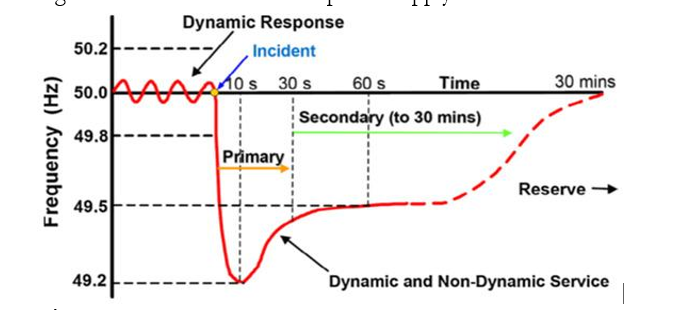
The integration of Thermostatically Controlled Loads (TCLs) into the active power regulation framework of power systems provides a variety of benefits and multifarious uses. The TCLs specifically heating, ventilation, and air-conditioning (HVAC) systems constitutes the majority of the power demands in modern power systems for centralized building structures. This study investigates the utilization of an aggregated HVAC/TCL resource as a supplementary demand side reserve in a single-area load frequency control system that features a 250 MW coal-fired thermal generating unit. A 40 MW step-load disturbance is used to evaluate the system response to frequency under primary control alone and synchronized primary and HVAC secondary control. Under primary control only, the system frequency falls from the nominal 60 Hz to around 59.725 Hz, producing a steady-state frequency error of roughly 0.275 Hz. The HVAC resource is used as secondary control, delivering an estimated aggregate response of 40 MW. The resulting frequency deviation is corrected, and the system's frequency is returned to about 60 Hz within about 60 seconds. During the restoration procedure, the demand side resource response achieves a transient peak of about 70 MW, while the entire system frequency has a maximum transient excursion of around 60.20 Hz. The results show that the modeled aggregated resource may offer sufficient secondary frequency support while eliminating the residual steady-state frequency error that remains after the initial thermal generating response. A comprehensive simulation model is developed using MATLAB to validate the efficiency of the proposed strategy. The simulation integrates a coal-based thermal power plant with a robust HVAC model within the framework of load frequency control (LFC). This collective approach improves the active power balance and the operational stability of the grid.
References
I. Beil, I. Hiskens, and S. Backhaus, “Frequency Regulation from Commercial Building HVAC Demand Response,” Proc. IEEE, vol. 104, no. 4, pp. 745–757, Apr. 2016, doi: 10.1109/JPROC.2016.2520640.
J. Cai and J. E. Braun, “Laboratory-based assessment of HVAC equipment for power grid frequency regulation: Methods, regulation performance, economics, indoor comfort and energy efficiency,” Energy Build., vol. 185, pp. 148–161, Feb. 2019, doi: 10.1016/j.enbuild.2018.12.022.
H. Wang, S. Wang, and K. Shan, “Experimental study on the dynamics, quality and impacts of using variable-speed pumps in buildings for frequency regulation of smart power grids,” Energy, vol. 199, p. 117406, May 2020, doi: 10.1016/j.energy.2020.117406.
A. Basit, T. Ahmad, A. Yar Ali, K. Ullah, G. Mufti, and A. D. Hansen, “Flexible Modern Power System: Real-Time Power Balancing through Load and Wind Power,” Energies, vol. 12, no. 9, p. 1710, May 2019, doi: 10.3390/en12091710.
H. Wang and S. Wang, “A hierarchical optimal control strategy for continuous demand response of building HVAC systems to provide frequency regulation service to smart power grids,” Energy, vol. 230, p. 120741, Sep. 2021, doi: 10.1016/j.energy.2021.120741.
H. Wang, S. Wang, and R. Tang, “Development of grid-responsive buildings: Opportunities, challenges, capabilities and applications of HVAC systems in non-residential buildings in providing ancillary services by fast demand responses to smart grids,” Appl. Energy, vol. 250, pp. 697–712, Sep. 2019, doi: 10.1016/j.apenergy.2019.04.159.
N. Mahdavi, J. H. Braslavsky, M. M. Seron, and S. R. West, “Model Predictive Control of Distributed Air-Conditioning Loads to Compensate Fluctuations in Solar Power,” IEEE Trans. Smart Grid, vol. 8, no. 6, pp. 3055–3065, Nov. 2017, doi: 10.1109/TSG.2017.2717447.
F. Conte, M. Crosa Di Vergagni, S. Massucco, F. Silvestro, E. Ciapessoni, and D. Cirio, “Performance analysis of frequency regulation services provided by aggregates of domestic thermostatically controlled loads,” Int. J. Electr. Power Energy Syst., vol. 131, p. 107050, Oct. 2021, doi: 10.1016/j.ijepes.2021.107050.
S. Kiani, K. Sheshyekani, and H. Dagdougui, “A unified state space model for aggregation and coordination of large-scale TCLs and EVs for frequency regulation,” Electr. Power Syst. Res., vol. 195, p. 107181, Jun. 2021, doi: 10.1016/j.epsr.2021.107181.
A. Kasis and I. Lestas, “Frequency regulation with thermostatically controlled loads: aggregation of dynamics and synchronization,” Oct. 27, 2021, arXiv: arXiv:2002.06649. doi: 10.48550/arXiv.2002.06649.
M. Liu, Y. Tian, D. Cheng, Y. Zhang, and L. Ding, “Modelling and control of central air‐conditioning loads for power system emergency frequency control,” IET Gener. Transm. Distrib., vol. 16, no. 20, pp. 4054–4067, Oct. 2022, doi: 10.1049/gtd2.12571.
T. Bal, S. Ray, N. Sinha, R. Devarapalli, and Ł. Knypiński, “Integrating Demand Response for Enhanced Load Frequency Control in Micro-Grids with Heating, Ventilation and Air-Conditioning Systems", Energies, vol. 16, no. 15, p. 5767, 2023, doi: 10.3390/en16155767”.
B. Jiang, Z. Yang, W. Xiong, L. Chen, P. Wang, and S. Liao, “Decentralized control strategy of air-conditioning loads for primary frequency regulation based on environment information,” Front. Energy Res., vol. 11, p. 1347789, Jan. 2024, doi: 10.3389/fenrg.2023.1347789.
L. Li, H. Li, M.-L. Tseng, H. Feng, and A. S. F. Chiu, “Renewable Energy System on Frequency Stability Control Strategy Using Virtual Synchronous Generator,” Symmetry, vol. 12, no. 10, p. 1697, Oct. 2020, doi: 10.3390/sym12101697.
S. Wen, Y. Wang, Y. Tang, Y. Xu, P. Li, and T. Zhao, “Real-Time Identification of Power Fluctuations Based on LSTM Recurrent Neural Network: A Case Study on Singapore Power System,” IEEE Trans. Ind. Inform., vol. 15, no. 9, pp. 5266–5275, Sep. 2019, doi: 10.1109/TII.2019.2910416.
C. Chen, K. Zhang, J. Geng, K. Yuan, Z. Yang, and L. Li, “Multiobjective-based optimal allocation scheme for load frequency control,” Int. Trans. Electr. Energy Syst., vol. 27, no. 7, p. e2334, Jul. 2017, doi: 10.1002/etep.2334.
Downloads
Published
How to Cite
Issue
Section
License
Copyright (c) 2026 50sea

This work is licensed under a Creative Commons Attribution 4.0 International License.