Enhanced Facial Emotion Recognition for Autism Spectrum Disorder Using Multi-Model CNN Architectures
Keywords:
Facial Emotion Recognition, Autism Spectrum Disorder (ASD), Deep Learning, Transfer Learning, CNN (Convolutional Neural Network)Abstract
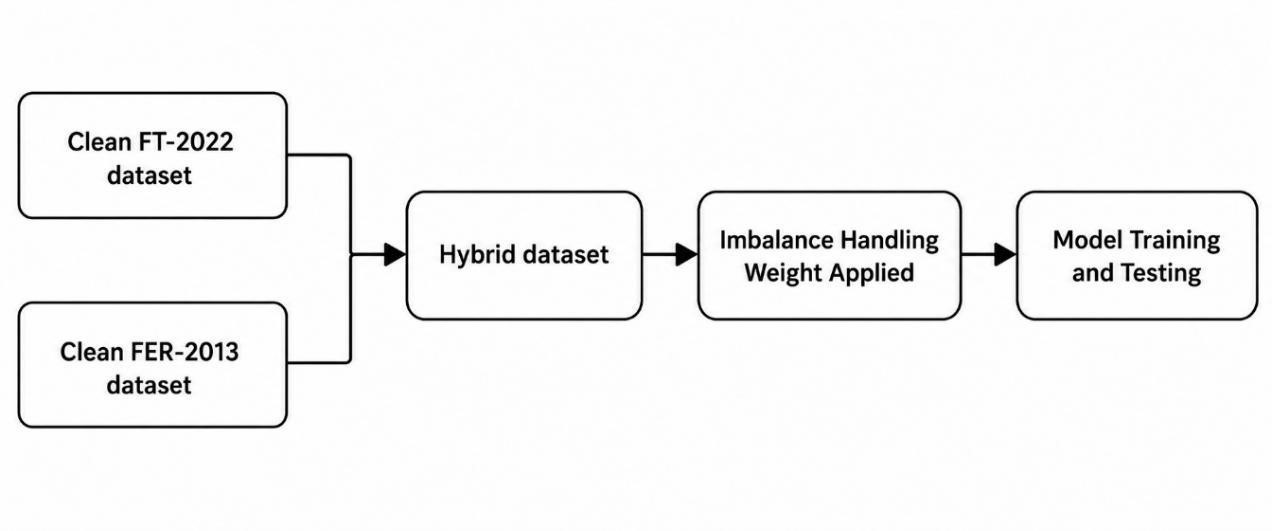
Facial Emotion Recognition (FER) plays an important role in assistive technologies for individuals with autism spectrum disorder (ASD), particularly in therapeutic and educational settings. However, existing FER systems often rely on generic facial expression datasets that may not adequately represent the distinctive characteristics of emotional expressions associated with ASD. To address this limitation, this study develops an enhanced FER framework by integrating the FER-2013 dataset with the FT-2022 ASD-specific dataset. Following quality filtering, the resulting hybrid dataset contained 30,106 facial images, combining the diversity of general facial expressions with ASD-specific emotional characteristics. Three transfer-learning-based convolutional neural network (CNN) architectures, namely VGG16, ResNet50, and Xception, were systematically evaluated individually and in combination. On the hybrid dataset, the individual models achieved accuracies of 91% (VGG16), 90% (ResNet50), and 68% (Xception), with corresponding F1-scores of 0.90, 0.89, and 0.68, respectively. Three multi-model configurations were subsequently evaluated: ResNet50–VGG16, ResNet50–Xception, and VGG16–Xception. The corresponding accuracies were 99%, 98%, and 65%, with F1-scores of 0.99, 0.98, and 0.65, respectively. The ResNet50–VGG16 configuration achieved the highest accuracy, improving performance by 8 percentage points over the best individual model, VGG16. These results demonstrate that combining complementary CNN architectures can substantially improve FER performance when applied to a diverse hybrid dataset containing both general and ASD-specific facial expressions. The proposed framework provides a promising foundation for ASD-focused assistive technologies supporting emotion recognition and social interaction in therapeutic and educational settings.
References
A. Rehman, M. Mujahid, A. Elyassih, B. AlGhofaily, and S. A. O. Bahaj, “Comprehensive Review and Analysis on Facial Emotion Recognition: Performance Insights into Deep and Traditional Learning with Current Updates and Challenges,” Comput. Mater. Contin., vol. 82, no. 1, pp. 41–72, Jan. 2025, doi: 10.32604/CMC.2024.058036.
A. L. Cîrneanu, D. Popescu, and D. Iordache, “New Trends in Emotion Recognition Using Image Analysis by Neural Networks, A Systematic Review,” Sensors 2023, Vol. 23, Page 7092, vol. 23, no. 16, p. 7092, Aug. 2023, doi: 10.3390/S23167092.
S. Li and W. Deng, “Deep Facial Expression Recognition: A Survey,” IEEE Trans. Affect. Comput., vol. 13, no. 3, pp. 1195–1215, 2022, doi: 10.1109/TAFFC.2020.2981446.
T. Khan, M. Yasir, and C. Choi, “Attention-enhanced optimized deep ensemble network for effective facial emotion recognition,” Alexandria Eng. J., vol. 119, pp. 111–123, Apr. 2025, doi: 10.1016/J.AEJ.2025.01.078.
N. P. Madali and S. Hawamdeh, “Autism Information Progression and the Impact of Misinformation on Autism Knowledge, Awareness and Stigmatization,” Behav. Sci. (Basel, Switzerland), vol. 16, no. 5, May 2026, doi: 10.3390/BS16050660.
J. Zeidan et al., “Global prevalence of autism: A systematic review update,” Autism Res., vol. 15, no. 5, pp. 778–790, May 2022, doi: 10.1002/AUR.2696.
K. Briot, A. Pizano, M. Bouvard, and A. Amestoy, “New Technologies as Promising Tools for Assessing Facial Emotion Expressions Impairments in ASD: A Systematic Review,” Front. psychiatry, vol. 12, May 2021, doi: 10.3389/FPSYT.2021.634756.
American Psychiatric Association, “Diagnostic and Statistical Manual of Mental Disorders,” Diagnostic Stat. Man. Ment. Disord., May 2013, doi: 10.1176/APPI.BOOKS.9780890425596.
A. H. Al-Nefaie, T. H. H. Aldhyani, S. Ahmad, and E. M. Alzahrani, “Application of artificial intelligence in modern healthcare for diagnosis of autism spectrum disorder,” Front. Med., vol. 12, p. 1569464, May 2025, doi: 10.3389/FMED.2025.1569464/TEXT.
I. Ahmad, J. Rashid, M. Faheem, A. Akram, N. A. Khan, and R. ul Amin, “Autism spectrum disorder detection using facial images: A performance comparison of pretrained convolutional neural networks,” Healthc. Technol. Lett., vol. 11, no. 4, pp. 227–239, Aug. 2024, doi: 10.1049/HTL2.12073.
C. Qian, J. A. Lobo Marques, A. R. de Alexandria, and S. J. Fong, “Application of Multiple Deep Learning Architectures for Emotion Classification Based on Facial Expressions,” Sensors 2025, Vol. 25, Page 1478, vol. 25, no. 5, p. 1478, Feb. 2025, doi: 10.3390/S25051478.
J. M. Mayor Torres, T. Clarkson, K. M. Hauschild, C. C. Luhmann, M. D. Lerner, and G. Riccardi, “Facial Emotions Are Accurately Encoded in the Neural Signal of Those With Autism Spectrum Disorder: A Deep Learning Approach,” Biol. Psychiatry Cogn. Neurosci. Neuroimaging, vol. 7, no. 7, pp. 688–695, Jul. 2022, doi: 10.1016/j.bpsc.2021.03.015.
S. mohammed, hesham ali, W. El-Shafai, A. D. Algarni, naglaa soliman, and fathi abd-elsamie, “Predicting of Uncertainty Facial Expressions in Children with Autism Spectrum Disorder Based on an Improved Fuzzy Convolutional Neural Network Model,” 2024, doi: 10.2139/SSRN.4846036.
T. Kopalidis, V. Solachidis, N. Vretos, and P. Daras, “Advances in Facial Expression Recognition: A Survey of Methods, Benchmarks, Models, and Datasets,” Inf. 2024, Vol. 15, Page 135, vol. 15, no. 3, p. 135, Feb. 2024, doi: 10.3390/INFO15030135.
S. Ullah, J. Ou, Y. Xie, and W. Tian, “Facial expression recognition (FER) survey: a vision, architectural elements, and future directions,” PeerJ. Comput. Sci., vol. 10, 2024, doi: 10.7717/PEERJ-CS.2024.
A. P. Munanday, N. Sazali, A. S. Veerendra, and K. Kadirgama, “Facial Emotion Recognition: Methods, Applications and Future Challenges,” Int. J. Integr. Eng., vol. 18, no. 4, pp. 22–39, Jun. 2026, doi: 10.30880/IJIE.2026.18.04.002.
H. Ge, Z. Zhu, Y. Dai, B. Wang, and X. Wu, “Facial expression recognition based on deep learning,” Comput. Methods Programs Biomed., vol. 215, p. 106621, Mar. 2022, doi: 10.1016/J.CMPB.2022.106621.
and S. J. K. Sarvakar, R. Senkamalavalli, S. Raghavendra, J. Santosh Kumar, R. Manjunath, “Facial emotion recognition using convolutional neural networks,” Mater. Today Proc., vol. 8, no. 3, pp. 3560–3564, 2023, doi: https://doi.org/10.1016/j.matpr.2021.07.297.
C. Gupta, “Techniques for Transfer Learning to Enhance Image Classification in Facial Emotion Recognition,” Lect. Notes Electr. Eng., vol. 1528 LNEE, pp. 487–503, 2026, doi: 10.1007/978-981-95-5831-5_50/SAVE-RESEARCH.
B. Ashwini, A. Sarkar, P. R. Behera, and J. Shukla, “Multi-source transfer learning for facial emotion recognition using multivariate correlation analysis,” Sci. Rep., vol. 13, no. 1, Dec. 2023, doi: 10.1038/S41598-023-48250-X.
R. Angeline and A. A. Nithya, “Multimodal Human Facial Emotion Recognition Using DenseNet-161 and Image Feature Stabilization Algorithm,” Trait. du Signal, vol. 39, no. 6, pp. 2165–2172, Dec. 2022, doi: 10.18280/TS.390630.
I. Bah and Y. Xue, “Facial expression recognition using adapted residual based deep neural network,” Intell. Robot., vol. 2, no. 1, p. 72, Mar. 2022, doi: 10.20517/IR.2021.16.
H. M. Shahzad, S. M. Bhatti, A. Jaffar, M. Rashid, and S. Akram, “Multi-Modal CNN Features Fusion for Emotion Recognition: A Modified Xception Model,” IEEE Access, vol. 11, pp. 94281–94289, 2023, doi: 10.1109/ACCESS.2023.3310428.
Y. Ji et al., “Hugging Rain Man: A Novel Facial Action Units Dataset for Analyzing Atypical Facial Expressions in Children with Autism Spectrum Disorder,” IEEE Trans. Affect. Comput., vol. 16, no. 3, pp. 2287–2302, Nov. 2024, doi: 10.1109/TAFFC.2025.3558914.
“Autistic Children Emotions - Dr. Fatma M. Talaat.” Accessed: Oct. 23, 2026. [Online]. Available: https://www.kaggle.com/datasets/fatmamtalaat/autistic-children-emotions-dr-fatma-m-talaat
D. Madhusoodanan, N. Sagar, R. Vismaya, H. Santhosh, and S. Palaniswamy, “Facial Emotion Detection in Autistic Children: A Deep Learning Approach,” 2nd Int. Conf. Electron. Comput. Commun. Control Technol. ICECCC 2025, 2025, doi: 10.1109/ICECCC65144.2025.11063965.
P. Radočaj and G. Martinović, “Emotion Recognition in Autistic Children Through Facial Expressions Using Advanced Deep Learning Architectures,” Appl. Sci. 2025, Vol. 15, Page 9555, vol. 15, no. 17, p. 9555, Aug. 2025, doi: 10.3390/APP15179555.
F. E. El Rhatassi, B. El Ghali, and N. Daoudi, “Deep learning approaches for recognizing facial emotions on autistic patients,” Int. J. Electr. Comput. Eng., vol. 14, no. 4, pp. 4034–4045, Aug. 2024, doi: 10.11591/IJECE.V14I4.PP4034-4045.
D. Kiejdo, M. Depka Prądzinska, and T. Zawadzka, “Late Fusion Model for Emotion Recognition from Facial Expressions and Biosignals in a Dataset of Children with Autism Spectrum Disorder,” Sensors 2025, Vol. 25, Page 7485, vol. 25, no. 24, p. 7485, Dec. 2025, doi: 10.3390/S25247485.
J. Awatramani and N. Hasteer, “Facial Expression Recognition using Deep Learning for Children with Autism Spectrum Disorder,” 2020 IEEE 5th Int. Conf. Comput. Commun. Autom. ICCCA 2020, pp. 35–39, Oct. 2020, doi: 10.1109/ICCCA49541.2020.9250768.
B. Awaji et al., “Hybrid Techniques of Facial Feature Image Analysis for Early Detection of Autism Spectrum Disorder Based on Combined CNN Features,” Diagnostics 2023, Vol. 13, Page 2948, vol. 13, no. 18, p. 2948, Sep. 2023, doi: 10.3390/DIAGNOSTICS13182948.
M. Afrin, K. E. Hoque, and R. Das Chaiti, “Emotion Recognition of Autistic Children from Facial Images Using Hybrid Model,” 2024 15th Int. Conf. Comput. Commun. Netw. Technol. ICCCNT 2024, 2024, doi: 10.1109/ICCCNT61001.2024.10724499.
“sklearn.utils.class_weight.compute_class_weight — scikit-learn 1.2.2 documentation.” Accessed: Oct. 22, 2026. [Online]. Available: https://scikit-learn.org/1.2/modules/generated/sklearn.utils.class_weight.compute_class_weight.html
H. Alkahtani, T. H. H. Aldhyani, and M. Y. Alzahrani, “Deep Learning Algorithms to Identify Autism Spectrum Disorder in Children-Based Facial Landmarks,” Appl. Sci. 2023, Vol. 13, Page 4855, vol. 13, no. 8, p. 4855, Apr. 2023, doi: 10.3390/APP13084855.
“Deep learning models and techniques for facial emotion recognition | Proceedings of the 31st Annual International Conference on Computer Science and Software Engineering.” Accessed: Oct. 23, 2026. [Online]. Available: https://dl.acm.org/doi/10.5555/3507788.3507792
Muhammad Kamran Abid, Rabia Sajjad, Muhammad Fuzail, Ahmad Naeem, Naeem Aslam, and Kiran Shahzadi, “Integrating temporal dynamics in facial emotion recognition using hybrid CNN-RNN models for enhanced human-computer interaction,” Kashf J. Multidiscip. Res., vol. 2, no. 06, pp. 1–15, Jun. 2025, doi: 10.71146/KJMR463.
J. Shaik, R. Shekhar, and C. J. Shelke, “Hybrid Deep Learning Framework for Autism Detection in Children Using Facial Emotion Recognition,” Ing. des Syst. d’Information, vol. 30, no. 10, pp. 2595–2607, Oct. 2025, doi: 10.18280/ISI.301007.
Downloads
Published
How to Cite
Issue
Section
License
Copyright (c) 2026 50sea

This work is licensed under a Creative Commons Attribution 4.0 International License.