Artificial Neural Network Prediction for Thermal Characteristics of Nanofluid over a Stretching Sheet with Variable Properties
Keywords:
Bvp4c Approach, Artificial Neural Network, Levenberg Marquardt Technique with Back Propagations, Nano Fluid, Heat Transfer, Variable Flow Properties, Stretching Sheet, Stagnation PointAbstract
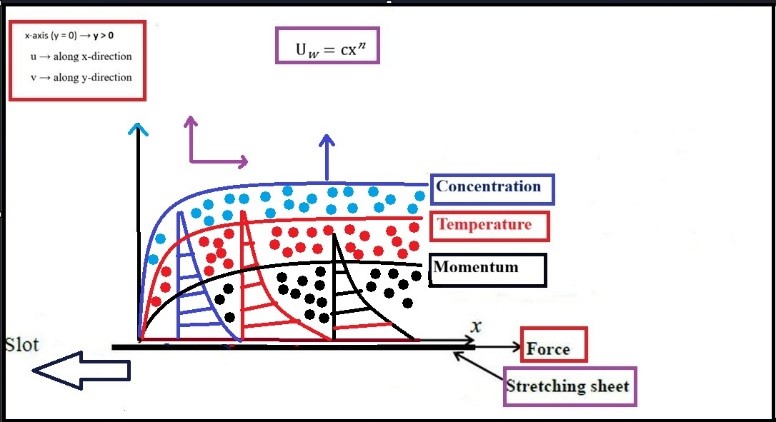
Stagnation-point heat transmission is one such crucial phenomenon taking place in various industrial and technical processes, particularly those involving stretched surfaces. In this study the heat transfer qualities of nanofluids flow towards a stretched sheet under boundary conditions at stagnation point with variable thermophysical properties have been investigated using an ANN framework. Compared to conventional fluids, nanofluids which consist of a base fluid and suspended nanoparticles perform better in heat transmission and have a higher thermal conductivity. The mathematical model in the form of governing partial differential equations has been obtained and transformed into nonlinear ordinary differential equations using the appropriate similarity transformations. These differential equations have subsequently been solved using the appropriate numerical techniques in BVP4c solver in MATLAB. In order to describe and forecast the heat transfer behavior of nanofluids close to a stretching sheet with variable thermophysical properties, the current study explores the use of Artificial Neural Networks (ANN) in physical problems. The impact of important parameters such as the stretching parameter, Prandtl number, nanoparticle volume fraction, and variable property parameters on the velocity and temperature profiles is examined. The ANN model has been trained using the numerical solutions obtained from MATLAB BVP4c. It was observed that the heat transfer performance improves by increasing the nanoparticle concentration. The numerical findings have compared the trained network predicts velocity profile, temperature field and concentration with minimum inaccuracy. The work demonstrates improvements in thermal systems that incorporate nanofluids on stretched surfaces with potential utilizations in cooling technologies.
References
G. K. Ramesh, B. C. P. Kumara, B. J. Gireesha, and R. S. Reddy Gorla, “MHD Stagnation Point Flow of Nanofluid Towards a Stretching Surface with Variable Thickness and Thermal Radiation,” J. Nanofluids, vol. 4, no. 2, pp. 247–253, Mar. 2015, doi: 10.1166/JON.2015.1144.
A. Malvandi, F. Hedayati, and D. D. Ganji, “Nanofluid flow on the stagnation point of a permeable non-linearly stretching/shrinking sheet,” Alexandria Eng. J., vol. 57, no. 4, pp. 2199–2208, Dec. 2018, doi: 10.1016/J.AEJ.2017.08.010.
M. Abdollahzadeh, A. A. Sedighi, and M. Esmailpour, “Stagnation point flow of nanofluids towards stretching sheet through a porous medium with heat generation,” J. Nanofluids, vol. 7, no. 1, pp. 149–155, 2018, doi: 10.1166/jon.2018.1431.
A. Ali, H. S. Khan, S. Saleem, and M. Hussan, “EMHD Nanofluid Flow with Radiation and Variable Heat Flux Effects along a Slandering Stretching Sheet,” Nanomater. 2022, Vol. 12, Page 3872, vol. 12, no. 21, p. 3872, Nov. 2022, doi: 10.3390/NANO12213872.
M. A. A. Hamad and M. Ferdows, “Similarity solution of boundary layer stagnation-point flow towards a heated porous stretching sheet saturated with a nanofluid with heat absorption/generation and suction/blowing: A Lie group analysis,” Commun. Nonlinear Sci. Numer. Simul., vol. 17, no. 1, pp. 132–140, Jan. 2012, doi: 10.1016/J.CNSNS.2011.02.024.
J. Jeong, C. Li, Y. Kwon, J. Lee, S. H. Kim, and R. Yun, “Particle shape effect on the viscosity and thermal conductivity of ZnO nanofluids,” Int. J. Refrig., vol. 36, no. 8, pp. 2233–2241, Dec. 2013, doi: 10.1016/J.IJREFRIG.2013.07.024.
M. Hemmat Esfe, S. Saedodin, and M. Mahmoodi, “Experimental studies on the convective heat transfer performance and thermophysical properties of MgO–water nanofluid under turbulent flow,” Exp. Therm. Fluid Sci., vol. 52, pp. 68–78, Jan. 2014, doi: 10.1016/J.EXPTHERMFLUSCI.2013.08.023.
M. A. Z. Raja, A. Latif, M. Khalid, K. S. Nisar, and M. Shoaib, “Intelligent predictive networks for Cattaneo-Christov heat and mass transfer dissipated Williamson fluid through double stratification,” Case Stud. Therm. Eng., vol. 64, p. 105411, Dec. 2024, doi: 10.1016/J.CSITE.2024.105411.
M. A. Z. Raja, A. Latif, M. Shamim, K. S. Nisar, and M. Shoaib, “Design of artificial neural network for buongiorno model with nanofluids flow through stretching sheet,” Case Stud. Therm. Eng., vol. 69, p. 106054, May 2025, doi: 10.1016/J.CSITE.2025.106054.
M. A. Z. Raja, A. Latif, M. Shamim, K. S. Nisar, and M. Shoaib, “A stochastic numerical analysis for viscoelastic fluid traversing a permeable perpendicular surface,” Int. Commun. Heat Mass Transf., vol. 165, p. 108996, Jun. 2025, doi: 10.1016/J.ICHEATMASSTRANSFER.2025.108996.
B. Alqahtani, Z. Mahmood, M. A. Alyami, A. M. Alotaibi, U. Khan, and A. M. Galal, “Heat and mass transfer analysis of MHD stagnation point flow of carbon nanotubes with convective stretching disk and viscous dissipation,” Adv. Mech. Eng., vol. 14, no. 10, Oct. 2022, doi: 10.1177/16878132221128390;WGROUP:STRING:PUBLICATION.
A. Latif, S. Iftikhar, H. Ali, S. Sheraz Asghar, F. Pakistan, and A. S. S, “MatLab Bvp4c Technique to Compute Thermophoresis and Brownian Motion in Nanofluid Flow Over a Transient Stretching Sheet,” Int. J. Innov. Sci. Technol., vol. 7, no. 3, pp. 2171–2183, Sep. 2025, doi: 10.33411/IJIST/1554.
H. Zargartalebi, M. Ghalambaz, A. Noghrehabadi, and A. Chamkha, “Stagnation-point heat transfer of nanofluids toward stretching sheets with variable thermo-physical properties,” Adv. Powder Technol., vol. 26, no. 3, pp. 819–829, May 2015, doi: 10.1016/J.APT.2015.02.008.
M. Abd El-Aziz, “Effect of time-dependent chemical reaction on stagnation point flow and heat transfer over a stretching sheet in a nanofluid,” Phys. Scr., vol. 89, no. 8, p. 085205, Jul. 2014, doi: 10.1088/0031-8949/89/8/085205.
W. A. Khan, O. D. Makinde, and Z. H. Khan, “Non-aligned MHD stagnation point flow of variable viscosity nanofluids past a stretching sheet with radiative heat,” Int. J. Heat Mass Transf., vol. 96, pp. 525–534, May 2016, doi: 10.1016/J.IJHEATMASSTRANSFER.2016.01.052.
C. S. K. Raju, N. Sandeep, M. Jayachandra Babu, and J. V. Ramana Reddy, “Stagnation-Point Flow of a Ferrofluid Towards a Stretching Sheet,” J. Nanofluids, vol. 5, pp. 245–252, 2016, [Online]. Available: https://www.ingentaconnect.com/contentone/asp/jon/2016/00000005/00000002/art00007?crawler=true&mimetype=application/pdf
A. Hamid, Hashim, M. Khan, and A. Hafeez, “Unsteady stagnation-point flow of Williamson fluid generated by stretching/shrinking sheet with Ohmic heating,” Int. J. Heat Mass Transf., vol. 126, pp. 933–940, Nov. 2018, doi: 10.1016/J.IJHEATMASSTRANSFER.2018.05.076.
M. Khan, T. Salahuddin, S. Ayub, M. Altanji, and S. R. Saydaxmetova, “Stagnation point flow of a heated stretching surface boundary layer with temperature dependent viscosity,” Chinese J. Phys., vol. 90, pp. 846–852, Aug. 2024, doi: 10.1016/J.CJPH.2024.06.009.
T. Muhammad et al., “Thermo-bioconvection in stagnation point flow of third-grade nanofluid towards a stretching cylinder involving motile microorganisms,” PhyS, vol. 96, no. 3, p. 035208, Mar. 2021, doi: 10.1088/1402-4896/ABD441.
A. Abbasi, W. Farooq, F. Mabood, and Z. Hussain, “Finite difference simulation for oblique stagnation point flow of viscous nanofluid towards a stretching cylinder,” Phys. Scr., vol. 96, no. 1, Jan. 2021, doi: 10.1088/1402-4896/ABC927.
I. Khan et al., “Design of Neural Network with Levenberg-Marquardt and Bayesian Regularization Backpropagation for Solving Pantograph Delay Differential Equations,” IEEE Access, vol. 8, pp. 137918–137933, 2020, doi: 10.1109/ACCESS.2020.3011820.
S. A. A. Shah, F. S. Alshammari, M. F. Malik, and S. Batool, “Numerical–ANN Framework for Thermal Analysis of MHD Water-Based Prandtl Nanofluid Flow over a Stretching Sheet Using Bvp4c,” Symmetry 2025, Vol. 17, Page 1347, vol. 17, no. 8, p. 1347, Aug. 2025, doi: 10.3390/SYM17081347.
H. Pourpasha, P. Farshad, and S. Zeinali Heris, “Modeling and optimization the effective parameters of nanofluid heat transfer performance using artificial neural network and genetic algorithm method,” Energy Reports, vol. 7, pp. 8447–8464, Nov. 2021, doi: 10.1016/J.EGYR.2021.10.121.
G. Fan et al., “A well-trained artificial neural network (ANN) using the trainlm algorithm for predicting the rheological behavior of water – Ethylene glycol/WO3 – MWCNTs nanofluid,” Int. Commun. Heat Mass Transf., vol. 131, p. 105857, Feb. 2022, doi: 10.1016/J.ICHEATMASSTRANSFER.2021.105857.
S. Liaqat, A. A. Alhashmi, I. H. Jaghdam, T. M. Alkhaldi, M. Abbas, and A. A. Darem, “Bayesian regularization optimization technique for hybrid nanofluid with Cattaneo Christov flux model using wax and sand nanoparticles,” Discov. Nano 2026 211, vol. 21, no. 1, pp. 143-, Apr. 2026, doi: 10.1186/S11671-026-04531-8.
I. Khan and M. W. Ahmed Khan, “Artificial neural networking for computational assessment of ternary hybrid nanofluid flow caused by a stretching sheet: implications of machine-learning approach,” Eng. Appl. Comput. Fluid Mech., vol. 18, no. 1, Dec. 2024, doi: 10.1080/19942060.2024.2411786.
Downloads
Published
How to Cite
Issue
Section
License
Copyright (c) 2026 50sea

This work is licensed under a Creative Commons Attribution 4.0 International License.