Optimizer Choice Under Learning-Rate Scheduling: A Two-Dataset Empirical Analysis of Stability and Generalization
Keywords:
Optimization Algorithms, Learning-Rate Scheduling, Stochastic Gradient Descent, Statistical Significance TestingAbstract
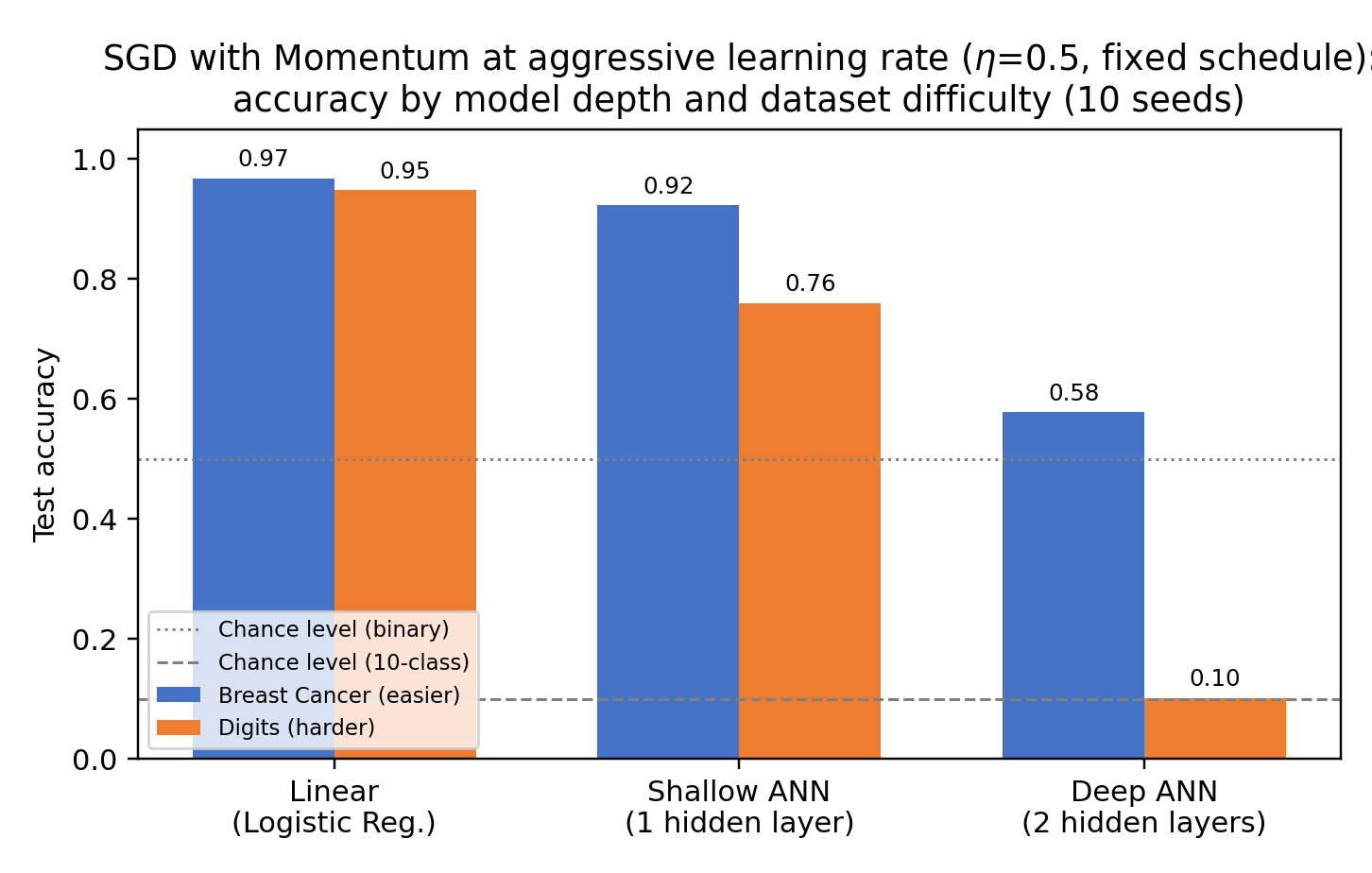
Whether adaptive optimizers such as Adaptive Moment Estimation, Root Mean Square Propagation and the Adaptive Gradient algorithm genuinely outperform classical stochastic gradient descent remains debated, and whether the difference depends on problem difficulty and model depth, rather than the optimizer alone, is rarely tested directly. This revised study evaluates five optimizers under three learning-rate schedules on two University of California, Irvine datasets of contrasting, numerically defined difficulty, a small Breast Cancer Wisconsin dataset and a harder, higher-dimensional Optical Digits dataset, using linear, shallow and deep architectures, across 2,520 runs with ten seeds per configuration. On the easier dataset, well-tuned optimizers differed by at most 2.1 percentage points and were mostly not statistically significant. On the harder dataset, Root Mean Square Propagation and Adaptive Moment Estimation significantly outperformed stochastic gradient descent with momentum on the linear model (paired t-test, p less than 0.001, Cohen's d above 2.7). A dedicated depth-by-difficulty analysis shows momentum instability at an aggressive learning rate scales with both factors independently: accuracy fell from 97% (linear) to 92% (shallow) to 58% (deep) on the easier dataset, and to 10.1%, chance level, on the harder, deep combination, while every adaptive optimizer stayed above 95% throughout. A decay schedule recovered most of this loss. The implementation was cross-validated against scikit-learn's native optimizers, agreeing within 1 percentage point. These results indicate the adaptive-optimizer advantage and the momentum-instability risk both grow with problem difficulty and model depth jointly, refining recent claims in the 2022-2026 literature on this gap.
References
F. Kunstner, J. Chen, J. W. Lavington, and M. Schmidt, “Noise Is Not the Main Factor Behind the Gap Between SGD and Adam on Transformers, but Sign Descent Might Be,” 11th Int. Conf. Learn. Represent. ICLR 2023, Apr. 2023, Accessed: Sep. 23, 2026. [Online]. Available: https://arxiv.org/pdf/2304.13960
Y. Zhang, C. Chen, T. Ding, Z. Li, R. Sun, and Z. Q. Luo, “Why Transformers Need Adam: A Hessian Perspective,” Adv. Neural Inf. Process. Syst., vol. 37, Feb. 2024, doi: 10.52202/079017-4190.
F. Kunstner, A. Milligan, R. Yadav, M. Schmidt, and A. Bietti, “Heavy-Tailed Class Imbalance and Why Adam Outperforms Gradient Descent on Language Models,” Adv. Neural Inf. Process. Syst., vol. 37, Feb. 2024, doi: 10.52202/079017-0948.
R. Zhao, D. Morwani, D. Brandfonbrener, N. Vyas, and S. Kakade, “Deconstructing What Makes a Good Optimizer for Language Models,” 16th Annu. Work. Optim. Mach. Learn., Jul. 2024, Accessed: Sep. 23, 2026. [Online]. Available: https://arxiv.org/pdf/2407.07972
H. Robbins, S. M.-T. annals of mathematical statistics, and undefined 1951, “A stochastic approximation method,” JSTOR, Accessed: Sep. 23, 2026. [Online]. Available: https://www.jstor.org/stable/2236626
B. T. Polyak, “Some methods of speeding up the convergence of iteration methods,” USSR Comput. Math. Math. Phys., vol. 4, no. 5, pp. 1–17, Jan. 1964, doi: 10.1016/0041-5553(64)90137-5.
Y. Nesterov, “A method for solving the convex programming problem with convergence rate O(1/k^2),” Proc. USSR Acad. Sci., 1983.
H. Seya and D. Shiroi, “Lecture 6.5‐rmsprop: Divide the Gradient by a Running Average of Its Recent Magnitude,” COURSERA Neural Networks Mach. Learn., vol. 4, no. 2, pp. 26-, Apr. 2012, doi: 10.1111/GEAN.12283.
J. Duchi, E. Hazan, and Y. Singer, “Adaptive Subgradient Methods for Online Learning and Stochastic Optimization,” J. Mach. Learn. Res., vol. 12, no. 61, pp. 2121–2159, 2011, Accessed: Sep. 23, 2026. [Online]. Available: http://jmlr.org/papers/v12/duchi11a.html
L. N. Smith, “Cyclical Learning Rates for Training Neural Networks,” Proc. - 2017 IEEE Winter Conf. Appl. Comput. Vision, WACV 2017, pp. 464–472, Jun. 2015, doi: 10.1109/WACV.2017.58.
D. Berrar, “Estimating the Replication Probability of Significant Classification Benchmark Experiments,” J. Mach. Learn. Res., vol. 25, no. 311, pp. 1–42, 2024, Accessed: Sep. 23, 2026. [Online]. Available: http://jmlr.org/papers/v25/24-0158.html
F. Pedregosa FABIANPEDREGOSA et al., “Scikit-learn: Machine Learning in Python,” J. Mach. Learn. Res., vol. 12, no. 85, pp. 2825–2830, 2011, Accessed: Sep. 25, 2026. [Online]. Available: http://jmlr.org/papers/v12/pedregosa11a.html
Diederik P. Kingma, Jimmy Ba, “Adam: A Method for Stochastic Optimization,” arXiv:1412.6980, 2017, [Online]. Available: https://arxiv.org/abs/1412.6980
S. Ruder, “An overview of gradient descent optimization algorithms,” Sep. 2016, Accessed: Sep. 23, 2026. [Online]. Available: https://arxiv.org/pdf/1609.04747
P. Virtanen et al., “SciPy 1.0: fundamental algorithms for scientific computing in Python,” Nat. Methods 2020 173, vol. 17, no. 3, pp. 261–272, Feb. 2020, doi: 10.1038/s41592-019-0686-2.
Y. Bestgen, “Please, Don’t Forget the Difference and the Confidence Interval when Seeking for the State-of-the-Art Status,” 2022 Lang. Resour. Eval. Conf. Lr. 2022, pp. 5956–5962, May 2022, doi: 10.63317/2gavpzzwqkcx.
A. C. Wilson, R. Roelofs, M. Stern, N. Srebro, and B. Recht, “The Marginal Value of Adaptive Gradient Methods in Machine Learning,” Adv. Neural Inf. Process. Syst., vol. 2017-December, pp. 4149–4159, May 2017, Accessed: Sep. 23, 2026. [Online]. Available: https://arxiv.org/pdf/1705.08292
N. S. Keskar, J. Nocedal, P. T. P. Tang, D. Mudigere, and M. Smelyanskiy, “On Large-Batch Training for Deep Learning: Generalization Gap and Sharp Minima,” 5th Int. Conf. Learn. Represent. ICLR 2017 - Conf. Track Proc., Sep. 2016, Accessed: Sep. 23, 2026. [Online]. Available: https://arxiv.org/pdf/1609.04836
A. Defazio, X. Yang, H. Mehta, K. Mishchenko, A. Khaled, and A. Cutkosky, “The Road Less Scheduled,” Adv. Neural Inf. Process. Syst., vol. 37, May 2024, doi: 10.52202/079017-0320.
Y. Wu and L. Liu, “Selecting and Composing Learning Rate Policies for Deep Neural Networks,” ACM Trans. Intell. Syst. Technol., vol. 14, no. 2, Oct. 2022, doi: 10.1145/3570508.
M. Faw, I. Tziotis, C. Caramanis, A. Mokhtari, S. Shakkottai, and R. Ward, “The Power of Adaptivity in SGD: Self-Tuning Step Sizes with Unbounded Gradients and Affine Variance,” Proc. Mach. Learn. Res., vol. 178, pp. 313–355, Feb. 2022, Accessed: Sep. 30, 2026. [Online]. Available: https://arxiv.org/pdf/2202.05791
N. Xiao, X. Hu, X. Liu, and K. C. Toh, “Adam-family Methods for Nonsmooth Optimization with Convergence Guarantees,” J. Mach. Learn. Res., vol. 25, May 2023, Accessed: Sep. 30, 2026. [Online]. Available: https://arxiv.org/pdf/2305.03938
R. Altaher and H. Koyuncu, “Novel Hybrid Optimization Techniques for Enhanced Generalization and Faster Convergence in Deep Learning Models: The NestYogi Approach to Facial Biometrics,” Mathematics, vol. 12, no. 18, pp. 1–23, 2024, Accessed: Sep. 30, 2026. [Online]. Available: https://ideas.repec.org/a/gam/jmathe/v12y2024i18p2919-d1481570.html
S. A. Aula and T. A. Rashid, “Foxtsage vs. Adam: Revolution or evolution in optimization?,” Cogn. Syst. Res., vol. 92, p. 101373, Sep. 2025, doi: 10.1016/J.COGSYS.2025.101373.
R. Genet and H. Inzirillo, “CaAdam: Improving Adam optimizer using connection aware methods,” Oct. 2024, Accessed: Sep. 30, 2026. [Online]. Available: https://arxiv.org/pdf/2410.24216
X. Chen et al., “Symbolic Discovery of Optimization Algorithms,” Adv. Neural Inf. Process. Syst., vol. 36, Feb. 2023, doi: 10.52202/075280-2140.
N. Faraj, “Tuning Learning Rates with the Cumulative-Learning Constant,” Apr. 2025, Accessed: Sep. 30, 2026. [Online]. Available: https://arxiv.org/pdf/2505.13457
R. Jiang, A. Kavis, and A. Mokhtari, “Online Learning-guided Learning Rate Adaptation via Gradient Alignment,” Jun. 2025, Accessed: Sep. 29, 2026. [Online]. Available: https://arxiv.org/pdf/2506.08419
“Breast Cancer Wisconsin (Diagnostic) Data Set.” Accessed: Sep. 23, 2026. [Online]. Available: https://www.kaggle.com/datasets/uciml/breast-cancer-wisconsin-data
“GitHub - patidarparas13/Optical-recognition-of-handwritten-digits-dataset: Optical recognition of handwritten digits dataset **Data Set Characteristics:** :Number of Instances: 5620 :Number of Attributes” Accessed: Sep. 23, 2026. [Online]. Available: https://github.com/patidarparas13/Optical-recognition-of-handwritten-digits-dataset
Downloads
Published
How to Cite
Issue
Section
License
Copyright (c) 2026 50SEA

This work is licensed under a Creative Commons Attribution 4.0 International License.