Design and Development of Functional Electrical Stimulation Circuit
Keywords:
Functional Electrical Stimulation, Biphasic Pulse, Boost Converter, Closed-Loop Voltage Control, Portable Stimulator, Wrist Flexion, RehabilitationAbstract
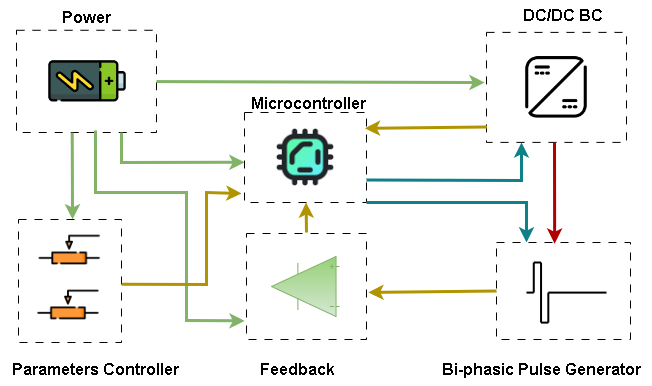
Functional electrical stimulator (FES) is a device that creates controlled electrical pulses with a specific waveform to contract or relax muscles when it’s placed in the correct position. The device is useful for patients with strokes or any spinal injury and they have lost or weakened the nerve control to their muscles. This study focuses on the design and development of a portable, single channel, biphasic and inexpensive FES circuit using Arduino Pro Mini [1]. A 7.4 V two-cell Li-ion battery feeds a 20 kHz PWM-driven DC–DC boost converter (L = 100 µH, C = 100 µF) that supplies up to 40 V to a MOSFET H-bridge. A resistive divider closes the voltage loop and holds the feedback signal within ±0.1 V of its set-point, while a 10 Ω shunt and an LM358 amplifier (28.5 mV/mA) monitor the load current. If the output reaches 40 V, the device stops stimulating for 2 s. Symmetric biphasic pulses were delivered at 30 Hz, with pulse widths of 224–1280 µs and a 150 µs interphase gap. The device operates entirely through the skin with no need of invasive methods using surface electrodes. The working frequency used is 30Hz, the pulse width is varied from 224-1280µs. Through experiments the output voltage was observed from 12.0-30.0 Vpp and PWM duty cycle from 19-62%. Beyond this level, the subjects began to experience mild discomfort. The experiments were performed on healthy subjects with the followed data. For participant 1 the voltage range was 12.0-22.6 Vpp and PWM duty cycle ranged from 19-49%. Respectively for participant 2 the voltage was 14.0-30.0 Vpp and PWM duty cycle from 23-62%. The reason for this variation can be different like ion concentration in muscles, sensitivity, skin thickness or subcutaneous fat layer. The FES system at the moment works as a voltage-controlled system but for future improvements multi-channel direct current controlled systems can be added. Functional electrical stimulation (FES) is a technique that uses low electrical currents to stimulate the nerves of the body muscles that has lost their senses such as in paralysis. This paper presents the design and development of a single-channel, biphasic FES device using an Arduino controller. The circuit consists of a DC-DC boost converter to generate high voltage, an H-bridge to produce biphasic pulses, a feedback mechanism for output control, and a pulse width modulation module. The device stimulates wrist flexion through surface electrodes on the Flexor Digitorum Superficialis (FDS) muscle. Experiments conducted on two healthy subjects demonstrate the ability to control pulse width (224 − 1280µs) and the voltage amplitude (up to 30V) to elicit muscle contractions. Mild wrist flexion is observed above 12 V. The portable Arduino-based device offers advantages such as cost-effectiveness, precise output regulation through feedback, and safety enhancements to prevent reverse current. Further clinical testing can affirm the therapeutic applicability for neuromuscular conditions. This FES device system can be enhanced to multi-channel capabilities and adaptive control algorithms.
References
“Arduino Pro Mini | Arduino Documentation.” Accessed: Nov. 08, 2026. [Online]. Available: https://docs.arduino.cc/retired/boards/arduino-pro-mini/
D. R. Merrill, M. Bikson, and J. G. R. Jefferys, “Electrical stimulation of excitable tissue: design of efficacious and safe protocols,” J. Neurosci. Methods, vol. 141, no. 2, pp. 171–198, Feb. 2005, doi: 10.1016/J.JNEUMETH.2004.10.020.
D. C. de Souza, M. do C. Gaiotto, G. N. Nogueira Neto, M. C. F. de Castro, and P. Nohama, “Power amplifier circuits for functional electrical stimulation systems,” Res. Biomed. Eng., vol. 33, no. 2, pp. 144–155, Jun. 2017, doi: 10.1590/2446-4740.07716.
X. Li, S. Zhong, and J. Morizio, “16-Channel biphasic current-mode programmable charge balanced neural stimulation,” Biomed. Eng. Online, vol. 16, no. 1, p. 104, Aug. 2017, doi: 10.1186/S12938-017-0385-0.
C. C. Chen and K. T. Tang, “A 12V-500μA neuron stimulator with current calibration mechanism in 0.18μm standard CMOS process,” 2011 IEEE Biomed. Circuits Syst. Conf. BioCAS 2011, pp. 57–60, 2011, doi: 10.1109/BIOCAS.2011.6107726.
A. Tamtrakarn, Tamtrakarn, Atit, Tamtrakarn, and Atit, “A 115V bi-phasic pulse electrical muscle stimulator by using inductor-sharing dual-output boost converter with supply-stepping switch driver,” rcsy, vol. 2018-January, p. 3, Jul. 2017, doi: 10.1109/ICECS.2017.8291997.
K. W. E. Cheng, Y. Lu, K. Y. Tong, A. B. Rad, D. H. K. Chow, and D. Sutanto, “Development of a circuit for functional electrical stimulation,” IEEE Trans. Neural Syst. Rehabil. Eng., vol. 12, no. 1, pp. 43–47, Mar. 2004, doi: 10.1109/TNSRE.2003.819936.
D. R. P. Chamal, M. I. M. Fernando, W. P. M. W. Kulathunga, K. D. Pathirana, and N. W. Prins, “Design of a Novel Current Controlling Module for Functional Electrical Stimulation (FES) System,” Proc. 6th Int. Conf. Inf. Technol. Res. Digit. Resil. Reinvention, ICITR 2021, 2021, doi: 10.1109/ICITR54349.2021.9657272.
A. Tamtrakarn, “A portable switching bi-phasic stimulator with level-shifting inverter for functional electrical stimulation operating under a 6V supply voltage,” IEEE Reg. 10 Annu. Int. Conf. Proceedings/TENCON, vol. 2016-January, Jan. 2016, doi: 10.1109/TENCON.2015.7373081.
H. P. Wang, Z. G. Wang, X. Y. Lu, Z. H. Huang, and Y. X. Zhou, “Design of a pulse-triggered four-channel functional electrical stimulator using complementary current source and time division multiplexing output method,” Proc. Annu. Int. Conf. IEEE Eng. Med. Biol. Soc. EMBS, vol. 2015-November, pp. 1671–1674, Nov. 2015, doi: 10.1109/EMBC.2015.7318697.
B. Basumatary, R. S. Halder, and A. Sahani, “A Microcontroller based Charge Balanced Trapezoidal Stimulus Generator for FES System,” Conf. Rec. - IEEE Instrum. Meas. Technol. Conf., vol. 2021-May, May 2021, doi: 10.1109/I2MTC50364.2021.9459837.
T. Ward et al., “Multichannel Biphasic Muscle Stimulation System for Post Stroke Rehabilitation,” Electron. 2020, Vol. 9, Page 1156, vol. 9, no. 7, p. 1156, Jul. 2020, doi: 10.3390/ELECTRONICS9071156.
T. F. De Almeida, L. H. B. Borges, and A. F. O. de A. Dantas, “Development of an IoT Electrostimulator with Closed-Loop Control,” Sensors 2022, Vol. 22, Page 3551, vol. 22, no. 9, p. 3551, May 2022, doi: 10.3390/S22093551.
M. C. Santos et al., “Easy-to-implement configurable multimodal electrostimulator,” INSCIT 2021 - 5th Int. Symp. Instrum. Syst. Circuits Transducers, Aug. 2021, doi: 10.1109/INSCIT49950.2021.9557252.
M. S. J. et al., “A Functional Electrical Stimulator to Enable Grasping Through Wrist Flexion,” Int. J. Biol. Biomed. Eng., vol. 16, pp. 19–29, 2022, doi: 10.46300/91011.2022.16.4.
M. A. Trout, A. T. Harrison, M. R. Brinton, and J. A. George, “A portable, programmable, multichannel stimulator with high compliance voltage for noninvasive neural stimulation of motor and sensory nerves in humans,” Sci. Rep., vol. 13, no. 1, Dec. 2023, doi: 10.1038/S41598-023-30545-8.
T. Coelho-Magalhães, E. Fachin-Martins, A. Silva, C. A. Coste, and H. Resende-Martins, “Development of a High-Power Capacity Open Source Electrical Stimulation System to Enhance Research into FES-Assisted Devices: Validation of FES Cycling,” Sensors 2022, Vol. 22, Page 531, vol. 22, no. 2, p. 531, Jan. 2022, doi: 10.3390/S22020531.
H. Wang, R. Tang, and X. Liu, “Development of a Compact High-Voltage Functional Electrical Stimulation Device,” Dec. 2024, Accessed: Nov. 08, 2026. [Online]. Available: https://arxiv.org/pdf/2412.12064
R. Lakatem, S. Boontaklang, and C. Chompoo-inwai, “Advanced Design and Implementation of a 2-Channel, Multi-Functional Therapeutic Electrical Stimulator,” Electron. 2024, Vol. 13, Page 3793, vol. 13, no. 19, p. 3793, Sep. 2024, doi: 10.3390/ELECTRONICS13193793.
L. Popović-Maneski and S. Mateo, “MotiMove: Multi-purpose transcutaneous functional electrical stimulator,” Artif. Organs, vol. 46, no. 10, pp. 1970–1979, Oct. 2022, doi: 10.1111/AOR.14379;PAGE:STRING:ARTICLE/CHAPTER.
Y. You, R. Tian, Y. Zhang, Z. Chen, W. Lu, and Y. Zhang, “A High-Voltage-Compliant 86% Peak Efficiency Current-Mode Stimulator With Dynamic Voltage Supply for Implantable Medical Devices,” IEEE J. Solid-State Circuits, vol. 60, no. 7, pp. 2606–2618, 2025, doi: 10.1109/JSSC.2024.3505059.
K. Cui, Y. Jin, X. Fan, and Y. Ma, “A 3-mV Precision Dual-Mode-Controlled Fast Charge Balancing for Implantable Biphasic Neural Stimulators,” IEEE Trans. Biomed. Circuits Syst., vol. 18, no. 4, pp. 896–907, 2024, doi: 10.1109/TBCAS.2024.3366518.
Y. Oh, J. Hong, and J. Kim, “Integrated Low-Voltage Compliance and Wide-Dynamic Stimulator Design for Neural Implantable Devices,” Sensors 2023, Vol. 23, Page 492, vol. 23, no. 1, p. 492, Jan. 2023, doi: 10.3390/S23010492.
B. Garnier et al., “A novel functional electrical stimulation sleeve based on textile-embedded dry electrodes,” Biomed. Eng. OnLine 2024 231, vol. 23, no. 1, pp. 51-, Jun. 2024, doi: 10.1186/S12938-024-01246-8.
S. Xu et al., “Closed-Loop Wearable Device Network of Intrinsically-Controlled, Bilateral Coordinated Functional Electrical Stimulation for Stroke,” Adv. Sci. (Weinheim, Baden-Wurttemberg, Ger., vol. 11, no. 17, May 2024, doi: 10.1002/ADVS.202304763.
J. W. Lee, E. Grabke, K. Chow, K. E. Musselman, and K. Masani, “Development of a closed-loop controller for functional electrical stimulation therapy plus visual feedback balance training for standing balance training,” Med. Eng. Phys., vol. 132, Oct. 2024, doi: 10.1016/J.MEDENGPHY.2024.104238.
I. Brunner, C. B. Lundquist, A. R. Pedersen, E. G. Spaich, S. Dosen, and A. Savic, “Brain computer interface training with motor imagery and functional electrical stimulation for patients with severe upper limb paresis after stroke: a randomized controlled pilot trial,” J. Neuroeng. Rehabil., vol. 21, no. 1, Dec. 2024, doi: 10.1186/S12984-024-01304-1.
M. A. Khan et al., “A systematic review on functional electrical stimulation based rehabilitation systems for upper limb post-stroke recovery,” Front. Neurol., vol. 14, 2023, doi: 10.3389/FNEUR.2023.1272992.
C. Höhler, E. Trigili, D. Astarita, J. Hermsdörfer, K. Jahn, and C. Krewer, “The efficacy of hybrid neuroprostheses in the rehabilitation of upper limb impairment after stroke, a narrative and systematic review with a meta-analysis,” Artif. Organs, vol. 48, no. 3, pp. 232–253, Mar. 2024, doi: 10.1111/AOR.14618.
L. R. L. Cardoso, V. Bochkezanian, A. Forner-Cordero, A. Melendez-Calderon, and A. P. L. Bo, “Soft robotics and functional electrical stimulation advances for restoring hand function in people with SCI: a narrative review, clinical guidelines and future directions,” J. Neuroeng. Rehabil., vol. 19, no. 1, Dec. 2022, doi: 10.1186/S12984-022-01043-1.
C. SK and S. M, “The Effects of Functional Electrical Stimulation Cycling on Muscle Spasticity in Individuals With Spinal Cord Injury: A Systematic Review,” Top. Spinal Cord Inj. Rehabil., vol. 31, no. 1, pp. 77–99, Dec. 2025, doi: 10.46292/SCI23-00048.
G. A. Hawker, S. Mian, T. Kendzerska, and M. French, “Measures of adult pain: Visual Analog Scale for Pain (VAS Pain), Numeric Rating Scale for Pain (NRS Pain), McGill Pain Questionnaire (MPQ), Short-Form McGill Pain Questionnaire (SF-MPQ), Chronic Pain Grade Scale (CPGS), Short Form-36 Bodily Pain Scale (S…,” Arthritis Care Res. (Hoboken)., vol. 63 Suppl 11, no. SUPPL. 11, Nov. 2011, doi: 10.1002/ACR.20543.
N. Mohan, T. M. Undeland, and W. P. Robbins, “Power Electronics Convertors, Applictions, and Design,” p. 824, 2002, Accessed: Nov. 08, 2026. [Online]. Available: https://www.wiley.com/en-us/power-electronics-converters-applications-and-design-3rd-edition-p-9780471226932
B. M. Hasaneen and A. A. E. Mohammed, “Design and simulation of DC/DC boost converter,” 2008 12th Int. Middle East Power Syst. Conf. MEPCON 2008, pp. 335–340, 2008, doi: 10.1109/MEPCON.2008.4562340.
D. W. Hart, “Circuit Simulation as an Aid in Teaching the Principles of Power Electronics,” IEEE Trans. Educ., vol. 36, no. 1, pp. 10–16, 1993, doi: 10.1109/13.204808.
“Power Electronics - an overview | ScienceDirect Topics.” Accessed: Nov. 08, 2026. [Online]. Available: https://www.sciencedirect.com/topics/engineering/power-electronics
“(PDF) Current-Controlled Stimulator with Variable High Voltage Generation.” Accessed: Nov. 08, 2026. [Online]. Available: https://www.researchgate.net/publication/336013151_Current-Controlled_Stimulator_with_Variable_High_Voltage_Generation
“Gray’s Anatomy: The Anatomical Basis of Clinical Practice.” Accessed: Nov. 08, 2026. [Online]. Available: https://www.jinnahmedicalbooks.com/product/grays-anatomy-the-anatomical-basis-of-clinical-practice-42nd-edition/
“Medical electrical equipment - Part 2-10: Particular requirements for the basic safety and essential performance of nerve and muscle stimulators | Standards Council of Canada.” Accessed: Nov. 08, 2026. [Online]. Available: https://scc-ccn.ca/standards/notices-of-intent/csa-group/medical-electrical-equipment-part-2-10-particular-1
Downloads
Published
How to Cite
Issue
Section
License
Copyright (c) 2026 50sea

This work is licensed under a Creative Commons Attribution 4.0 International License.