Integrative Multi-Omics Analysis Using Machine Learning for Biomarker Discovery in Ankylosing Spondylitis
DOI:
https://doi.org/10.33411/IJIST/2093Keywords:
Ankylosing Spondylitis, Machine Learning, Transcriptomics, Biomarker Discovery, GNLY, GZMK, External Validation, Logistic Regression, GSE73754, GSE18781, GSE221786, HLA-B27Abstract
Background: Ankylosing Spondylitis (AS) is a chronic immune-mediated inflammatory disease in which genetic susceptibility, antigen-processing mechanisms, cytokine signaling, and cellular immune responses interact with environmental and tissue-specific factors. Blood transcriptomic studies have identified candidate molecular signatures of AS, and machine-learning approaches can reduce high-dimensional expression data to compact predictive feature sets. However, small cohorts, biological heterogeneity, platform differences, and repeated model redevelopment during external testing can lead to optimistic estimates of biomarker performance.
Objective: We evaluated an evidence-controlled transcriptomic and machine-learning framework for AS biomarker discovery centered on a nine-gene signature identified during discovery and subsequently locked before independent external evaluation. Particular attention was given to GNLY and GZMK as cytotoxic/effector-associated candidate genes.
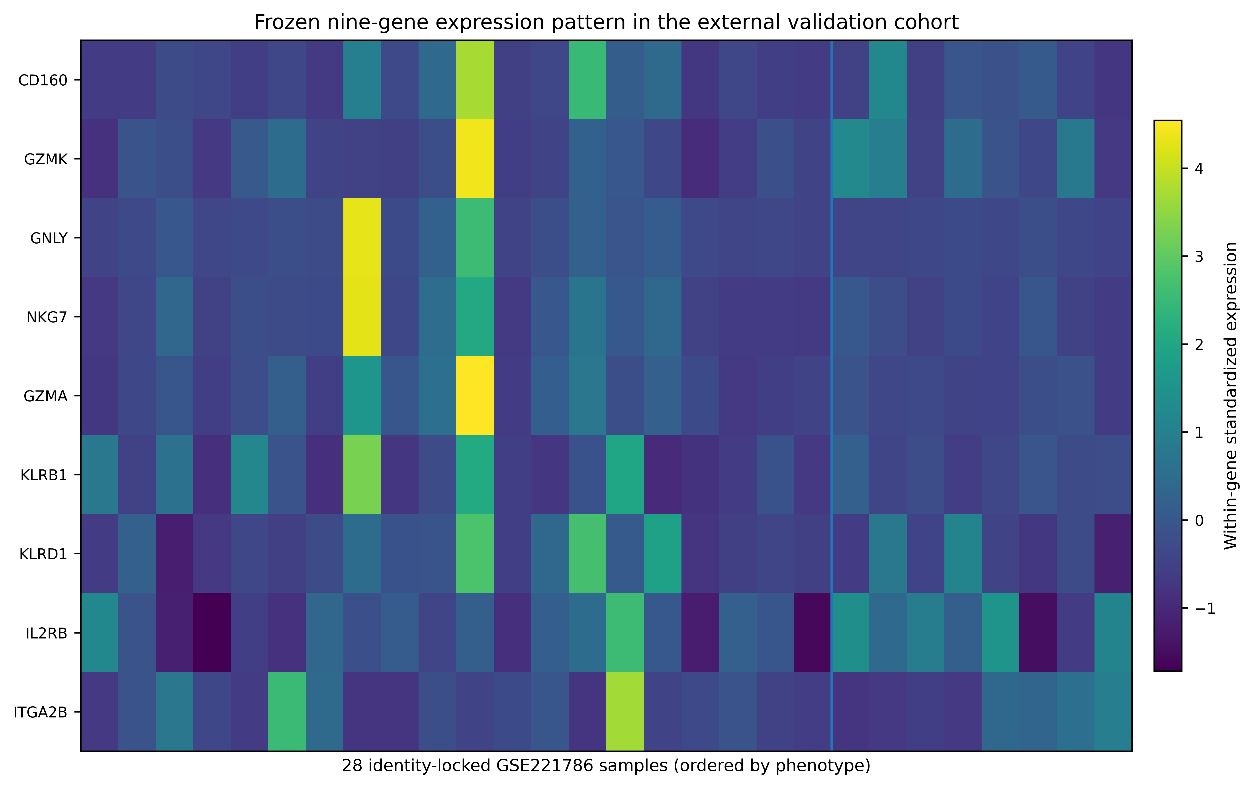
Methods: The principal transcriptomic discovery resource was GSE73754, containing 72 samples (52 AS and 20 healthy controls; 37 male and 35 female). Nine genes—CD160, GZMK, GNLY, NKG7, GZMA, KLRB1, KLRD1, IL2RB, and ITGA2B—met the prespecified statistical selection criterion and were subsequently frozen. The model-development resource, GSE18781, contained 43 samples (18 AS and 25 controls). The reproducible classifier pipeline was mean imputation, StandardScaler, and logistic regression (C=0.1; liblinear; max_iter=5000; random_state=42), evaluated with 20 repeated cross-validation iterations, 2,000 bootstrap resamples, and 2,000 permutation tests. The archived principal model-development analysis reported mean ROC-AUC 0.689 (SD 0.028; archived 95% CI 0.633–0.741). GSE221786 was independently audited at the raw-matrix and biological sample-identity levels and contained 28 samples (20 AS and 8 controls), with all nine genes present and no missing expression cells. The original serialized classifier binary was not recovered; therefore, GSE221786 was evaluated at the frozen-signature gene-expression level without model refitting, gene reselection, threshold optimization, hyperparameter tuning, or recalibration.
Results: The archived principal model-development analysis yielded accuracy 0.691, precision 0.667, recall 0.529, F1 0.589, and MCC 0.354; the permutation test gave P=0.052, which was not conventionally significant at α=0.05. In GSE221786, no gene satisfied the complete predefined external-replication criterion. GNLY showed the strongest individual external discrimination (AUC=0.704–0.706 depending on the archived external analysis) and a 5.35-fold descriptive difference, but its direction was discordant with the discovery pattern and its external P value was not significant. GZMK and IL2RB showed directional concordance but weak discrimination. Positional integration of IGAS summary statistics identified KLRB1 as the strongest genetically supported member of the signature (Fisher combined P=0.0223; BH-FDR=0.0670).
Conclusion: The findings support an evidence-controlled integrative multi-omics framework in which transcriptomic, machine-learning, functional, and genetic/HLA evidence are evaluated separately and then interpreted jointly. GNLY and GZMK remain priority transcriptomic candidates requiring further validation, while KLRB1 provides the strongest positional genetic support within the signature. None of the genes should currently be considered a clinically validated biomarker or causal disease mediator.
References
D. van der Heijde et al., “Goodbye to the term ‘ankylosing spondylitis’, hello ‘axial spondyloarthritis’: time to embrace the ASAS-defined nomenclature,” Ann. Rheum. Dis., vol. 83, no. 5, pp. 547–549, Dec. 2023, doi: 10.1136/ard-2023-225185.
V. Navarro-Compán et al., “ASAS consensus definition of early axial spondyloarthritis,” Ann. Rheum. Dis., vol. 83, no. 9, pp. 1093–1099, Aug. 2024, doi: 10.1136/ard-2023-224232.
J. D. Taurog, A. Chhabra, and R. A. Colbert, “Ankylosing Spondylitis and Axial Spondyloarthritis,” N. Engl. J. Med., vol. 374, no. 26, pp. 2563–2574, Jun. 2016, doi: 10.1056/NEJMRA1406182;SUBPAGE:STRING:METEREDCONTENT.
J. Sieper and D. Poddubnyy, “Axial spondyloarthritis,” Lancet, vol. 390, no. 10089, pp. 73–84, Jul. 2017, doi: 10.1016/S0140-6736(16)31591-4.
M. A. Brown, T. Kenna, and B. P. Wordsworth, “Genetics of ankylosing spondylitis--insights into pathogenesis,” Nat. Rev. Rheumatol., vol. 12, no. 2, pp. 81–91, Feb. 2016, doi: 10.1038/NRRHEUM.2015.133.
K. Du, C. Y. Zhang, A. Li, Q. H. Zuo, R. Guo, and S. M. Li, “Unraveling new therapeutic targets in ankylosing spondylitis: Multi-omics Mendelian randomization on immune cells, metabolites, and inflammation proteins,” Medicine (Baltimore)., vol. 104, no. 16, p. e42177, Apr. 2025, doi: 10.1097/MD.0000000000042177.
V. Ranganathan, E. Gracey, M. A. Brown, R. D. Inman, and N. Haroon, “Pathogenesis of ankylosing spondylitis - recent advances and future directions,” Nat. Rev. Rheumatol., vol. 13, no. 6, pp. 359–367, Jun. 2017, doi: 10.1038/NRRHEUM.2017.56.
F. Navid, L. Chen, P. Bowness, and R. A. Colbert, “HLA-B27 and spondyloarthritis: at the crossroads of innate and adaptive immunity,” Nat. Rev. Rheumatol., vol. 21, no. 2, pp. 77–87, Feb. 2025, doi: 10.1038/S41584-024-01189-3;SUBJMETA.
D. M. Evans et al., “Interaction between ERAP1 and HLA-B27 in ankylosing spondylitis implicates peptide handling in the mechanism for HLA-B27 in disease susceptibility,” Nat. Genet., vol. 43, no. 8, pp. 761–767, Aug. 2011, doi: 10.1038/NG.873.
P. R. Burton et al., “Association scan of 14,500 nonsynonymous SNPs in four diseases identifies autoimmunity variants,” Nat. Genet., vol. 39, no. 11, pp. 1329–1337, Nov. 2007, doi: 10.1038/NG.2007.17.
E. Gracey et al., “Sexual Dimorphism in the Th17 Signature of Ankylosing Spondylitis,” Arthritis Rheumatol. (Hoboken, N.J.), vol. 68, no. 3, pp. 679–689, Mar. 2016, doi: 10.1002/ART.39464.
L. Dai, L. Xia, G. Su, Y. Gao, Q. Jiang, and P. Yang, “Identifying prioritization of therapeutic targets for ankylosing spondylitis: a multi-omics Mendelian randomization study,” J. Transl. Med., vol. 22, no. 1, Dec. 2024, doi: 10.1186/S12967-024-05925-X.
Y. Chen, Y. Xu, S. Cao, Q. Lv, Y. Ye, and J. Gu, “Oxidative Phosphorylation Pathway in Ankylosing Spondylitis: Multi-Omics Analysis and Machine Learning,” Int. J. Rheum. Dis., vol. 28, no. 5, May 2025, doi: 10.1111/1756-185X.70175.
X. Xu et al., “Characterization of immune features and discovery of potential biomarkers for ankylosing spondylitis using deep plasma proteomics,” J. Adv. Res., vol. 81, pp. 223–234, Mar. 2026, doi: 10.1016/J.JARE.2025.05.052.
L. Cuesta-López et al., “Transcriptomic and proteomic analysis stratifies patients with axial spondyloarthritis based on disease activity, structural damage and radiographic progression,” RMD open, vol. 12, no. 1, Jan. 2026, doi: 10.1136/RMDOPEN-2025-006136.
M. Brown et al., “Multi-omic insights from a multi-ancestry genome-wide meta-analysis of ankylosing spondylitis reveal novel pathways of disease susceptibility,” Res. Sq., Jul. 2025, doi: 10.21203/RS.3.RS-6917334/V1.
GEO Accession viewer, “Sexual Dimorphism in the Th17 Signature of Ankylosing,” 2011. Accessed: Oct. 17, 2026. [Online]. Available: https://www.ncbi.nlm.nih.gov/geo/query/acc.cgi?acc=GSE73754.
Y. Zheng et al., “Identification of immune related cells and crucial genes in the peripheral blood of ankylosing spondylitis by integrated bioinformatics analysis,” PeerJ, vol. 9, Sep. 2021, doi: 10.7717/PEERJ.12125.
Y. Han et al., “Identification of diagnostic mRNA biomarkers in whole blood for ankylosing spondylitis using WGCNA and machine learning feature selection,” Front. Immunol., vol. 13, Sep. 2022, doi: 10.3389/FIMMU.2022.956027.
GEO Accession viewer, “Gene Expression in Inflammatory Diseases,” 2011. Accessed: Oct. 17, 2026. [Online]. Available: https://www.ncbi.nlm.nih.gov/geo/query/acc.cgi?acc=GSE18781
J. Wen, L. Wan, and X. Dong, “Novel peripheral blood diagnostic biomarkers screened by machine learning algorithms in ankylosing spondylitis,” Front. Genet., vol. 13, p. 1032010, Nov. 2022, doi: 10.3389/FGENE.2022.1032010/TEXT.
H. Liu and Y. Peng, “Identification of a Novel Gene Expression Signature Associated with Amino Acid Metabolism (AAM) in Ankylosing Spondylitis (AS),” Int. J. Gen. Med., vol. 17, pp. 597–609, Feb. 2024, doi: 10.2147/IJGM.S435650.
“Differentially Expressed Genes in Males and Females with Ankylosing Spondylitis (AS): Transcriptomics of IL-17-producing Cells in Patients with AS - ACR Meeting Abstracts.” Accessed: Oct. 10, 2026. [Online]. Available: https://acrabstracts.org/abstract/differentially-expressed-genes-in-males-and-females-with-ankylosing-spondylitis-as-transcriptomics-of-il-17-producing-cells-in-patients-with-as/
D. Li et al., “Identification of potential biomarkers for ankylosing spondylitis based on bioinformatics analysis,” BMC Musculoskelet. Disord., vol. 24, no. 1, p. 413, Dec. 2023, doi: 10.1186/S12891-023-06550-3.
X. Cao et al., “Integrated long-read transcriptomic profiling of peripheral blood from ankylosing spondylitis patients identifies regulatory shifts and core genes associated with programmed cell death,” Front. Immunol., vol. 17, 2026, doi: 10.3389/FIMMU.2026.1640271.
G. S. Collins et al., “TRIPOD+AI statement: updated guidance for reporting clinical prediction models that use regression or machine learning methods,” BMJ, vol. 385, Apr. 2024, doi: 10.1136/BMJ-2023-078378.
K. G. M. Moons et al., “PROBAST+AI: an updated quality, risk of bias, and applicability assessment tool for prediction models using regression or artificial intelligence methods,” BMJ, vol. 388, 2025, doi: 10.1136/BMJ-2024-082505.
Y. Gao, X. Li, F. Luo, R. Chen, and X. Zhang, “Integrative mass spectrometry-driven multi-omics and single cell technologies in ankylosing spondylitis: insights into pathogenesis, biomarker discovery, and precision medicine,” J. Transl. Autoimmun., vol. 11, Dec. 2025, doi: 10.1016/j.jtauto.2025.100319.
X. Dan et al., “Multi-Omics Integration Identifies a Six-Gene Diagnostic Signature for Ankylosing Spondylitis via Metabolic–Immune Crosstalk,” Int. J. Mol. Sci., vol. 27, no. 9, p. 3860, May 2026, doi: 10.3390/IJMS27093860/S1.
M. E. Ritchie et al., “limma powers differential expression analyses for RNA-sequencing and microarray studies,” Nucleic Acids Res., vol. 43, no. 7, pp. e47–e47, Apr. 2015, doi: 10.1093/NAR/GKV007.
Downloads
Published
How to Cite
Issue
Section
License
Copyright (c) 2026 50SEA

This work is licensed under a Creative Commons Attribution 4.0 International License.