Adaptive Compression Becomes Unreliable: Fixed, Rule-Based, and Tabular-Q-Learning Policies for Federated ECG Learning
Keywords:
Federated Learning, ECG Classification, Model Compression, Reinforcement Learning, Non-IID Data, Wearables, Communication EfficiencyAbstract
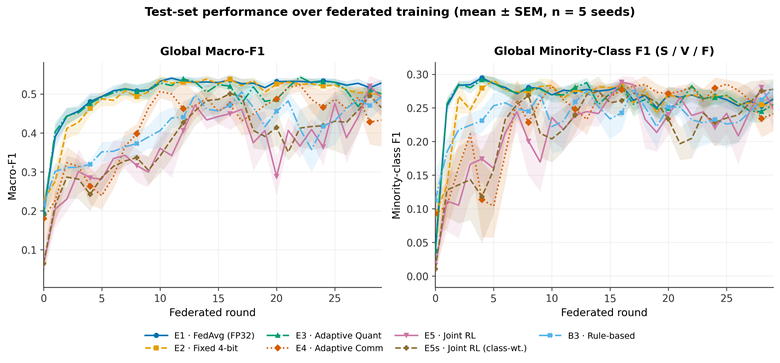
Wearable ECG monitoring needs federated learning for privacy and compression for bandwidth, and adaptive compression policies are often assumed to beat fixed ones. We tested that assumption on the MIT-BIH Arrhythmia Database with record-level, non-IID partitioning (Dirichlet alpha = 0.5, four eligible clients, 30 rounds, five paired seeds). Seven configurations were compared: FP32 FedAvg (E1), fixed 4-bit update quantization (E2), tabular Q-learning policies that adapt quantization (E3), sparsification (E4) or both (E5, E5s), and a hand-written rule (B3). Fixed 4-bit quantization cut total communication by 43.7% (9.067 to 5.107 MB). Its macro-F1 was lower than E1's in all five seeds (mean difference 0.033, 95% t-interval -0.012 to 0.078, exact Wilcoxon p = 0.0625), a consistent direction that does not establish a difference at this sample size. B3 had the highest mean composite minority F1 (0.2790) and the lowest communication (4.670 MB); its macro-F1 was close to E2's (0.4936 against 0.4958). No comparison against E5 was significant (all exact Wilcoxon p >= 0.31), and the two nominal paired-t results involving composite minority F1 did not survive correction for 18 exploratory tests (smallest adjusted p = 0.28). Two audits change how the results should be read. The uncompressed FP32 downlink carried 50% of E1's traffic and 85% to 97% of every compressed configuration's, which limits any uplink-only saving to about 11% relative to E2 in this setup. And the composite minority F1 is driven by ventricular beats: F1 for supraventricular and fusion beats stayed below 0.013 in all 35 runs. For practice, fixed 4-bit quantization is the safer default here, learned sparsification control needs ablation before use, and downlink compression and better supraventricular and fusion learning come first.
References
B. A. y A. H. Brendan McMahan, Eider Moore, Daniel Ramage, Seth Hampson, “Communication-Efficient Learning of Deep Networks from Decentralized Data,” arXiv:1602.05629, vol. 54, 2017, doi: https://doi.org/10.48550/arXiv.1602.05629.
Nicola Rieke, Jonny Hancox, Wenqi Li, Fausto Milletarì, Holger R. Roth, “The future of digital health with federated learning,” npj Digit. Med., vol. 3, 2020, [Online]. Available: https://www.nature.com/articles/s41746-020-00323-1
P. Kairouz et al., “Advances and Open Problems in Federated Learning,” Found. Trends Mach. Learn., vol. 14, no. 1–2, pp. 1–210, Jun. 2021, doi: 10.1561/2200000083.
D. M. Jimenez Gutierrez, H. M. Hassan, L. Landi, A. Vitaletti, and I. Chatzigiannakis, “Application of federated learning techniques for arrhythmia classification using 12-lead ECG signals,” Lect. Notes Comput. Sci. (including Subser. Lect. Notes Artif. Intell. Lect. Notes Bioinformatics), vol. 14053 LNCS, pp. 38–65, Aug. 2022, doi: 10.1007/978-3-031-49361-4_3.
A. Vikhyat et al., “Federated Learning and Differential Privacy Techniques on Multi-hospital Population-scale Electrocardiogram Data,” ACM Int. Conf. Proceeding Ser., pp. 143–152, Apr. 2024, doi: 10.1145/3673971.3673990.
S. Sakib, M. M. Fouda, Z. Md Fadlullah, K. Abualsaud, E. Yaacoub, and M. Guizani, “Asynchronous Federated Learning-based ECG Analysis for Arrhythmia Detection,” 2021 IEEE Int. Mediterr. Conf. Commun. Networking, MeditCom 2021, pp. 277–282, 2021, doi: 10.1109/MEDITCOM49071.2021.9647636.
Q. Z. S. Sricharan Donkada, Seyedamin Pouriyeh, Reza M. Parizi, Meng Han, Nasrin Dehbozorgi, Nazmus Sakib, “Uncovering Promises and Challenges of Federated Learning to Detect Cardiovascular Diseases: A Scoping Literature Review,” Comput. Sci. > Mach. Learn., doi: https://doi.org/10.48550/arXiv.2308.13714.
J. Konečn, H. Brendan McMahan, F. X. Yu, A. Theertha Suresh, D. Bacon Google, and P. Richtárik, “Federated Learning: Strategies for Improving Communication Efficiency,” Oct. 2016, Accessed: Oct. 19, 2026. [Online]. Available: https://arxiv.org/pdf/1610.05492
D. Alistarh, D. Grubic, J. Z. Li, R. Tomioka, and M. Vojnovic, “QSGD: Communication-Efficient SGD via Gradient Quantization and Encoding,” Adv. Neural Inf. Process. Syst., vol. 2017-December, pp. 1710–1721, Oct. 2016, Accessed: Oct. 19, 2026. [Online]. Available: https://arxiv.org/pdf/1610.02132
A. Reisizadeh, A. Jadbabaie, A. Mokhtari, H. Hassani, and R. Pedarsani, “FedPAQ: A Communication-Efficient Federated Learning Method with Periodic Averaging and Quantization,” Proc. Mach. Learn. Res., vol. 108, pp. 2021–2031, Sep. 2019, Accessed: Oct. 19, 2026. [Online]. Available: https://arxiv.org/pdf/1909.13014
S. U. Stich, J. B. Cordonnier, and M. Jaggi, “Sparsified SGD with Memory,” Adv. Neural Inf. Process. Syst., vol. 2018-December, pp. 4447–4458, Sep. 2018, Accessed: Oct. 19, 2026. [Online]. Available: https://arxiv.org/pdf/1809.07599
R. Hönig, Y. Zhao, and R. Mullins, “DAdaQuant: Doubly-adaptive quantization for communication-efficient Federated Learning,” Proc. Mach. Learn. Res., vol. 162, pp. 8852–8866, Oct. 2021, Accessed: Oct. 19, 2026. [Online]. Available: https://arxiv.org/pdf/2111.00465
Y. Mao et al., “Communication Efficient Federated Learning with Adaptive Quantization,” ACM Trans. Intell. Syst. Technol., vol. 13, no. 4, Apr. 2021, doi: 10.1145/3510587.
B. Isik, F. Pase, D. Gunduz, S. Koyejo, T. Weissman, and M. Zorzi, “Adaptive Compression in Federated Learning via Side Information,” Proc. Mach. Learn. Res., vol. 238, pp. 487–495, Jun. 2023, Accessed: Oct. 19, 2026. [Online]. Available: https://arxiv.org/pdf/2306.12625
V. Tsouvalas, A. Saeed, T. Ozcelebi, and N. Meratnia, “Communication-Efficient Federated Learning through Adaptive Weight Clustering and Server-Side Distillation,” ICASSP, IEEE Int. Conf. Acoust. Speech Signal Process. - Proc., pp. 5805–5809, Jan. 2024, doi: 10.1109/ICASSP48485.2024.10447174.
S. Q. Zhang, J. Lin, and Q. Zhang, “A Multi-agent Reinforcement Learning Approach for Efficient Client Selection in Federated Learning,” Proc. 36th AAAI Conf. Artif. Intell. AAAI 2022, vol. 36, pp. 9091–9099, Jan. 2022, doi: 10.1609/aaai.v36i8.20894.
S. Cao et al., “FedQMIX: Communication-efficient federated learning via multi-agent reinforcement learning,” High-Confidence Comput., vol. 4, no. 2, p. 100179, Jun. 2024, doi: 10.1016/J.HCC.2023.100179.
Z. Shu, T. Cao, and H.-W. Huang, “BiFedKD: Bidirectional Federated Knowledge Distillation Framework for Non-IID and Long-Tailed ECG Monitoring,” May 2026, Accessed: Oct. 19, 2026. [Online]. Available: https://arxiv.org/pdf/2605.14886
H. Wu, “Towards Family-Grouped Hierarchical Federated Learning on Sub-5KB Models: A Feasibility Study of Privacy-Preserving ECG Monitoring for Ultra-Resource-Constrained Wearables,” May 2026, Accessed: Oct. 19, 2026. [Online]. Available: https://arxiv.org/pdf/2605.18862
G. B. Moody and R. G. Mark, “The impact of the MIT-BIH arrhythmia database,” IEEE Eng. Med. Biol. Mag., vol. 20, no. 3, pp. 45–50, 2001, doi: 10.1109/51.932724.
“ANSI/AAMI EC57:2012/(R)2020; Testing and reporting performance results of cardiac rhythm and ST segment measurement algorithms,” ANSI/AAMI EC572012/(R)2020; Test. Report. Perform. results Card. Rhythm ST Segm. Meas. algorithms, Jan. 2013, doi: 10.2345/9781570204784.
A. Y. Hannun et al., “Cardiologist-level arrhythmia detection and classification in ambulatory electrocardiograms using a deep neural network,” Nat. Med. 2019 251, vol. 25, no. 1, pp. 65–69, Jan. 2019, doi: 10.1038/s41591-018-0268-3.
A. H. Ribeiro et al., “Automatic diagnosis of the 12-lead ECG using a deep neural network,” Nat. Commun. 2020 111, vol. 11, no. 1, pp. 1760-, Apr. 2020, doi: 10.1038/s41467-020-15432-4.
Tsung-Yi Lin, Priya Goyal, Ross Girshick, Kaiming He, Piotr Dollár., “Focal Loss for Dense Object Detection,” arXiv, vol. 1, 2017, doi: https://doi.org/10.48550/arXiv.1708.02002 Focus to learn more.
Justin M. Johnson & Taghi M. Khoshgoftaar, “Survey on deep learning with class imbalance,” J. Big Data, vol. 6, 2019, [Online]. Available: https://link.springer.com/article/10.1186/s40537-019-0192-5
K. Bonawitz et al., “Practical secure aggregation for privacy-preserving machine learning,” Proc. ACM Conf. Comput. Commun. Secur., pp. 1175–1191, Oct. 2017, doi: 10.1145/3133956.3133982
J. Zhang, C. Luo, M. Carpenter, and G. Min, “Federated Learning for Distributed IIoT Intrusion Detection Using Transfer Approaches,” IEEE Trans. Ind. Informatics, vol. 19, no. 7, pp. 8159–8169, Jul. 2023, doi: 10.1109/TII.2022.3216575.
T.-M. H. Hsu, H. Qi, and M. Brown, “Measuring the Effects of Non-Identical Data Distribution for Federated Visual Classification,” Sep. 2019, Accessed: Oct. 19, 2026. [Online]. Available: https://arxiv.org/pdf/1909.06335
T. Li, A. K. Sahu, M. Zaheer, M. Sanjabi, A. Talwalkar, and V. Smith, “Federated Optimization in Heterogeneous Networks,” Dec. 2018, Accessed: Oct. 19, 2026. [Online]. Available: https://arxiv.org/pdf/1812.06127
S. P. Karimireddy, S. Kale, M. Mohri, S. J. Reddi, S. U. Stich, and A. T. Suresh, “SCAFFOLD: Stochastic Controlled Averaging for Federated Learning,” 37th Int. Conf. Mach. Learn. ICML 2020, vol. PartF168147-7, pp. 5088–5099, Oct. 2019, Accessed: Oct. 19, 2026. [Online]. Available: https://arxiv.org/pdf/1910.06378
D. A. E. Acar, Y. Zhao, R. M. Navarro, M. Mattina, P. N. Whatmough, and V. Saligrama, “Federated Learning Based on Dynamic Regularization,” ICLR 2021 - 9th Int. Conf. Learn. Represent., Nov. 2021, Accessed: Oct. 19, 2026. [Online]. Available: https://arxiv.org/pdf/2111.04263
S. J. Reddi et al., “Adaptive Federated Optimization,” ICLR 2021 - 9th Int. Conf. Learn. Represent., Feb. 2020, Accessed: Oct. 19, 2026. [Online]. Available: https://arxiv.org/pdf/2003.00295
X. Li, M. Jiang, X. Zhang, M. Kamp, and Q. Dou, “FedBN: Federated Learning on Non-IID Features via Local Batch Normalization,” ICLR 2021 - 9th Int. Conf. Learn. Represent., Feb. 2021, Accessed: Oct. 19, 2026. [Online]. Available: https://arxiv.org/pdf/2102.07623
Y. Wu and K. He, “Group normalization,” Lect. Notes Comput. Sci. (including Subser. Lect. Notes Artif. Intell. Lect. Notes Bioinformatics), vol. 11217 LNCS, pp. 3–19, 2018, doi: 10.1007/978-3-030-01261-8_1/TABLES/8.
F. Sattler, S. Wiedemann, K. R. Muller, and W. Samek, “Robust and Communication-Efficient Federated Learning from Non-i.i.d. Data,” IEEE Trans. Neural Networks Learn. Syst., vol. 31, no. 9, pp. 3400–3413, Sep. 2020, doi: 10.1109/TNNLS.2019.2944481.
M. M. Amiri, D. Gunduz, S. R. Kulkarni, and H. V. Poor, “Federated Learning With Quantized Global Model Updates,” Jun. 2020, Accessed: Oct. 19, 2026. [Online]. Available: https://arxiv.org/pdf/2006.10672
T. Nishio and R. Yonetani, “Client Selection for Federated Learning with Heterogeneous Resources in Mobile Edge,” IEEE Int. Conf. Commun., vol. 2019-May, May 2019, doi: 10.1109/ICC.2019.8761315.
Sutton, R. S., & Barto, A. G, “Reinforcement learning: An introduction, 2nd ed.,” MIT Press, 2018, [Online]. Available: https://psycnet.apa.org/record/2019-19679-000
R. Schwartz, J. Dodge, N. A. Smith, and O. Etzioni, “Green AI,” Commun. ACM, vol. 63, no. 12, pp. 54–63, Nov. 2020, doi: 10.1145/3381831.
Downloads
Published
How to Cite
Issue
Section
License
Copyright (c) 2026 50SEA

This work is licensed under a Creative Commons Attribution 4.0 International License.