Transfer Learning Based Diabetic Retinopathy Grading System
Keywords:
Diabetic Retinopathy, Transfer Learning, Data Fusion, AugmentationAbstract
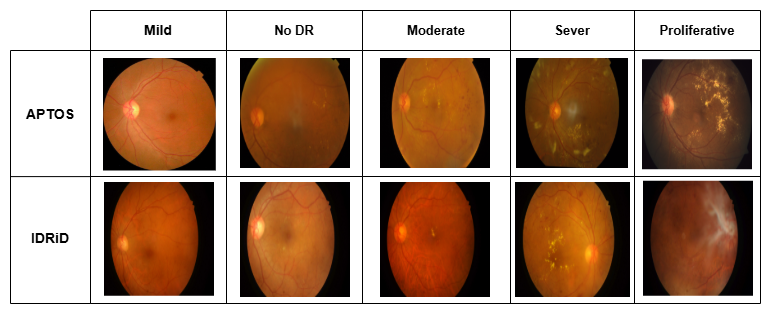
Diabetes-related related disease known as diabetic retinopathy damages the retinal blood vessels and leads to vision impairment. Analyzing diabetic retinopathy images manually is time-consuming and susceptible to mistakes. Traditional detection methods relying on manually engineered features often lack flexibility and accuracy. This work is dedicated to creating a system that is both automated and reliable for detecting diabetic retinopathy by overcoming the limitations of conventional techniques that depend on manually generated features. In this study, we present a unified ensemble-based deep learning framework for dual-task diabetic retinopathy grading addressing five-class severity classification and binary. Two publicly accessible datasets, IDRiD and APTOS, are fused. Preprocessing techniques including image resizing, Contrast Limited Adaptive Histogram Equalization (CLAHE) and Synthetic Minority Over-sampling Technique (SMOTE) are used to improve image quality and address class imbalance. Data augmentation methods including flipping, zooming and rotation are applied for further diversity. The classification model is constructed by the ensemble of two complementary transfer-learning architectures, ResNet50 and EfficientNetB2. After fine-tuning and hyper-parameter optimization, the models are trained and evaluated. The ensemble model yielded 96.83% test accuracy on multi-class while 99.04% on binary classification surpassing individual backbone models and previous state-of-the-art techniques. Its interpretability is further enhanced through Gradient-weighted Class Activation Mapping (Grad-CAM) visualizations which showed that the proposed framework focused on relevant retinal lesions.
References
P. M. Ebin and P. Ranjana, “A Variant Binary Classification Model for No-DR Mild-DR Detection using CLAHE Images with Transfer Learning,” Proc. Int. Conf. Comput. Commun. Secur. Intell. Syst. IC3SIS 2022, 2022, doi: 10.1109/IC3SIS54991.2022.9885665.
A. Bora et al., “Predicting the risk of developing diabetic retinopathy using deep learning,” Lancet Digit. Heal., vol. 3, no. 1, pp. e10–e19, Jan. 2021, doi: 10.1016/S2589-7500(20)30250-8.
Z. W. & H. Z. Feng Li, Yuguang Wang, Tianyi Xu, Lin Dong, Lei Yan, Minshan Jiang, Xuedian Zhang, Hong Jiang, “Deep learning-based automated detection for diabetic retinopathy and diabetic macular oedema in retinal fundus photographs,” Eye, vol. 36, pp. 1433–1441, 2022, [Online]. Available: https://www.nature.com/articles/s41433-021-01552-8
W. L. Alyoubi, W. M. Shalash, and M. F. Abulkhair, “Diabetic retinopathy detection through deep learning techniques: A review,” Informatics Med. Unlocked, vol. 20, p. 100377, Jan. 2020, doi: 10.1016/J.IMU.2020.100377.
S. Akhtar et al., “A deep learning based model for diabetic retinopathy grading,” Sci. Reports 2025 151, vol. 15, no. 1, pp. 3763-, Jan. 2025, doi: 10.1038/s41598-025-87171-9.
Samia Akhtar,Shabib Aftab., “A Framework for Diabetic Retinopathy Detection using Transfer Learning and Data Fusion,” Res. gate, vol. 16, no. 6, pp. 61–73, doi: 10.5815/ijitcs.2024.06.05.
M. K. Jabbar, J. Yan, H. Xu, Z. U. Rehman, and A. Jabbar, “Transfer Learning-Based Model for Diabetic Retinopathy Diagnosis Using Retinal Images,” Brain Sci., vol. 12, no. 5, p. 535, May 2022, doi: 10.3390/BRAINSCI12050535.
S. Ghosh and A. Chatterjee, “Transfer-Ensemble Learning based Deep Convolutional Neural Networks for Diabetic Retinopathy Classification,” 2023 3rd Int. Conf. Adv. Electron. Commun. Eng. AECE 2023, pp. 489–493, Aug. 2023, doi: 10.1109/AECE59614.2023.10428233.
E. AbdelMaksoud, S. Barakat, and M. Elmogy, “A computer-aided diagnosis system for detecting various diabetic retinopathy grades based on a hybrid deep learning technique,” Med. Biol. Eng. Comput. 2022 607, vol. 60, no. 7, pp. 2015–2038, May 2022, doi: 10.1007/S11517-022-02564-6.
S. Akhtar, S. Aftab, M. Ahmad, and A. Akhtar, “Diabetic Retinopathy Severity Grading Using Transfer Learning Techniques,” Int. J. Eng. Manuf., vol. 14, no. 6, pp. 41–53, Dec. 2024, doi: 10.5815/IJEM.2024.06.04.
Samia Akhtar,Shabib Aftab., “Diabetic Retinopathy Severity Classification Using Data Fusion and Ensemble Transfer Learning,” J. Softw. Eng. Appl., vol. 18, no. 1, pp. 1–23, doi: 10.4236/jsea.2025.181001.
B. Ebrahimi et al., “Optimizing the OCTA layer fusion option for deep learning classification of diabetic retinopathy,” Biomed. Opt. Express, vol. 14, no. 9, p. 4713, Sep. 2023, doi: 10.1364/BOE.495999.
G. Çınarer, K. Kılıç, and T. Parlar, “A Deep Transfer Learning Framework For The Staging of Diabetic Retinopathy,” J. Sci. Reports-A, no. 051, pp. 106–119, Dec. 2022, Accessed: Oct. 21, 2026. [Online]. Available: https://dergipark.org.tr/en/pub/jsr-a/article/1166858
S. Akhtar, S. Aftab, S. Kousar, A. Rehman, M. Ahmad, and A. Q. Saeed, “A Severity Grading Framework for Diabetic Retinopathy Detection using Transfer Learning,” 2024 Int. Conf. Decis. Aid Sci. Appl. DASA 2024, 2024, doi: 10.1109/DASA63652.2024.10836441.
B. Menaouer, Z. Dermane, N. El Houda Kebir, and N. Matta, “Diabetic Retinopathy Classification Using Hybrid Deep Learning Approach,” SN Comput. Sci. 2022 35, vol. 3, no. 5, pp. 357-, Jul. 2022, doi: 10.1007/S42979-022-01240-8.
S. Yan, M. Feng, and Y. Cai, “An integrated deep learning model with enhanced EfficientNetB0 and MobileNetV1 for diabetic retinopathy grading,” Biomed. Signal Process. Control, vol. 113, p. 108915, Mar. 2026, doi: 10.1016/J.BSPC.2025.108915.
S. M. Darwish, K. G. Milad, and R. E. E. D. Ibrahim, “An enhanced diabetic retinopathy detection approach using optimized deep learning technique,” Sci. Reports 2026 161, vol. 16, no. 1, pp. 9825-, Mar. 2026, doi: 10.1038/s41598-026-41998-y.
Deepak Chandra Uprety, Jyotirmay Patel, Manju Ramrao Bhosle, Navpreet Kaur, Suresh Kumar, and Jamal Akhtar Khan, “An Explainable AI-Based Predictive Modeling Framework for Early Detection of Diabetic Retinopathy,” Int. J. Comput. Inf. Syst. Ind. Manag. Appl., vol. 18, no. 12s, pp. 1074–1082, Jul. 2026, doi: 10.70917/IJCISIM-2026-3980.
M. Al-Smadi, M. Hammad, Q. B. Baker, and S. A. Al-Zboon, “A transfer learning with deep neural network approach for diabetic retinopathy classification,” Int. J. Electr. Comput. Eng., vol. 11, no. 4, pp. 3492–3501, Aug. 2021, doi: 10.11591/IJECE.V11I4.PP3492-3501.
N. Sikder, M. Masud, A. K. Bairagi, A. S. M. Arif, A. Al Nahid, and H. A. Alhumyani, “Severity Classification of Diabetic Retinopathy Using an Ensemble Learning Algorithm through Analyzing Retinal Images,” Symmetry 2021, Vol. 13, Page 670, vol. 13, no. 4, p. 670, Apr. 2021, doi: 10.3390/SYM13040670.
B. Kotiyal and H. Pathak, “Diabetic Retinopathy Binary Image Classification Using Pyspark,” Int. J. Math. Eng. Manag. Sci., vol. 7, no. 5, pp. 624–642, 2022, doi: 10.33889/IJMEMS.2022.7.5.041.
Padmanayana and D. A. Anoop, “Binary Classification of DR-Diabetic Retinopathy using CNN with Fundus Colour Images,” Mater. Today Proc., vol. 58, pp. 212–216, Jan. 2022, doi: 10.1016/J.MATPR.2022.01.466.
C. L. Lin and K. C. Wu, “Development of revised ResNet-50 for diabetic retinopathy detection,” BMC Bioinforma. 2023 241, vol. 24, no. 1, pp. 157-, Apr. 2023, doi: 10.1186/S12859-023-05293-1.
A. Skouta, A. Elmoufidi, S. Jai-Andaloussi, and O. Ochetto, “Automated Binary Classification of Diabetic Retinopathy by Convolutional Neural Networks,” Adv. Intell. Syst. Comput., vol. 1188, pp. 177–187, 2021, doi: 10.1007/978-981-15-6048-4_16/SAVE-RESEARCH.
H. Liu, K. Yue, S. Cheng, C. Pan, J. Sun, and W. Li, “Hybrid Model Structure for Diabetic Retinopathy Classification,” J. Healthc. Eng., vol. 2020, 2020, doi: 10.1155/2020/8840174.
X. Li, T. Pang, B. Xiong, W. Liu, P. Liang, and T. Wang, “Convolutional neural networks based transfer learning for diabetic retinopathy fundus image classification,” Proc. - 2017 10th Int. Congr. Image Signal Process. Biomed. Eng. Informatics, CISP-BMEI 2017, vol. 2018-January, Jul. 2017, doi: 10.1109/CISP-BMEI.2017.8301998.
Z. Rafie, M. S. Talab, B. E. Z. Koor, A. Garavand, C. Salehnasab, and M. Ghaderzadeh, “Leveraging XGBoost and explainable AI for accurate prediction of type 2 diabetes,” BMC Public Health, vol. 25, no. 1, Dec. 2025, doi: 10.1186/S12889-025-24953-W.
D. B. Soomro et al., “Automated dual CNN-based feature extraction with SMOTE for imbalanced diabetic retinopathy classification,” Image Vis. Comput., vol. 159, p. 105537, Jun. 2025, doi: 10.1016/J.IMAVIS.2025.105537.
S. Yasmin, M. Hasan, F. Jahan, and M. F. Mridha, “DR-RetinaNet: A Deep Learning Approach for Early Screening of Diabetic Retinopathy,” Human-Centric Intell. Syst. 2025 54, vol. 5, no. 4, pp. 497–513, Nov. 2025, doi: 10.1007/S44230-025-00114-5.
G. P. Reddy, P. D. Javali, R. Ramyashree, S. Raghavendra, C. B. Chandrakala, and P. S. Venugopala, “A Hybrid Deep Learning Approach With Explainable AI for Diabetic Retinopathy Classification,” IEEE Access, vol. 14, pp. 28819–28839, 2026, doi: 10.1109/ACCESS.2026.3665564.
B. Menaouer, Z. Dermane, N. El Houda Kebir, and N. Matta, “Diabetic Retinopathy Classification Using Hybrid Deep Learning Approach,” SN Comput. Sci. 2022 35, vol. 3, no. 5, pp. 357-, Jul. 2022, doi: 10.1007/S42979-022-01240-8.
P. Porwal et al., “Indian Diabetic Retinopathy Image Dataset (IDRiD),” IEEE Dataport, 2018, doi: 10.21227/H25W98.
“APTOS 2019 Blindness Detection | Kaggle.” Accessed: Oct. 21, 2026. [Online]. Available: https://www.kaggle.com/c/aptos2019-blindness-detection
D. Das, S. K. Biswas, and S. Bandyopadhyay, “Detection of Diabetic Retinopathy using Convolutional Neural Networks for Feature Extraction and Classification (DRFEC),” Multimed. Tools Appl., vol. 82, no. 19, p. 1, Aug. 2022, doi: 10.1007/s11042-022-14165-4.
M. S. Khandakar, M. Samsuddoha, S. Jahan, and R. H. Faisal, “An automated analytics approach for diabetic retinopathy detection with ensemble deep learning models in healthcare,” Healthc. Anal., vol. 9, p. 100449, Jun. 2026, doi: 10.1016/J.HEALTH.2026.100449.
S. Saleem, R. Talib, M. K. Hanif, and M. U. Sarwar, “Clinical-guided deep learning framework for diabetic retinopathy: integrating lesion-aware attention, adversarial augmentation, and uncertainty quantification,” Sci. Reports 2026 161, vol. 16, no. 1, pp. 24161-, Aug. 2026, doi: 10.1038/s41598-026-58690-w.
S. Akhtar, S. Aftab, S. Kousar, A. Rehman, M. Ahmad, and A. Q. Saeed, “Performance Analysis of Training Optimizers on Diabetic Retinopathy Detection Using SP-Net CNN,” 2024 Int. Conf. Decis. Aid Sci. Appl. DASA 2024, 2024, doi: 10.1109/DASA63652.2024.10836543.
Y. Fu, Y. Wei, S. Chen, G. Mushtaq, and F. Siddiqui, “Detection of diabetic retinopathy using deep learning methodology,” IOP Conf. Ser. Mater. Sci. Eng., vol. 1070, no. 1, p. 012049, Feb. 2021, doi: 10.1088/1757-899X/1070/1/012049.
W. L. Alyoubi, M. F. Abulkhair, and W. M. Shalash, “Diabetic Retinopathy Fundus Image Classification and Lesions Localization System Using Deep Learning,” Sensors (Basel)., vol. 21, no. 11, Jun. 2021, doi: 10.3390/S21113704.
M. Shaban et al., “A convolutional neural network for the screening and staging of diabetic retinopathy,” PLoS One, vol. 15, no. 6, Jun. 2020, doi: 10.1371/JOURNAL.PONE.0233514.
S. H. Abbood, H. N. A. Hamed, M. S. M. Rahim, A. Rehman, T. Saba, and S. A. Bahaj, “Hybrid Retinal Image Enhancement Algorithm for Diabetic Retinopathy Diagnostic Using Deep Learning Model,” IEEE Access, vol. 10, pp. 73079–73086, 2022, doi: 10.1109/ACCESS.2022.3189374.
N. Nasir, P. Oswald, O. Alshaltone, F. Barneih, M. Al Shabi, and A. Al-Shammaa, “Deep DR: Detection of Diabetic Retinopathy using a Convolutional Neural Network,” 2022 Adv. Sci. Eng. Technol. Int. Conf. ASET 2022, 2022, doi: 10.1109/ASET53988.2022.9734314.
R. Adriman, K. Muchtar, and N. Maulina, “Performance Evaluation of Binary Classification of Diabetic Retinopathy through Deep Learning Techniques using Texture Feature,” Procedia Comput. Sci., vol. 179, pp. 88–94, Jan. 2021, doi: 10.1016/J.PROCS.2020.12.012.
M. Rao, M. Zhu, and T. Wang, “Conversion and Implementation of State-of-the-Art Deep Learning Algorithms for the Classification of Diabetic Retinopathy,” Oct. 2020, Accessed: Oct. 21, 2026. [Online]. Available: https://arxiv.org/pdf/2010.11692
S. S. Mondal, N. Mandal, K. K. Singh, A. Singh, and I. Izonin, “EDLDR: An Ensemble Deep Learning Technique for Detection and Classification of Diabetic Retinopathy,” Diagnostics, vol. 13, no. 1, p. 124, Jan. 2022, doi: 10.3390/DIAGNOSTICS13010124.
Z. Salehnasab, A. Mousavizadeh, G. Ghalamfarsa, A. Garavand, and C. Salehnasab, “Predictive modeling of COVID-19 hospitalization using twenty machine learning classification algorithms on cohort data,” Front. Heal. Informatics, vol. 12, 2023, doi: 10.30699/FHI.V12I0.473.
D. S. S. Raja, S. Kumarganesh, K. M. Sagayam, and H. Dang, “Diabetic retinopathy detection and grading system using deep learning approach,” Digit. Heal., vol. 12, p. 20552076251410984, Jan. 2026, doi: 10.1177/20552076251410982.
G. Ali et al., “Hierarchical deep learning with stability-driven normalization and regularization for accurate multi-class diabetic retinopathy diagnosis,” Ain Shams Eng. J., vol. 17, no. 12, p. 104453, Dec. 2026, doi: 10.1016/J.ASEJ.2026.104453.
M. T. A. Tashrif et al., “Privacy-aware diabetic retinopathy grading and visual lesion-focused interpretability through mixture-of-experts federated deep learning with explainable AI,” Sci. Reports 2026, Jun. 2026, doi: 10.1038/S41598-026-58292-6.
M. Ghaderzadeh and C. Salehnasab, “Filter-Based Feature Selection for Type II Diabetes Prediction,” J. Clin. Care Ski., vol. 6, no. 3, pp. 121–128, 2025, doi: 10.58209/JCCS.6.3.121.
M. Ghaderzadeh, A. Garavand, and C. Salehnasab, “Artificial intelligence in polycystic ovary syndrome: a systematic review of diagnostic and predictive applications,” BMC Med. Inform. Decis. Mak., vol. 25, no. 1, p. 427, Dec. 2025, doi: 10.1186/S12911-025-03255-6.
Downloads
Published
How to Cite
Issue
Section
License
Copyright (c) 2026 50sea

This work is licensed under a Creative Commons Attribution 4.0 International License.