Consequences of the Protected Tariff Threshold on Residential Electricity Subsidy Targeting in Pakistan
Keywords:
electricity subsidy, protected consumers, increasing block tariff, subsidy targeting, PakistanAbstract
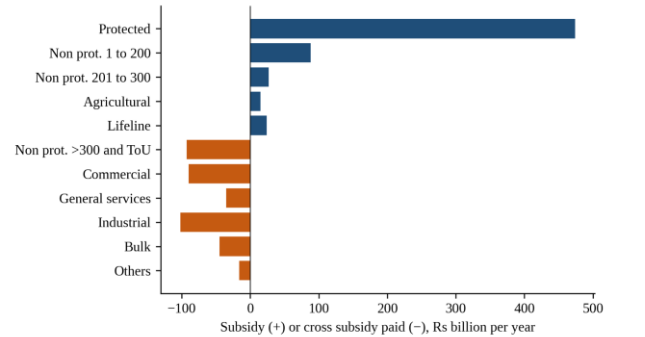
A protected category of residential electricity consumers was introduced in Pakistan in September 2021 for households consuming 200 kWh or less in each of the previous 6 months, with the aim of directing the tariff subsidy to the poorest 40% of households. In this study, the category is evaluated against its design target using 5 tariff decisions issued between 2021 and 2026, the periodic adjustment decisions and the performance report of the distribution companies. Household consumption is not measured: the consumer counts and sales by tariff block are reported in the decisions, and all other values are derived from them. As reported, the rule is designed to protect 44.4% of residential consumers, whereas the protected share is 27.8%, 54.0%, 56.4% and 58.8% in 2022, 2024, 2025 and 2026, respectively. As derived, the monthly bill gap at 190 kWh, including sales tax, rises from zero to Rs 3,093, a cost of Rs 18,557 over the 6 months that follow a single month above 200 kWh. The derived share of residential sales above 200 kWh falls from 46.0% to 39.1% between 2024 and 2026, with the largest fall in the companies where protection grows fastest (Spearman −0.87, 95% confidence interval −0.98 to −0.43, p = 0.001, 10 companies). The association is partly mechanical but persists after controlling for losses, load shedding and net metered solar export. For target shares of 40% and 44.4% of meters, the estimated lower bounds show that at least 30.5% and 37.4% of the target group, respectively, is excluded in 2022, whereas at least 32.0% and 24.5% of protected meters, respectively, lie outside it in 2026. The associations of protection with losses and load shedding are not significant after false discovery rate control. The protected subsidy of Rs 474 billion per year equals approximately two thirds of the national cash transfer budget.
References
C. Trimble, N. Yoshida, and M. Saqib, “Rethinking Electricity Tariffs and Subsidies in Pakistan,” Rethink. Electr. Tarif. Subsid. Pakistan, Jul. 2011, doi: 10.1596/19456.
“(PDF) Making Power Affordable for Africa and Viable for Its Utilities.” Accessed: Oct. 20, 2026. [Online]. Available: https://www.researchgate.net/publication/316147737_Making_Power_Affordable_for_Africa_and_Viable_for_Its_Utilities?__cf_chl_tk=TifgGYEfTDXpBmvXFIT3x8DrBSrgsAidY5R7imMFkP0-1792480039-1.0.1.1-OE2Zn2N0PoWeqxWzY6jbU3EeNG_buyxPb1kNya2FHTM
H. Cardenas and D. Whittington, “The consequences of increasing block tariffs on the distribution of residential electricity subsidies in Addis Ababa, Ethiopia,” Energy Policy, vol. 128, pp. 783–795, May 2019, doi: 10.1016/J.ENPOL.2019.01.033.
T. Walker, E. Canpolat, F. K. Khan, and A. Kryeziu, “Residential electricity subsidies in Pakistan : targeting, welfare impacts, and options for reform,” Policy Res. Work. Pap. Ser., Dec. 2016, Accessed: Oct. 20, 2026. [Online]. Available: https://ideas.repec.org/p/wbk/wbrwps/7912.html
A. Feltenstein and B. K. Datta, “Broad-based subsidies or targeted transfers? Distributional equity vs macroeconomic costs,” J. Econ. Policy Reform, vol. 25, no. 3, pp. 211–228, 2022, doi: 10.1080/17487870.2020.1785299.
“National Electric Power Regulatory Authority, Determination of the Authority in the matter of policy guidelines under Section 31 of the Regulation of Generation, Transmission and Distribution of Electric Power Act, 1997 regarding re targeting power sec”.
“Pakistan assures IMF of replacing 200-unit power subsidy with BISP-linked system - Profit by Pakistan Today.” Accessed: Oct. 20, 2026. [Online]. Available: https://profit.pakistantoday.com.pk/2026/05/07/pakistan-assures-imf-of-ending-subsidy-for-consumers-using-up-to-200-electricity-units-from-jan-2027
S. A. Khalid and V. Salman, “‘Welfare impact of electricity subsidy reforms in Pakistan: A micro model study,’” Energy Policy, vol. 137, Feb. 2020, doi: 10.1016/j.enpol.2019.111097.
R. Ilyas, K. Hussain, M. Z. Ullah, and J. Xue, “Distributional impact of phasing out residential electricity subsidies on household welfare,” Energy Policy, vol. 163, Apr. 2022, doi: 10.1016/j.enpol.2022.112825.
M. Z. Jan, K. Ullah, F. Abbas, H. A. Khalid, and T. M. Bajwa, “Barriers to the adoption of social welfare measures in the electricity tariff structure of developing countries: A case of Pakistan,” Energy Policy, vol. 179, Aug. 2023, doi: 10.1016/j.enpol.2023.113648.
R. Ilyas, H. U. Khan, and A. Rauf, “Welfare Impacts of Policy Reforms: A Case of Electricity Subsidies in Pakistan,” Int. J. Energy Econ. Policy, vol. 12, no. 3, pp. 41–49, 2022, Accessed: Oct. 20, 2026. [Online]. Available: https://ideas.repec.org/a/eco/journ2/2022-03-5.html
G. Samad, N. Faraz, and H. S. Awan, “Tariff differential subsidy (TDS) effects and welfare gains in Pakistan,” Indian Econ. Rev., vol. 57, no. 2, pp. 373–392, Dec. 2022, doi: 10.1007/S41775-022-00150-Z.
A. Awan, F. Bilgili, and D. B. Rahut, “Energy poverty trends and determinants in Pakistan: Empirical evidence from eight waves of HIES 1998–2019,” Renew. Sustain. Energy Rev., vol. 158, Apr. 2022, doi: 10.1016/j.rser.2022.112157.
M. Aslam and E. Ahmad, “Untangling electricity demand elasticities: Insights from heterogeneous household groups in Pakistan,” Energy, vol. 282, p. 128827, Nov. 2023, doi: 10.1016/J.ENERGY.2023.128827.
F. Mehmood, M. Umar, C. Dominguez, and H. Kazmi, “The role of residential distributed energy resources in Pakistan’s energy transition,” Energy Policy, vol. 167, Aug. 2022, doi: 10.1016/j.enpol.2022.113054.
A. Amirali, “State and capital in Pakistan’s rooftop solar transition,” Geoforum,, doi: https://doi.org/10.1016/j.geoforum.2026.104738.
K. Ahmed, A. Khalique, and B. Khan, “Solar energy transition under IMF conditionality: Distributive justice and energy policy imperative in Pakistan,” Energy Policy, vol. 210, Mar. 2026, doi: 10.1016/j.enpol.2026.115070.
H. Kazmi, F. Mehmood, and M. Shah, “Quantifying residential energy flexibility potential for demand response programs using observational data from grid outages: Evidence from Pakistan,” Energy Policy, vol. 188, p. 114094, May 2024, doi: 10.1016/J.ENPOL.2024.114094.
L. Do and T. H. Le, “On the welfare effect of retail electricity subsidy in Vietnam,” J. Econ. Dev., vol. 25, no. 4, pp. 286–301, Nov. 2023, doi: 10.1108/JED-02-2023-0034/FULL/PDF.
“Project MUSE - A Reappraisal of Electricity Subsidies and Household Welfare in Brunei Darussalam.” Accessed: Oct. 20, 2026. [Online]. Available: https://muse.jhu.edu/pub/70/article/855256/pdf
O. Bertín, T. García, F. Pizzi, A. Porto, J. Puig, and J. Puig, “Energy subsidies: conceptual framework and measurement for distributional impacts in Argentina,” Energy Sustain. Dev., vol. 83, p. 101557, Dec. 2024, doi: 10.1016/J.ESD.2024.101557.
A. Muktarbek kyzy and F. Alfnes, “Household energy responses to the introduction of increasing block tariffs on residential electricity in Kyrgyzstan,” Energy Policy, vol. 203, Aug. 2025, doi: 10.1016/j.enpol.2025.114629.
Y. Kou, S. Hirmer, P. Yang, A. Leonard, and F. Egli, “Assessing grid affordability for universal electricity access in Sub-Saharan Africa,” Nat. Commun. 2026 171, vol. 17, no. 1, pp. 8455-, Jul. 2026, doi: 10.1038/s41467-026-75104-7.
K. Ito, “Do Consumers Respond to Marginal or Average Price? Evidence from Nonlinear Electricity Pricing,” Am. Econ. Rev., vol. 104, no. 2, pp. 537–563, Feb. 2014, doi: 10.1257/AER.104.2.537.
H. J. Kleven, “Bunching,” Annu. Rev. Econom., vol. 8, no. 1, pp. 435–464, Oct. 2016, doi: 10.1146/ANNUREV-ECONOMICS-080315-015234.
T. Apaitan, T. Tosborvorn, and W. Wibulpolprasert, “Bunching for Free Electricity,” PIER Discuss. Pap., 2020, Accessed: Oct. 20, 2026. [Online]. Available: https://ideas.repec.org/p/pui/dpaper/136.html
B. M. Marcoje, L. Schiavon, M. Hallack, D. C. Machado, and M. W. de Abreu, “Impact evaluation of the social electricity tariff program in Brazil: Evidence from a regression discontinuity design,” Energy Policy, vol. 213, p. 115143, Jun. 2026, doi: 10.1016/J.ENPOL.2026.115143.
Z. Fang, T. H. Le, J. Yu, and M. Fan, “Evaluating Causal Effects of Increasing Block Pricing Policy on Residential Electricity Consumption in China,” Manag. Decis. Econ., vol. 46, no. 3, pp. 1661–1676, Apr. 2025, doi: 10.1002/MDE.4466.
T. Hadush Meles and G. Köhlin, “Do Consumers Respond to Marginal Prices at Kink Points? Evidence From 40+ Million Electricity Bills in Ethiopia,” Oxf. Bull. Econ. Stat., 2026, doi: 10.1111/OBES.70110;WGROUP:STRING:PUBLICATION.
P. J. Burke and S. Kurniawati, “Electricity subsidy reform in Indonesia: Demand-side effects on electricity use,” Energy Policy, vol. 116, pp. 410–421, May 2018, doi: 10.1016/j.enpol.2018.02.018.
R. K. Gobel, B. S. Laksmono, M. Huseini, and M. Siscawati, “Equity and Efficiency: An Examination of Indonesia’s Energy Subsidy Policy and Pathways to Inclusive Reform,” Sustain. 2024, Vol. 16, Page 407, vol. 16, no. 1, p. 407, Jan. 2024, doi: 10.3390/SU16010407.
M. Howells, D. G. Victor, T. Gaunt, R. J. Elias, and T. Alfstad, “Beyond free electricity: The costs of electric cooking in poor households and a market-friendly alternative,” Energy Policy, vol. 34, no. 17, pp. 3351–3358, 2006, Accessed: Oct. 20, 2026. [Online]. Available: https://ideas.repec.org/a/eee/enepol/v34y2006i17p3351-3358.html
Y. Ye, S. F. Koch, and J. Zhang, “Determinants of household electricity consumption in South Africa,” Energy Econ., vol. 75, pp. 120–133, Sep. 2018, doi: 10.1016/j.eneco.2018.08.005.
Z. Zarepour and N. Wagner, “Cash instead of subsidy: Assessing the impact of the iranian energy subsidy reform on households,” Energy Policy, vol. 168, Sep. 2022, doi: 10.1016/j.enpol.2022.113145.
G. Grande, J. Islas, and M. Rios, “Technical and economic analysis of Domestic High Consumption Tariff niche market for photovoltaic systems in the Mexican household sector,” Renew. Sustain. Energy Rev., vol. 48, pp. 738–748, Jul. 2015, doi: 10.1016/j.rser.2015.04.038.
S. Khanna and K. Rowe, “The long-run value of electricity reliability in India,” Resour. Energy Econ., vol. 77, Apr. 2024, doi: 10.1016/j.reseneeco.2024.101425.
D. Runfola et al., “geoBoundaries: A global database of political administrative boundaries,” PLoS One, vol. 15, no. 4, Apr. 2020, doi: 10.1371/JOURNAL.PONE.0231866.
“National Electric Power Regulatory Authority, Decision of the Authority in the matter of Federal Government motion and policy guidelines for rationalization of tariff of XWDISCOs and K Electric, TRF 100, Islamabad - Google Search.” Accessed: Oct. 20, 2026. [Online]. Available: https://www.google.com/search?q=38.+National+Electric+Power+Regulatory+Authority%2C+Decision+of+the+Authority+in+the+matter+of+Federal+Government+motion+and+policy+guidelines+for+rationalization+of+tariff+of+XWDISCOs+and+K+Electric%2C+TRF+100%2C+Islamabad
“National Electric Power Regulatory Authority, Decision of the Authority in the matter of motion filed by the Federal Government with respect to recommendation of consumer end tariff, TRF 100”.
“National Electric Power Regulatory Authority, Decision of the Authority in the matter of motion filed by the Federal Government under Section 7 and 31(7) of the NEPRA Act 1997 with respect to recommendation of consumer end tariff, TRF 100”.
“KE releases sustainability report 2025, reaffirms drive for resilient, inclusive energy future.” Accessed: Oct. 20, 2026. [Online]. Available: https://www.app.com.pk/national/ke-releases-sustainability-report-2025-reaffirms-drive-for-resilient-inclusive-energy-future/
“National Electric Power Regulatory Authority, Performance Evaluation Report of Distribution Companies FY 2024 to 25”, [Online]. Available: https://nepra.org.pk/M&E/PER/Distribution/2026/PER 2024-25 Distribution Companies.pdf
“National Electric Power Regulatory Authority, Decision of the Authority in the matter of motion filed by the Federal Government under Section 7 and 31(7) of the NEPRA Act 1997 with respect to recommendation of consumer end tariff, TRF 100”, [Online]. Available: https://nepra.org.pk/tariff/Tariff/Ex-WAPDA DISCOS/2026/Decision of the Authority Motion of Federal Govt. 1004-23 dated 12.01.2026.PDF
“National Electric Power Regulatory Authority, Decision of the Authority in the matter of requests filed by XWDISCOs for periodic adjustment in tariff for the 3rd quarter of FY 2024 to 25, TRF 100”, [Online]. Available: https://nepra.org.pk/tariff/Tariff/Ex-WAPDA DISCOS/2025/TRF-100 XWDISCOs 3rd QTR FY 2024-25 09-05-2025 5808-11.PDF
“National Electric Power Regulatory Authority, Decision of the Authority in the matter of fuel charges adjustment for the month of July 2025 for Ex WAPDA DISCOs”, [Online]
“National Electric Power Regulatory Authority, Decision of the Authority in the matter of fuel charges adjustment for the month of December 2025 for XWDISCOs, Islamabad”, [Online].
“Government of Pakistan, Ministry of Energy (Power Division), S.R.O. 2408(I)/2025, quarterly adjustment for the 1st quarter of FY”, [Online]. Available: https://ke.com.pk/wp-content/uploads/2025/12/SRO-2408I-2025-Dated-10-12-2025.pdf
“Federal Board of Revenue, The Sales Tax Act, 1990, Section 3, amended up to 30 June 2025, Islamabad, 2025. - Google Search.” Accessed: Oct. 20, 2026. [Online].
“The News, Centre ends provincial electricity duty on power bills from July 1, 30 June 2025. https://www.thenews.pk/latest/1325669-centre-ends-provincial-electricity-duty-on-power-bills-from-july-1 - Google Search”, [Online].
“From crisis to clean energy: Pakistan emerges as top solar market in 2024 - Markets - Business Recorder.” Accessed: Oct. 20, 2026. [Online]. Available: https://www.brecorder.com/news/40357512/from-crisis-to-clean-energy-pakistan-emerges-as-top-solar-market-in-2024
E. Bellini, “Pakistan unveils new net metering rules for rooftop PV”, [Online]. Available: https://www.pv-magazine.com/2025/12/18/pakistan-unveils-new-net-metering-rules-for-rooftop-pv/
“State Bank of Pakistan, Press release on the Annual Report 2022 to 23 on the state of the economy, Karachi”, [Online]. Available: https://www.sbp.org.pk/assets/document/publications/HalfYear-FY23_1.pdf
“State Bank of Pakistan, Press release on the Annual Report 2024 to 25 on the state of the economy, Karachi”, [Online]. Available: https://archive.sbp.org.pk/press/2025/Pr-17-oct-2025.pdf
D. G. Bonett and T. A. Wright, “Sample size requirements for estimating Pearson, Kendall and Spearman correlations,” Psychometrika, vol. 65, no. 1, pp. 23–28, 2000, doi: 10.1007/BF02294183/METRICS.
Y. Benjamini and Y. Hochberg, “Controlling the False Discovery Rate: A Practical and Powerful Approach to Multiple Testing,” J. R. Stat. Soc. Ser. B Stat. Methodol., vol. 57, no. 1, pp. 289–300, Jan. 1995, doi: 10.1111/J.2517-6161.1995.TB02031.X.
“First Lady Asifa Bhutto Zardari briefed on Benazir Income Support Programme.” Accessed: Oct. 20, 2026. [Online]. Available: https://www.app.com.pk/national/first-lady-asifa-bhutto-zardari-briefed-on-benazir-income-support-programme/
MuhammadMahmood., “Protected electricity consumers likely to get relief on using more than 200 units,” Pakistan, [Online]. Available: https://pakobserver.net/protected-electricity-consumers-likely-to-get-relief-on-using-more-than-200-units/
Downloads
Published
How to Cite
Issue
Section
License
Copyright (c) 2026 50sea

This work is licensed under a Creative Commons Attribution 4.0 International License.