Air-Bleed Aerodynamics: A Mesh-Sensitivity CFD Study of Pressure, Turbulence, and Heat in a Synthetic Shuttlecock
Keywords:
Aerodynamics, Computational fluid dynamics, Mesh Sensitivity, Synthetic Shuttlecock, Porous Bluff Body, Subsonic FlowAbstract
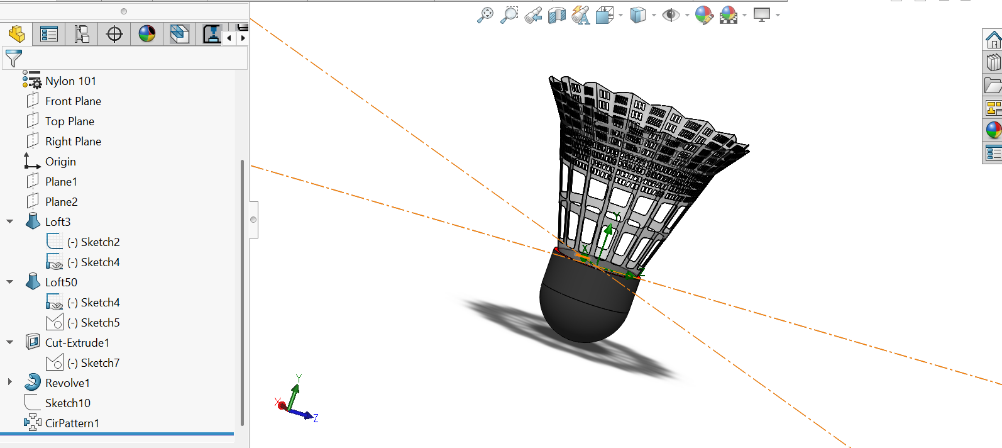
This study presents a steady-state computational fluid dynamics (CFD) investigation of the airflow around a porous synthetic badminton shuttlecock. The study aims to quantify drag, surface pressure, wall shear stress, turbulence, and temperature, and to assess how sensitive these quantities are to mesh resolution. An explicit three-dimensional multi-body CAD model, including the micro-pore windows of the skirt, was simulated in SolidWorks Flow Simulation at a freestream velocity of 20 m/s (Reynolds number Re = 8.7×10⁴, air at 101,325 Pa) with a modified k–ε turbulence model. Three Cartesian cut-cell meshes of 4,177, 11,840 and 127,646 cells gave averaged drag forces of 1.259 N, 7.299 N and 6.269 N, respectively. The drag response is oscillatory rather than monotonic, and the 14.1 % difference between the medium and fine meshes shows that mesh independence has not yet been achieved, so the work is reported as a mesh-sensitivity study. On the fine mesh, the peak surface pressure was 101,421.94 Pa (96.94 Pa above ambient, a pressure coefficient of 0.40), the peak wall shear stress was 2.41 Pa, the maximum local velocity was 21.904 m/s, and the peak static temperature was 293.39 K, which is consistent with the stagnation temperature rise of about 0.2 K expected from the energy equation. For a shuttlecock with a 66 mm skirt diameter, the predicted drag corresponds to a drag coefficient far above the published values of about 0.5-0.7, so the absolute force is not validated and only the qualitative flow features are considered reliable. These features are a stagnation zone on the nose cap, a low-pressure recirculation wake, and air bleed through the skirt pores. The study provides a documented baseline and a clear refinement and validation path for the CFD-based design of synthetic shuttlecocks.
References
Alison J. Cooke, “Shuttlecock aerodynamics,” Engineering, 19999, [Online]. Available: https://www.semanticscholar.org/paper/Shuttlecock-aerodynamics-Cooke/7a056bb4b96f52cacbb411beddc2aaeaf5b85932?p2df
F. Alam, H. Chowdhury, C. Theppadungporn, and A. Subic, “Measurements of aerodynamic properties of badminton shuttlecocks,” Procedia Eng., vol. 2, no. 2, pp. 2487–2492, Jun. 2010, doi: 10.1016/J.PROENG.2010.04.020.
H. Hasegawa, S. Kitta, M. Murakami, and S. Obayashi, “Flow analysis and aerodynamic characteristics of a badminton shuttlecock with spin at high Reynolds numbers,” Sport. Eng., vol. 16, no. 2, pp. 91–98, Jun. 2013, doi: 10.1007/S12283-013-0112-4.
J. H. Hart, J. R. Potts, and D. J. James, “Comparison of turbulence modelling approaches in simulation of a feather shuttle: a porous conical bluff body,” Sport. Eng. 2018 214, vol. 21, no. 4, pp. 465–478, Nov. 2018, doi: 10.1007/S12283-018-0293-Y.
C. S. H. Lin, C. K. Chua, and J. H. Yeo, “Aerodynamics of badminton shuttlecock: Characterization of flow around a conical skirt with gaps, behind a hemispherical dome,” J. Wind Eng. Ind. Aerodyn., vol. 127, pp. 29–39, Apr. 2014, doi: 10.1016/J.JWEIA.2014.02.002.
A. Verma, A. Desai, and S. Mittal, “Aerodynamics of badminton shuttlecocks,” J. Fluids Struct., vol. 41, pp. 89–98, Aug. 2013, doi: 10.1016/J.JFLUIDSTRUCTS.2013.01.009.
J. Hart and J. Potts, “Numerical Investigation of the Flow around a Feather Shuttlecock with Rotation,” Proc. 2020, Vol. 49, Page 28, vol. 49, no. 1, p. 28, Jun. 2020, doi: 10.3390/PROCEEDINGS2020049028.
D. Zala, H. Dechiraju, and S. Mittal, “Computational analysis of the fluid-structure interactions of a synthetic badminton shuttlecock,” Phys. Fluids, vol. 36, no. 1, Jan. 2024, doi: 10.1063/5.0182411/2932813.
D. A. Rasid, M. F. Remeli, B. Singh, and H. Moria, “Aerodynamic properties comparison between natural feather, nylon, and synthetic shuttlecocks,” Int. J. Eng. Syst. Model. Simul., vol. 16, no. 1, pp. 44–51, 2025, doi: 10.1504/IJESMS.2025.142974.
L. Zhou, “Aerodynamic characteristics and trajectory analysis of badminton shuttlecocks,” Acta Bioeng. Biomech., vol. 26, no. 4, pp. 29–37, Dec. 2025, doi: 10.37190/ABB-02508-2024-01.
Y. IMAMATSU, K. NAKAGAWA, H. HASEGAWA, and M. MURAKAMI, “Turnover Stability of a Badminton Shuttlecock during Flip Movement,” Proc. Symp. Sport. Hum. Dyn., vol. 2018, no. 0, pp. C–11, 2018, doi: 10.1299/JSMESHD.2018.C-11.
M. Arora and R. Jain, “CFD and Data Analysis of the Shuttlecock: To Evaluate the Correlation Between the Drag Force and Trajectory Parameters,” Lect. Notes Networks Syst., vol. 1263 LNNS, pp. 495–506, 2025, doi: 10.1007/978-981-96-2724-0_36/SAVE-RESEARCH.
Z. Zhang, Z. Peng, X. Li, Z. Ma, P. Zhou, and X. Huang, “Shuttlecock trajectory during spin serves,” Phys. Fluids, vol. 37, no. 8, Aug. 2025, doi: 10.1063/5.0275494/3359548.
M. K. Kansara and S. Mittal, “Wind-tunnel study of the effect of autorotation on feather and nylon badminton shuttlecock,” Phys. Fluids, vol. 38, no. 9, Sep. 2026, doi: 10.1063/5.0338356/3403634.
H. Ozaki et al., “Comparison of traditional badminton waterfowl-feather shuttlecocks versus synthetic-feather shuttlecocks using different test modalities,” Sport. Eng. 2026 291, vol. 29, no. 1, pp. 18-, May 2026, doi: 10.1007/S12283-026-00551-W.
T. Woo, F. Alam, and A. Kootsookos, “The scientific development of badminton shuttlecocks: Review paper,” Sustain. Sport. Sci. J., vol. 2, no. 3, pp. 149–165, Jun. 2024, doi: 10.55860/ZQQE3823.
S. H. Park, D. H. Seo, and J. H. Jeong, “Experimental and numerical analysis of thermal flow in open-cell porous metal during Darcy-Forchheimer transition regime,” Appl. Therm. Eng., vol. 181, p. 116029, Nov. 2020, doi: 10.1016/J.APPLTHERMALENG.2020.116029.
P. J. Boache, “Perspective: A Method for Uniform Reporting of Grid Refinement Studies,” J. Fluids Eng., vol. 116, no. 3, pp. 405–413, Sep. 1994, doi: 10.1115/1.2910291.
I. B. Celik, U. Ghia, P. J. Roache, C. J. Freitas, H. Coleman, and P. E. Raad, “Procedure for estimation and reporting of uncertainty due to discretization in CFD applications,” J. Fluids Eng. Trans. ASME, vol. 130, no. 7, pp. 0780011–0780014, Jul. 2008, doi: 10.1115/1.2960953/444689.
G. Vivarelli, N. Qin, and S. Shahpar, “A Review of Mesh Adaptation Technology Applied to Computational Fluid Dynamics,” Fluids, vol. 10, no. 5, May 2025, doi: 10.3390/FLUIDS10050129.
X. Zhang, M. Savoie, M. K. Quinn, B. Parslew, and A. Revell, “Simulation of Flow Around a Finite Rectangular Prism: Influence of Mesh, Model, and Subgrid Length Scale,” Entropy 2025, Vol. 27, Page 65, vol. 27, no. 1, p. 65, Jan. 2025, doi: 10.3390/E27010065.
H. J. Lee and J. J. Kim, “Enhancing geometric fidelity and wind-field prediction accuracy in complex urban environments using a Cartesian cut-cell CFD model,” Sustain. Cities Soc., vol. 140, p. 107247, Apr. 2026, doi: 10.1016/J.SCS.2026.107247.
“SOLIDWORKS Flow Simulation”.
Lam, C. K. G., and Bremhorst, K., “A Modified Form of the k-ε Model for Predicting Wall Turbulence,” ASME. J. Fluids Eng, vol. 10, no. 3, pp. 456–460, 1981, doi: https://doi.org/10.1115/1.3240815.
Downloads
Published
How to Cite
Issue
Section
License
Copyright (c) 2026 50sea

This work is licensed under a Creative Commons Attribution 4.0 International License.