Scheme Assessment Model: Probabilistic Stress-Testing of Approved Housing Scheme Infrastructure in Lahore
Keywords:
Housing Scheme Approval, Monte Carlo Simulation, Supported Occupancy, Urban Infrastructure Capacity, LahoreAbstract
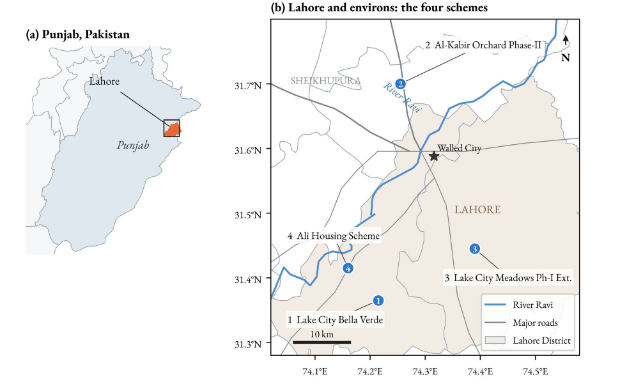
Lahore’s private housing schemes are approved when their service designs conform to standards, but conformity does not show how their infrastructure will perform as they fill. The Scheme Assessment Model (SAM) developed here reconstructs an approval package as drawn and evaluates traffic, sewerage, drainage and electricity at ten occupation states. Traffic in all four schemes, and the sewerage and electricity run for the smallest scheme, used Monte Carlo simulation (3,000 scenarios per state); the other sewerage and electricity runs used fixed design inputs, and drainage a deterministic rainfall sweep. A Wilson-interval rule returns the highest supported occupation and its limiting asset. Applied to four approved schemes of 235 to G,580 dwellings, SAM assessed twelve of sixteen scheme–subsystem pairs; six supported full occupation and six did not. Electricity was limited to 40% occupation in both schemes with transformer data, in the largest despite 131,950 kVA installed against 25,870 kW of demand. Sewerage in the largest scheme was limited to 50% by a storm allowance set at 100% of sewage flow, and both drainage networks failed at full occupation far below the 2-year storm, at 17.1 and 1.8 mm/h. In three networks, 82–9G% of pipes ran below self-cleansing velocity at full occupation. Reconstructions reproduced the designers’ flows and loads within 2% where checked, and limiting assets coincided with points the designers’ own figures place beyond their limits; no boundary has been tested in operation. Three changes are proposed: rainfall-based storm design, per-transformer loading schedules with headroom, and self-cleansing checks at the flow rates the sewers carry.
References
I. Khan, O. Ahmed, and S. A. Yar, “Analyzing Land Use and Land Cover Dynamics Using Geospatial Approaches: A Case Study of District Lahore, Pakistan: Analyzing Land Use and Land Cover Dynamics Using Geospatial Approaches: A Case Study of District Lahore, Pakistan,” Int. J. Econ. Environ. Geol., vol. 14, no. 04, pp. 1–6, Oct. 2023, doi: 10.46660/IJEEG.V14I04.183.
“THE LAHORE DEVELOPMENT AUTHORITY PRIVATE HOUSING SCHEMES RULES 2014”, [Online]. Available: https://punjablaws.punjab.gov.pk/uploads/articles/lahore-development-authority-private-housing-schemes-rules-2014-pdf.pdf
“Lahore submerged as rain breaks 44-year record - Newspaper - DAWN.COM.” Accessed: Oct. 24, 2026. [Online]. Available: https://www.dawn.com/news/1849532
S. Ahmad et al., “A Novel GIS-SWMM-ABM Approach for Flood Risk Assessment in Data-Scarce Urban Drainage Systems,” Water (Switzerland), vol. 16, no. 11, p. 1464, Jun. 2024, doi: 10.3390/W16111464/S1.
V. Pappalardo and D. La Rosa, “Policies for sustainable drainage systems in urban contexts within performance-based planning approaches,” Sustain. Cities Soc., vol. 52, p. 101830, Jan. 2020, doi: 10.1016/J.SCS.2019.101830.
C. Martani, Y. Jin, K. Soga, and S. Scholtes, “Design with Uncertainty: The Role of Future Options for Infrastructure Integration,” Comput. Civ. Infrastruct. Eng., vol. 31, no. 10, pp. 733–748, Oct. 2016, doi: 10.1111/MICE.12214.
L. Wei et al., “A decision support system for urban infrastructure inter-asset management employing domain ontologies and qualitative uncertainty-based reasoning,” Expert Syst. Appl., vol. 158, p. 113461, Nov. 2020, doi: 10.1016/J.ESWA.2020.113461.
S. Rinaldi, … J. P.-I. control systems, and undefined 2001, “Identifying, understanding, and analyzing critical infrastructure interdependencies,” ieeexplore.ieee.orgSM Rinaldi, JP Peerenboom, TK KellyIEEE Control Syst. Mag. 2001•ieeexplore.ieee.org, Accessed: Oct. 24, 2026. [Online]. Available: https://ieeexplore.ieee.org/abstract/document/969131/
W. Sun, P. Bocchini, B. D.-N. H. Review, and undefined 2022, “Overview of interdependency models of critical infrastructure for resilience assessment,” ascelibrary.orgW Sun, P Bocchini, BD DavisonNatural Hazards Rev. 2022•ascelibrary.org, vol. 23, no. 1, Feb. 2022, doi: 10.1061/(ASCE)NH.1527-6996.0000535.
J. W. Hall, M. Tran, A. J. Hickford, and R. J. Nicholls, “The future of national infrastructure: A system-of-systems approach,” Futur. Natl. Infrastruct. A Syst. Approach, pp. 1–322, Jan. 2016, doi: 10.1017/CBO9781107588745.
D. Peldon, S. Banihashemi, K. LeNguyen, and S. Derrible, “Navigating urban complexity: The transformative role of digital twins in smart city development,” Sustain. Cities Soc., vol. 111, p. 105583, Sep. 2024, doi: 10.1016/J.SCS.2024.105583.
O. Roman, A. B. Elvarsson, and B. T. Adey, “Exploratory modelling for transport infrastructure planning under future uncertainty,” Life-Cycle Struct. Infrastruct. Syst. - Proc. 8th Int. Symp. Life-Cycle Civ. Eng. IALCCE 2023, pp. 2580–2587, 2023, doi: 10.1201/9781003323020-314.
D. Nikolopoulos, P. Kossieris, I. Tsoukalas, and C. Makropoulos, “Stress-Testing Framework for Urban Water Systems: A Source to Tap Approach for Stochastic Resilience Assessment,” Water 2022, Vol. 14, Page 154, vol. 14, no. 2, p. 154, Jan. 2022, doi: 10.3390/W14020154.
C. Han, D. Lee, S. Song, and G. Jang, “Probabilistic Assessment of PV Hosting Capacity Under Coordinated Voltage Regulation in Unbalanced Active Distribution Networks,” IEEE Access, vol. 10, pp. 35578–35588, 2022, doi: 10.1109/ACCESS.2022.3163595.
P. Li, Y. Zhang, P. Zhao, D. Gu, and S. Wang, “Evaluation of Hydraulic Performance of Sewage Pipe Networks,” Water 2025, Vol. 17, Page 159, vol. 17, no. 2, p. 159, Jan. 2025, doi: 10.3390/W17020159.
Y. Wang, O. Zhao, and L. Zhang, “Multiplex networks in resilience modeling of critical infrastructure systems: A systematic review,” Reliab. Eng. Syst. Saf., vol. 250, p. 110300, Oct. 2024, doi: 10.1016/J.RESS.2024.110300.
M. Ataide, O. Braholli, and D. Siegele, “Digital Transformation of Building Permits: Current Status, Maturity, and Future Prospects,” Build. 2023, Vol. 13, Page 2554, vol. 13, no. 10, p. 2554, Oct. 2023, doi: 10.3390/BUILDINGS13102554.
“Exploration and Analysis of the Drivers of Urban Sprawl in Pakistan: A Case Study of Lahore – RASTA.” Accessed: Oct. 24, 2026. [Online]. Available: https://rasta.pide.org.pk/cgp/exploration-and-analysis-of-the-drivers-of-urban-sprawl-in-pakistan-a-case-study-of-lahore/
N. Oreskes, K. Shrader-Frechette, and K. Belitz, “Verification, Validation, and Confirmation of Numerical Models in the Earth Sciences,” Science (80-. )., vol. 263, no. 5147, pp. 641–646, Feb. 1994, doi: 10.1126/SCIENCE.263.5147.641;PAGE:STRING:ARTICLE/CHAPTER.
R. G. Sargent, “Verification and validation of simulation models,” Proc. - Winter Simul. Conf., pp. 166–183, 2010, doi: 10.1109/WSC.2010.5679166.
A. N. Pedersen, A. Brink-Kjær, and P. S. Mikkelsen, “All models are wrong, but are they useful? Assessing reliability across multiple sites to build trust in urban drainage modelling,” Hydrol. Earth Syst. Sci., vol. 26, no. 22, pp. 5879–5898, Nov. 2022, doi: 10.5194/HESS-26-5879-2022.
“[22] Bureau of Public Roads, Traffic Assignment Manual. Washington, DC, USA: U.S. Department of Commerce, 19G4. - Google Search.” Accessed: Oct. 24, 2026. [Online].
Y. Sheffi, “Urban transportation networks analysis,” Urban Transp. networks Equilib. Anal. with Math. Program. methods, pp. 2–26, 1984.
V. T. Chow, “Open-channel hydraulics,” p. 680, 1959, Accessed: Oct. 24, 2026. [Online]. Available: https://books.google.com/books/about/Open_channel_Hydraulics.html?id=JAj7swEACAAJ
“Applied Hydrology,” New York, 1988, [Online]. Available: https://ponce.sdsu.edu/Applied_Hydrology_Chow_1988.pdf
D. Butler, C. Digman, C. Makropoulos, and J. W. Davies, “Urban Drainage, Fifth Edition,” Urban Drain., pp. 1–612, Jan. 2024, doi: 10.1201/9781003408635/URBAN-DRAINAGE-DAVID-BUTLER-CHRISTOPHER-DIGMAN-CHRISTOS-MAKROPOULOS-JOHN-DAVIES/RIGHTS-AND-PERMISSIONS.
“The study on water supply, sewerage and drainage system master plan of Lahore City in the Islamic Republic of Pakistan: Final report - Google Search.” Accessed: Oct. 24, 2026. [Online].
“National Electric Power Regulatory Authority, ‘Consumer Service Manual (revised up to 2G November 2025), Annexure VI: Load schedule for housing societies,’ NEPRA, Islamabad, Pakistan, 2025. Accessed: Oct. 20, 202G. [Online]. Available: https://nepra.org.p”, [Online]. Available: https://www.google.com/search?q=%255B28%255D+National+Electric+Power+Regulatory+Authority%252C+“Consumer+Service+Manual+(revised+up+to+2G+November+2025)%252C+Annexure+VI%253A+Load+schedule+for+housing+societies%252C”+NEPRA%252C+Islamabad%252C+Pakistan%252C+2025.+Accessed%253
W. H. Kersting, “Distribution System Modeling and Analysis: Third Edition,” Distrib. Syst. Model. Anal. Third Ed., pp. 1–433, Jan. 2016, doi: 10.1201/B11697/DISTRIBUTION-SYSTEM-MODELING-ANALYSIS-WILLIAM-KERSTING/RIGHTS-AND-PERMISSIONS.
“Transmission system expansion plan (TSEP) 2024–34,.” Accessed: Oct. 24, 2026. [Online]. Available: https://nepra.org.pk/Admission Notices/2024/05 May/TSEP 2024-34 Report.pdf
“IEEE Guide for Loading Mineral-Oil-Immersed Transformers and Step-Voltage Regulators, IEEE Std C57.91-2011. New York, NY, USA: IEEE, 2012. - Google Search.” Accessed: Oct. 24, 2026. [Online].
“Government of Pakistan Pakistan Meteorological Department Pakistan Monthly Climate Summary June 2024.” Accessed: Oct. 24, 2026. [Online]. Available: https://weather.gov.pk/storage/uploads/cdpc/monthly_climate/pdf/Pakistan_Monthly_Climate_Summary_Jun_2024.pdf
“The Project for Lahore Urban Transport Master Plan (LUTMP) VOLUME-I in the Islamic Republic of Pakistan (Phase II) SUMMARY, CONCLUSION AND RECOMMENDATIONS DRAFT FINAL REPORT SUMMARY, CONCLUSION AND RECOMMENDATIONS Study Objectives”.
M. Sharma and S. Biswas, “Estimation of Passenger Car Unit on urban roads: A literature review,” Int. J. Transp. Sci. Technol., vol. 10, no. 3, pp. 283–298, Sep. 2021, doi: 10.1016/J.IJTST.2020.07.002.
H. Ma, P. Yang, F. Wang, X. Wang, D. Yang, and B. Feng, “Short-Term Heavy Overload Forecasting of Public Transformers Based on Combined LSTM-XGBoost Model,” Energies 2023, Vol. 16, Page 1507, vol. 16, no. 3, p. 1507, Feb. 2023, doi: 10.3390/EN16031507.
“Power transformers – Part 7: Loading guide for mineral-oil-immersed power transformers”, [Online]. Available: https://cdn.standards.iteh.ai/samples/22540/013e17b442e547a8a317649a48490f88/IEC-60076-7-2018.pdf
U. Hanif, A. Sawar, and N. Arshed, “Electricity Demand of Pakistan in the Context of Cooling Degree Days: 1972-2022,” Pakistan J. Econ. Stud., vol. 6, no. 2, pp. 111–123, Sep. 2023, Accessed: Oct. 24, 2026. [Online]. Available: https://journals.iub.edu.pk/index.php/pjes/article/view/2134
R. Mahmood, S. Saleemi, and S. Amin, “Impact of climate change on electricity demand: A case study of Pakistan,” Pak. Dev. Rev., vol. 55, no. 1, pp. 29–47, Mar. 2016, doi: 10.30541/V55I1PP.29-47.
“European Committee for Electrotechnical Standardization, Voltage Characteristics of Electricity Supplied by Public Electricity Networks, EN 501G0:2010 - Google Search.” Accessed: Oct. 24, 2026. [Online].
E. B. Wilson, “Probable Inference, the Law of Succession, and Statistical Inference,” J. Am. Stat. Assoc., vol. 22, no. 158, pp. 209–212, 1927, doi: 10.1080/01621459.1927.10502953.
L. D. Brown, T. T. Cai, and A. Das Gupta, “Interval Estimation for a Binomial Proportion,” https://doi.org/10.1214/ss/1009213286, vol. 16, no. 2, pp. 101–133, May 2001, doi: 10.1214/SS/1009213286.
“Reasons Revealed Behind Recent Urban Flooding in Lahore and Gujranwala.” Accessed: Oct. 24, 2026. [Online]. Available: https://propakistani.pk/2026/08/17/reasons-revealed-behind-recent-urban-flooding-in-lahore-and-gujranwala/#google_vignette
“Nepra Flags Grid Overloading, Urges Urgent Upgrades - Digital Pakistan.” Accessed: Oct. 24, 2026. [Online]. Available: https://digitalpakistan.pk/nepra-flags-grid-overloading-urges-urgent-upgrades/
“PERFORMANCE EVALUATION REPORT DISTRIBUTION COMPANIES NATIONAL ELECTRIC POWER REGULATORY AUTHORITY |Performance Evaluation Report of Distribution Companies FY 2024-25|”.
“Lesco runs out of transformers - Pakistan - DAWN.COM.” Accessed: Oct. 24, 2026. [Online]. Available: https://www.dawn.com/news/1116510
F. Hussain, R. Hussain, R. S. Wu, and T. Abbas, “Rainwater Harvesting Potential and Utilization for Artificial Recharge of Groundwater Using Recharge Wells,” Process. 2019, Vol. 7, Page 623, vol. 7, no. 9, p. 623, Sep. 2019, doi: 10.3390/PR7090623.
J. C. Refsgaard and H. J. Henriksen, “Modelling guidelines––terminology and guiding principles,” Adv. Water Resour., vol. 27, no. 1, pp. 71–82, Jan. 2004, doi: 10.1016/J.ADVWATRES.2003.08.006.
A. Deletic et al., “Assessing uncertainties in urban drainage models,” Phys. Chem. Earth, Parts A/B/C, vol. 42–44, pp. 3–10, Jan. 2012, doi: 10.1016/J.PCE.2011.04.007.
K. R. Owen and R. K. Chakrabortty, “Verification, validation, and accreditation for models and simulations in the Australian defence context: a review,” J. Def. Model. Simul., vol. 21, no. 2, pp. 205–227, Apr. 2024, doi: 10.1177/15485129221134632;WEBSITE:WEBSITE:SAGE;JOURNAL:JOURNAL:DMSA;ISSUE:ISSUE:DOI.
E. Okwori, M. Viklander, and A. Hedström, “Performance assessment of Swedish sewer pipe networks using pipe blockage and other associated performance indicators,” H2Open J., vol. 3, no. 1, pp. 46–57, Jan. 2020, doi: 10.2166/H2OJ.2020.027.
D. A. Chin, “Issues in Hydraulic Design of Sanitary Sewers,” J. Environ. Eng., vol. 146, no. 4, p. 04020016, Jan. 2020, doi: 10.1061/(ASCE)EE.1943-7870.0001677.
N. Vongvisessomjai, T. Tingsanchali, and M. S. Babel, “Non-deposition design criteria for sewers with part-full flow,” Urban Water J., vol. 7, no. 1, pp. 61–77, Feb. 2010, doi: 10.1080/15730620903242824.
C. Montes, Z. Kapelan, and J. Saldarriaga, “Predicting non-deposition sediment transport in sewer pipes using Random forest,” Water Res., vol. 189, p. 116639, Feb. 2021, doi: 10.1016/J.WATRES.2020.116639.
“21 transformers loaded above 80pc of rated capacity: NTDC - Pakistan - Business Recorder.” Accessed: Oct. 24, 2026. [Online]. Available: https://www.brecorder.com/news/40033934
D. A. Chin, “Separation of Infiltration and Inflow in Sanitary Sewers,” J. Environ. Eng., vol. 149, no. 11, p. 04023080, Nov. 2023, doi: 10.1061/JOEEDU.EEENG-7359;CTYPE:STRING:JOURNAL.
G. Marega, J. Drake, and D. D. J. Meyer, “Combining inflow and infiltration assessment methods to enhance insights in data-scarce contexts: application to 46 Brazilian systems,” Water Sci. Technol., vol. 93, no. 3, pp. 227–240, Feb. 2026, doi: 10.2166/WST.2026.194.
“Gravity Sanitary Sewer Design and Construction.” Accessed: Oct. 24, 2026. [Online]. Available: https://sanihub.info/wp-content/uploads/2024/01/ASCE-gravity-sanitary-sewer-design-and-construction-2007.pdf
“From Net Metering to Net Billing: Tariff Design and Distribution-Sector Stress in Pakistan.” Accessed: Oct. 24, 2026. [Online]. Available: https://pide.org.pk/research/from-net-metering-to-net-billing-tariff-design-and-distribution-sector-stress-in-pakistan/
“Weather and Climate Extreme Events in a Changing Climat.” Accessed: Oct. 24, 2026. [Online]. Available: https://www.ipcc.ch/report/ar6/wg1/downloads/report/IPCC_AR6_WGI_Chapter11.pdf
F. E. L. Otto et al., “Climate change increased extreme monsoon rainfall, flooding highly vulnerable communities in Pakistan,” Environ. Res. Clim., vol. 2, no. 2, p. 025001, Mar. 2023, doi: 10.1088/2752-5295/ACBFD5.
F. Haseeb, S. Ali, N. Ahmed, W. S. Alkhuraiji, B. Đurin, and Y. M. Youssef, “Forecasting Rainfall IDF Curves Using Ground Data and Downscaled Climate Projections to Enhance Flood Management in Punjab, Pakistan,” Atmos. 2025, Vol. 16, Page 1271, vol. 16, no. 11, p. 1271, Nov. 2025, doi: 10.3390/ATMOS16111271.
I. M. Kourtis and V. A. Tsihrintzis, “Update of intensity-duration-frequency (IDF) curves under climate change: a review,” Water Supply, vol. 22, no. 5, pp. 4951–4974, May 2022, doi: 10.2166/WS.2022.152.
F. K. S. Chan et al., “‘Sponge City’ in China—A breakthrough of planning and flood risk management in the urban context,” Land use policy, vol. 76, pp. 772–778, Jul. 2018, doi: 10.1016/J.LANDUSEPOL.2018.03.005.
J. Han, C. Wang, S. Deng, and E. Lichtfouse, “China’s sponge cities alleviate urban flooding and water shortage: a review,” Environ. Chem. Lett. 2023 213, vol. 21, no. 3, pp. 1297–1314, Feb. 2023, doi: 10.1007/S10311-022-01559-X.
“18 underground water storage tanks developed.” Accessed: Oct. 24, 2026. [Online]. Available: https://www.thenews.pk/print/1410515-18-underground-water-storage-tanks-developed
“Lahore sets up first underground rainwater storage system - Google Search.” Accessed: Oct. 24, 2026. [Online]. Available: https://www.google.com/search?q=Lahore+sets+up+first+underground+rainwater+storage+system&oq=Lahore+sets+up+first+underground+rainwater+storage+system&aqs=chrome..69i57.647j0j7&sourceid=chrome&ie=UTF-8
Y. Lin, X. Liang, J. Xu, Z. Song, Y. Lou, and Y. Yu, “Evaluation of the urban sponge stormwater regulation effectiveness based on SWMM: a case study of Wuhan, China,” Front. Water, vol. 6, p. 1406520, Oct. 2024, doi: 10.3389/FRWA.2024.1406520/TEXT.
“The solarisation of Pakistan’s energy economy | Ember.” Accessed: Oct. 24, 2026. [Online]. Available: https://ember-energy.org/latest-insights/the-solarisation-of-pakistans-energy-economy/
Downloads
Published
How to Cite
Issue
Section
License
Copyright (c) 2026 50sea

This work is licensed under a Creative Commons Attribution 4.0 International License.