Improvement of Overall Efficiency (UPH) of Assembly Production Line in Refrigerator Factory through Time Study and Kaizen-Based Line Balancing: A Case Study from Pakistan's Appliance Industry
Keywords:
Line Balancing, Time Study, Takt Time, Kaizen, Value Stream Mapping, Manpower AllocationAbstract
Importance of Study: The following reasons explain why the study was conducted at local facilities: Unbalanced workstations and undocumented work procedures prevent many local facilities from operating at the desired level. The present study examines the general assembly line of the largest refrigerator manufacturing plant in Pakistan, which is currently operating at 80 units per hour (UPH) against a designed capacity of 120 UPH.
Novelty Statement: The study combines time study, Kaizen, line balancing, and manpower optimization into a single statistically validated model, which is rarely reported in the literature, particularly in the context of the appliance industry in Pakistan, using a real factory case.
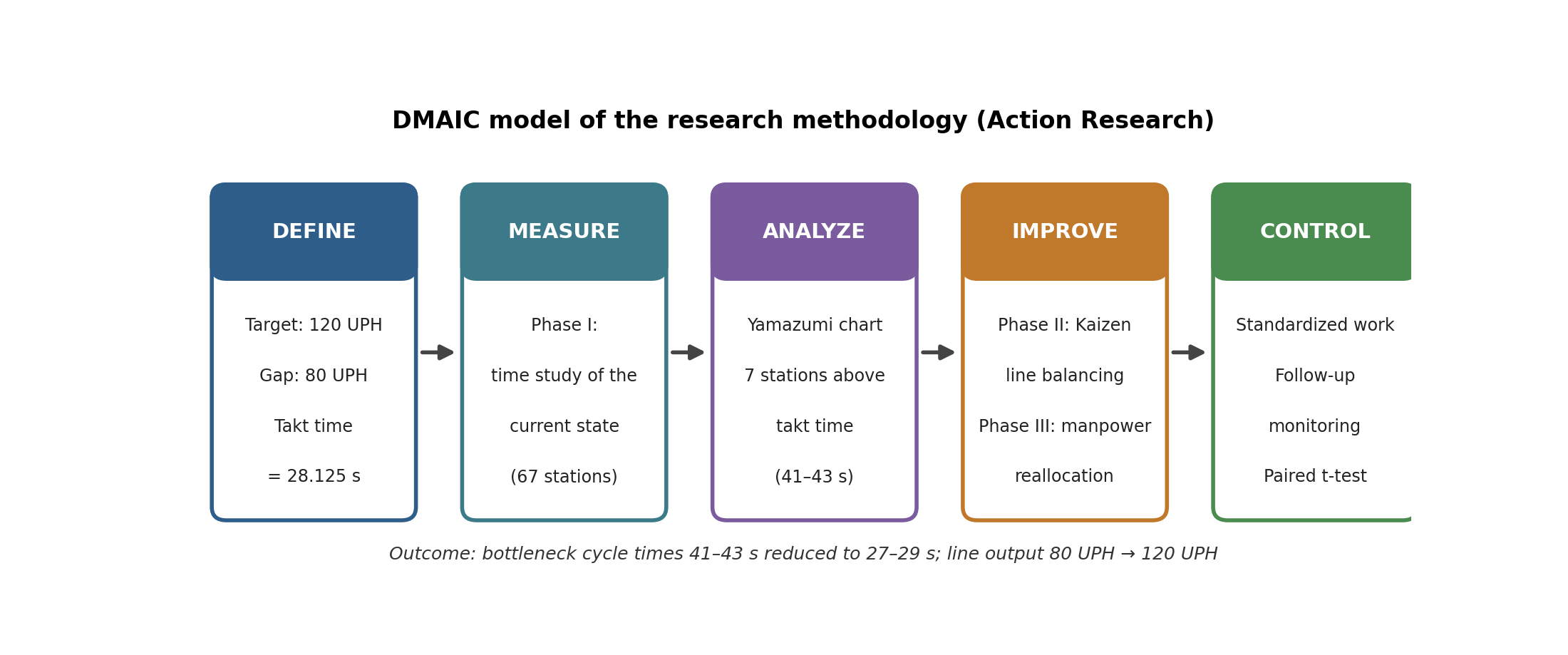
Material and Method: The structured methodology adopted for improvement included detailed time study, bottleneck diagnosis using Yamazumi charts, station redesign based on Kaizen, line balancing, ergonomic interventions, and manpower reallocation across all 67 workstations.
Result & Discussion: Seven bottleneck stations were identified, with cycle times of 41–43 seconds, all exceeding the takt time of 28.125 seconds. Six stations were reduced to 27-28 seconds (or less) by Kaizen interventions. Station S44 (Helium Recovery) was reduced from 43 seconds to 29 seconds, just slightly above the takt time because of the minimum cycle time of the equipment, however, the ability to do parallel processing at S44 allowed the throughput at that station to be doubled, eliminating it as a station bottleneck. The line throughput increased from 80 UPH to 120 UPH (+50%), with the binding constraint eliminated. A paired t-test was then performed on the cycle times of all 67 stations, and the improvement was found to be statistically significant (t = 2.785, df = 66, p = 0.007). Labour Cost per Unit decreased by 33% (Rs 500 per unit to Rs 333 per unit) and the capacity grew by some 7,800 units per month.
Conclusions: It is seen that the use of time study and Kaizen along with line balancing can be used to overcome the large gaps in the efficiency achieved and the developed model can be used in other high volume assembly lines.
References
“Automation, Production Systems, and Computer-Integrated Manufacturing.” Accessed: Oct. 28, 2026. [Online]. Available: https://www.pearson.com/en-us/subject-catalog/p/automation-production-systems-and-computer-integrated-manufacturing/P200000003297/9780137518579?srsltid=AYCX9vKM6vxvpFF9VVHvU4n5SqW5R5OvtRcc7-mhx0VyFp1KgLeDrtTY
“(PDF) Improvement of overall efficiency of production line by using line balancing.” Accessed: Oct. 28, 2026. [Online]. Available: https://www.researchgate.net/publication/305373459_Improvement_of_overall_efficiency_of_production_line_by_using_line_balancing
A. I. Ezzeldin, T. A. Mohamed, and K. S. Abdallah, “Improving the productivity of an assembly production line utilizing lean tools and simulation: a case study,” Int. J. Six Sigma Compet. Advant., vol. 1, no. 1, p. 1, 2021, doi: 10.1504/IJSSCA.2021.10045212.
A. Qattawi and S. Chalil Madathil, “Assembly line design using a hybrid approach of lean manufacturing and balancing models,” Prod. Manuf. Res., vol. 7, no. 1, pp. 125–142, Jan. 2019, doi: 10.1080/21693277.2019.1604274.
F. E. . Meyers, “Motion and time study : for lean manufacturing,” p. 334, 1999, Accessed: Oct. 28, 2026. [Online]. Available: https://books.google.com/books/about/Motion_and_Time_Study.html?id=5tseAQAAIAAJ
A. Mortada and A. Soulhi, “Improvement of Assembly Line Efficiency by Using Lean Manufacturing Tools and Line Balancing Techniques,” Adv. Sci. Technol. Res. J., vol. 17, no. 4, pp. 89–109, 2023, doi: 10.12913/22998624/169257.
N. Boysen, P. Schulze, and A. Scholl, “Assembly line balancing: What happened in the last fifteen years?,” Eur. J. Oper. Res., vol. 301, no. 3, pp. 797–814, Sep. 2022, doi: 10.1016/J.EJOR.2021.11.043.
M. M. Teshome, T. Y. Meles, and C. L. Yang, “Productivity improvement through assembly line balancing by using simulation modeling in case of Abay garment industry Gondar,” Heliyon, vol. 10, no. 1, p. e23585, Jan. 2024, doi: 10.1016/J.HELIYON.2023.E23585.
“(PDF) Implementation of Lean Manufacturing Tools for Improving Productivity: A Case Study.” Accessed: Oct. 28, 2026. [Online]. Available: https://www.researchgate.net/publication/308071046_Implementation_of_Lean_Manufacturing_Tools_for_Improving_Productivity_A_Case_Study
A. Jessani, R. Kumar, and A. Gul, “Reduction of Lean Wastes by Using Value Stream Mapping: A Case Study of Textile Company in Pakistan,” Int. J. Supply Chain Manag., vol. 9, no. 2, pp. 37–61, Mar. 2024, doi: 10.47604/IJSCM.2399.
H. Darmawan, S. Hasibuan, and H. Hardi Purba, “Application of Kaizen Concept with 8 Steps PDCA to Reduce in Line Defect at Pasting Process: A Case Study in Automotive Battery,” Int. J. Adv. Sci. Res. Eng., vol. 4, no. 8, pp. 97–107, 2018, doi: 10.31695/IJASRE.2018.32800.
T. Y. Smith A, “Lean Thinking: An Overview,” Ind. Eng. Manag., vol. 04, no. 02, 2015, doi: 10.4172/2169-0316.1000159.
“Maynard’s industrial engineering handbook : Free Download, Borrow, and Streaming : Internet Archive.” Accessed: Nov. 09, 2026. [Online]. Available: https://archive.org/details/maynardsindustri0000unse
M. A. Habib, R. Rizvan, and S. Ahmed, “Implementing lean manufacturing for improvement of operational performance in a labeling and packaging plant: A case study in Bangladesh,” Results Eng., vol. 17, p. 100818, Mar. 2023, doi: 10.1016/J.RINENG.2022.100818.
K. A. Chauhan, A. Kumar, and J. B. Shah, “Maynard Operation and Sequence Technique (MOST) Intervention for Productivity Improvement of Manufacturing Process—A Review,” J. Mechatronics Autom., vol. 4, no. 3, pp. 24–26, 2017, Accessed: Oct. 28, 2026. [Online]. Available: https://engineeringjournals.stmjournals.in/index.php/JoMA/article/view/183
R. M. . Barnes, “Motion and time study : design and measurement of work,” p. 689, 1980, Accessed: Oct. 28, 2026. [Online]. Available: https://www.wiley.com/en-us/motion-and-time-study-design-and-measurement-of-work-7th-edition-p-9780471059059
L. Mulugeta, “Productivity improvement through lean manufacturing tools in Ethiopian garment manufacturing company,” Mater. Today Proc., vol. 37, no. Part 2, pp. 1432–1436, Jan. 2021, doi: 10.1016/J.MATPR.2020.06.599.
O. Battaïa and A. Dolgui, “Hybridizations in line balancing problems: A comprehensive review on new trends and formulations,” Int. J. Prod. Econ., vol. 250, p. 108673, Aug. 2022, doi: 10.1016/J.IJPE.2022.108673.
E. Álvarez-Miranda, J. Pereira, H. Torrez-Meruvia, and M. Vilà, “A Hybrid Genetic Algorithm for the Simple Assembly Line Balancing Problem with a Fixed Number of Workstations,” Math. 2021, Vol. 9, Page 2157, vol. 9, no. 17, p. 2157, Sep. 2021, doi: 10.3390/MATH9172157.
T. Ohno and N. Bodek, “Toyota Production System: Beyond Large-Scale Production,” Toyota Prod. Syst. Beyond Large-Scale Prod., pp. 1–143, Jan. 2019, doi: 10.4324/9780429273018/TOYOTA-PRODUCTION-SYSTEM-TAIICHI-OHNO/RIGHTS-AND-PERMISSIONS.
A. Bin Fazle, M. T. Y. Taimun, S. M. Fareed, and M. S. Alam, “Ergonomic and Automation Based Process Redesign in Industrial Workstations,” Glob. J. Eng. Technol. Adv., vol. 26, no. 1, pp. 091–108, Jan. 2026, doi: 10.30574/GJETA.2026.26.1.0010.
P. K. Kareska, “KAIZEN in Manufacturing: Transforming Productivity and Quality Through Continuous Improvement,” 2024, doi: 10.2139/SSRN.4844999.
C. Becker and A. Scholl, “A survey on problems and methods in generalized assembly line balancing,” Eur. J. Oper. Res., vol. 168, no. 3, pp. 694–715, Feb. 2006, doi: 10.1016/J.EJOR.2004.07.023.
G. Kanawaty, “Introduction to work study,” p. 524, 1992, Accessed: Oct. 28, 2026. [Online]. Available: https://www.scribd.com/document/374855832/Introduction-to-Work-Study-George-Kanawaty-4ed
K. E. Stecke and M. Mokhtarzadeh, “Balancing collaborative human–robot assembly lines to optimise cycle time and ergonomic risk,” Int. J. Prod. Res., vol. 60, no. 1, pp. 25–47, Jan. 2022, doi: 10.1080/00207543.2021.1989077.
“(PDF) Improving Productivity of Garment Industry with Time Study.” Accessed: Oct. 28, 2026. [Online]. Available: https://www.researchgate.net/publication/322656789_Improving_Productivity_of_Garment_Industry_with_Time_Study
M. Rother and J. Shook, “Learning to see : value-stream mapping to create value and eliminate muda,” p. 134, 2018, Accessed: Oct. 28, 2026. [Online]. Available: https://www.researchgate.net/publication/244433983_Learning_to_See_Value_Stream_Mapping_to_Create_Value_and_Eliminate_Muda
I. Publication and https://iaeme.academia.edu/publication, “Value Stream Mapping: A Case Study on Indian Manufacturing Firm,” IAEME Publ., Jan. 2016, Accessed: Oct. 28, 2026. [Online]. Available: https://www.academia.edu/52508846/Value_Stream_Mapping_A_Case_Study_on_Indian_Manufacturing_Firm
N. A. A. Rahman, S. M. Sharif, and M. M. Esa, “Lean Manufacturing Case Study with Kanban System Implementation,” Procedia Econ. Financ., vol. 7, pp. 174–180, Jan. 2013, doi: 10.1016/S2212-5671(13)00232-3.
“(PDF) Toyota Kata: Managing People for Improvement, Adaptiveness and Superior Results.” Accessed: Oct. 28, 2026. [Online]. Available: https://www.researchgate.net/publication/216744993_Toyota_Kata_Managing_People_for_Improvement_Adaptiveness_and_Superior_Results
Downloads
Published
How to Cite
Issue
Section
License
Copyright (c) 2026 50sea

This work is licensed under a Creative Commons Attribution 4.0 International License.