A Survey on Privacy-Preserving Multimodal AI Assistant Using Local Retrieval-Augmented Generation and Selective Cloud Processing
Keywords:
Multimodal Artificial Intelligence, Local Retrieval-Augmented Generation, Optical Character Recognition, Selective Cloud Processing, Privacy-PreservingAbstract
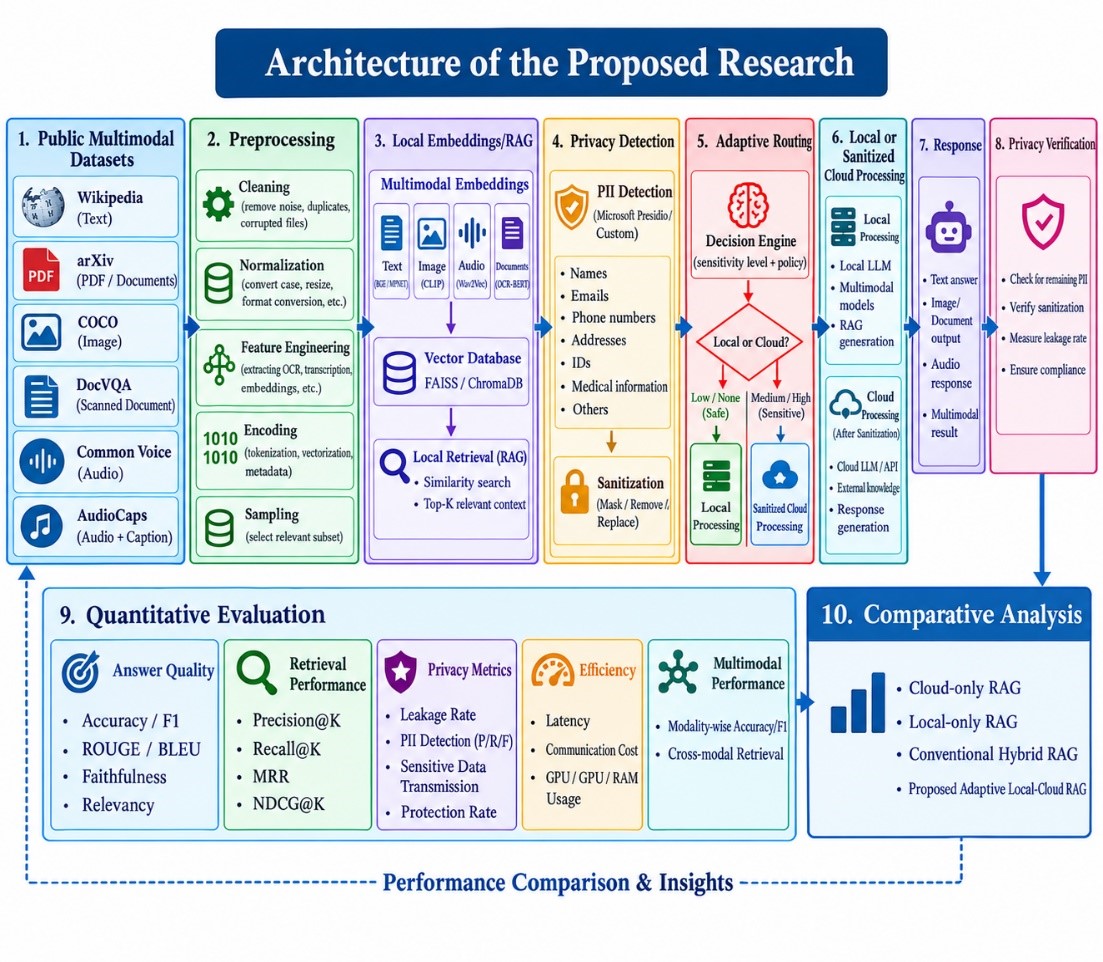
The fast development of multimodal Artificial Intelligence (AI) assistants allow users to interact with text, images, documents, and audio among a single intelligent system. However, existing AI assistants often rely heavily on cloud-based processing, requiring sensitive user data to be transmitted to remote servers. This prompts important concerns regarding privacy leakage, data security, communication overhead, and dependence on external cloud infrastructure. The proposed study aims to address these challenges by developing a Privacy-Preserving Multimodal AI Assistant using Local Retrieval-Augmented Generation (RAG) and Selective Cloud Processing. The motivation of this research is to attain a balance between privacy, response quality, computational efficiency, and latency. The proposed methodology will first process multimodal inputs locally utilizing Optical Character Recognition (OCR), speech recognition, document processing, and vision models. Relative information will then be cataloged in a local vector database and retrieved among a local RAG architecture. A privacy assessor will examine sensitive information such as names, identification numbers, email addresses, and medical information. An adaptive privacy-aware router will subsequently assess whether a query should be processed entirely locally or whether sanitized facts can be selectively sent to a cloud-based AI model. A final privacy-verification step will assure that sensitive facts is not unconsciously exposed. The proposed system is an adaptive local-cloud multimodal RAG architecture that dynamically equalizes privacy and AI performance. This technique will be evaluated using answer accuracy, RAM/VRAM, retrieval performance, computational resources, and privacy leakage rate (PLR), latency, and cloud data transmission. The importance of this research lies in providing a practical design for deploying trustworthy multimodal AI assistants in privacy-sensitive environments such as healthcare, education, research, and enterprise applications.
References
B. Ni et al., “Towards Trustworthy Retrieval Augmented Generation for Large Language Models: A Survey,” ACM Comput. Surv., vol. 58, no. 15, pp. 1–36, Feb. 2025, doi: 10.1145/3837074.
B. Palanisamy, G. S. S. Chalapathi, V. Hassija, and R. Buyya, “Security and Privacy in Retrieval-Augmented Generation: Architectures, Threats, Defenses, and Future Directions for Building Trustworthy Systems,” Jun. 2026, Accessed: Oct. 29, 2026. [Online]. Available: https://arxiv.org/pdf/2606.25533
Y. Zhang et al., “Privacy protection in RAG: A novel method and evaluation framework,” Inf. Process. Manag., vol. 63, no. 3, p. 104505, Apr. 2026, doi: 10.1016/J.IPM.2025.104505.
G. Zhang, M. Tian, X. Luan, Y. Ma, and J. Liu, “Is External Database Protection Static in Retrieval-Augmented Generation? Rethinking Privacy Preservation under Dynamic Queries,” vol. 14, no. 8, Jul. 2026, Accessed: Oct. 29, 2026. [Online]. Available: https://arxiv.org/pdf/2607.14811
M. M. Abootorabi et al., “Ask in Any Modality: A Comprehensive Survey on Multimodal Retrieval-Augmented Generation,” Proc. Annu. Meet. Assoc. Comput. Linguist., pp. 16776–16809, Feb. 2025, doi: 10.18653/v1/2025.findings-acl.861.
J. Zhang et al., “Beyond Text: Unveiling Privacy Vulnerabilities in Multi-modal Retrieval-Augmented Generation,” May 2025, Accessed: Oct. 29, 2026. [Online]. Available: https://arxiv.org/pdf/2505.13957
Y. Cheng, L. Zhang, J. Wang, M. Yuan, and Y. Yao, “RemoteRAG: A Privacy-Preserving LLM Cloud RAG Service,” Dec. 2024, Accessed: Oct. 29, 2026. [Online]. Available: https://arxiv.org/pdf/2412.12775
A. Chakraborty, C. Dahal, and V. Gupta, “Federated Retrieval-Augmented Generation: A Systematic Mapping Study,” EMNLP 2025 - 2025 Conf. Empir. Methods Nat. Lang. Process. Find. EMNLP 2025, pp. 7362–7374, May 2025, doi: 10.18653/v1/2025.findings-emnlp.388.
S. Zeng et al., “The Good and The Bad: Exploring Privacy Issues in Retrieval-Augmented Generation (RAG),” Proc. Annu. Meet. Assoc. Comput. Linguist., pp. 4505–4524, Feb. 2024, doi: 10.18653/v1/2024.findings-acl.267.
S. Zeng et al., “Mitigating the Privacy Issues in Retrieval-Augmented Generation (RAG) via Pure Synthetic Data,” EMNLP 2025 - 2025 Conf. Empir. Methods Nat. Lang. Process. Proc. Conf., pp. 24527–24558, Jun. 2024, doi: 10.18653/v1/2025.emnlp-main.1247.
S. Yu et al., “VisRAG: Vision-based Retrieval-augmented Generation on Multi-modality Documents,” 13th Int. Conf. Learn. Represent. ICLR 2025, pp. 101219–101243, Oct. 2024, Accessed: Oct. 29, 2026. [Online]. Available: https://arxiv.org/pdf/2410.10594
S. Zhao, Y. Yang, Z. Wang, Z. He, L. K. Qiu, and L. Qiu, “Retrieval Augmented Generation (RAG) and Beyond: A Comprehensive Survey on How to Make your LLMs use External Data More Wisely,” Sep. 2024, Accessed: Oct. 29, 2026. [Online]. Available: https://arxiv.org/pdf/2409.14924
S. J. Ruochen Zhao, Hailin Chen, Weishi Wang, Fangkai Jiao, Xuan Long Do, Chengwei Qin, Bosheng Ding, Xiaobao Guo, Minzhi Li, Xingxuan Li, “Retrieving Multimodal Information for Augmented Generation: A Survey,” Find. Assoc. Comput, pp. 4736–4756, 2023, doi: 10.18653/v1/2023.findings-emnlp.314.
J. Chen et al., “Privacy-Preserving Reasoning with Knowledge-Distilled Parametric Retrieval Augmented Generation,” Sep. 2025, Accessed: Oct. 29, 2026. [Online]. Available: https://arxiv.org/pdf/2509.01088
A. Al-Lawati and S. Wang, “Do Multimodal RAG Systems Leak Data? A Comprehensive Evaluation of Membership Inference and Image Caption Retrieval Attacks,” Jan. 2026, Accessed: Oct. 29, 2026. [Online]. Available: https://arxiv.org/pdf/2601.17644
J. Zhan, H. Shen, Z. Lin, and T. He, “PRISM: Privacy-Aware Routing for Adaptive Cloud-Edge LLM Inference via Semantic Sketch Collaboration,” Nov. 2025, Accessed: Oct. 29, 2026. [Online]. Available: https://arxiv.org/pdf/2511.22788
H. Yu, A. Gan, K. Zhang, S. Tong, Q. Liu, and Z. Liu, “Evaluation of Retrieval-Augmented Generation: A Survey,” Commun. Comput. Inf. Sci., vol. 2301, pp. 102–120, Jul. 2024, doi: 10.1007/978-981-96-1024-2_8.
Z. Jiang et al., “Active Retrieval Augmented Generation,” EMNLP 2023 - 2023 Conf. Empir. Methods Nat. Lang. Process. Proc., pp. 7969–7992, May 2023, doi: 10.18653/v1/2023.emnlp-main.495.
W. Chen, H. Hu, X. Chen, P. Verga, and W. W. Cohen, “MuRAG: Multimodal Retrieval-Augmented Generator for Open Question Answering over Images and Text,” Proc. 2022 Conf. Empir. Methods Nat. Lang. Process. EMNLP 2022, pp. 5558–5570, Oct. 2022, doi: 10.18653/v1/2022.emnlp-main.375.
X. Zhang, X. Dong, Q. Wang, D. Zhang, and F. Cao, “A Survey of Multimodal Retrieval Augmented Generation: Architecture, Technologies, Applications, and Suggestions,” pp. 93–98, Sep. 2026, doi: 10.23919/AIDMCPS00019.2026.00052.
S. Gao et al., “Scaling Beyond Context: A Survey of Multimodal Retrieval-Augmented Generation for Document Understanding,” pp. 4458–4489, Oct. 2025, doi: 10.18653/v1/2026.acl-long.204.
S. Xiao, Z. Liu, P. Zhang, N. Muennighoff, D. Lian, and J.-Y. Nie, “C-Pack: Packed Resources For General Chinese Embeddings,” arXiv, vol. 1, Sep. 2023, doi: 10.1145/3626772.3657878.
A. Radford et al., “Learning Transferable Visual Models From Natural Language Supervision,” Proc. Mach. Learn. Res., vol. 139, pp. 8748–8763, Feb. 2021, Accessed: Oct. 02, 2023. [Online]. Available: https://arxiv.org/abs/2103.00020v1
I. S. Alec Radford, Jong Wook Kim, Tao Xu, Greg Brockman, Christine McLeavey, “Robust Speech Recognition via Large-Scale Weak Supervision,” Open AI, 2024, [Online]. Available: https://cdn.openai.com/papers/whisper.pdf
L. He, P. Tang, Y. Zhang, P. Zhou, and S. Su, “Mitigating privacy risks in Retrieval-Augmented Generation via locally private entity perturbation,” Inf. Process. Manag., vol. 62, no. 4, p. 104150, Jul. 2025, doi: 10.1016/J.IPM.2025.104150.
A. Hemmat, M. Moqadas, A. Mamanpoosh, A. Rismanchian, and A. Fatemi, “VAGUE‐Gate: Plug‐and‐Play Local‐Privacy Shield for Retrieval‐Augmented Generation,” pp. 3715–3730, Mar. 2025, doi: 10.18653/V1/2025.IJCNLP-LONG.194.
H. Jin and Y. Wu, “CE-CoLLM: Efficient and Adaptive Large Language Models Through Cloud-Edge Collaboration,” Proc. IEEE Int. Conf. Web Serv. ICWS, no. 2025, pp. 316–323, Nov. 2024, doi: 10.1109/ICWS67624.2025.00046.
Y. Gao, W. Luo, C. Wang, N. S. Ahmad, X. Wang, and P. Goh, “A privacy-preserving multi-user retrieval system for multimodal artificial intelligence,” Sci. Reports 2026 161, vol. 16, no. 1, pp. 10348-, Feb. 2026, doi: 10.1038/s41598-026-40734-w.
M. Mathew, D. Karatzas, and C. V. Jawahar, “DocVQA: A Dataset for VQA on Document Images,” Proc. - 2021 IEEE Winter Conf. Appl. Comput. Vision, WACV 2021, pp. 2199–2208, Jul. 2020, doi: 10.1109/WACV48630.2021.00225.
K. Srinivasan, K. Raman, J. Chen, M. Bendersky, and M. Najork, “WIT: Wikipedia-based Image Text Dataset for Multimodal Multilingual Machine Learning,” SIGIR 2021 - Proc. 44th Int. ACM SIGIR Conf. Res. Dev. Inf. Retr., pp. 2443–2449, Mar. 2021, doi: 10.1145/3404835.3463257.
Downloads
Published
How to Cite
Issue
Section
License
Copyright (c) 2026 50sea

This work is licensed under a Creative Commons Attribution 4.0 International License.