Machine Learning-Based Classification of Coronary Artery Disease Using Complete Blood Count and Basic Clinical Variables
Keywords:
Coronary Artery Disease Classification, Machine Learning, Complete Blood Count, Routine Clinical DataAbstract
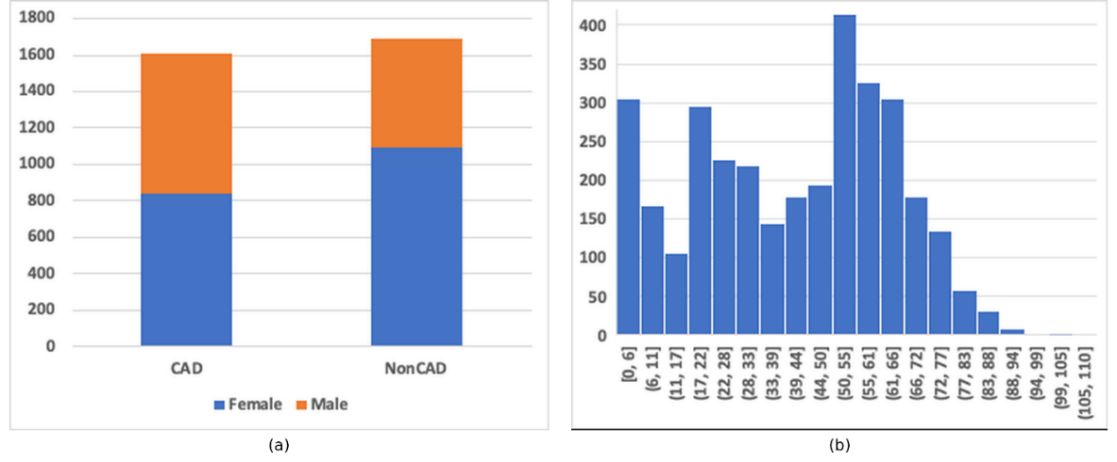
This retrospective study examined whether a restricted set of routinely collected complete blood count (CBC) variables, combined with basic demographic and clinical factors, can distinguish records labelled as coronary artery disease (CAD) from non-CAD records using conventional machine-learning classifiers. Anonymized hospital records collected from a local teaching hospital between November 2017 and November 2022 were retrospectively processed. After complete-case filtering, 3,301 records remained, including 1,607 CAD and 1,694 non-CAD records. Twelve predictors were used: age, gender, hypertension, diabetes, hemoglobin, total leukocyte count, neutrophils, lymphocytes, monocytes, eosinophils, hematocrit, and platelets. Six classifiers were evaluated using an 80/20 train-test split. On the 661-record held-out test set, Random Forest achieved the highest accuracy (81.24%) and F1-score (81.04%), Logistic Regression achieved the highest precision (84.72%), and Naïve Bayes achieved the highest recall/sensitivity (79.65%). These findings suggest that a compact set of CBC and basic clinical variables contains useful information for CAD classification in this retrospective cohort. However, the single-center design, complete-case selection, lack of feature-set ablation, external validation, and calibration assessment limit clinical interpretation. The findings should therefore be considered exploratory rather than evidence of a validated diagnostic tool.
References
“Cardiovascular diseases (CVDs).” Accessed: Nov. 10, 2026. [Online]. Available: https://www.who.int/news-room/fact-sheets/detail/cardiovascular-diseases-(cvds)
S. I. Ayon, M. M. Islam, and M. R. Hossain, “Coronary Artery Heart Disease Prediction: A Comparative Study of Computational Intelligence Techniques,” IETE J. Res., vol. 68, no. 4, pp. 2488–2507, 2022, doi: 10.1080/03772063.2020.1713916;.
R. Alizadehsani et al., “Machine learning-based coronary artery disease diagnosis: A comprehensive review,” Comput. Biol. Med., vol. 111, p. 103346, Aug. 2019, doi: 10.1016/J.COMPBIOMED.2019.103346.
C. W. Tsao et al., “Heart Disease and Stroke Statistics-2023 Update: A Report From the American Heart Association,” Circulation, vol. 147, no. 8, pp. E93–E621, Feb. 2023, doi: 10.1161/CIR.0000000000001123.
“About Coronary Artery Disease (CAD) | Heart Disease | CDC.” Accessed: Nov. 10, 2026. [Online]. Available: https://www.cdc.gov/heart-disease/about/coronary-artery-disease.html
“(PDF) Z-Alizadeh Sani Dataset.” Accessed: Nov. 10, 2026. [Online]. Available: https://www.researchgate.net/publication/296485502_Z-Alizadeh_Sani_Dataset
“Heart disease - Symptoms and causes - Mayo Clinic.” Accessed: Nov. 10, 2026. [Online]. Available: https://www.mayoclinic.org/diseases-conditions/heart-disease/symptoms-causes/syc-20353118
J. G. Truslow et al., “Cardiovascular Risk Assessment Using Artificial Intelligence-Enabled Event Adjudication and Hematologic Predictors,” Circ. Cardiovasc. Qual. Outcomes, vol. 15, no. 6, p. E008007, Jun. 2022, doi: 10.1161/CIRCOUTCOMES.121.008007.
H. Zhang, Z. Luo, D. Jia, D. Li, Y. Jia, and Z. Wan, “A risk score derived from complete blood count contributes to early risk stratification of acute myocardial infarction at the emergency department,” Int. Emerg. Nurs., vol. 68, May 2023, doi: 10.1016/j.ienj.2023.101287.
A. Koloi et al., “Predicting early-stage coronary artery disease using machine learning and routine clinical biomarkers improved by augmented virtual data,” Eur. Hear. J. - Digit. Heal., vol. 5, no. 5, pp. 542–550, Sep. 2024, doi: 10.1093/EHJDH/ZTAE049.
“(PDF) Predicting acute myocardial infarction from haematological markers utilizing machine learning and explainable artificial intelligence.” Accessed: Nov. 09, 2026. [Online]. Available: https://www.researchgate.net/publication/379271023_Predicting_acute_myocardial_infarction_from_haematological_markers_utilizing_machine_learning_and_explainable_artificial_intelligence
Y. C. He et al., “Construction of diagnostic and prognostic models for premature coronary artery disease based on multiple machine algorithms,” Front. Cardiovasc. Med., vol. 12, 2025, doi: 10.3389/FCVM.2025.1611709.
N. Tasmurzayev et al., “Enhancing Cardiovascular Disease Classification with Routine Blood Tests Using an Explainable AI Approach,” Algorithms 2025, Vol. 18, Page 708, vol. 18, no. 11, p. 708, Nov. 2025, doi: 10.3390/A18110708.
T. Liu, A. Krentz, L. Lu, and V. Curcin, “Machine learning based prediction models for cardiovascular disease risk using electronic health records data: systematic review and meta-analysis,” Eur. Hear. journal. Digit. Heal., vol. 6, no. 1, pp. 7–22, Jan. 2024, doi: 10.1093/EHJDH/ZTAE080.
M. Abdar, W. Książek, U. R. Acharya, R. S. Tan, V. Makarenkov, and P. Pławiak, “A new machine learning technique for an accurate diagnosis of coronary artery disease,” Comput. Methods Programs Biomed., vol. 179, Oct. 2019, doi: 10.1016/J.CMPB.2019.104992.
S. Srinivasan, S. Gunasekaran, S. K. Mathivanan, B. A. M. Benjula Anbu, P. Jayagopal, and G. T. Dalu, “An active learning machine technique based prediction of cardiovascular heart disease from UCI-repository database,” Sci. Reports 2023 131, vol. 13, no. 1, pp. 13588-, Aug. 2023, doi: 10.1038/s41598-023-40717-1.
D. Shah, S. Patel, and S. K. Bharti, “Heart Disease Prediction using Machine Learning Techniques,” SN Comput. Sci. 2020 16, vol. 1, no. 6, pp. 345-, Oct. 2020, doi: 10.1007/S42979-020-00365-Y.
H. Jindal, S. Agrawal, R. Khera, R. Jain, and P. Nagrath, “Heart disease prediction using machine learning algorithms,” IOP Conf. Ser. Mater. Sci. Eng., vol. 1022, no. 1, p. 012072, Jan. 2021, doi: 10.1088/1757-899X/1022/1/012072.
R. Alizadehsani et al., “A data mining approach for diagnosis of coronary artery disease,” Comput. Methods Programs Biomed., vol. 111, no. 1, pp. 52–61, Jul. 2013, doi: 10.1016/j.cmpb.2013.03.004.
C. A. ul Hassan et al., “Effectively Predicting the Presence of Coronary Heart Disease Using Machine Learning Classifiers,” Sensors (Basel)., vol. 22, no. 19, p. 7227, Oct. 2022, doi: 10.3390/S22197227.
H. Khdair and N. M. Dasari, “Exploring Machine Learning Techniques for Coronary Heart Disease Prediction,” Int. J. Adv. Comput. Sci. Appl., vol. 12, no. 5, pp. 28–36, May 2021, doi: 10.14569/IJACSA.2021.0120505.
C. Boukhatem, H. Y. Youssef, and A. B. Nassif, “Heart Disease Prediction Using Machine Learning,” 2022 Adv. Sci. Eng. Technol. Int. Conf. ASET 2022, 2022, doi: 10.1109/ASET53988.2022.9734880.
K. N. Devi, S. Suruthi, and S. Shanthi, “Coronary Artery Disease prediction using Machine Learning Techniques,” 8th Int. Conf. Adv. Comput. Commun. Syst. ICACCS 2022, pp. 1029–1034, 2022, doi: 10.1109/ICACCS54159.2022.9785140.
“Framingham Heart Study.” Accessed: Nov. 10, 2026. [Online]. Available: https://www.framinghamheartstudy.org/
Q. Li, A. Campan, A. Ren, and W. E. Eid, “Automating and improving cardiovascular disease prediction using Machine learning and EMR data features from a regional healthcare system,” Int. J. Med. Inform., vol. 163, Jul. 2022, doi: 10.1016/j.ijmedinf.2022.104786.
L. J. Muhammad, I. Al-Shourbaji, A. A. Haruna, I. A. Mohammed, A. Ahmad, and M. B. Jibrin, “Machine Learning Predictive Models for Coronary Artery Disease,” SN Comput. Sci., vol. 2, no. 5, Sep. 2021, doi: 10.1007/S42979-021-00731-4.
C. Wang et al., “Development and Validation of a Predictive Model for Coronary Artery Disease Using Machine Learning,” Front. Cardiovasc. Med., vol. 8, Feb. 2021, doi: 10.3389/FCVM.2021.614204.
S. M. Naushad, T. Hussain, B. Indumathi, K. Samreen, S. A. Alrokayan, and V. K. Kutala, “Machine learning algorithm-based risk prediction model of coronary artery disease,” Mol. Biol. Rep., vol. 45, no. 5, pp. 901–910, Oct. 2018, doi: 10.1007/S11033-018-4236-2.
A. Khan, M. Qureshi, M. Daniyal, and K. Tawiah, “A Novel Study on Machine Learning Algorithm-Based Cardiovascular Disease Prediction,” Health Soc. Care Community, vol. 2023, pp. 1–10, Feb. 2023, doi: 10.1155/2023/1406060.
Downloads
Published
How to Cite
Issue
Section
License
Copyright (c) 2026 50sea

This work is licensed under a Creative Commons Attribution 4.0 International License.